Three engines of digital scale - volume, scope, and network and why each creates different economics and organizational requirements
By Alex Pawlowski
Published: 2026-09-11
URL: https://thestrategystack.substack.com/p/three-types-digital-scale
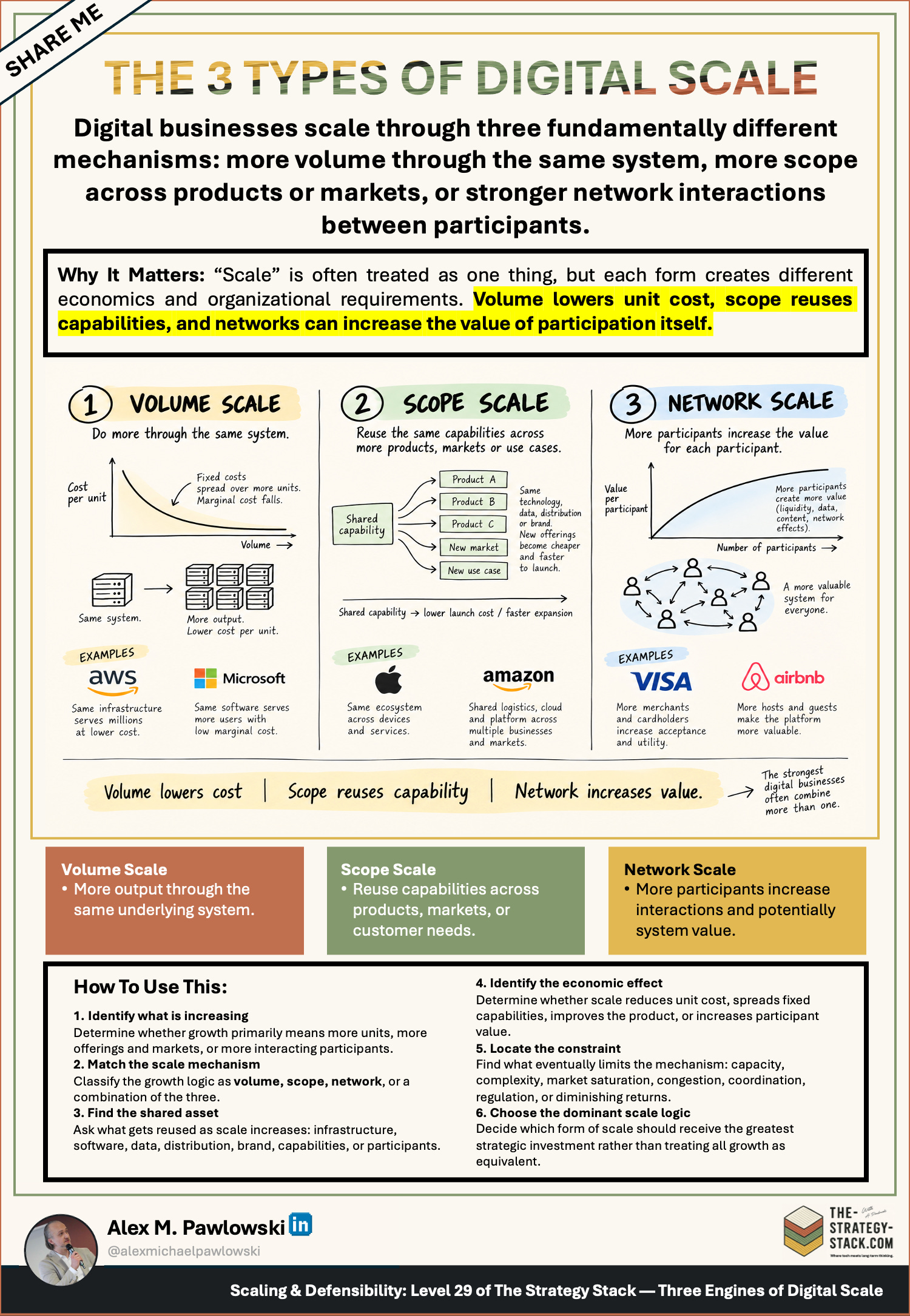
Scale is one word for three different mechanisms.
Teams chase headcount reduction, geographic expansion, or user growth - without asking which kind of scale their model actually supports. Investment follows the wrong logic. Economics disappoint. Strategy decks cite network effects for businesses that only have volume scale on a good day.
Digital businesses scale through three fundamentally different paths:
Volume scale - do more through the same system
Fixed costs spread over more units. Marginal cost falls. Same infrastructure, more output.
Scope scale - reuse capabilities across products, markets, or use cases
Shared technology, data, distribution, or brand make new offerings cheaper and faster to launch.
Network scale - more participants increase value for each participant
Liquidity, data, content, trust, or coordination improve as the network densifies.
The strongest digital businesses often combine more than one. The strategic error is treating them as interchangeable.
Volume Scale
Mechanism: Same system → more output → lower cost per unit
Economic effect: Marginal cost falls; operating leverage rises
Examples: AWS serving more workloads on shared infrastructure; Microsoft shipping the same software to more seats
Constraint: Capacity, congestion, quality at volume, operational complexity
Volume scale rewards efficiency and standardization. It does not automatically create defensibility - competitors can copy the system if the asset is not proprietary.
Scope Scale
Mechanism: Shared capability → new products, markets, use cases
Economic effect: Lower launch cost; faster expansion; amortized R&D
Examples: Apple’s ecosystem across devices and services; Amazon reusing logistics, cloud, and marketplace infrastructure
Constraint: Complexity, brand stretch, coordination cost between businesses
Scope scale rewards reusable assets and coherent capability maps. It fails when adjacency is really distraction.
Network Scale
Mechanism: More participants → more value per participant
Economic effect: Liquidity, data, content, trust compound with density
Examples: Visa - more merchants and cardholders increase acceptance; Airbnb - more hosts and guests improve selection and trust
Constraint: Cold start, congestion, multi-homing, governance of participants
Network scale rewards coordination and standards. It is the hardest to start and the most durable when it works - but not every product has a network mechanism just because it has users.
The Failure Pattern
Scale strategies fail when:
-
Volume tactics are applied to a business that needs network density
-
Scope expansion outruns shared capability - each new line is a startup
-
Network language hides a linear product with no cross-side reinforcement
-
Investment ignores the limiting factor for the chosen mechanism
-
Teams optimize one scale type while the model’s advantage lives in another
How to Use This Framework
1. Identify what is increasing
Units, offerings, or participants?
2. Match the scale mechanism
Volume, scope, network - or an explicit combination?
3. Find the shared asset
Infrastructure, software, data, brand, standards - what is reused?
4. Identify the economic effect
Lower unit cost, faster launches, or rising participant value?
5. Locate the constraint
Capacity, complexity, congestion, regulation - what breaks first?
6. Choose the dominant scale logic
Place strategic investment where the mechanism is real - not where the slide template looks impressive.
Diagnostic questions:
-
If usage doubled, would unit cost fall, launch cost fall, or participant value rise?
-
Which mechanism do competitors copy easiest - and which do they cannot?
-
Are you running a network playbook on a volume business?
👉 Unlock the Strategy Stack
…and access the Business Model Series, advanced Cheat Sheets, the Operator Vault, and various essays at the intersection of strategy and technology.
In this series →
Read next →
Go deeper →