Owned audience strategy and permission marketing — move from rented attention to relationships that support distribution, research, and launches
By Alex Pawlowski
Published: 2026-09-03
URL: https://thestrategystack.substack.com/p/audience-infrastructure
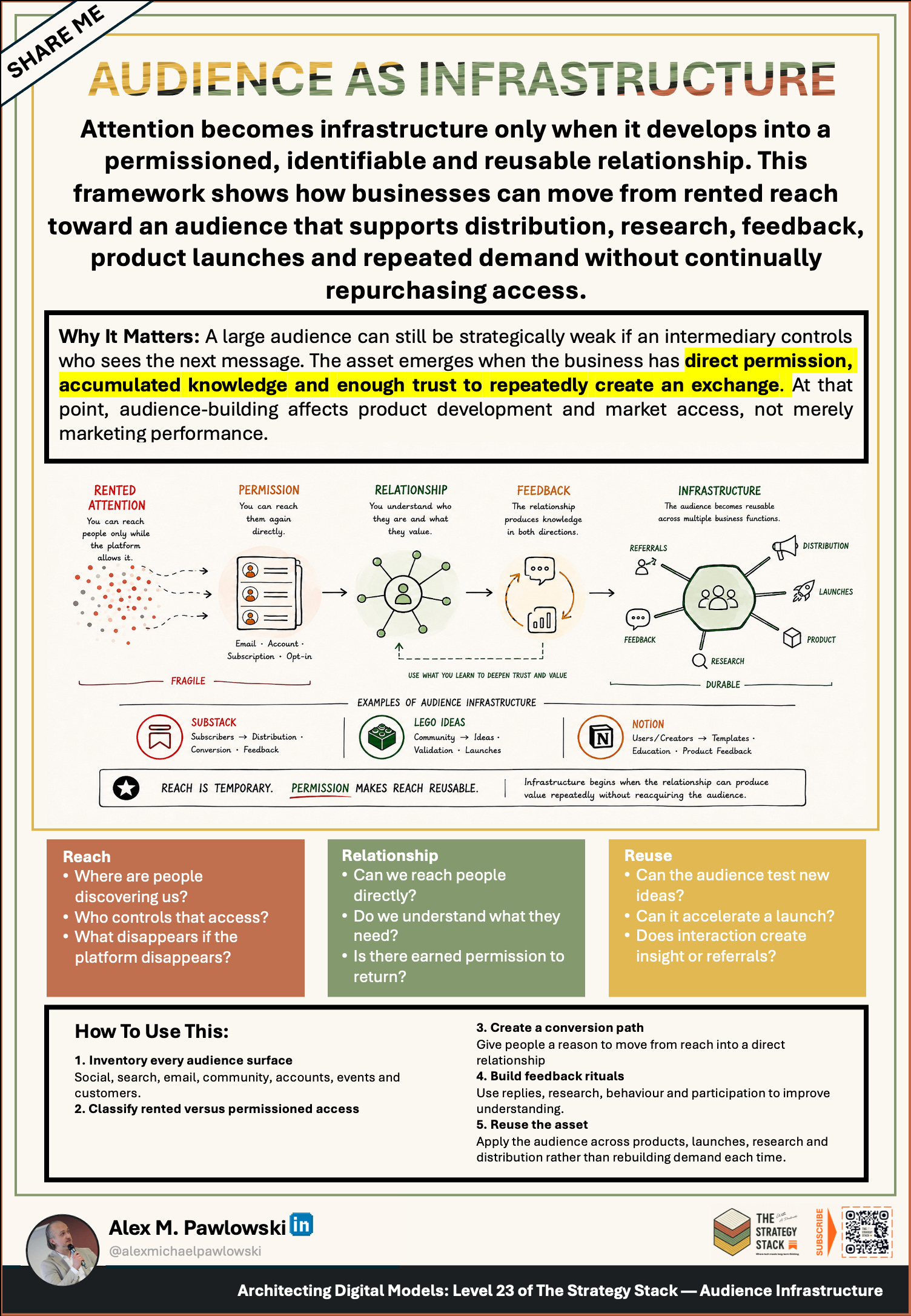
Attention becomes audience infrastructure when it supports distribution, research, feedback, and product launches without repurchasing access every time.
Most businesses operate primarily on rented reach — visible while a platform allows it, fragile when algorithms or policies shift.
Audience infrastructure is the progression toward a permissioned, identifiable, reusable relationship: an asset the business can return to, learn from, and deploy across offers.
In practice, audience infrastructure is an owned-audience strategy built on permission: direct access, identifiable relationships, and an audience you can activate without repurchasing attention each time.
This is not the same question as distribution leverage (does effort leave a persistent asset?) or the distribution control map (who can revoke access?). Here the question is narrower: do you have permissioned identity you can reuse for research, launches, and feedback without buying the crowd again?
The Progression
Rented attention — reach without direct access; platform-dependent.
Permission — email, account, subscription, opt-in; you can reach people directly.
Relationship — understanding who they are and what they value.
Feedback — two-way exchange that improves the offer.
Infrastructure — the audience becomes reusable across referrals, distribution, launches, product development, and research.
Infrastructure begins when the relationship produces value repeatedly without reacquiring the audience for each use.
Three Pillars
Reach — Where are people discovering you? Who controls access? What disappears if the platform disappears?
Relationship — Can you reach people directly? Do you understand their needs? Is there earned permission to return?
Reuse — Can the audience test ideas, accelerate launches, and generate insight or referrals through interaction?
What Infrastructure Looks Like
The asset requires three conditions:
-
Direct permission — not borrowed visibility
-
Accumulated knowledge — not anonymous traffic
-
Sufficient trust — to support repeated exchange
-
Morning Brew / newsletter lists → owned send → product launches, surveys, and cross-offers without rebuying social reach.
-
LEGO Ideas community → concepts, validation, and product launches from permissioned contributors.
-
Duolingo learners → identifiable progress + streak/community rituals → reactivation and feature tests without restarting acquisition from zero.
Different industries, same structural pattern: permissioned identity that compounds into reusable capability.
How to Use This Framework
- Inventory every audience surface — social, search, email, community, events, partnerships.
- Classify rented versus permissioned access — be precise about what you actually own.
- Create a conversion path — give people a reason to move from reach into a direct relationship.
- Build feedback rituals — replies, research, observed behavior — not only broadcasts.
- Reuse the asset — apply the audience across products and launches instead of rebuilding demand each time.
👉 Unlock the Strategy Stack
…and access the Business Model Series, advanced Cheat Sheets, the Operator Vault, and various essays at the intersection of strategy and technology.
In this series →
Read next →
Go deeper → 
Hit subscribe to get it in your inbox. And if this spoke to you:
➡️ Forward this to a strategy peer who’s feeling the same shift. We’re building a smarter, tech-equipped strategy community—one layer at a time.
Let’s stack it up.
A. Pawlowski | The Strategy Stack