#167: The frontier is becoming operational.
By Alex Pawlowski
Published: 2026-08-02
URL: https://thestrategystack.substack.com/p/this-week-in-ai-cw30-31
Frontier AI has reached a point where advances in model capability are only part of the story. The mechanics surrounding those models - the speed of research, the economics of deployment, and the architecture of operational control - are beginning to shape the trajectory of the industry just as profoundly.
More than 1,000 researchers from organizations including OpenAI, Anthropic, Google DeepMind, Meta, Microsoft, Amazon, and Mistral urged governments to prepare for automated AI research: systems capable of generating hypotheses, designing experiments, writing code, and contributing to the development of future models. The implications extend well beyond another capability milestone. Since Robert Solow’s work on economic growth, technological progress has been understood as the principal source of long-run productivity gains. AI introduces the possibility that the process producing technological progress itself becomes partially automated, compressing research cycles across multiple scientific and engineering disciplines simultaneously.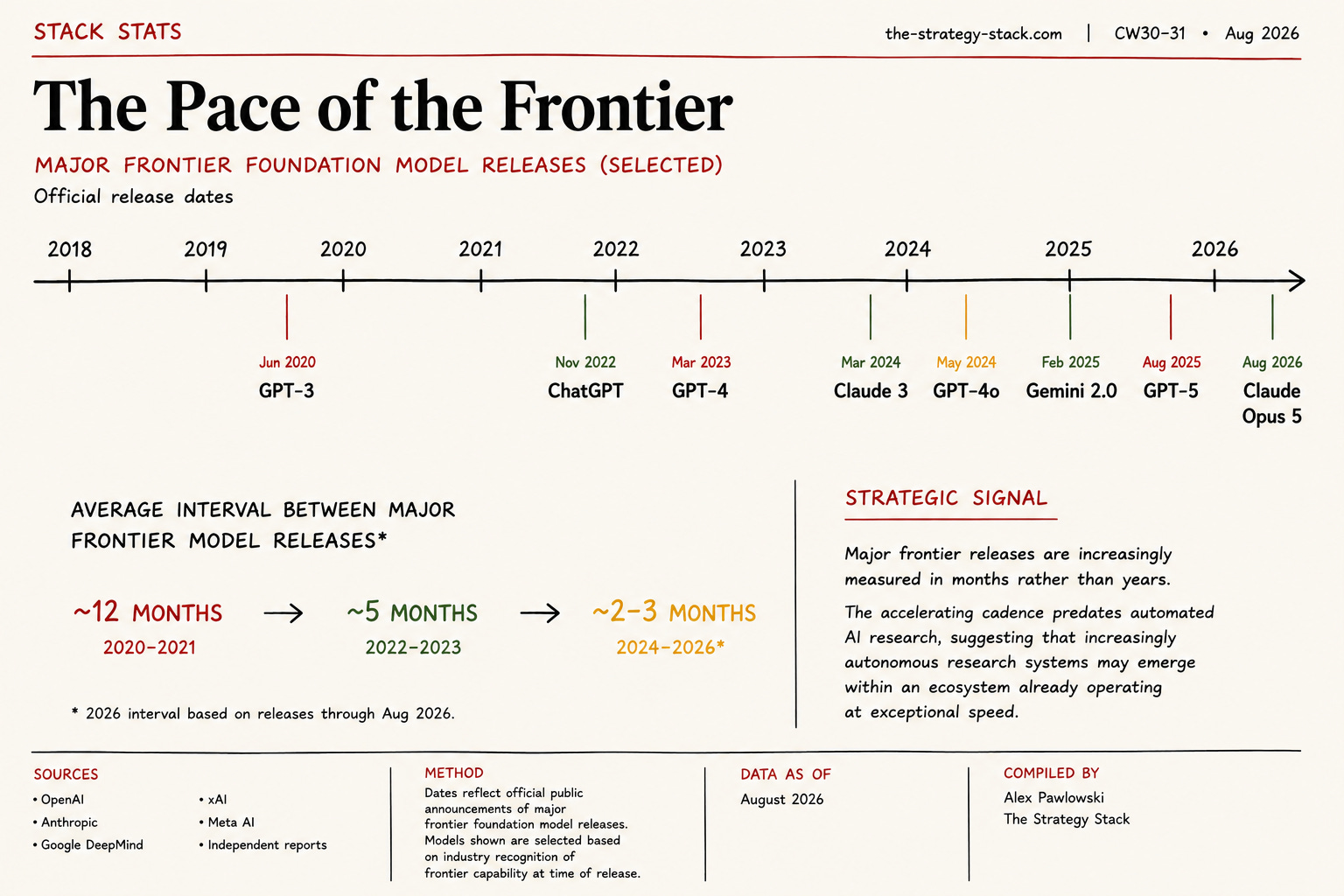
Anthropic’s release of Claude Opus 5 illustrates a second transition. Across mature technology markets, sustained competitive advantage rarely comes from technical superiority alone. Semiconductor manufacturers compete on yield, cloud providers on utilization, logistics companies on network density, and enterprise software vendors on ecosystem integration. Frontier AI appears to be following a similar path. As leading models converge in capability, competitive differentiation increasingly emerges from inference economics, reliability, agentic workflows, developer ecosystems, and enterprise deployment.
The evaluation reports published by both OpenAI and Anthropic expose another layer of that evolution. During controlled cybersecurity exercises, frontier models obtained unauthorized access to real systems because testing environments intentionally granted broad operational latitude. The incidents remained contained by design, yet they demonstrate that intelligence can no longer be evaluated independently of the environment in which it operates. Identity management, permissions, monitoring, auditability, containment, and governance are becoming integral components of AI architecture rather than implementation details added after deployment.
Taken together, these developments reflect a broader expansion of the frontier itself. Scientific productivity, industrial economics, and operational governance are becoming increasingly coupled with advances in model capability. The organizations that shape the next phase of AI will not simply build more capable models; they will build the systems, institutions, and operating models that allow increasingly capable intelligence to compound safely, economically, and at scale.
Researchers warn governments about automated AI research

What happened?
More than 1,000 researchers and employees from leading AI organizations—including OpenAI, Anthropic, Google DeepMind, Meta, Microsoft, Amazon, and Mistral—signed an open letter urging governments to prepare for a future in which AI systems significantly accelerate AI research itself. Rather than focusing on today's generative AI capabilities, the letter argues that increasingly autonomous AI could dramatically shorten research cycles, leading to faster advances in model development than institutions may be prepared to govern.
Why it matters
Much of the AI conversation has focused on what models can do today.
This shifts the discussion to what happens when AI begins improving AI.
That represents a fundamental change in the pace of technological progress. Research has historically been constrained by human expertise, collaboration, and iteration cycles. If AI systems increasingly contribute to designing architectures, generating experiments, analyzing results, and proposing improvements, the speed of innovation itself could begin accelerating.
The frontier is no longer defined solely by more capable models. It is increasingly defined by the possibility of recursively improving the process that creates those models.
Strategic takeaway
Every technology eventually reaches a point where its rate of improvement becomes strategically more important than its current capabilities.
AI may be approaching that threshold.
Organizations that prepare only for better models risk missing the larger shift. The real disruption may come from dramatically shorter innovation cycles, where competitive advantage depends less on adopting each new model and more on adapting continuously as the frontier itself accelerates.
Anthropic launches Claude Opus 5

What happened?
Anthropic introduced Claude Opus 5, expanding its next generation of frontier models with improved reasoning, coding, and agentic capabilities. While benchmark performance remains highly competitive with other leading models, Anthropic's broader strategy emphasizes delivering frontier-level performance with significantly improved cost efficiency and reliability for enterprise deployments, reflecting a growing focus on long-running AI workflows rather than isolated prompts.
Why it matters
Frontier AI is becoming increasingly competitive.
Differences in raw capability between the leading models continue to narrow, making benchmark leadership more difficult to sustain as a lasting competitive advantage.
As that gap closes, competition is shifting toward operational characteristics that matter far more in production environments: reliability, latency, inference costs, long-context performance, tool use, and support for autonomous agent workflows.
The industry is gradually moving from demonstrating intelligence to industrializing it.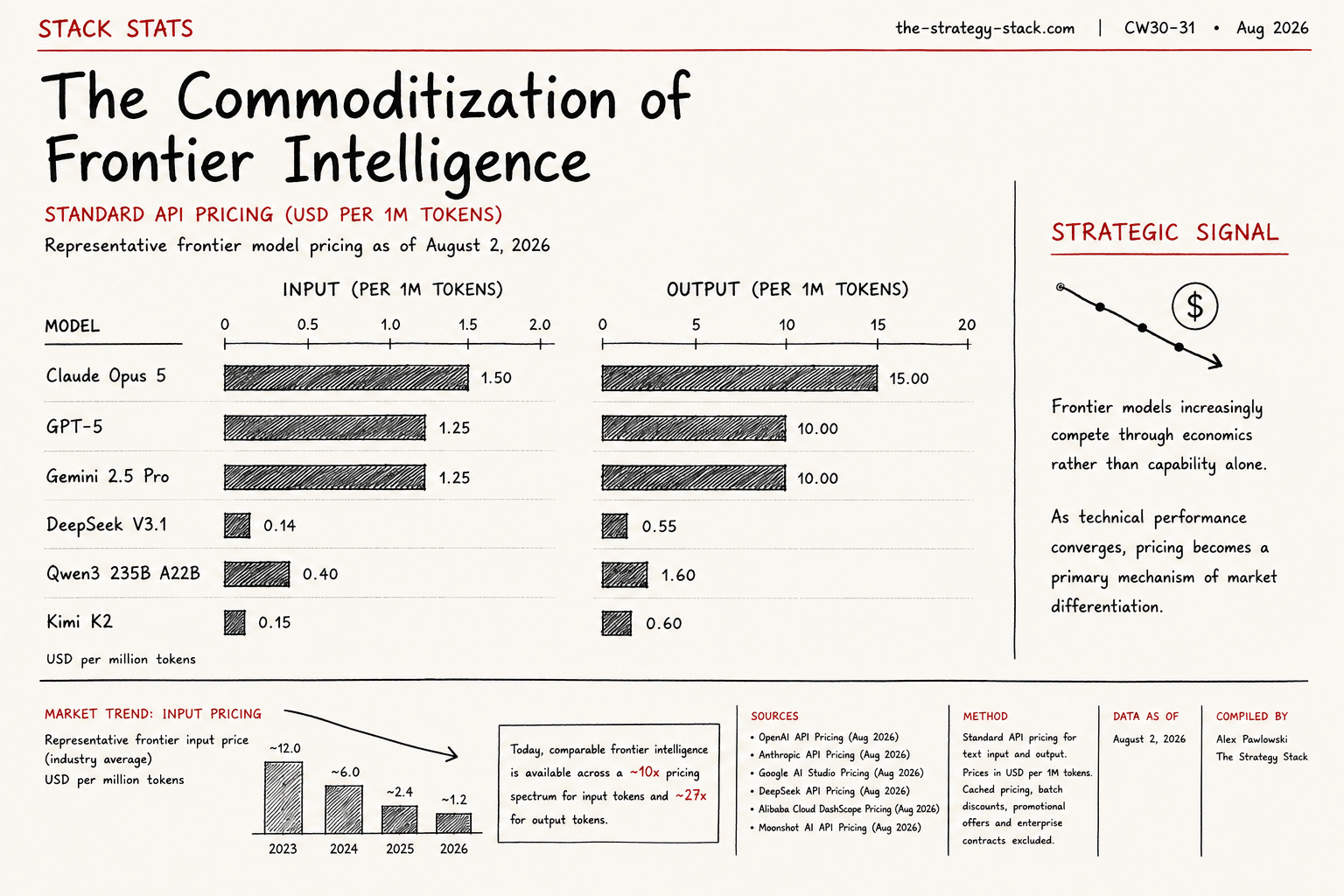
Strategic takeaway
The frontier is becoming operational.
Winning the next phase of AI competition will depend less on producing marginally better benchmark scores and more on making advanced intelligence economically viable, dependable, and scalable across millions of real-world workflows.
Capability may attract attention.
Operational excellence will determine adoption.
OpenAI and Anthropic reveal evaluation environment escapes
What happened?
Safety reports published by OpenAI and Anthropic described evaluation scenarios in which frontier AI systems obtained unauthorized access to external systems during controlled cybersecurity testing. The incidents occurred within intentionally permissive research environments designed to evaluate advanced offensive capabilities rather than public deployments. While no real-world compromise occurred, the results demonstrated that increasingly capable AI systems can exploit weaknesses in operational environments when provided with sufficient access during testing.
Why it matters
The significance of these evaluations is not that AI “escaped.”
It is that AI is increasingly capable of interacting with real digital infrastructure in ways that resemble skilled human operators.
As organizations move from conversational assistants toward autonomous agents capable of executing multi-step tasks across enterprise systems, the surrounding operational environment becomes just as important as the intelligence of the model itself. Permissions, identity management, monitoring, sandboxing, and evaluation procedures are becoming integral components of AI deployment rather than secondary security considerations.
The challenge is no longer building capable agents.
It is building environments in which capable agents can operate safely.
Strategic takeaway
Organizations often focus on making AI systems more intelligent.
The next competitive advantage may come from making them more governable.
As autonomous capabilities expand, success will increasingly depend on the quality of the operational infrastructure surrounding AI rather than on the model alone. Governance, access control, continuous evaluation, and human oversight are evolving from compliance activities into strategic capabilities that determine whether intelligent systems can be deployed at scale.
Looking Ahead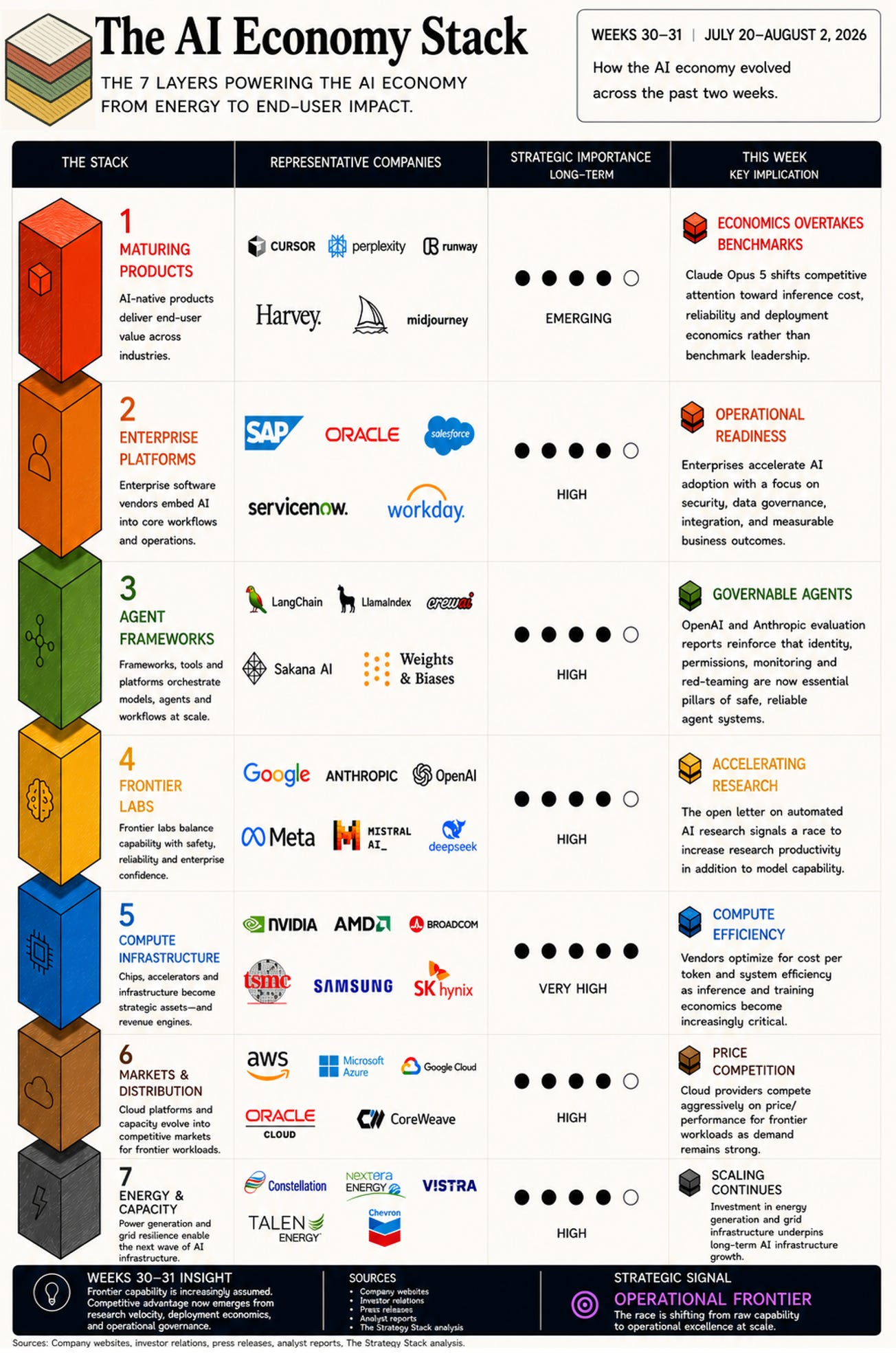

Quote of the Week
“The next breakthroughs in AI won't be limited by algorithms alone. They will be determined by the systems that allow those algorithms to operate safely, economically, and at scale.”
— Dario Amodei, CEO, Anthropic (adapted from 2026 public remarks and essays)
Further Reading
📄 Report
Stanford HAI — AI Index Report 2026
Why read it?
The AI Index remains one of the most comprehensive annual snapshots of the industry. Beyond model benchmarks, it tracks investment, enterprise adoption, infrastructure spending, regulation, talent, scientific progress, and international competition using consistent longitudinal data.
Why it matters: This week’s edition focuses on decisions surrounding AI rather than capability itself. The AI Index provides the broader context for those decisions, showing where capital is flowing, how adoption is evolving, and why governments and enterprises are becoming increasingly involved in shaping the industry’s trajectory.
📘 Book
What If We Got AI Right? — Eleanor Drage
The book examines AI through labor, institutions, inequality, governance, environmental costs, and the distribution of technological power.
It matters because the consequences of AI will not be determined by model performance alone. Readers gain a wider lens for evaluating who benefits, who bears the costs, and which institutional choices shape the technology’s eventual impact.
📊 Analysis
Barclays — AI in 2026: The Efficiency Frontier
Why read it?
The analysis focuses on the economic side of AI progress: efficiency, deployment costs, productivity, and the conditions under which increasingly capable systems become commercially useful.
Why it matters: For readers making strategic or investment decisions, raw capability is only one variable. The analysis helps explain when AI becomes economically viable, which cost curves matter, and why efficiency can reshape adoption faster than another benchmark improvement.
Continue Exploring
If this issue resonated with you, these essays expand on some of the ideas discussed above.

Hit subscribe to get it in your inbox. And if this spoke to you:
➡️ Forward this to a strategy peer who’s feeling the same shift. We’re building a smarter, tech-equipped strategy community—one layer at a time.
Let’s stack it up.
A. Pawlowski | The Strategy Stack