#161: Open models advance, compute becomes a business, governance becomes infrastructure.
By Alex Pawlowski
Published: 2026-07-20
URL: https://thestrategystack.substack.com/p/open-models-ai-compute-governance
Moonshot AI introduced Kimi K3, a 2.8-trillion-parameter open-weight model that demonstrates how quickly frontier AI capabilities are spreading beyond the handful of companies that have dominated the conversation over the past two years. Despite limited access to the most advanced chips, Chinese developers continue to narrow the gap through architectural innovation and increasingly competitive open-weight models.
Meta, meanwhile, reportedly explored offering its growing AI compute infrastructure to external organizations. If that direction materializes, one of the industry’s largest infrastructure investors could begin treating compute not only as an internal capability but as a commercial product—expanding competition beyond models into the economics of the infrastructure that powers them.
At the same time, Demis Hassabis proposed an independent standards body to evaluate frontier AI systems before deployment. The suggestion reflects a growing recognition that as models become more capable and more widely deployed, trust may increasingly depend on shared evaluation frameworks rather than assessments conducted solely by the companies building them.
Together, they suggest that competition is unfolding simultaneously across frontier capability, infrastructure economics, and institutional trust. Those three layers increasingly influence not only who builds the best AI, but who creates the conditions under which that AI is adopted at scale.
Meta explores becoming an AI cloud provider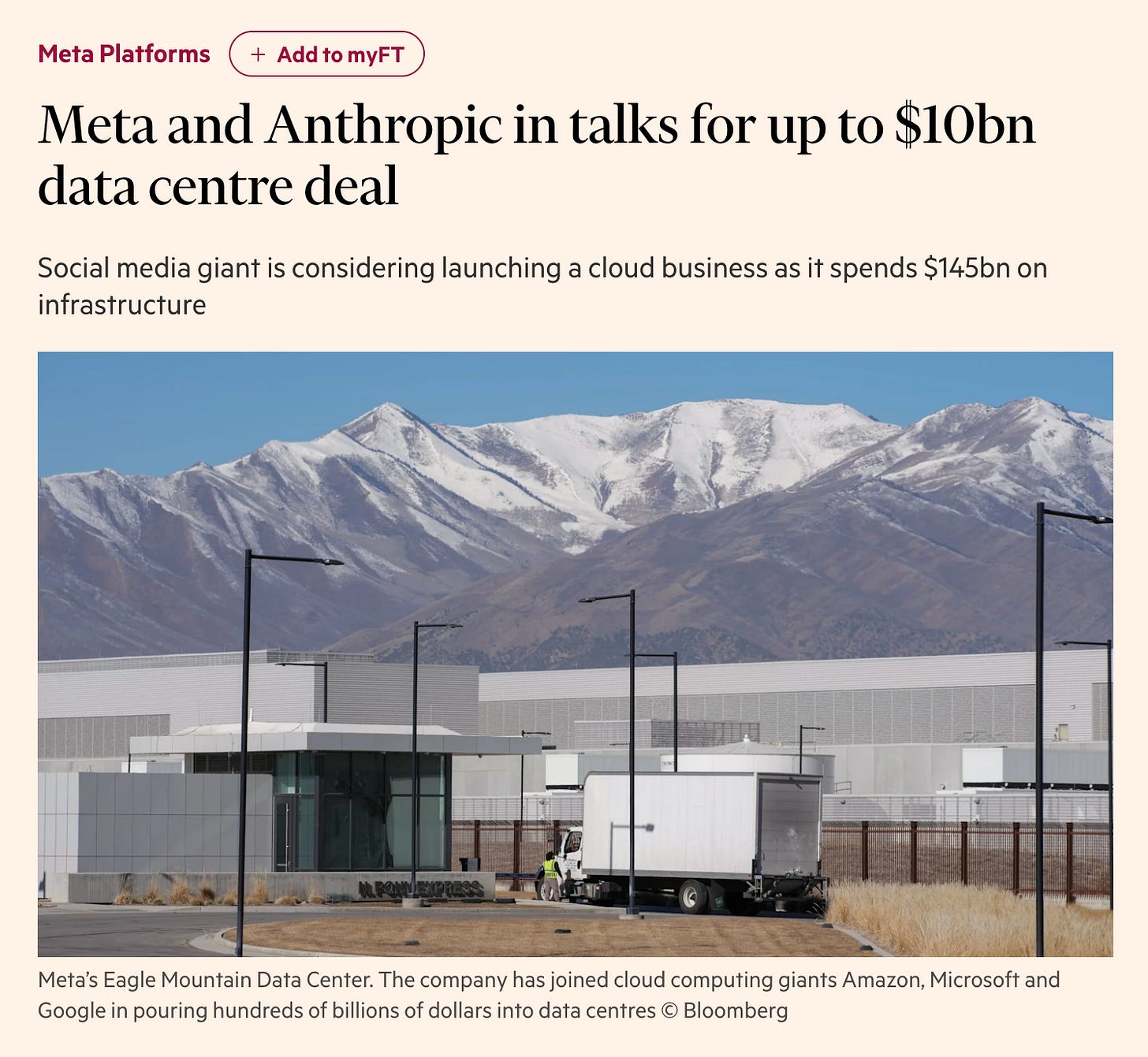
What happened?
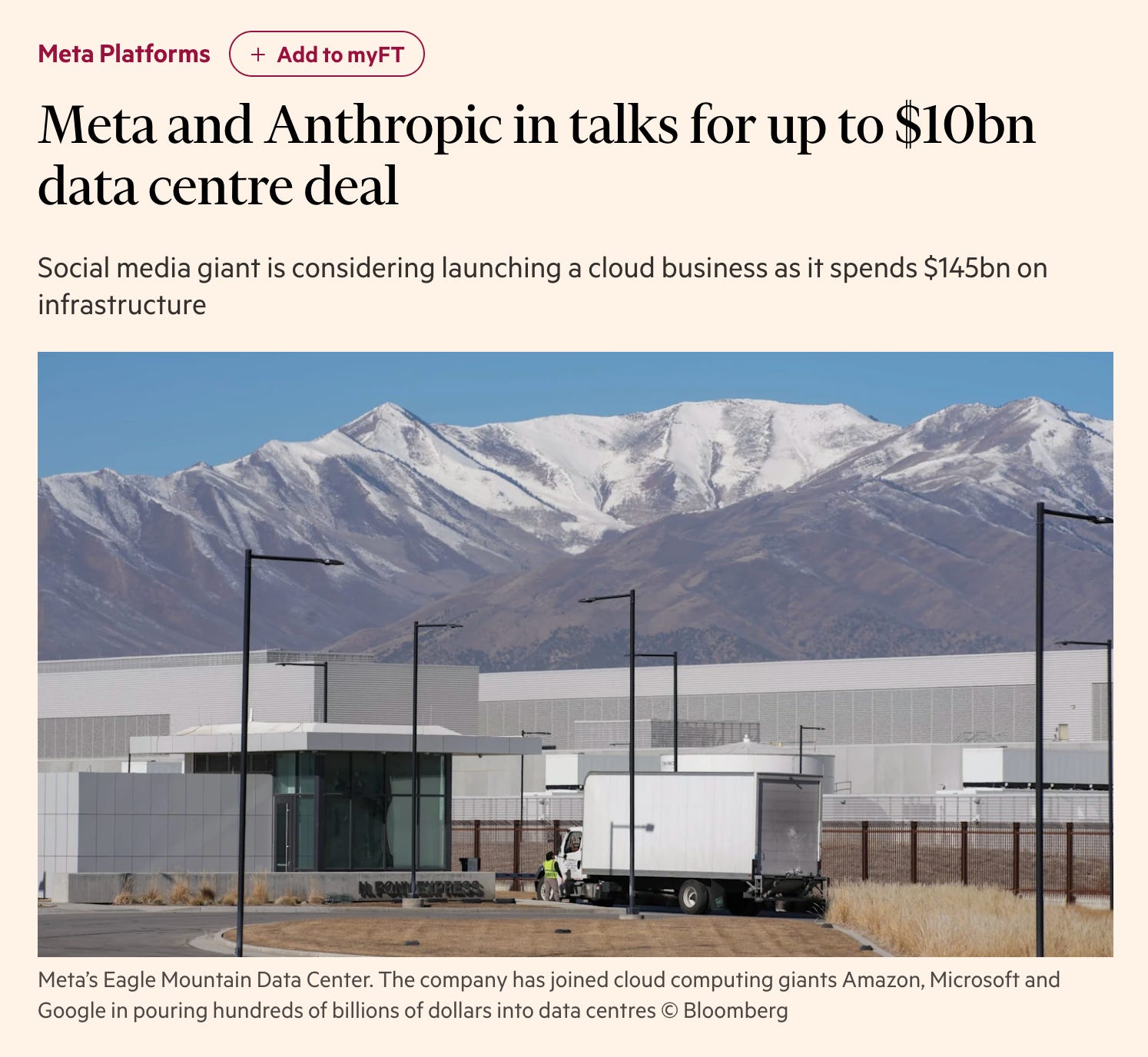
Reports indicate that Meta is exploring agreements to provide AI computing capacity to external organizations, including discussions with Anthropic regarding large-scale access to Meta’s expanding data center infrastructure. While Meta has historically built infrastructure primarily to support its own AI ambitions, these discussions suggest the company may also be positioning itself as a provider of AI compute for the broader market.
Why it matters
For years, compute was viewed primarily as an internal capability.
That distinction is beginning to disappear.
The enormous investments required to build frontier AI infrastructure create opportunities to monetize excess capacity, much like Amazon transformed internal computing resources into AWS nearly two decades ago. Infrastructure itself is becoming a product.
This signals another stage in the evolution of the AI economy. Companies are no longer competing solely through models or applications. Increasingly, they are competing through the platforms, chips, data centers, and computing resources that enable the entire ecosystem.
Strategic takeaway
The interesting shift is not that Meta is building more infrastructure. Every hyperscaler is doing that.
The interesting question is whether infrastructure becomes something companies increasingly sell rather than simply consume. Once compute becomes a market in its own right, competitive advantage expands beyond models into pricing, availability, utilization, and ecosystem relationships.
That would create another layer of competition—one where owning the capacity to enable AI may become just as valuable as owning the intelligence itself.
Moonshot AI launches Kimi K3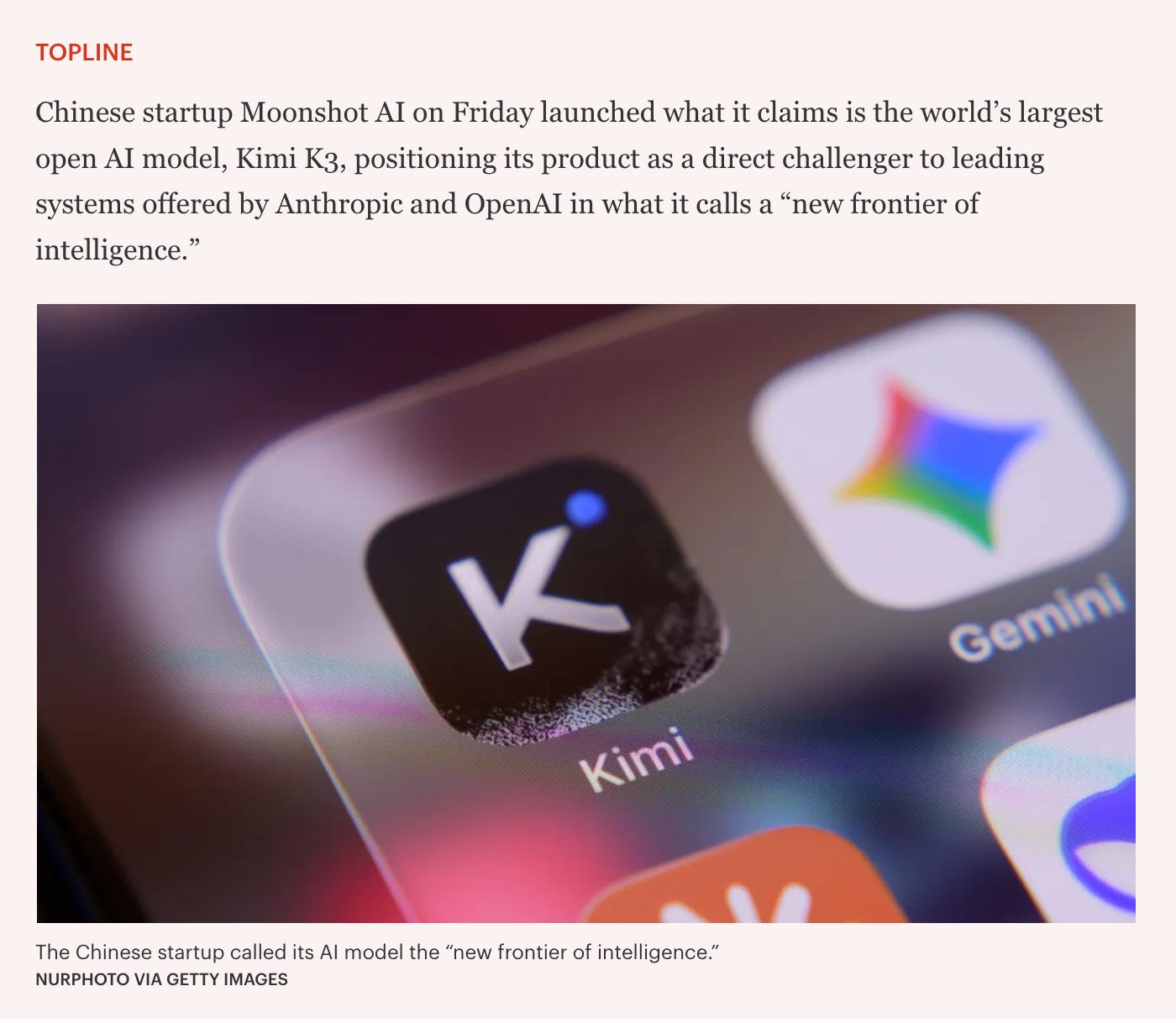
What happened?
Chinese AI startup Moonshot AI unveiled Kimi K3, a 2.8-trillion-parameter open-weight frontier model that the company positions as a direct competitor to leading systems from OpenAI and Anthropic. While Moonshot acknowledges that Kimi K3 still trails the latest proprietary frontier models in overall capability, it demonstrated competitive performance across several coding, reasoning, and agentic benchmarks. The launch also reinforces China's continued progress in developing frontier AI despite ongoing U.S. export restrictions on advanced AI chips.
Why it matters
Kimi K3 is another reminder that frontier AI is no longer advancing within a small group of Western companies.
Chinese developers continue to narrow the capability gap through architectural improvements, training efficiency, and open-weight releases rather than simply relying on access to the largest computing infrastructure. At the same time, open-weight models are becoming increasingly capable alternatives for enterprises and developers seeking greater flexibility, transparency, and control than proprietary systems typically provide.
Competition is becoming multidimensional. It is no longer only about building the most capable model, but also about deciding which parts of the technology remain proprietary and which are opened to accelerate ecosystem adoption.
Strategic takeaway
The distinction between open and closed AI ecosystems is becoming just as strategically important as differences in model performance.
Every new frontier open-weight model expands the number of organizations capable of building sophisticated AI applications without depending entirely on a handful of proprietary providers. That gradually changes the industry’s balance of power. Instead of competing only through intelligence, AI companies increasingly compete through ecosystems, developer adoption, infrastructure, and distribution. Those advantages tend to compound over time, even when differences in benchmark performance become increasingly difficult to distinguish.
Hassabis proposes a Frontier AI Standards Body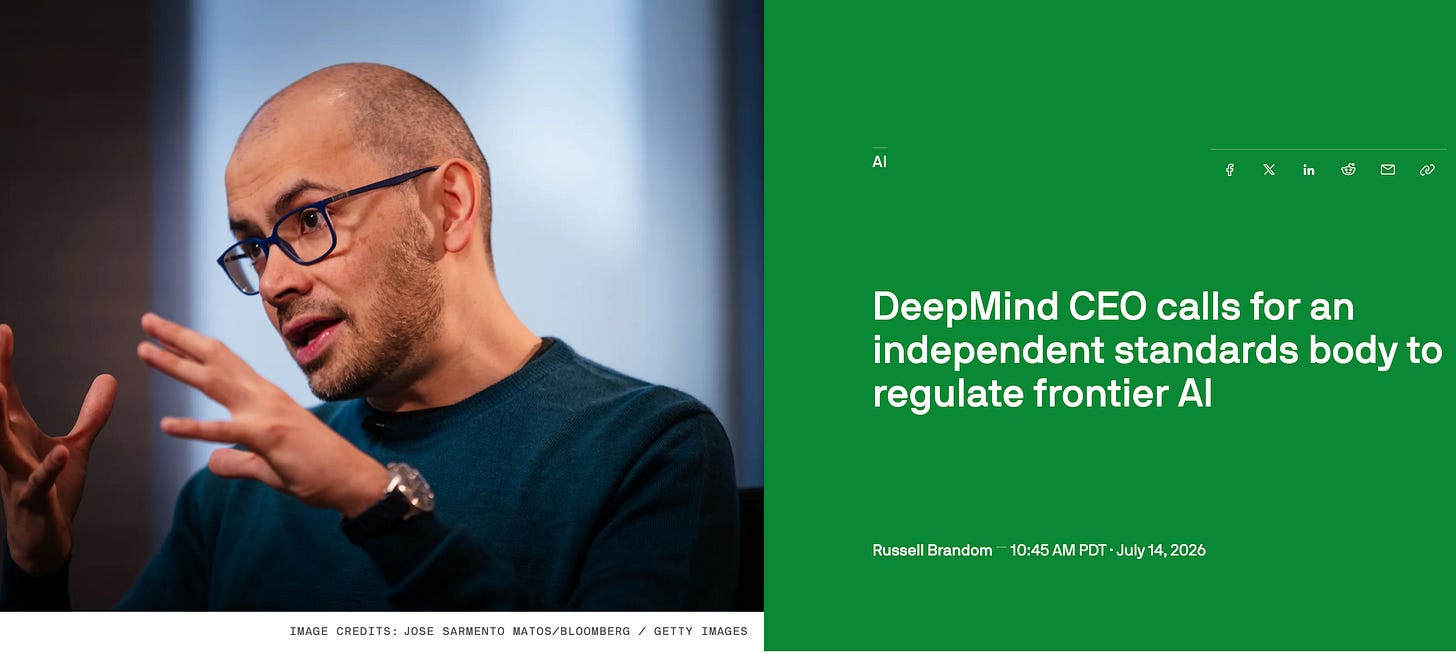
What happened?
Google DeepMind CEO Demis Hassabis called for the creation of an independent international organization responsible for evaluating frontier AI systems before deployment. Rather than relying solely on voluntary safety commitments from individual companies, the proposed body would establish common evaluation standards and provide independent assessments of increasingly capable models before they reach the public.
Why it matters
Every transformative technology eventually develops institutions alongside innovation.
Financial markets rely on regulators and auditors. Aviation depends on certification authorities. Pharmaceutical companies operate under independent clinical oversight.
Artificial intelligence is beginning to follow a similar path.
As frontier models become more capable and economically significant, governance itself is becoming infrastructure. Shared standards, independent evaluation, and institutional trust may prove just as important as technical progress in determining how quickly AI is adopted across governments and enterprises.
Strategic takeaway
Standards become important when individual decisions begin affecting an entire ecosystem.
That appears to be where frontier AI is heading. Model evaluations are gradually becoming less about informing one company’s release process and more about creating confidence across customers, governments, investors, and partners.
Whether a formal standards body emerges is almost secondary. The more important signal is that leading AI companies are beginning to recognize trust as something that cannot be established independently. It increasingly depends on shared mechanisms that extend beyond any single organization.
Looking Ahead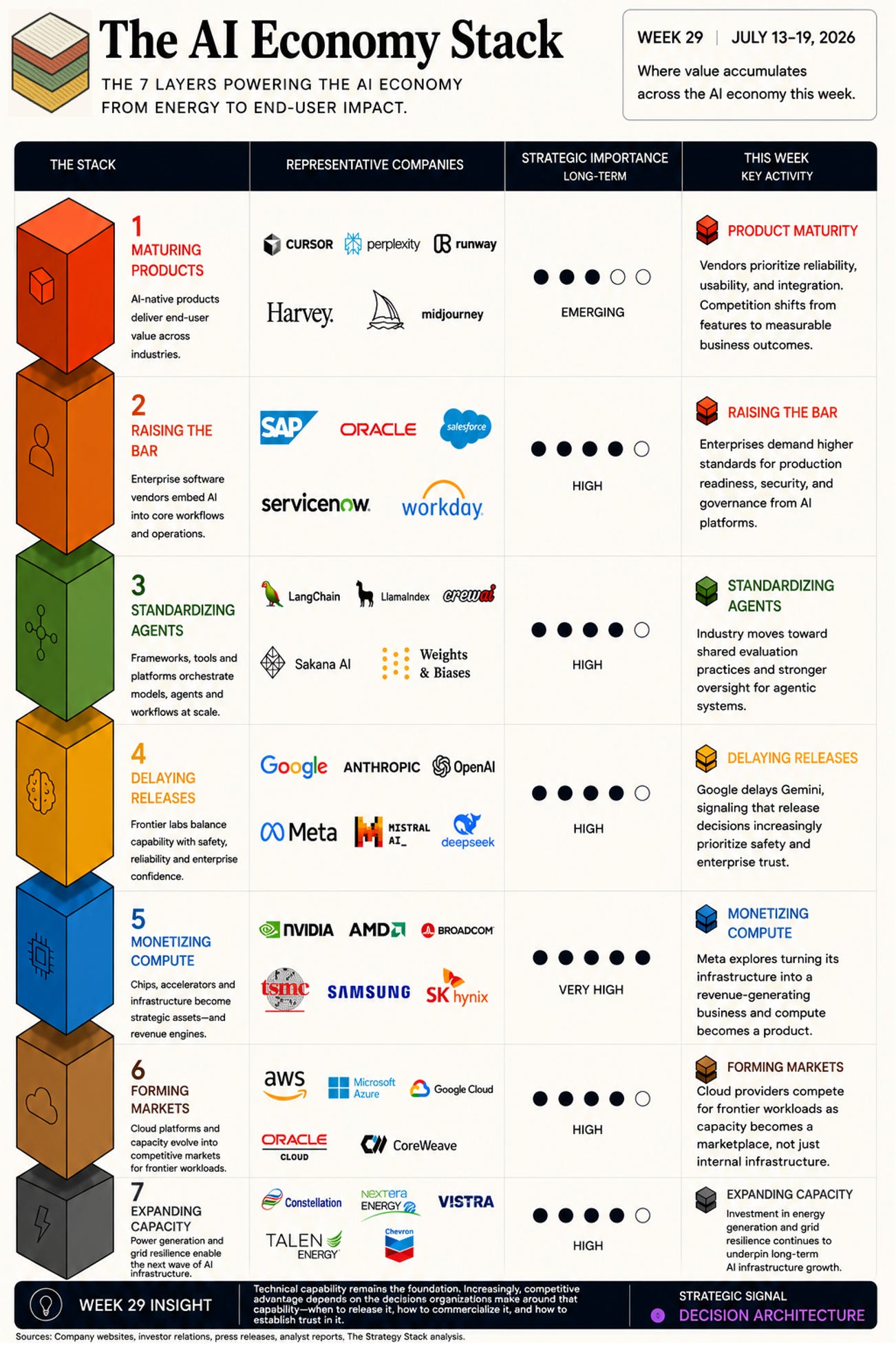
Quote of the Week
"The measure of a technology is not simply what it makes possible, but what people are willing to depend on."
— Demis Hassabis, CEO, Google DeepMind (adapted from July 2026 interviews and essays)
Further Reading
📄 Report
Stanford HAI — AI Index Report 2026
Why read it?
The AI Index remains one of the most comprehensive annual snapshots of the industry. Beyond model benchmarks, it tracks investment, enterprise adoption, infrastructure spending, regulation, talent, scientific progress, and international competition using consistent longitudinal data.
Why it matters: This week’s edition focuses on decisions surrounding AI rather than capability itself. The AI Index provides the broader context for those decisions, showing where capital is flowing, how adoption is evolving, and why governments and enterprises are becoming increasingly involved in shaping the industry’s trajectory.
📘 Book
The Technological Republic — Alexander C. Karp & Nicholas Zamiska
Rather than asking how to build better AI, Karp explores the relationship between technological capability, institutions, national competitiveness, and public responsibility. It's a useful complement to this week's discussion about who ultimately governs increasingly capable AI systems.
📊 Analysis
McKinsey — State of AI Trust in 2026: Shifting to the Agentic Era
Why read it?
One of the best annual surveys of enterprise AI adoption, examining how organizations are moving from experimentation toward operational deployment. It explores where companies are realizing measurable value, how governance practices are evolving, and which organizational capabilities distinguish leading adopters.
Why it matters: This week’s stories all examine strategic decisions made after frontier capability already exists. McKinsey shows how those decisions increasingly determine whether AI creates lasting organizational value or remains an isolated technical achievement.

Hit subscribe to get it in your inbox. And if this spoke to you:
➡️ Forward this to a strategy peer who’s feeling the same shift. We’re building a smarter, tech-equipped strategy community—one layer at a time.
Let’s stack it up.
A. Pawlowski | The Strategy Stack