#157: Three developments shaping the future of business, technology, and competition.
By Alex Pawlowski
Published: 2026-06-28
URL: https://thestrategystack.substack.com/p/this-week-in-ai-001-june-28-2026
Over the past few months, I’ve found myself reading more AI news than ever—and enjoying less of it.
Not because there isn’t interesting work happening. Quite the opposite.
The challenge is that it’s becoming increasingly difficult to separate meaningful structural shifts from the constant stream of product launches, benchmark improvements, and funding announcements.
So I’m introducing a new weekly format: This Week in AI.
Every weekend, I’ll step back from the headlines and highlight the three developments that I believe matter most—not because they generated the most attention, but because they reveal something about where the AI ecosystem is heading.
My goal isn’t to help you keep up with the news.
It’s to help you recognize the patterns shaping the future of business, technology, and strategy.
Asian AI startups launch Mythos-like models as Anthropic’s export ban drags on
What happened?
Two Asian AI companies used the past week to introduce frontier models positioned as alternatives to Anthropic’s latest systems. Japan’s Sakana AI launched Fugu, an orchestration model designed to coordinate multiple AI systems rather than relying on a single foundation model. Meanwhile, Chinese cybersecurity company 360 unveiled Tulongfeng, a security-focused model it claims can compete with Anthropic’s Mythos.
The launches come just weeks after U.S. export restrictions prevented Anthropic’s most advanced models from being made available outside the United States. While Sakana emphasized that its release had been planned long before the restrictions, both companies have clearly positioned themselves as regional alternatives for organizations seeking continued access to frontier AI capabilities.
Why it matters
This story isn’t really about Anthropic.
It’s about the next phase of global AI competition.
For the past several years, the prevailing assumption was that the world’s most advanced AI models would increasingly converge around a handful of U.S. providers. Export restrictions challenge that assumption. When access to frontier models becomes uncertain, governments and enterprises begin investing in domestic alternatives—not necessarily because they are better, but because they are available.
At the same time, Sakana’s emphasis on orchestration rather than ever-larger foundation models highlights another emerging trend. Competitive advantage may increasingly come from intelligently coordinating multiple specialized models instead of relying on a single dominant system.
Taken together, these developments suggest that the AI landscape is becoming more regional, more diversified, and more resilient. Instead of one global frontier, we may see several regional AI ecosystems emerge—each optimized for different languages, regulations, industries, and strategic priorities.
Strategic takeaway
Organizations should prepare for a future in which AI capabilities are sourced from multiple providers across different regions, making model orchestration and vendor diversification strategic capabilities rather than technical implementation choices.
This new research challenges nearly every big AI narrative of 2026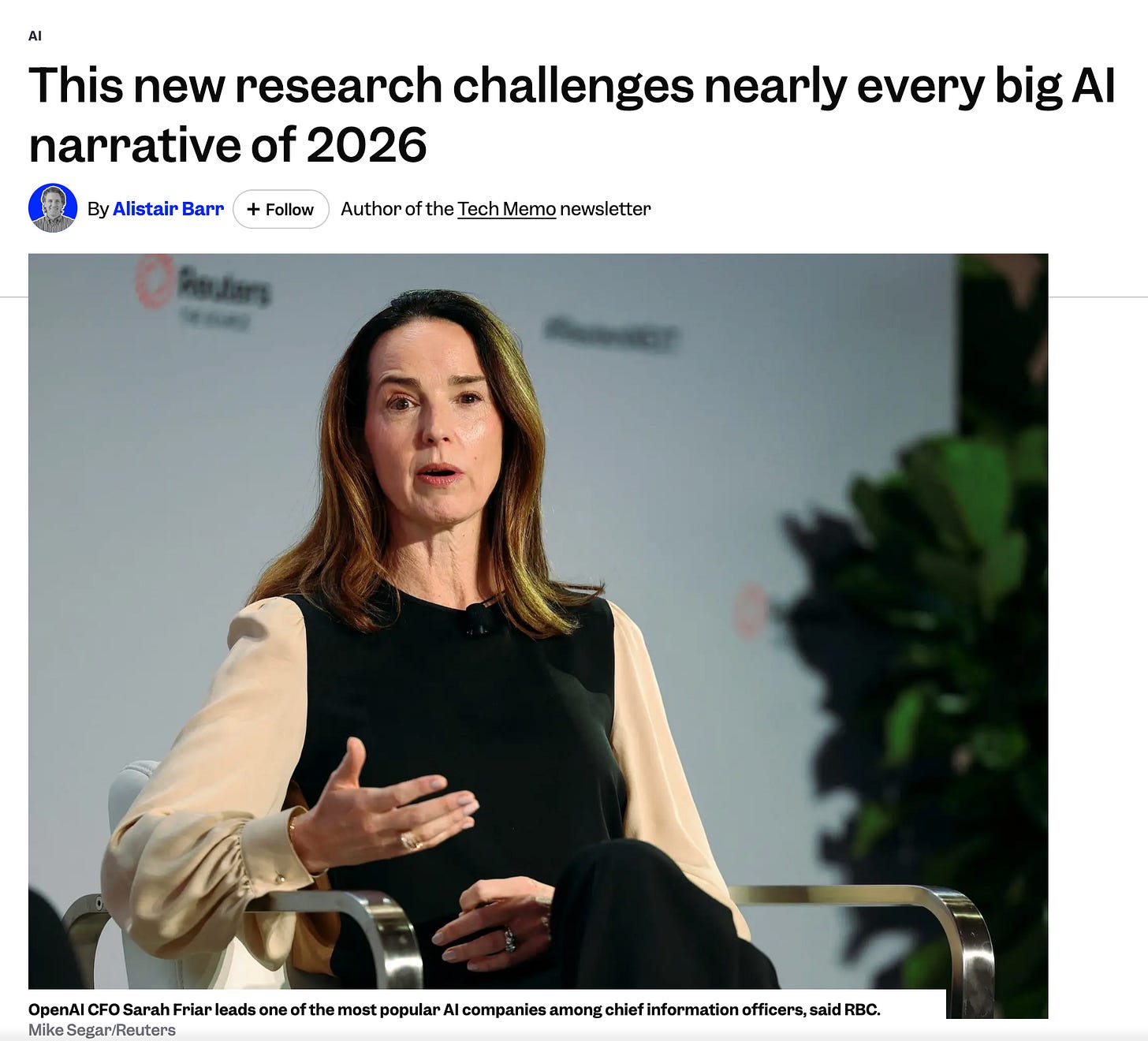
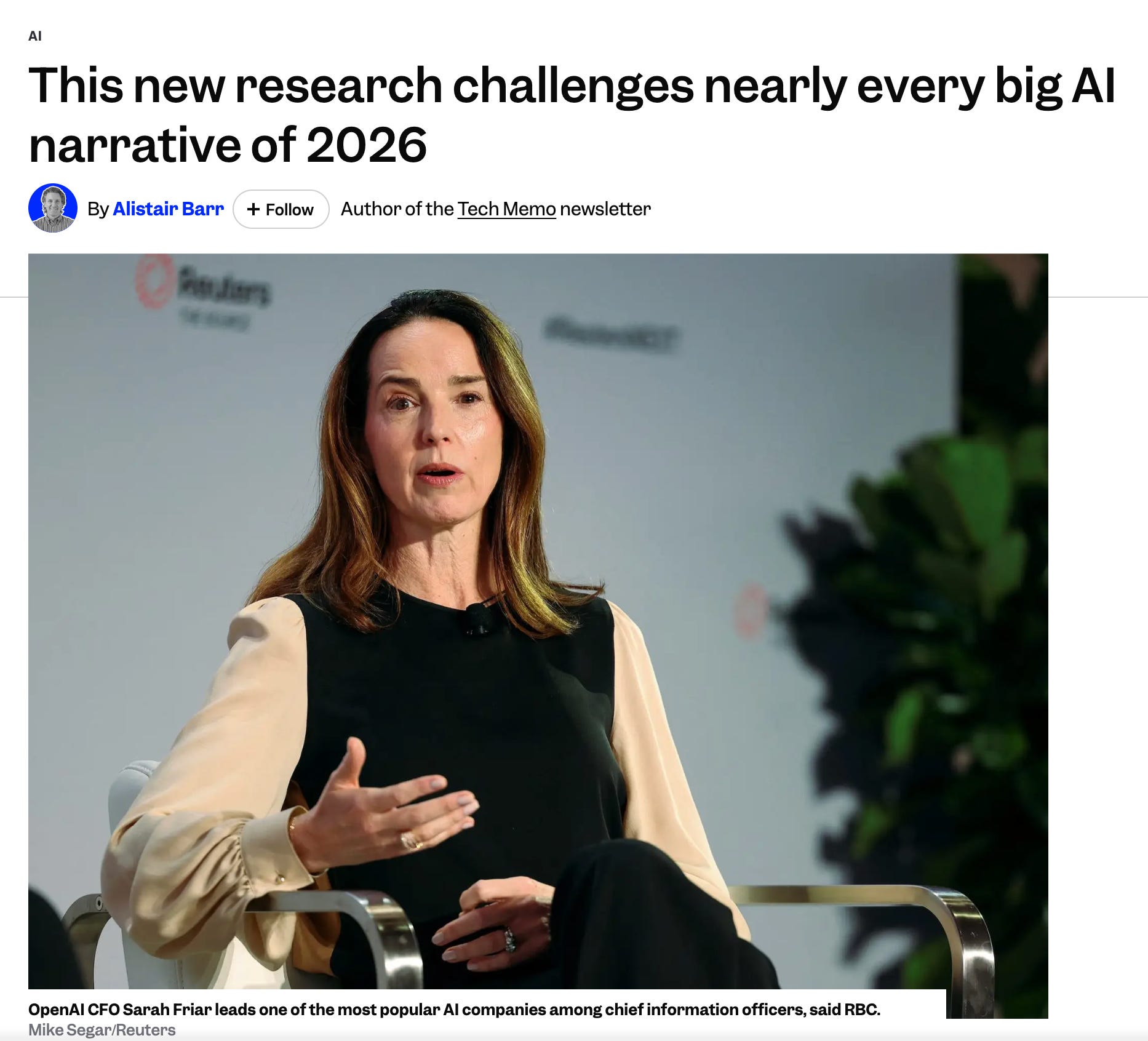
What happened?
A new survey from RBC Capital Markets, based on responses from more than 100 chief information officers and technology leaders responsible for billions of dollars in enterprise IT spending, suggests that enterprise AI has reached a significant inflection point.
More than half of organizations report that AI is already running in production, while another 35% expect to move from pilot projects to production deployments within the next six months. Every respondent reported allocating budget to AI initiatives, and over 90% said those investments are being funded through entirely new AI budgets rather than by reducing spending elsewhere.
The survey also challenges several common assumptions. Token costs are proving far more manageable than expected, enterprise software spending continues to grow alongside AI investment rather than being displaced by it, and hybrid pricing models that combine traditional software licenses with usage-based AI consumption are rapidly becoming the preferred commercial model.
Why it matters
For much of the past two years, the central question surrounding enterprise AI was whether organizations would move beyond experimentation.
That question is increasingly being answered.
The challenge is no longer convincing executives that AI has value. It is determining how AI can be integrated into business processes, governed at scale, and translated into measurable productivity gains.
Equally important, the survey undermines several narratives that have dominated AI discussions throughout 2026. Enterprises are not abandoning traditional software to fund AI. Token costs are not becoming a major barrier to adoption. Instead, organizations are expanding technology budgets, treating AI as an additional strategic capability rather than a replacement for existing systems.
This marks an important shift in the AI market. Competitive advantage is becoming less about experimenting with foundation models and more about operationalizing AI across the enterprise.
Strategic takeaway
Organizations should shift their focus from proving AI's value to building the governance, operating models, and organizational capabilities required to deploy AI reliably and at scale.
Artificial Intelligencer: Wall Street can’t decide what to think about AI
What happened?
This week, Reuters highlighted a growing divide in how investors view the next phase of the AI boom. On one side is the belief that the hundreds of billions of dollars being invested in AI infrastructure—spanning data centers, custom chips, networking, cooling systems, and energy—will ultimately prove essential to supporting the next generation of AI applications. On the other is increasing concern that the industry may be investing too much, too quickly.
According to Morgan Stanley, the world’s largest technology companies are expected to spend roughly $1 trillion on capital projects next year, with AI infrastructure accounting for a significant share of that investment. At the same time, companies such as OpenAI are developing custom AI chips, Apple is exploring expanded domestic semiconductor manufacturing, and technology firms are increasingly turning to debt markets to finance AI expansion. The amount of AI-related debt issued during the first five months of 2026 reached $236 billion, four times higher than the same period a year earlier.
Why it matters
The conversation surrounding AI is beginning to shift.
For the past several years, competitive advantage was largely defined by who could build the most capable models. Increasingly, however, the limiting factor is no longer intelligence—it’s infrastructure.
Every frontier model depends on an enormous physical ecosystem: semiconductor manufacturing, memory, networking, power generation, cooling technologies, financing, and specialized data centers. As AI systems become more powerful, these supporting capabilities become strategic assets in their own right.
This also marks a new stage in the AI investment cycle. Markets are no longer questioning whether AI will transform industries. Instead, they are evaluating whether the unprecedented capital required to build the underlying infrastructure will generate sufficient long-term economic returns.
In other words, the AI race is evolving into an infrastructure race.
Strategic takeaway
Organizations should begin viewing AI infrastructure—not just AI models—as a strategic capability, because future competitive advantage will increasingly depend on access to compute, energy, capital, and the broader ecosystem that enables intelligence at scale.
Looking Ahead
The next wave of enterprise AI is unlikely to be built around a single model provider.
As organizations move from pilots to production, reliability, cost, regulatory exposure, and infrastructure constraints will increasingly outweigh benchmark performance. Rather than standardizing on one frontier model, enterprises are likely to build portfolios of models optimized for different tasks, regions, and regulatory environments.
This shift is already visible. OpenAI is developing custom silicon with Broadcom to reduce its dependence on third-party hardware. Sakana AI is positioning orchestration—not model size—as its competitive advantage. At the same time, hyperscalers continue investing hundreds of billions of dollars into compute infrastructure while investors begin questioning whether those investments can generate sufficient long-term returns.
Over the coming quarters, watch for enterprise software vendors to compete less on access to the “best” model and more on how effectively they orchestrate multiple models, integrate them into business workflows, and deliver measurable business outcomes.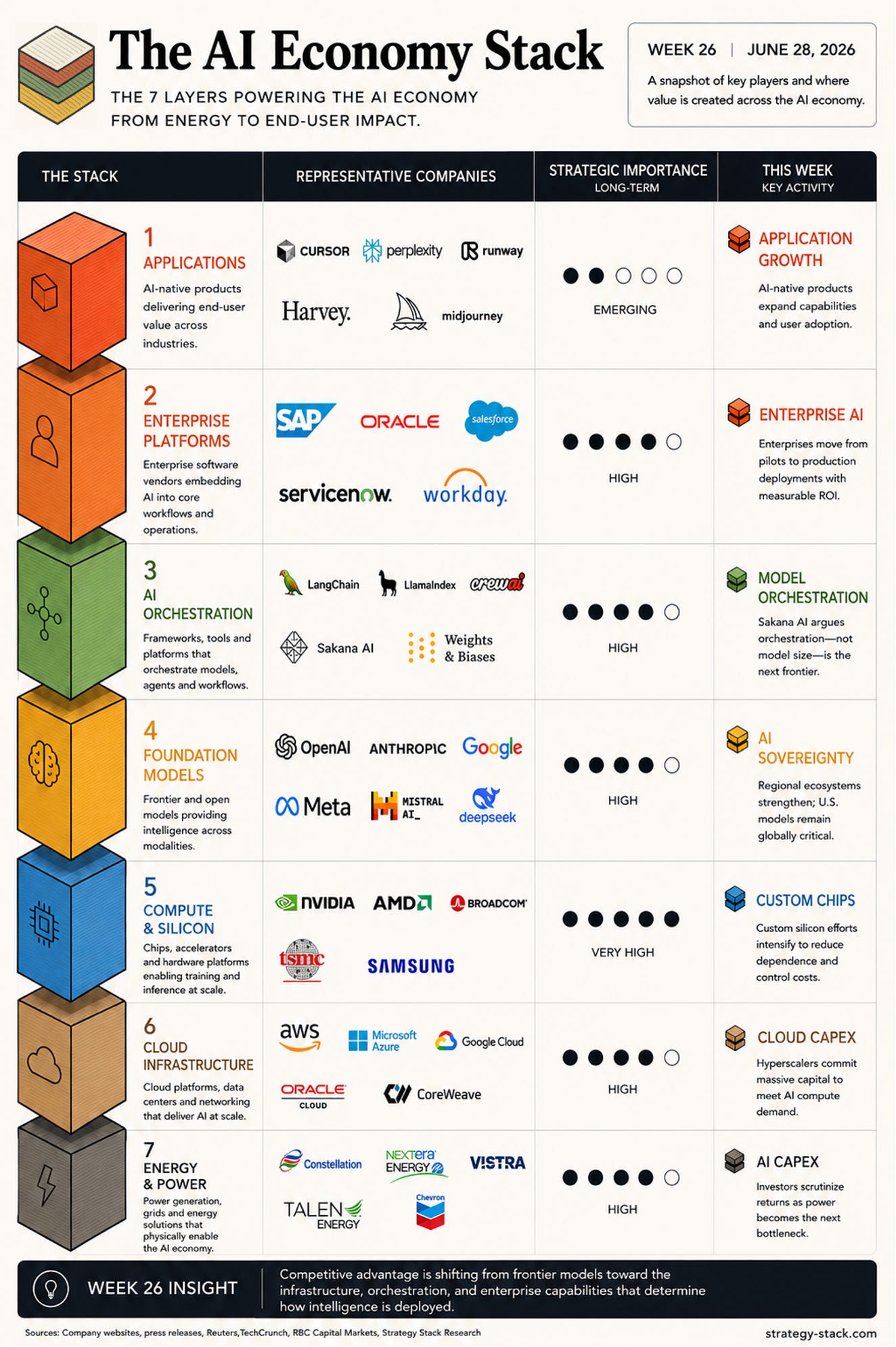
Quote of the Week
“Access to top models can disappear overnight. Collective intelligence is the practical hedge against this concentration of power.”
— David Ha, Co-founder & CEO, Sakana AI
Further Reading
📄 Research Paper
The Shift to Agentic AI: Evidence from Codex (OpenAI researchers, June 2026)
Why read it?
This week’s edition explored three major transitions: enterprise AI moving into production, the emergence of regional AI ecosystems, and the growing importance of AI infrastructure. This paper provides empirical evidence that organizations are simultaneously changing how work is performed.
Analyzing large-scale usage data from OpenAI’s Codex, the researchers show that agentic AI adoption is accelerating rapidly, users are delegating increasingly complex tasks, and organizations are restructuring workflows around autonomous AI systems rather than conversational assistants.
Why it matters: If this week’s stories explain where the AI industry is heading, this paper shows how organizations are already beginning to operate there.
📘 OECD Report
The Agentic AI Landscape and Its Conceptual Foundations
This report is probably one of the most important policy publications of 2026 because it establishes a shared vocabulary for “AI agents” and “agentic AI.” It distinguishes autonomous agents from broader agentic systems and explains why coordination, delegation, and multi-agent collaboration are becoming defining characteristics of next-generation AI.
This is ideal for executives who want a rigorous conceptual foundation rather than another product announcement.
📊 McKinsey
Building the Foundations for Agentic AI at Scale
McKinsey argues that the biggest obstacle to scaling agentic AI is no longer model quality but fragmented enterprise data, governance, and operating models. That aligns closely with your second signal on enterprise AI moving from pilots to production.

Hit subscribe to get it in your inbox. And if this spoke to you:
➡️ Forward this to a strategy peer who’s feeling the same shift. We’re building a smarter, tech-equipped strategy community—one layer at a time.
Let’s stack it up.
A. Pawlowski | The Strategy Stack