#151: A practical system for building a living market model—using AI to surface tensions, test assumptions, and turn fragmented signals into strategic clarity
By Alex Pawlowski
Published: 2026-03-30
URL: https://thestrategystack.substack.com/p/ai-market-research-tension-map
TL;DR
Market research is changing quickly.
Not because there is more data—but because it has become harder to know what actually matters.
AI has made it easier than ever to collect information, but much harder to turn that information into clear decisions.
This guide shows how to use AI for market research (full system) in a different way: not as a faster search engine, but as a system for identifying where a market is under tension and where real opportunities emerge.
The most useful shift is this:
Market research should now move beyond collecting facts. How? Think about where a market is under tension:
- where users want more than products deliver
- where pricing and value feel misaligned
- where incumbents are strong but unloved
- where friction is tolerated, but only because alternatives are worse
This article introduces two core ideas to turn raw information into structured market insight:
- The Tension Map — a way to read markets through contradictions, pressure points, and gaps
- The Three Research Modes — Discovery, Tension, and Decision
The practical workflow has 7 steps:
- Define the market question
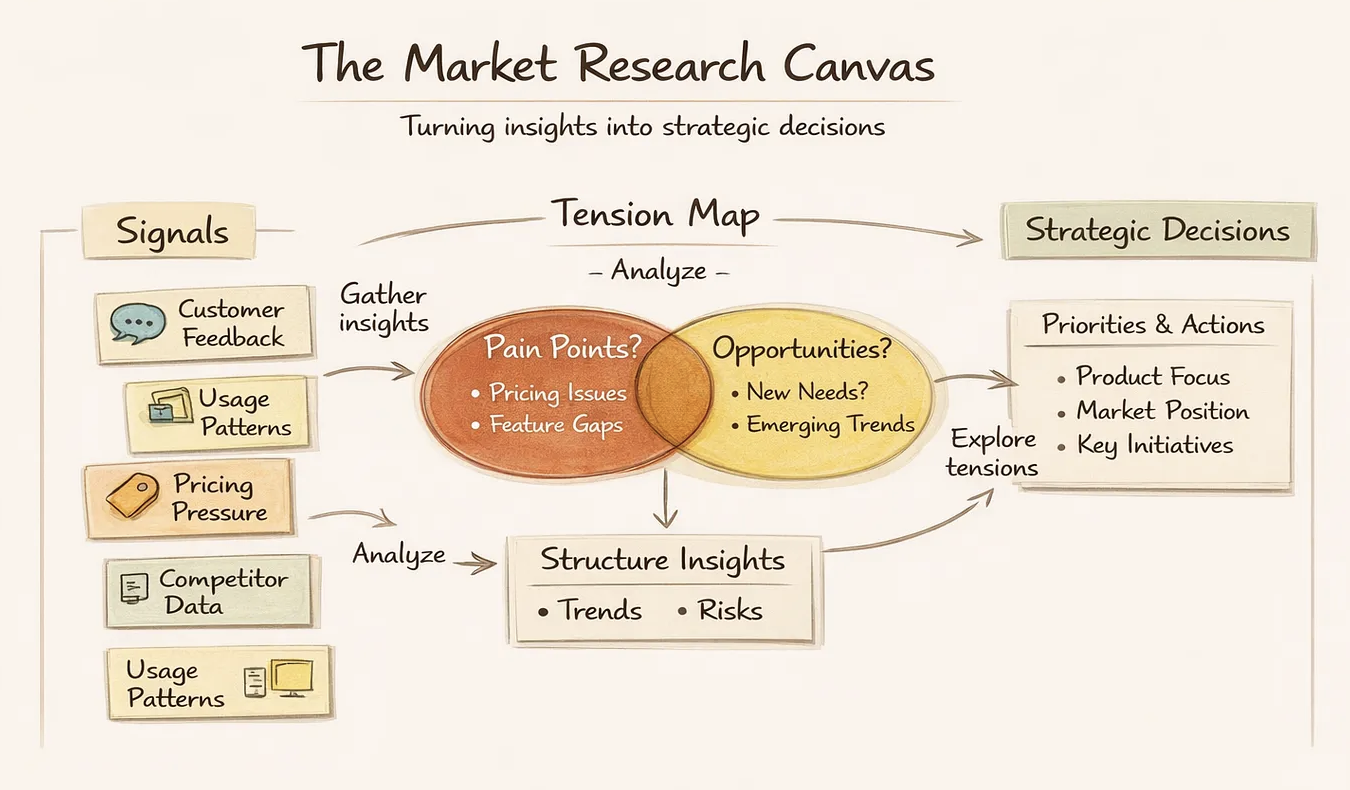
- Gather raw signals
- Build a Tension Map
- Use AI to structure the market
- Stress-test the interpretation
- Turn tensions into decisions
- Save the output as a living market model
Used well, AI changes who you become while doing it: someone who can update their view of a market and continuous market learning using AI before others have finished summarizing it.
Table of Contents
- Why Market Research Needs a New Model
- The First-Principles Shift
- The Tension Map
- The Three Research Modes
- The 7-Step AI Market Research Workflow
Step 1 — Define the Market Question
Step 2 — Gather Raw Signals
Step 3 — Build the Tension Map
Step 4 — Use AI to Structure the Market
Step 5 — Stress-Test the Interpretation
Step 6 — Turn Tensions into Strategic Decisions
Step 7 — Save the Output as a Living Market Model
- How to Actually Set This Up in 15 Minutes
- Which Tools to Use, and When
- How to Combine Claude, ChatGPT, Perplexity, and Multi-Agent Setups
- Common Mistakes
- Final Thought
1. Why Market Research Needs a New Model
Traditional market research still assumes a world in which the main difficulty is obtaining information.
That is no longer the real bottleneck.
Today the problem is different:
- there is too much information
- it is uneven in quality
- it changes quickly
- most of it matters only in relation to something else
The old model tends to produce reports that feel complete, but arrive late. They summarize what a market looked like at a given moment, not how it is moving or where it is becoming unstable.
That is why so much research feels “correct” and still fails to change decisions.
It describes reality after the fact.
What companies need now is not a static summary, but a way to maintain an updated view of the market while it is changing.
2. The First-Principles Shift
The most useful way to rethink market research is this:
You are not trying to collect enough information to eliminate uncertainty.
You are trying to build a living decision surface.
That means a model of the market that helps you answer questions such as:
- where is demand stronger than current supply?
- where does customer frustration exceed switching behavior?
- where are competitors overbuilt, under-loved, or mispriced?
- where is something stable enough to bet on, and where is it still too noisy?
This changes the job of research.
You are no longer producing a report. You are maintaining a working model of:
- what matters
- what is changing
- where the pressure points are
- which moves are becoming more attractive
This is where AI becomes genuinely valuable.
It helps you move from information accumulation to ongoing interpretation.
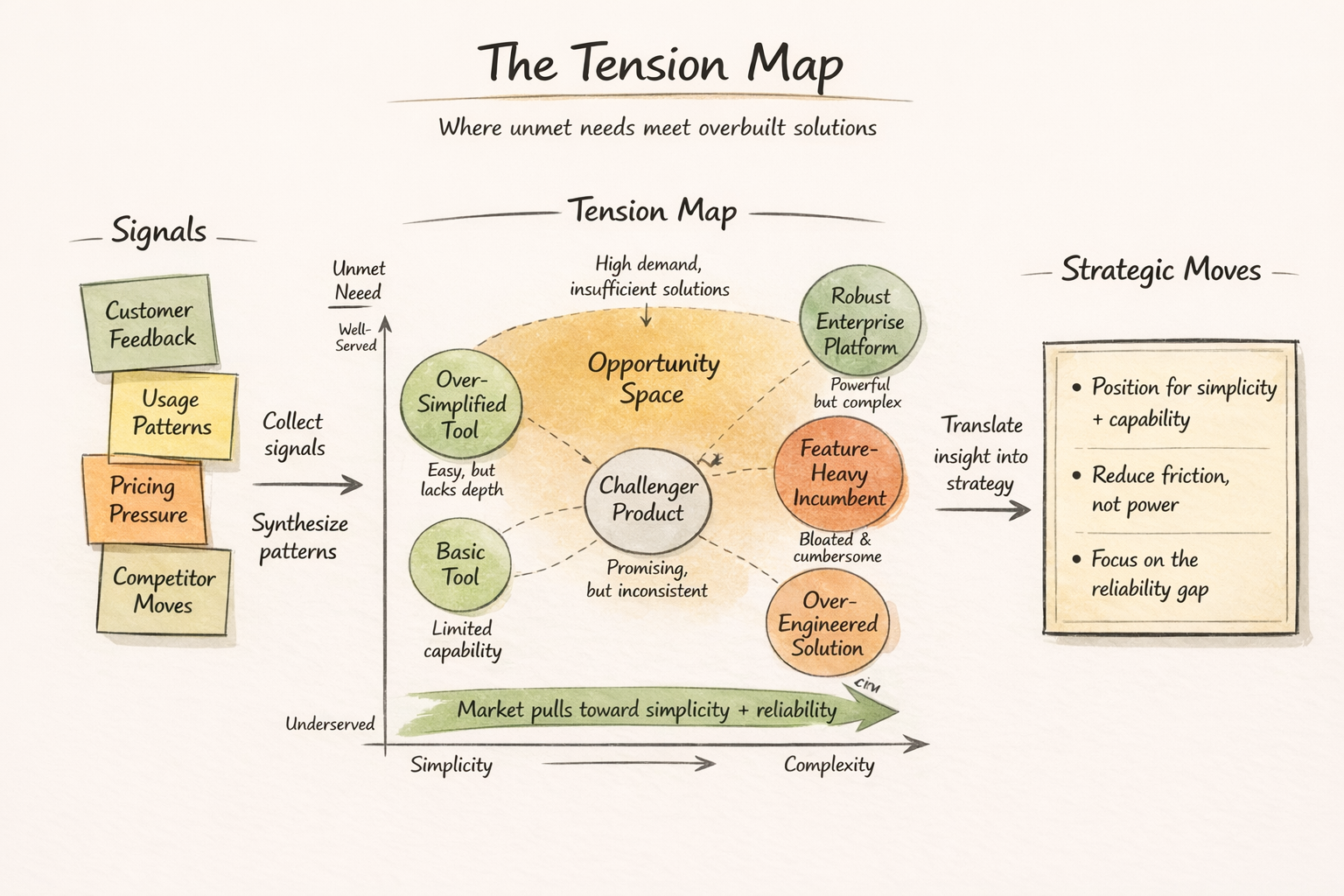
3. The Tension Map
This is the most important idea in the article.
A market is more than a set of companies, customers, and prices.
It is a field of tensions.
These tensions are where the most useful signal lives.
Examples:
- users want simplicity, but products keep adding complexity
- customers are willing to pay, but resent how value is packaged
- incumbents are powerful, but emotionally weak
- products are feature-rich, but outcomes arrive too late
- users stay because switching is painful, not because they are delighted
That is what I mean by a Tension Map.
You are looking for mismatches such as:
- expectation vs experience
- flexibility vs usability
- feature depth vs clarity
- willingness to pay vs trust
- adoption vs retention
Once you start seeing markets this way, research becomes sharper.
You are no longer asking: “What is happening in this market?”
You are asking: “Where is this market under strain, and what might that allow?”
That is a much better question.
This is the layer that connects intent, execution, and learning—the AI operating model →
4. The Three Research Modes
To make this usable, separate your research into three distinct modes.
Discovery Mode
Goal: understand what exists.
You ask:
- who are the players?
- how are they positioned?
- what are the visible patterns?
This is broad orientation.
Tension Mode
Goal: identify contradictions, pressure points, and weak spots.
You ask:
- where are users dissatisfied but still present?
- where is value obvious but hard to realize?
- where is the market over-serving one segment and under-serving another?
This is where most opportunity lives.
Decision Mode
Goal: turn interpretation into strategic movement.
You ask:
- what action becomes possible now?
- what segment looks more attractive?
- what product move becomes clearer?
- what should be tested next?
This is where research stops being interesting and starts becoming useful.
5. The 7-Step AI Market Research Workflow
Here is the full sequence.
- Define the market question
- Gather raw signals
- Build the Tension Map
- Use AI to structure the market
- Stress-test the interpretation
- Turn tensions into decisions
- Save the output as a living market model
The important thing is not memorizing the steps. It is learning to move through them repeatedly until the market starts to feel legible.
Step 1 — Define the Market Question
This is where most leverage sits.
A vague question produces broad, unhelpful output. A precise question introduces tension.
Weak questions:
- Analyze the market
- What are the trends?
- Who are the competitors?
Better questions:
- Where are users accepting poor trade-offs because no better alternative exists?
- Which competitors win on trust even when their product is weaker?
- Where does pricing feel tolerated rather than embraced?
- Which segments are being served indirectly rather than intentionally?
These questions are stronger because they imply a decision.
A practical rule: AI changes how markets are analyzed
A good market research question should make you slightly uncomfortable. It should point toward something that could actually change what you build, how you position, or where you focus.
Step 2 — Gather Raw Signals
Do not begin with polished summaries unless you have to.
Use:
- landing pages
- product pages
- pricing pages
- onboarding flows
- documentation
- customer reviews
- Reddit threads
- founder interviews
- support complaints
- changelogs
This is where the real signal sits.
For example, if you are researching AI note-taking tools, gather:
- 5 pricing pages
- 5 homepage narratives
- 30 user reviews
- 3 comparison threads
- onboarding screenshots
- one or two founder interviews
That is enough to see a surprising amount.
You want raw material because polished content has already filtered the contradictions out.
Step 3 — Build the Tension Map
Now move from collection to interpretation.
Create a simple grid and ask:
- Where is demand visible but satisfaction weak?
- Where is complexity tolerated but disliked?
- Where is there trust without excitement?
- Where is there excitement without retention?
- Where is pricing accepted but clearly misaligned with felt value?
Example: AI note-taking tools
You might discover:
- users love the promise of meeting automation
- they complain about post-meeting accuracy
- premium pricing is tolerated for teams, but individuals feel overcharged
- incumbent tools are trusted, but newer ones feel more exciting
- real dissatisfaction sits not at the feature level, but at the moment where summaries must become action
That is already much more useful than a standard competitor summary.
You are now seeing tensions.
Step 4 — Use AI to Structure the Market
This is where Claude, ChatGPT, and other tools become powerful.
The job here is not “tell me the answer.” The job is “help me impose structure.”
Example 1: Claude for long-context synthesis
Claude is especially useful when you have many long inputs:
- a full analyst report
- several product pages
- many user reviews
- documentation
- a long interview transcript
Use Claude when you want to preserve nuance across large context windows.
Prompt:
Here are product pages, pricing pages, and 30 user reviews for 5 AI note-taking tools. Build a market map with:
- positioning
- pricing logic
- user frustrations
- hidden tensions
- underserved segments
If you use Claude Projects, this gets even better. Put all recurring source material into a Project so Claude can reference a stable corpus instead of treating each prompt as an isolated event.
Example 2: ChatGPT for iterative refinement
ChatGPT is excellent when you want:
- repeated reframing
- sharper comparison
- scenario testing
- turning observations into frameworks
Prompt:
Map these tools along two axes:
- simplicity of user experience
- reliability of output
Then explain what strategic whitespace appears in the upper-left and lower-right corners.
Then follow up:
Now re-run the analysis from the perspective of a team lead buying for 50 employees instead of an individual user.
That is where the analysis becomes strategic.
Example 3: Perplexity for discovery
Perplexity is useful at the edge of the process:
- to find players you might have missed
- to quickly surface relevant sources
- to verify whether a pattern is isolated or broader
It is particularly strong early in Discovery Mode.
Prompt:
What are the most discussed AI note-taking tools in 2026 across reviews, comparisons, and forums?
Then move the raw material into Claude or ChatGPT for actual thinking.
Step 5 — Stress-Test the Interpretation
This is where weak analysis gets filtered out.
Once you have an interpretation, do not stop.
Push against it.
Ask the model:
- What assumptions in this analysis are weakest?
- Which conclusion would a skeptical competitor reject?
- What evidence would reverse this view?
- If we segmented by use case instead of company size, what changes?
This is where AI becomes more than a summarizer.
It becomes a pressure-testing environment.
You are rehearsing better judgment.
This is especially effective in ChatGPT or Claude if you explicitly ask the system to take on opposing perspectives.
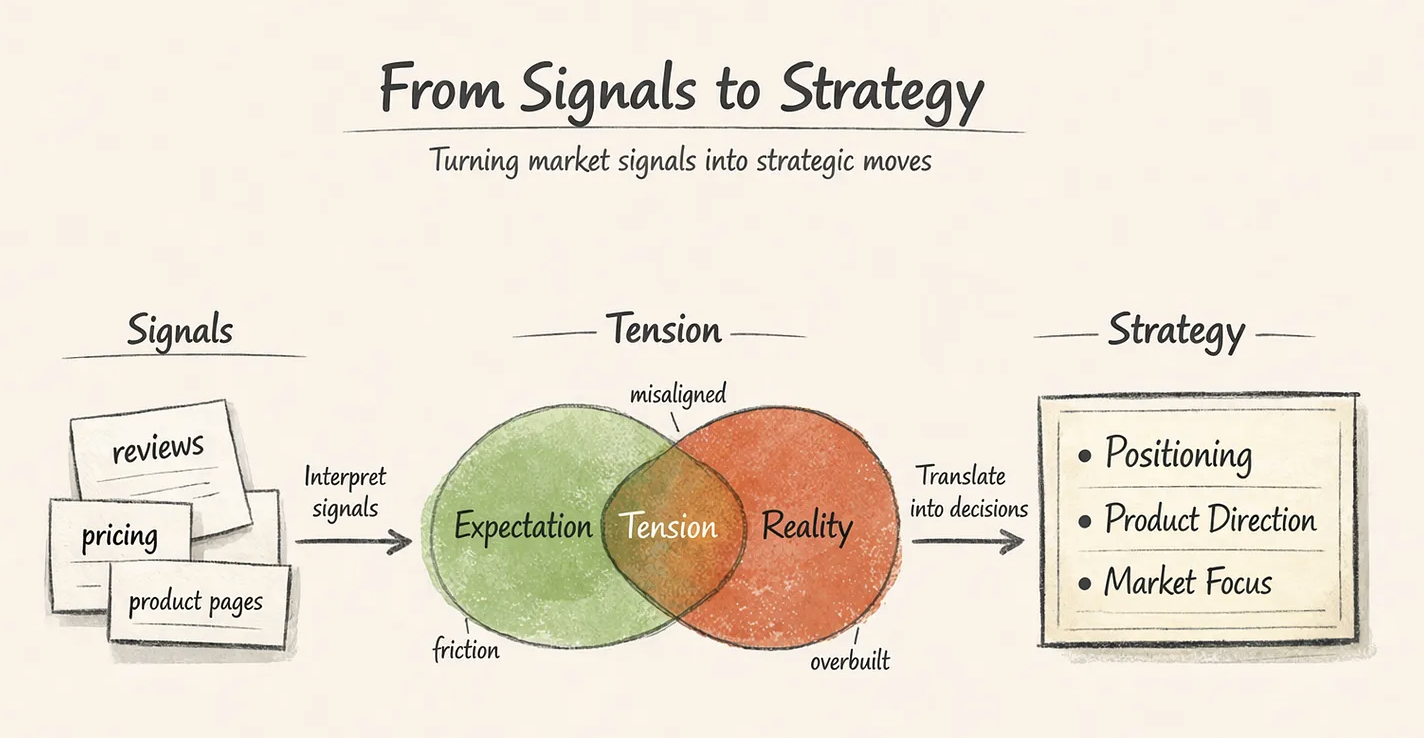
Step 6 — Turn Tensions into Strategic Decisions
This is where most people stop too early.
They gather insights, organize them well, and then never turn them into action.
A useful structure is:
Observation → Tension → Decision
Example:
Observation:Users praise AI note-taking products during trial, but complain later about summary reliability.
Tension: The market is over-optimizing for first impression and under-investing in dependable post-trial value.
Decision: There may be room for a product positioned around operational reliability rather than demo magic.
That is not just an insight. It is the beginning of a strategic move.
Step 7 — Save the Output as a Living Market Model
This is what makes the whole system compound.
Do not let each research cycle disappear into a one-off document.
Instead, save:
- your Tension Map
- segmentation ideas
- competitor positions
- recurring user complaints
- potential strategic implications
Over time, this becomes a living market model.
That model should be revisited and updated regularly.
This is where the compounding happens:
- your future research gets faster
- your comparisons get sharper
- your strategic intuition improves
At that point, you are no longer “doing research.”
You are maintaining an evolving understanding of the market.

6. How to Actually Set This Up in 15 Minutes
At this point, the system should make sense.
The only remaining question is how to actually run this in practice—without overcomplicating it.
You do not need a complex setup.
A simple configuration is enough to get started.
Step 1 — Create a working environment (Claude or ChatGPT)
If you use Claude:
- Open Claude
- Create a Project (top left → “New Project”)
- Name it something like:
→ Market Research — AI Note-Taking Tools
Then:
- Upload or paste:
- 3–5 competitor landing pages
- pricing pages
- a batch of user reviews
- any relevant notes
This becomes your persistent research context.
Claude will remember this across prompts.
If you use ChatGPT:
- Open a new chat
- Paste your materials in structured blocks
Optional (recommended):
- Use Custom Instructions to set behavior:
Example:
Always structure outputs into:
- patterns
- tensions
- implications
- decisions
This keeps outputs consistent.
Step 2 — Run your first Tension Map
In Claude or ChatGPT, paste:
Based on these materials, identify:
- where user expectations exceed product delivery
- where pricing feels misaligned with value
- where complexity is tolerated but disliked
- where trust exists without strong enthusiasm
Then summarize the main tensions in this market.
This is your first real insight moment.
Step 3 — Force structure (this is where it clicks)
Now refine:
Map these companies along:
- ease of use
- output reliability
Then identify:
- clusters
- outliers
- gaps in the market
You should now see the market, not just read about it.
Step 4 — Stress-test the output
Now challenge it:
What assumptions in this analysis are weakest?
What would a strong competitor disagree with?
What evidence would invalidate this view?
This step prevents shallow conclusions.
Step 5 — Turn it into decisions
Now push it one level further:
Based on these tensions, what product or positioning opportunities emerge?
What would a new entrant do differently?
This is where research becomes strategy.
Step 6 — (Optional) Use multi-agent mode
If your tool supports it (or you simulate it):
You can assign roles:
- Analyst → builds the map
- Critic → challenges assumptions
- Strategist → proposes moves
Prompt:
Act as three roles:
1. Market analyst
2. Skeptical competitor
3. Product strategist
Debate the strongest interpretation of this market and converge on the most actionable insight.
If done right using multi-agent market research workflows often produces much sharper conclusions.
Step 7 — Save your output
Do not leave the output in the chat.
Save:
- your Tension Map
- key patterns
- strategic options
Use:
- Notion
- a doc
- or Claude Projects
This becomes your living market model.
What this setup does
Once you’ve done this once, something changes.
You no longer approach markets as something to “research.”
You approach them as something to:
- scan
- structure
- pressure-test
- update
And that shift compounds quickly.
7. Which Tools to Use, and When
A simple rule is to match the tool to the kind of thinking you are doing.
Each tool is not just a capability. It creates a different mode of working.
Use Perplexity when you need to expand the surface area
Perplexity is best used at the edge of your knowledge.
It helps you:
- discover players you would not have considered
- quickly map unfamiliar terrain
- validate whether something is niche or widely discussed
This is exploration.
You are not looking for conclusions yet. You are trying to avoid blind spots.
A good use of Perplexity feels like:
- scanning widely
- opening new threads
- identifying what is worth deeper analysis
A weak use is treating it as a final answer.
Use Claude when you need depth and continuity
Claude is strongest when the problem requires holding a lot of context at once.
Use it when:
- you are working with many long documents
- nuance matters
- contradictions need to be preserved, not simplified
The key advantage of Claude is that it does not force early compression.
It allows patterns to emerge gradually across large inputs.
Strong usage looks like:
- uploading a full corpus into a Project
- asking for pattern extraction across sources
- identifying contradictions and clusters
Weak usage is asking for short summaries of already summarized material.
Use ChatGPT when you need speed, structure, and iteration
ChatGPT is best used once you already have material and initial insight.
It excels at:
- reframing problems
- generating alternative structures
- turning observations into models and decisions
This is where raw interpretation becomes usable.
Strong usage looks like:
- mapping markets along axes
- generating multiple segmentations
- turning tensions into strategic options
- testing different perspectives quickly
Weak usage is asking for generic explanations.
Use multi-agent setups when you need tension in your thinking
Most analysis fails because it becomes internally consistent too early.
Multi-agent setups introduce productive disagreement.
Use them when:
- the market is noisy
- you are at risk of overconfidence
- the decision has meaningful consequences
The goal is not consensus.
The goal is pressure.
Strong setups assign roles such as:
- analyst (builds the model)
- critic (attacks assumptions)
- strategist (extracts decisions)
The value comes from forcing your interpretation to survive challenge.
8. How to Combine Claude, ChatGPT, Perplexity, and Multi-Agent Setups
A strong research system moves from expansion to compression to pressure.
Phase 1 — Discovery (expand the surface)
Start with Perplexity.
You are trying to answer:
- what exists?
- what am I missing?
- what seems important?
Search for:
- competitors
- comparison threads
- reviews
- emerging tools
- adjacent categories
At this stage, speed matters more than precision.
You are building a rough map.
Phase 2 — Corpus creation (build your raw material)
Move from links to substance.
Take the best sources and bring them into Claude:
- landing pages
- pricing pages
- user reviews
- documentation
- transcripts
- reports
Put them into a Claude Project.
This matters.
Without a stable corpus, every prompt becomes shallow. With it, your analysis compounds.
Phase 3 — Tension extraction (find where the market is strained)
Now use Claude to work across the full material.
Ask for:
- recurring frustrations
- contradictions between promise and experience
- patterns across segments
- where value breaks down
This is where your Tension Map is formed.
You are not summarizing. You are detecting strain.
Phase 4 — Strategic structuring (make the market legible)
Move into ChatGPT.
Take Claude’s output and impose structure.
Ask it to:
- map competitors across key dimensions
- generate alternative segmentations
- identify clusters and gaps
- translate tensions into strategic options
This is where clarity emerges.
You move from “interesting observations” to “usable models.”
Phase 5 — Multi-agent challenge (stress-test your view)
Now challenge your interpretation.
Set up roles:
- Market Mapper → presents the current model
- Skeptic → attacks assumptions and weak points
- Strategist → proposes actions based on both
Ask them to:
- debate the strongest interpretation
- identify what would break it
- converge on the most actionable insight
This step is often skipped.
It is also where weak thinking gets exposed.
What this system does
Once you run this loop a few times, something changes.
You stop approaching markets as static objects to understand.
You start treating them as dynamic systems to read and update.
The tools matter.
But the real shift is this:
You are no longer trying to get the right answer.
You are building a process that makes your answers better over time.
9. Common Mistakes
The most common failures are subtle.
Using AI as a leverage layer for market analysis and as a shortcut often produces shallow certainty.
Starting with vague questions leads to outputs that sound polished but say very little.
Relying only on summaries removes the tension that makes markets interesting.
Skipping validation creates confidence without grounding.
And most importantly: insight that never becomes a decision has no real leverage.
10. Final Thought
The deepest shift is not that market research becomes faster.
It becomes closer to judgment.
You are no longer trying to produce a finished view of a market.
You are learning how to maintain one.
And once that happens, you stop treating research as a report.
You start treating it as an operating system for better decisions.
👉 Unlock the Strategy Stack
…and access the Business Model Series, advanced Cheat Sheets and various essays at the intersection of strategy and technology.
Hit subscribe to get it in your inbox. And if this spoke to you:
➡️ Forward this to a strategy peer who’s feeling the same shift. We’re building a smarter, tech-equipped strategy community—one layer at a time.
Let’s stack it up.
A. Pawlowski | The Strategy Stack