#146: Most teams ship features. The best teams compound learning.
By Alex Pawlowski
Published: 2026-02-14
URL: https://thestrategystack.substack.com/p/the-value-creation-loop-why-learning
Most teams are busy.
They ship every sprint. They hit roadmap milestones. They release more than ever.
And yet — progress feels slow.
Retention plateaus. Quality stalls. Market fit drifts.
The problem isn’t effort.
It’s that output has replaced learning as the goal.
The Hidden Failure Mode in Product Development
Shipping feels like progress.
Learning is progress.
But most teams confuse the two.
They measure velocity by features delivered instead of questions answered. They track opinions instead of behavior. They optimize plans instead of feedback.
As a result, products drift away from real user needs — even as activity increases.
That’s how teams work harder and get worse.
Why This Matters
Most teams ship.
Very few teams learn.
Without a tight feedback loop, decisions are driven by intuition, politics, or stale assumptions. Metrics become reports instead of signals. And progress slows despite increased output.
The Value Creation Loop turns product development into a compounding system.
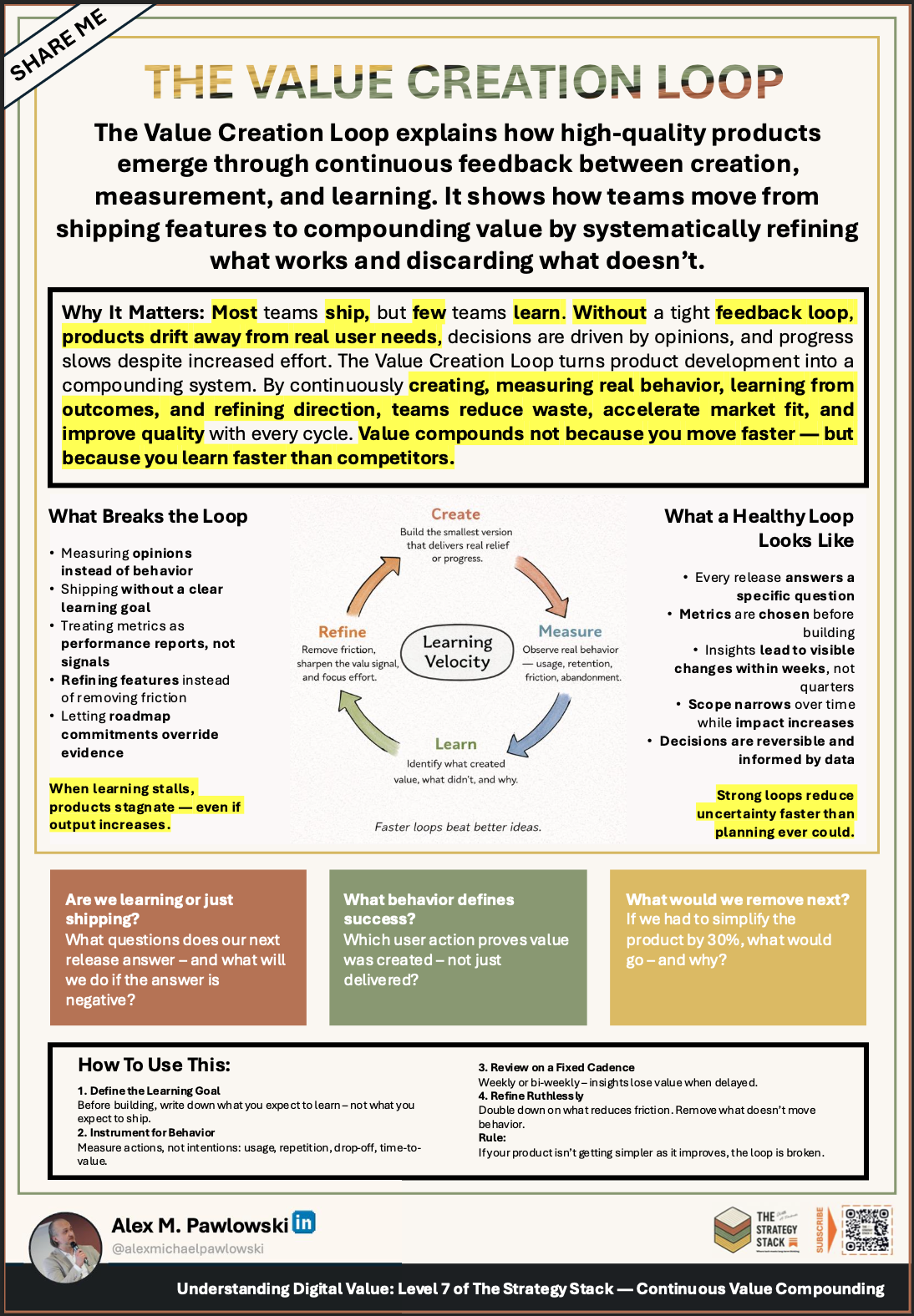
By continuously creating, measuring real behavior, learning compounds from outcomes, and refining direction, teams:
- Reduce waste
- Accelerate market fit
- Improve quality every cycle
Value compounds not because you move faster — but because you learn faster than competitors.
The Value Creation Loop Explained
High-quality products don’t emerge from inspiration.
They emerge from iteration.
The loop has four stages:
Create Build the smallest version that delivers real relief or progress.
Measure Observe actual behavior — usage, retention, friction, abandonment.
Learn Identify what created value, what didn’t, and why.
Refine Remove friction, sharpen the signal, and focus effort.
At the center isn’t speed.
It’s learning velocity.
What Breaks the Loop
Most loops don’t fail loudly.
They decay quietly.
Common failure modes include:
- Measuring opinions instead of behavior
- Shipping without a clear learning goal
- Treating metrics as performance reports, not signals
- Refining features instead of removing friction
- Letting roadmap commitments override evidence
When learning stalls, products stagnate — even if output increases.
What a Healthy Loop Looks Like
Strong loops behave differently:
- Every release answers a specific question
- Metrics are chosen before building
- Insights lead to visible changes within weeks, not quarters
- Scope narrows while impact increases
- Decisions are reversible and informed by data
Strong loops reduce uncertainty faster than planning ever could.
The Question Teams Rarely Ask
Before your next release, ask:
- Are we learning — or just shipping?
- What question does this release answer?
- What behavior will tell us if we’re wrong?
- What will we remove if the answer is negative?
If the answer is “we’ll figure it out later,” the loop is already broken.
How to Use This Framework
This cheat sheet is designed to restore learning as the primary output.
Use it like this:
1. Define the Learning Goal
Before you build, write down what you expect to learn — not what you plan to ship.
2. Instrument for Behavior
Measure actions, not intentions: usage, repetition, drop-off, time-to-value.
3. Review on a Fixed Cadence
Weekly or bi-weekly. Insights lose value when delayed.
4. Refine Ruthlessly
Double down on what reduces friction. Remove what doesn’t move behavior.
Rule: If your product isn’t getting simpler as it improves, the loop is broken.
The Real Insight
Great products aren’t built by teams with better ideas.
They’re built by teams with faster learning loops.
Teams that treat every release as an experiment. Every metric as a signal. Every cycle as a chance to remove waste.
That’s how quality compounds.
That’s how direction sharpens.
That’s how effort turns into advantage.
Why This Layer Exists in The Strategy Stack
Most strategy discussions focus on positioning, structure, or scale.
This layer focuses on how value actually emerges day to day.
Because without a functioning learning loop, every other layer degrades over time.
And with one, even imperfect ideas can become exceptional products.
👉 Unlock the Strategy Stack
…and access the Business Model Series, advanced Cheat Sheets, the S-Vault, and various essays at the intersection of strategy and technology.
Hit subscribe to get it in your inbox. And if this spoke to you:
➡️ Forward this to a strategy peer who’s feeling the same shift. We’re building a smarter, tech-equipped strategy community—one layer at a time.
Let’s stack it up.
A. Pawlowski | The Strategy Stack