#136: Compute is becoming the new choke point. Model choice is becoming the new operating advantage. And Davos made it official: power + connectivity now sit at the center of the AI cycle.
By Alex Pawlowski
Published: 2026-01-25
URL: https://thestrategystack.substack.com/p/signal-brief-january-25-2026
This week didn’t deliver a shiny new “AI breakthrough.” It exposed something more important: who can scale without stalling.
OpenAI is widening its AI compute capacity supply chain into 2028, Microsoft is normalizing a multi-model AI stack inside its own engineering orgs, and Davos made the subtext explicit: AI advantage now runs through power, capacity, and deployment speed.
In 2026, you don’t win by being smartest. You win by shipping under constraint.
The week in one sentence
AI is starting to look less like software and more like infrastructure: supply chains, utilities, procurement contracts, and geopolitical exposure determine who scales.
1) OpenAI’s Cerebras compute deal — not bigger models, faster reality
This week OpenAI made a very specific bet: speed wins markets.
 \Source: reuters.com\
According to reporting, OpenAI struck a multi-year, multi-billion-dollar agreement with Cerebras to add ~750MW of AI compute into its inference-as-a-service stack, rolling out in phases through 2028.
This matters because it’s not framed like a training arms race. It’s framed like a latency, throughput, and inference capacity war.
OpenAI’s Sachin Katti described the logic clearly: OpenAI wants a “resilient portfolio” where the right systems match the right workloads — and Cerebras adds dedicated low-latency inference to make responses faster, more natural, and scalable in real time.
Cerebras’ pitch is equally direct: it’s not another GPU farm — it’s wafer-scale architecture designed to remove the bottlenecks that slow conventional inference. OpenAI and Cerebras have worked together since 2017, and more recently Cerebras supported OpenAI’s GPT-OSS-120B at 3,045 tokens/second, a figure positioned as ~15× faster than leading GPU cloud setups.
And OpenAI isn’t hiding the intent: Greg Brockman framed the partnership as a path for ChatGPT to become not just the most capable, but the fastest AI platform.
So why does this deal matter strategically?
First: it’s an inference expansion, not an R&D flex. This is about what happens after the demo — when usage spikes, traffic grows, and real-world product demand stops caring about benchmark charts.
Second: OpenAI is quietly breaking the GPU dependency narrative. Nvidia remains dominant, but this move adds real leverage: new capacity pools, new architecture options, and more bargaining power on pricing and delivery timelines.
Third: the deal makes AI feel more like broadband than software. Cerebras’ CEO Andrew Feldman used the analogy directly: real-time inference changes what can be built. Once response speed moves toward “instant,” entire product categories shift from asking AI to living inside AI.
This is what AI looks like when it turns into infrastructure: inference workloads, data center power limits, and supply-chain math.
Bottom line: OpenAI is buying the right to scale real-time AI without choking on latency — and positioning speed itself as a competitive moat.
Source: https://www.reuters.com/technology/openai-buy-compute-capacity-startup-cerebras-around-10-billion-wsj-reports-2026-01-14/?utm\_source=chatgpt.com
Source: https://www.forbes.com/sites/karlfreund/2026/01/15/cerebras-ai-lands-a-whale-as-it-prepares-to-go-public/?utm\_source=chatgpt.com
2) Microsoft’s internal multi-model drift (Claude Code inside the stack)
Microsoft sells GitHub Copilot to the world — but inside the company, the default behavior is shifting.
 \Source: theverge.com\
According to The Verge (Tom Warren), Microsoft is now encouraging thousands of employees to adopt Anthropic’s Claude Code, not just in developer teams, but across major orgs — including people who don’t traditionally code.
The scope is the tell. Claude Code has moved beyond developer circles into Microsoft’s CoreAI org (led by Jay Parikh) and into Experiences + Devices — the org behind Windows, Microsoft 365, Teams, Outlook, Edge, Bing, and Surface. Even non-technical roles are being pushed to prototype with it, and engineers are expected to run Claude Code alongside GitHub Copilot and report back on performance.
That’s not a casual experiment. That’s organizational intent.
The interesting part isn’t “Microsoft likes Claude.” It’s the operating logic underneath:
Internally, model choice is starting to behave like an operating lever: speed per task, cost per workflow, reliability per team. And once Microsoft normalizes that behavior at scale, the competitive edge shifts away from vendor loyalty and toward orchestration — routing the right model into the right workflow fast enough that the org compounds.
The deeper shift is strategic: multi-model isn’t a philosophy anymore — it’s procurement reality. When an organization the size of Microsoft normalizes multiple model paths internally, it effectively admits that the competitive edge will come from routing + orchestration, not from betting the company on one brain.
Bottom line: the next platform advantage is having the ability to swap models fast and steer them into the right workflows, and optimize for outcomes under real constraints: cost, latency, reliability, and speed of shipping.

3) Davos / World Economic Forum — the tech signals that mattered (and why leaders should care)
Davos 2026 didn’t feel like a conference about “AI possibilities.” It felt like a conference about constraint management: power, supply chains, sovereignty, cyber fragility, and the institutional capacity required to deploy advanced systems without breaking societies in the process.
The official theme was “A Spirit of Dialogue” — but the subtext was sharper: the old order isn’t returning, and technology is now one of the main arenas where that rupture becomes visible.
3.1 Energy / grid (Birol)
One of the most telling moments came from Fatih Birol (Executive Director, International Energy Agency), who framed the current environment bluntly:
Energy security is no longer a secondary policy issue — it’s becoming part of national security.
This wasn’t abstract Davos talk. It fits the reality on the ground: the more AI expands, the more it behaves like heavy industry. Compute is not software. It is electricity + permitting + construction timelines + grid reliability.
AI deployment at scale is now limited by electricity, permitting, and grid reliability — not ideas.
Bottom line: energy is becoming the first hard ceiling on AI scale — leaders who treat power access like a strategic asset (not an ops detail) will simply be able to ship more than everyone else.
3.2 Human capacity erosion (Haidt / Kennedy)
A surprisingly strong thread at Davos was not “AI will take jobs” — it was the fear that AI will quietly weaken the mental and emotional scaffolding that makes societies functional.
Two interventions landed hard:
- Jonathan Haidt (author, The Anxious Generation) warned that we’ve already allowed companies to “hack attention,” and the next frontier is deeper: attachment and emotional development.
- Becky Kennedy (CEO & Founder, Good Inside) made the case that human growth requires friction — and if AI removes too much struggle too early, we risk raising people who never develop the cognitive tools to deal with uncertainty.
This wasn’t moral panic — it was a strategy warning: automation without human strengthening creates brittle systems.
Bottom line: the next competitive advantage isn’t just adopting AI fast — it’s adopting it in ways that preserve human judgment, creativity, and resilience instead of hollowing them out.
3.3 Jobs impact (Georgieva)
Kristalina Georgieva (Managing Director, IMF) delivered one of the cleanest “numbers that changes posture” lines:
- ~40% of jobs globally will be impacted by AI in the next couple of years
- ~60% in advanced economies
- Even the IMF has already reduced internal translator roles dramatically (a real example of transformation, not theory)
This matters because it reframes AI from “productivity upside” to structural reallocation pressure.
Bottom line: if you’re leading strategy and you don’t have a workforce redesign story (skills, workflows, transition capacity), you don’t have an AI strategy — you have a future reorg you haven’t written yet.
3.4 Multi-model / operating stance (Nadella / Sweet)
One of the quiet but important Davos signals is that the largest players are behaving as if model monopoly is unlikely.
You could hear it indirectly through the way tech leaders spoke:
- Satya Nadella (Microsoft) emphasized usefulness and outcomes — not model worship.
- Julie Sweet (Accenture) captured the operational stance with a line that spread fast in Davos circles:
“It’s human in the lead, not human in the loop.”
That sentence signals an adoption model where AI isn’t a chatbot bolted onto work — it becomes part of the operating system of execution, with humans steering direction and accountability.
Bottom line: enterprise advantage won’t come from picking “the best model.” It comes from building multi-model operating capacity: routing, evaluation, governance, observability, cost control, and switching agility.
3.5 Geopolitics / fragmentation
Davos 2026 was packed with power statements, but what mattered strategically was the underlying implication:
Fragmentation is accelerating — and tech infrastructure is one of the first places it becomes tangible.
Notable signals:
- Donald Trump framed energy, trade, and growth as core Western priorities — and the U.S.–Europe relationship felt visibly strained in the background.
- Gita Gopinath (Harvard, former IMF First Deputy MD) described the trust rupture between the U.S. and Europe as deeply consequential.
- Ursula von der Leyen (EU Commission President) pushed “strategic autonomy” language openly — not as aspiration but as direction.
Once you translate this into technology terms, it becomes obvious what’s happening:
- data centers become geopolitics
- cloud becomes sovereignty
- chips become foreign policy
- infrastructure becomes leverage
Bottom line: the firms that scale AI fastest won’t just win on product — they’ll win on jurisdictional positioning (power availability + regulatory stability + supply resilience).
The Davos tech takeaway
Davos 2026 made one thing clear: the AI era is no longer defined by who can invent intelligence — it’s defined by who can operate intelligence at scale without running into power ceilings, governance failure, security fragility, or social backlash.
Source: https://www.weforum.org/stories/2026/01/4-takeaways-from-davos-2026/
4) Davos: Jensen Huang’s “five-layer cake” — the real AI stack leaders have to build
One of the most useful “tell” signals at Davos this year came from Jensen Huang — not because he hyped a new model, but because he framed AI the way industrial leaders actually understand it: as infrastructure.
 \Source: blogs.nvidia.com\
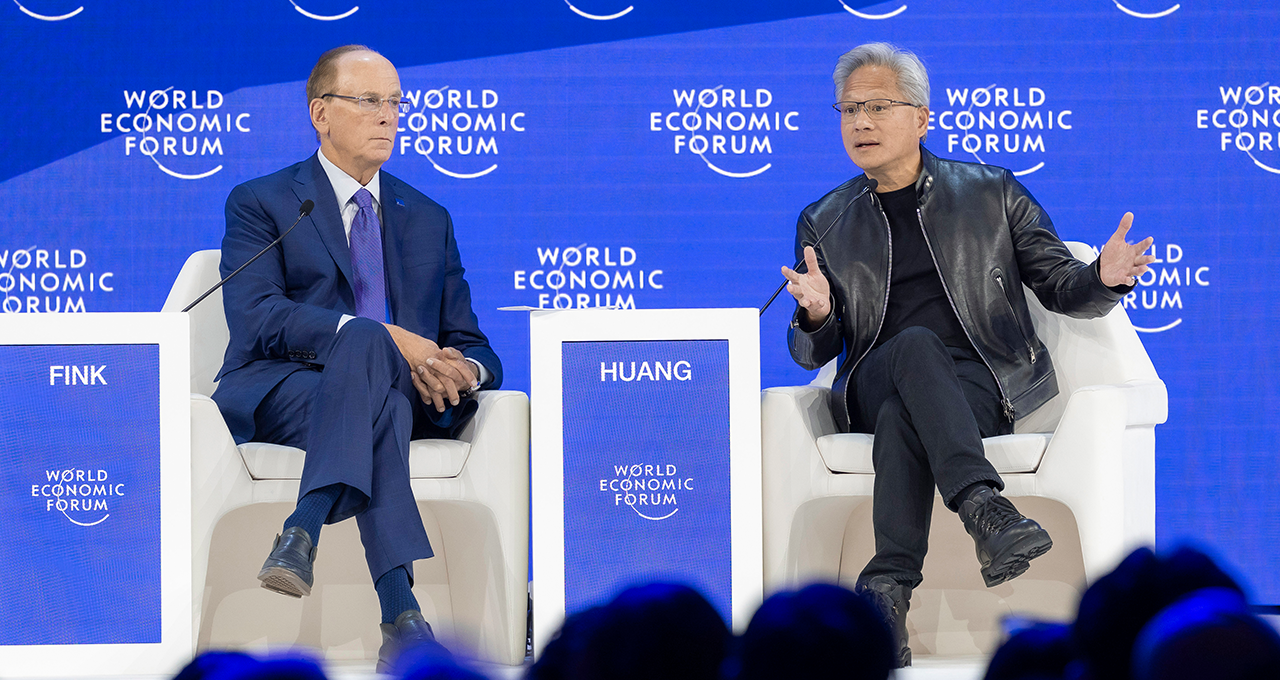
On the World Economic Forum mainstage in Davos, NVIDIA CEO Jensen Huang described AI as the foundation of what he called “the largest infrastructure buildout in human history.” In conversation with BlackRock CEO Larry Fink, he broke the AI wave into a five-layer stack — essentially a “cake” where every layer has to exist before the next one matters.
Taken together, OpenAI’s Cerebras move and Microsoft’s multi-model behavior make sense: they’re responses to the same stack Huang is describing — the real constraint isn’t intelligence, it’s infrastructure.
1) Energy (the base layer) AI starts with electricity. Not in metaphorical terms — in grid terms. If power generation, transmission, and permitting don’t scale, everything above hits a ceiling. This is why AI is starting to behave like a national security and industrial policy topic, not an IT procurement question.
Bottom line: power availability is becoming strategy, not operations.
2) Chips + compute infrastructure This is the hardware substrate: advanced accelerators, memory, bandwidth, networking — the machinery that turns models into throughput. The important point isn’t “GPUs are valuable.” It’s that chip production capacity, supply chains, and access terms increasingly determine who can move fastest.
Bottom line: whoever controls compute supply controls the pace of deployment.
3) Cloud data centers (the physical buildout layer) Huang’s framing makes the construction boom legible: the cloud isn’t “digital.” It’s steel, cooling, electricians, networks, land, permits, and long lead times. AI is turning data centers into the factories of the next economy — and pulling skilled labor demand with it.
Bottom line: AI scale is constrained by physical buildout speed, not just software speed.
4) Models (the intelligence layer) Only once the energy + compute + data center layers are in place does the model layer become the differentiator. Huang made a subtle but important implication here: models are powerful, but they don’t “stand alone.” Their real value is unlocked only when the industrial stack underneath them is secured.
Bottom line: model capability is downstream of infrastructure readiness.
5) Applications (where the economic benefit shows up) Huang was explicit that the real payoff happens at the top: applications in healthcare, manufacturing, finance, education — the layer where AI stops being “technology” and becomes productivity, margin expansion, and advantage.
Bottom line: the winners won’t be the best model builders — they’ll be the best deployers.
Huang also pushed one of the clearest positioning statements of the week: AI should be treated as national infrastructure — like roads or electricity — and every country should build capabilities aligned with its language, culture, and economy.
That’s not just narrative. It’s a blueprint for how leaders will justify capital, policy, and supply-chain decisions in 2026.
Bottom line: the AI race is becoming less about “who invents the smartest thing,” and more about who can build and operate the full stack without breaking.
Source: https://blogs.nvidia.com/blog/davos-wef-blackrock-ceo-larry-fink-jensen-huang/?utm\_source=chatgpt.com
Key takeaways
- Compute is being locked in multi-year blocks, signaling that capacity is now a strategic asset, not a variable input.
- Multi-model behavior is spreading because cost/performance/reliability trade-offs are too real to ignore.
- Davos placed power and connectivity at the center of the AI narrative, which is another way of saying: AI is becoming physical.
- Cyber resilience is becoming an adoption constraint, not a compliance afterthought.
If you’re leading strategy in 2026, the job is no longer “pick the best model.” It’s build the operating system that can deploy AI repeatedly under real constraints — power, cost, latency, security, and supply.
Hit subscribe to get it in your inbox. And if this spoke to you:
➡️ Forward this to a strategy peer who’s feeling the same shift. We’re building a smarter, tech-equipped strategy community—one layer at a time.
Let’s stack it up.
A. Pawlowski | The Strategy Stack