It runs on Pangram, whose own documents give two answers, four times apart, for how often it calls a human a machine.
By Dr Sam Illingworth
Published: 2026-10-30
URL: https://theslowai.substack.com/p/substack-ai-score-character-count
Since July, anyone reading your Substack has been able to run a check on your writing and get a percentage back. A number beside your name, produced by a stranger, about something you may have spent a fortnight on. Here is how Substack describes it:
“Scan for AI text estimates whether text was written by a human or AI-assisted. It works on posts and notes published on or after July 21, 2026, and uses Pangram to assign a percentage of how much of the text is human-written or AI-assisted.”
Anyone reading in the Substack Reader or the iOS app can run it on a post, a note, a comment, or a reply.
I have spoken to a lot of Substackers about this, and most of us read that percentage the same way: 40% means four words in ten came from a machine. It does not, and it never has, and the company behind the number says so in its own documents. I know because I have read them: two model cards, a technical report, and the pages where Pangram reports other people’s tests of its work. What follows is what they say, with every sum shown so you can check for yourself.
What the percentage actually measures
I ran it on my own post from Wednesday. The verdict came back as “Fully AI-assisted text”.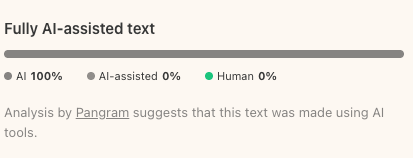
The heading calls the post fully AI-assisted. The AI-assisted figure on the line underneath it is zero. When I see this score, I read it as if my entire post was written by AI via a one-shot prompt.
Reader, my post was not one-shotted by AI.
Unfortunately, Substack’s help page does not say how any of the three numbers are worked out.
To find out what the figures are, you have to go and read the Pangram documentation. There are two model cards to consider. Pangram 4.1 is the current one, published on 19 October, and it notes “No change from Pangram 4” with regards to model training or inference. This sends you to the July card for Pangram 4.0, which makes clear that the model returns three figures, one each for ‘human’, ‘AI-assisted’, and ‘AI-generated’. The card notes that these outputs are:
“The character-weighted fraction of the analyzed document assigned to each provenance class. These values are between 0.0 and 1.0 and sum to 1.0.”
The technical report then explains that:
Document fractions are computed by character length:
In plain terms, the model reads your post, cuts it into stretches, marks each stretch human, AI-assisted, or AI-generated, and then measures how long the stretches are. Mark 600 characters of a 4,000-character post and that is 15% (600 divided by 4,000 multiplied by 100). The percentage measures length. It says nothing about how sure the model is.
The technical report also defines all three labels:
-
human means that the text was solely authored by humans, or that the amount of AI contribution is so low as to be negligible (e.g., light copyediting, literal translation, spelling and grammar fixes).
-
AI-Assisted means that the text is co-authored and homogeneously mixed. Although this label is nebulous for a single token, a segment of consecutive tokens with the AI-Assisted label indicates genuine co-authorship between humans and AI.
-
AI-Generated means that the text is solely authored by AI, or that the text is significantly more AI-authored than human-authored
The model learned that boundary by being trained on human pieces that had been put through a machine editor, and it went through them clause by clause.
Pangram explains how in section 3.5 of their technical report, and the method is a sensible one. Nobody had a pile of real part-written text with the human and machine parts already marked, so they built one. Starting with documents confirmed to be human, they ran a machine editor over each. Now there is a before and an after, and it is known exactly what changed.
All of this is still the training stage, done on Pangram’s own before-and-after pairs. Each edited version is cut into clauses, which the report defines as “a group of words that contains a subject and a verb”, using Claude Haiku 4.5 to do the cutting. For each clause in the edited version, the tool then finds the closest passage in the human original it came from, and asks three questions in order:
-
Does the wording still match the original? Then the words are the writer’s own, and the clause is labelled ‘human’.
-
Does the wording differ while the meaning survives? Then the idea is the writer’s and the sentence is the machine’s, and the clause is labelled ‘AI-assisted’.
-
Does neither match? Then the machine wrote that clause from nothing, and it is labelled ‘AI-generated’.
Every word inherits the label of the clause it sits in. That is how the training examples got their answers, but your post never goes through any of it. This is because there is no ‘original’ to compare against. It works from your words alone.
Instead, your post gets split into a series of overlapping windows of 512 tokens, roughly 100 words, each overlapping the one before by half, with each window read twice so that every word is seen in the context of the whole. For every word the model produces three scores, one for human, one for AI-assisted, and one for AI-generated. For each window it also produces an overall estimate on a fifteen-point scale running from entirely human to entirely machine. Words that fall in more than one window have their scores averaged. A final pass then assigns every word one of the three labels.
So the number on your post is a recognition rather than a comparison. In training, a clause was counted as human when its wording had survived a real edit, and the model learned what that looks like. On your post it is answering a different question. It cannot know whether your wording survived anything. It is inferring, from your finished text alone, what that comparison would have shown.
How often it gets things wrong
A false positive is the tool saying a machine was involved when a person wrote the thing unaided.
Pangram publishes several figures for this.
The Pangram 4.0 card, in July, gave 41 false positives in a million English pages from the open web; this is 1 in 24,390. Then the Pangram 4.1 card arrived. It measures the new model on 781,981 pages, having excluded
“pages that are not natural-language writing, such as spam, advertising and machine-generated listings”,
and reports 70 false positives, or 1 in 11,171. The headline for the current model is now more than twice as bad.
The Pangram 4.1 card also scores the old model on the new set of data. It gives Pangram 4.0 128 false positives, or 1 in 6,109. As noted above, Pangram 4.0’s own card had previously said 1 in 24,390.
Those two numbers describe the same model, so whatever changed, it was not the model. In any case, the published error rate for one model moves by a factor of four depending on which pages you happen to feed it.
Which version of Pangram is running on your posts, I cannot tell you. Substack’s help page names no version, and it was last updated before Pangram 4.1 shipped.
Go back to the Pangram 4.0 card. It tests eleven kinds of writing, and the figures vary wildly. Creative writing and speeches come back with 0 false positives out of 10,495 texts. Academic writing is given as 0.019%, which is 1 in 5,263 (divide 100 by 0.019) out of 62,971 texts. Poetry is 0.078%, or 1 in 1,282, across 12,769 texts. That is almost 20 times higher than the card’s overall false positive rate of 1 in 24,390.
The Pangram 4.1 card gives one global rate and no breakdown by kind of writing at all. So everything anybody knows about how this varies by genre comes from the old model, and none of it has been recalculated.
I write poetry, so this one matters to me. The Pangram 4.0 card gives poetry as 0.078% of 12,769 poems, which is about ten mistakes in that selection.
Ten is a small count, and a small count carries a wide margin. That margin has a name. A confidence interval is the band of true values that could still have produced the result you actually saw, and the fewer mistakes you have counted, the wider it gets.
Put 10 flagged poems out of 12,769 into an exact binomial confidence interval and it returns a range of 0.0376% to 0.1440%. Divide 100 by each end, the same sum as before, and that is 1 in 2,662 at the good end and 1 in 694 at the bad end.
So the real version of the poetry figure is a rate somewhere between 1 in 2,662 and 1 in 694. The 1 in 1,282 printed on the card is a value somewhere in the middle of that band rather than the final answer.
Let’s take the bad end of it and work the sum through.
Risk stacks. One poem carries a 1 in 694 chance of coming back wrongly marked, so 50 poems carry roughly 50 times that. Fifty divided by 694 is about 7%. So a poet publishing 50 poems a year runs about a 7% chance of being wrongly marked at some point in the year, and at that rate it happens to them about once every fourteen years.
A writers’ group putting out 100 a year between them is at 14%, or about once every seven years. Somebody who writes four poems a year is at 0.6%, or about once every 175 years, which is another way of saying the risk falls almost entirely on the people who write the most.
Do you know someone that is worried about AI detection on Substack? Send them this article.
Why zero mistakes does not mean no mistakes
Say you test a thousand pieces of human writing and the tool gets none of them wrong. You have not shown it never errs. You have shown that whatever the true rate is, it is small enough to hide in a thousand pieces. The range of rates still consistent with what you saw is the confidence interval, and the fewer you tested, the wider that range.
The detectors of a few years ago were measurably biased against people writing in English as a second language, which is the Stanford finding everyone cites. It ran on 91 Test of English as a Foreign Language (TOEFL) essays. Pangram 4.0 runs those same essays and gets none of them wrong. Strangely, its model card counts 91 of them, but its technical report counts 89.
Yet zero false positives in this sample size do not mean that the detector is infallible. This is because of what statisticians call the rule of three: when you see no failures in a sample, the worst rate still consistent with that result is about three divided by the number you tested. Three divided by 89 (or 91) is about 1 in 30. So a clean sweep of 89 essays is also consistent with a tool that gets one piece in 30 wrong.
The bigger test sits in the technical report rather than the model card. Table 9 puts those 89 essays inside four collections of second-language writing totalling 24,586 documents, with one false positive between them, which is big enough to put the worst case at about 1 in 4,400.
What narrows that range is the number of mistakes you see, and about thirty of them is where an estimate starts to settle. At the rate the Pangram 4.1 card publishes, 1 in 11,171, thirty mistakes means feeding in thirty times 11,171 documents, about 335,000 pieces of writing you are certain a person produced unaided. The largest independent collection this tool has been run against holds 7,968 human documents, a figure I take from Table 19 of the technical report, which scores Pangram 4.0.
This means that the independent check of this tool is more than forty times too small to measure the thing it is checking.
What that works out to across Substack
Substack’s own site says the platform carries five million paid subscriptions, and trade reporting through 2026 has put the number of publications earning money at about 100,000.
Take only those 100,000, ignore every publication that earns nothing, and assume each of them posts once a week. Detection reaches back to everything published on or after 21 July, which is around fourteen weeks ago. A hundred thousand publishers posting weekly for fourteen weeks is 1.4 million posts. Call it a million, so that every figure below is an understatement.
So at the rate the current card publishes, 1 in 11,171, about 90 of those paying writers have already had a piece wrongly marked as machine-written. At Pangram 4.0’s rate of 1 in 24,390 it is closer to 40. At 1 in 6,109, which is what the current card says the Pangram 4.0 model was actually doing, it is 164. Three answers to the same question, from two documents by the same company.
Whatever the true figure, every one of these false positives is a person whose income sits on a platform’s opinion of whether they are a fraud. And these are just the statistics for the publications that charge.
My book goes underneath all of this. Slow AI is about the question this post is a corner of: knowing when to use these tools, and when to leave them alone. It was a #1 Amazon bestseller in Education.
The sentence I got wrong
In August I said this on NPR, on the record:
“Anyone who's learned any other language as a second language, you learn it to be much more structured than somebody who is a native speaker. So this means that AI-detection software is biased against non-native English speakers. It's also the case for people who identify as being neurodiverse.”
Having now read in detail what Pangram publishes, I cannot support that sentence as I said it, about this tool. As outlined above, Table 9 of Pangram’s technical report tests four collections of writing by people using English as a second language, 24,586 documents in all, and reports one false positive in the lot.
The Stanford set everyone cites sits inside that table as 89 essays, with none wrong. One mistake in 24,586 is consistent with a true rate no worse than about 1 in 4,400, and that is better evidence than I expected to find.
The documented bias for non-native English speakers belongs to the 2023 generation of detectors, and the study that documented it ran on 91 essays. Pangram’s second-language evidence is now 270 times that size and points the other way. On neurodiverse writers there is nothing in either direction, because nobody has gone looking. So I was wrong about this tool on second-language writing, and the neurodiversity half is still unanswered.
Who gets to train on your writing
Substack holds years of long-form writing with author identity, timestamps, and archives from before late 2022, when the supply of certainly-human text stopped growing. Running a detector across a library like that does two things. It tells readers something about each post, and it labels the library: human here, assisted there, machine over there. Labelled text of that kind is the raw material for building better detectors.
To their credit, Pangram addresses this directly, and in bold, in the technical report:
“Pangram 4 is not trained on user-submitted data, customer data from API users, or data obtained by unauthorized Internet crawls.”
They add that every dataset used is
“either openly licensed for commercial use or their rights are owned by the company”,
and the report breaks the training material down by category. It names no source and gives no volume.
Substack answers part of it too, in a single sentence:
“Neither Substack nor Pangram uses publisher content to train generative AI models.”
Read the two together and a gap remains. Pangram’s sentence covers one model that has already been built. Substack’s covers generative models, and a detector is a classifier. Neither of them says what Pangram receives when your post goes through the scanner, how long it may hold it, who owns the three labels that come out, or what trains the next version.
Both companies could settle this in a paragraph, and neither of them has.
Why AI detection will look ridiculous within a year
The writers I work with are already getting things from these tools that are worth having. For example, a scientist with good results and third-language English getting past a desk reject that would once have ended it.
I honestly believe that counting how much of a sentence a machine touched will age like counting how much of a letter was typed rather than written by hand.
What replaces it is the organic aisle, and it is already here.
The Society of Authors, working with the Authors Guild in the US, has launched Human Authored, a logo authors can put on a qualifying book to demonstrate:
“that the text is their own intellectual creation, produced through human skill, labour and judgment”.
An author registers a book by reading the definition and signing an agreement. There is no verification step, because there is nothing to verify against. It is a declaration, which is the thing this whole industry has spent three years insisting cannot be trusted. For now it is open only to Society of Authors members.
What to do until then
Declare it.
Substack already has a field for this, called “How I make this”, sitting in your publication settings. One line in your own words, saying what AI tools you used and what you did yourself. Here’s mine:
I use AI to research, to edit, and now and then for a turn of phrase I keep. I also use AI for my artwork. The thinking is mine, the argument is mine, and every source here is one I have checked myself.
Trust what a writer tells you about their process before you trust a percentage from a tool that guesses. The risk falls hardest on the people who publish the most, and on poets. Nobody has checked what it does to neurodiverse writers at all. Be kind. Be fair.
The cost of a wrong accusation falls entirely on the accused, and here it falls on their income as well as their reputation. If a number makes you suspicious of a writer you have read for two years, ask them, in a tone you would accept yourself.
Go slow.
Somebody has to read the 38-page technical report. Subscribe and I will keep doing it.