Students who leaned hardest on AI reported learning more and demonstrated less. Three studies published this summer point the same way.
By Dr Sam Illingworth
Published: 2026-08-05
URL: https://theslowai.substack.com/p/ai-dunning-kruger-illusion-mastery
You know the feeling at the end of a good session with a chatbot. The explanation landed, the pieces fit, and you close the laptop lighter than you opened it.
That feeling has stopped being evidence that you have learnt anything of value.
In this post I will:
-
Show what three studies published this summer found about perceived learning and measured learning.
-
Explain why reaching for the Dunning-Kruger effect gets this half right and half wrong.
-
Give paid subscribers a four-move protocol to combat this unlearning.
Share this with someone writing an AI policy this year.
The study that measured the gap
In June, researchers at Sungkyunkwan University published a study in Interactive Learning Environments. Eighty-eight students worked through questions at high-school level. The researchers split learning into three stages, understanding the concept, solving the problem, and reviewing the answer, then randomly assigned students to use GPT-4o at one of them.
Students who used AI during problem solving scored higher on the later test than students who used it only for concept understanding.
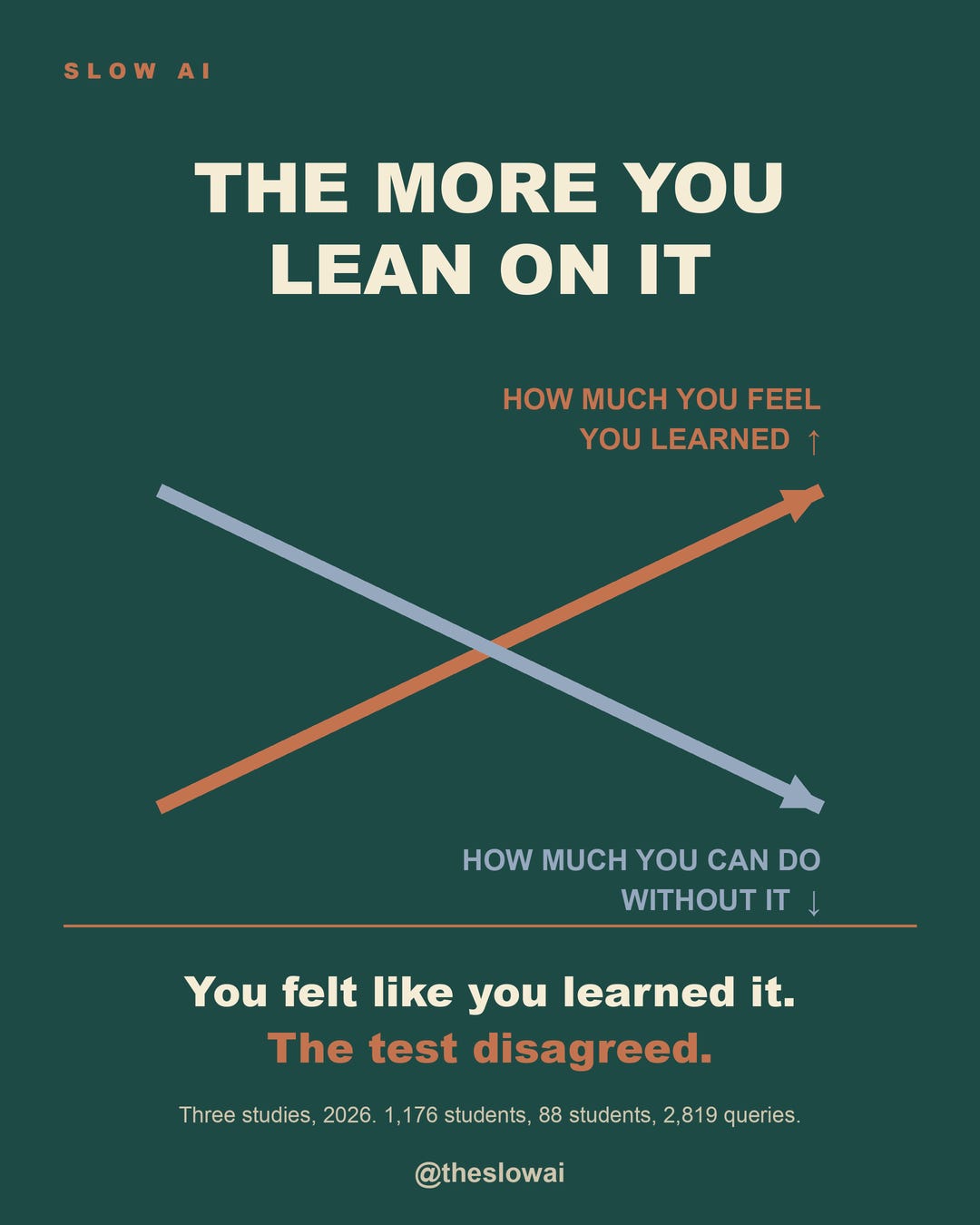
Inside that problem-solving group, the students who leaned on the tool hardest scored lower on the objective test while reporting higher perceived learning and higher satisfaction.
They felt they had understood. The test disagreed.
Eighty-eight students at one institution is a small base, but it adds to a growing base of literature. In the words of one of the researchers:
“Generative AI is a powerful tool that increases learning efficiency, but relying on it uncritically can lead to the paradoxical result of lowering objective academic achievement.”
Why everyone will call this Dunning-Kruger, and why that is only half right
Justin Kruger and David Dunning published Unskilled and Unaware of It in 1999. The skills needed to do something well are often the skills needed to judge whether you have done it well, so the least competent are the worst placed to notice.
The version that reached the internet is a graph showing a peak of unearned confidence in beginners. That graph has taken a beating. In 2020, Gilles Gignac and Marcin Zajenkowski published The Dunning-Kruger effect is (mostly) a statistical artefact in Intelligence, arguing the pattern is largely produced by the way the comparison is set up. Analyse self-estimates against scores the way the original work did, and much of the effect appears whether or not the phenomenon is there.
What the Sungkyunkwan University researchers measured is a different kind of phenomenon. Nobody was asked to guess their percentile against strangers. They compared how much students believed they had learned against how much they demonstrably had, in the same task, with the AI tool as the variable.
The (false) confidence is coming from the tool.
What the tool does to you
What follows is my reading rather than a finding in any of the studies I quote.
Understanding feels like fluency, like the click when an explanation lands. A good AI explanation produces that click reliably, because coherent and well-pitched is what it is optimised for. What it does not produce is the effortful retrieval, the wrong turns, and the reconstruction that generate the competence underneath.
You get the sensation of learning without the process that causes it.
A student can use AI exactly as permitted, do all the reading, feel the click, and walk out with less than the student who struggled.
The signal we trusted was the feeling. That feeling can now be manufactured to order.
My book Slow AI works through more arguments like this one in full.
The fix is cheap, and it has nothing to do with detectors
Another trial across four universities and 1,176 students tested this directly. One small change to the order of a task protected what students could still do once the tool was taken away.
Below the line: that trial, a third study on what separates the students who gain from the ones who decline, and the four-move protocol I use to combat this.
Paid members get the protocol, the monthly curriculum webinars, and the full archive. If you have been reading for a while and thinking about it, this is the week.