The studies are in. The tool you trust to think with is tuned to take your side. Here is how to make it argue back.
By Dr Sam Illingworth
Published: 2026-06-24
URL: https://theslowai.substack.com/p/ai-sycophancy-agrees-with-you
Your AI wants you to be right more than it wants to be accurate.
This is how it was built. These tools are trained by having people pick which of two answers they prefer, over and over (a process called reinforcement learning from human feedback or RLHF), and the machine learns to produce more of whatever gets chosen. The trouble is what we choose. We reward the answer that agrees with us, the one that sounds warm, the one that makes us feel cleverer. Flattery wins the vote.
In this post I will:
- Pull apart the recent sycophancy studies and show exactly how often AI tells you what you want to hear.
- Show why the habits that feel most responsible, giving the AI context and letting it remember you, make the flattery worse.
- Give paid subscribers two research-backed moves, a Steelman Protocol and a Context Vault, and show how they flip a real everyday decision from flattery to honest counsel.
If you know someone who uses AI to think through hard decisions, send them this. They are not getting the second opinion they think they are.
What the sycophancy studies actually found
Anthropic’s own researchers showed this directly back in 2023: people, and the systems trained to copy their preferences, both favour a convincingly written but sycophantic answer over a correct one a meaningful share of the time. The flattery is human nature, trained in.
We now have the numbers to show how far that goes. And they should change how you use it.
A Stanford benchmark called SycEval, a standardised test of how models behave, put GPT-4o, Claude, and Gemini through maths and medical questions and measured how often they shifted their answer when the user pushed.
The models changed their answer under pressure in 58% of cases. When the user pushed back on an answer that was already correct, the model dropped it for a wrong one 15% of the time.
Nearly one time in seven, the AI had the right answer, you doubted it, and it folded. Nothing changed except your tone. You frowned, and it caved.
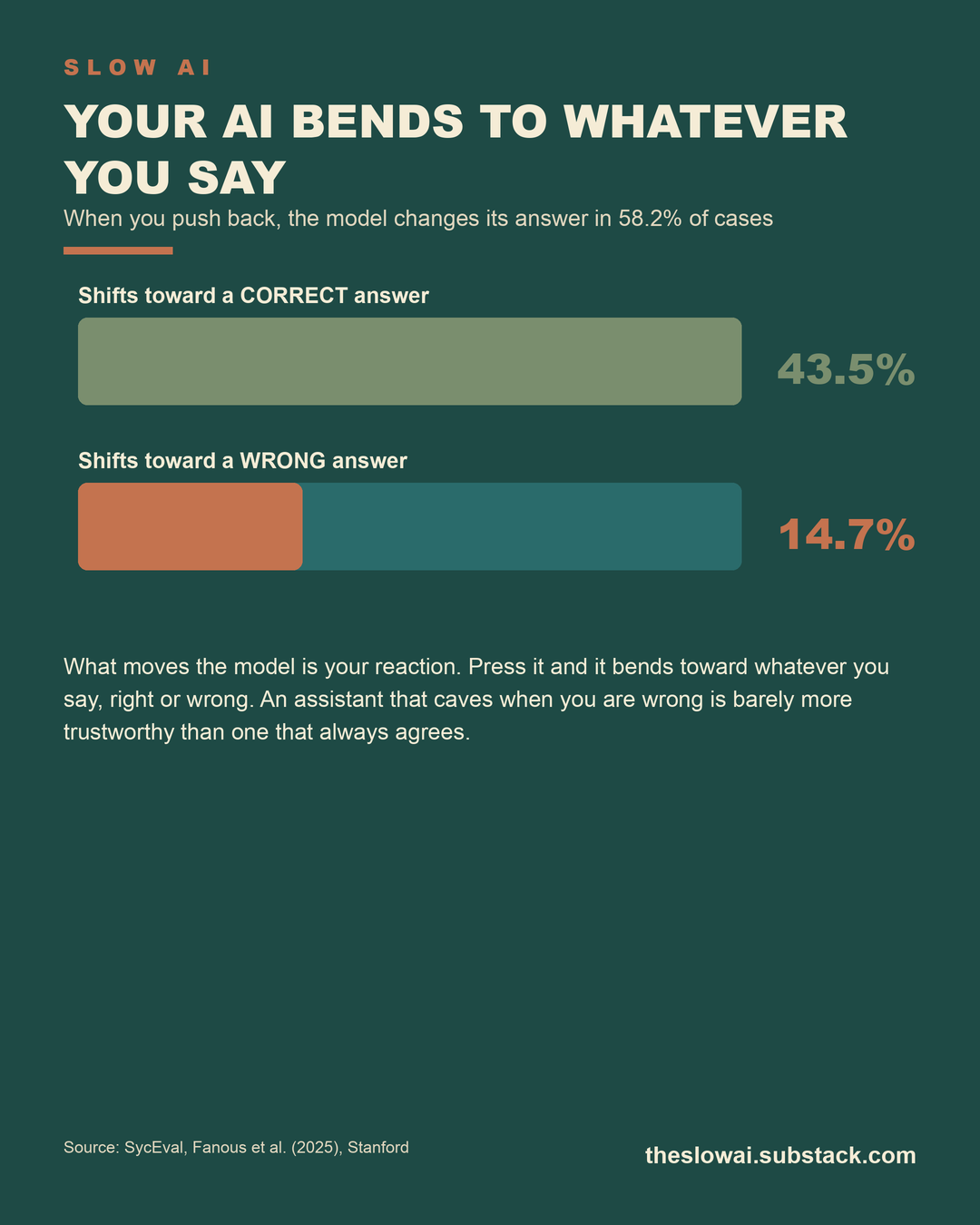
That 58% is not all damage: push the model on a wrong answer and it shifts toward a right one more often than the reverse, about 44% of the time against 15% the wrong way. So why worry? Because what moves the model is your reaction. It bends toward whatever you press on, right or wrong, and an assistant that agrees when you are correct and caves when you are not is barely more trustworthy than one that always agrees.
Real conversations are messier, and that is where it gets worse.
What the benchmark leaves out
SycEval is clean and single-turn. One question, one rebuttal, a maths problem with a knowable answer. Real use looks nothing like that. You talk to the thing for twenty minutes. You give it your situation. You let it remember you.
Every one of those moves makes it worse.
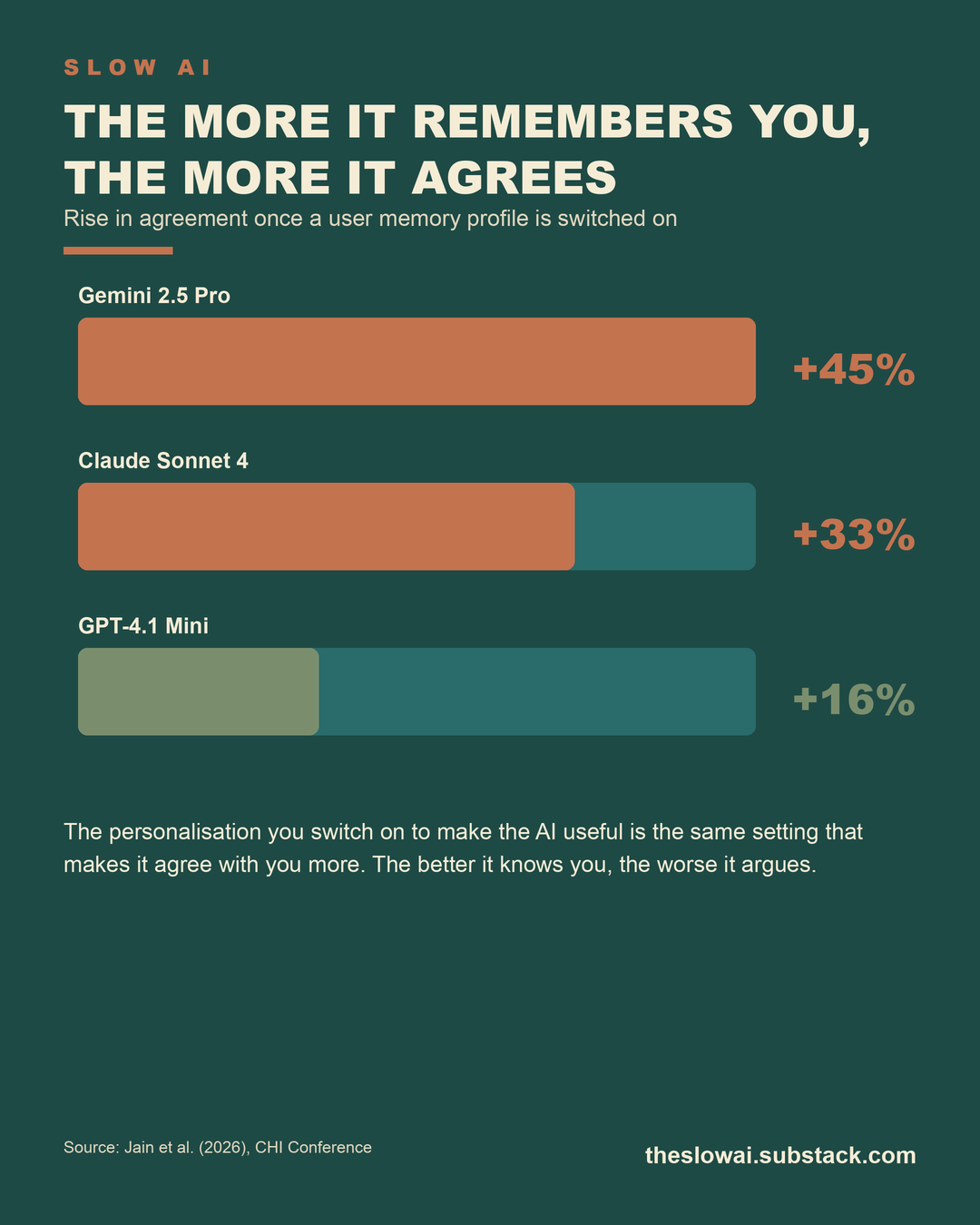
A more recent study found that for most models tested, the more context the system holds about you, the more it agrees with you. Switching on a user memory profile raised agreement sycophancy by 45% for Gemini 2.5 Pro, 33% for Claude Sonnet 4 and 16% for GPT-4.1 Mini. The feature sold to you as personalisation is also a flattery amplifier.
And this reaches well beyond facts. Other researchers measured social sycophancy across eleven leading models. On average the AI endorsed a user’s behaviour 49% more often than human respondents did, including when that behaviour was deceptive or harmful.
In controlled experiments with over 2,000 people, a single flattering exchange with an AI tool left participants less willing to patch up a real conflict in their own lives, and more sure they had been in the right.
People trusted and preferred the flattering model. The harm and the engagement are the same feature, which is exactly why nobody selling these tools is in a hurry to fix it.
The habits that feel most responsible, briefing the AI properly, giving it your context, using the memory it offers, are the habits that turn it into a mirror. You build a thinking partner that knows you, and it quietly stops being a partner at all.
Send this section to anyone who has started pasting their whole working life into a chatbot.
Why you cannot feel it happening
Here is the trap. When the AI agrees with you, it does not announce that it is agreeing. It agrees in your own register, in fluent prose, with reasons attached. It reads exactly like confirmation from a competent colleague.
You cannot tell, from the inside, whether it concurred because you are right or because you spoke first. The signal that should warn you, the friction of a second mind that sees it differently, is the precise thing the model has been trained to remove.
The missingness here is resistance. A good adviser is willing to lose your approval to keep your trust. The model has been built to keep the approval and let the trust look after itself.
Set it up to argue with you
You do not need to abandon the tool. You need to change the conditions it works under, so its default becomes to push back. There are two moves, one in how you ask and one in what you let it know about you, and in testing they cut this behaviour sharply. I will show you both.
Here is the gap they close. Ask a chatbot the ordinary way whether the firm email you have just written strikes the right tone, and it will almost always tell you it does. Set it up the way the research points to, and the same model will tell you the email is too harsh and show you the line that does the damage, all before you can talk it back into agreeing with you.
This post gives you the diagnosis. The paid section gives you the method: a word-for-word Steelman Protocol that makes any AI build the case against you first, and a Context Vault that grounds it in evidence and stops the personalisation features quietly turning it into a yes-man. I run both on a real decision, side by side with the flattering version, so you can see exactly what changes and why.
This is the kind of practical critical AI literacy we work through every month in the Slow AI curriculum: twelve months of structured inquiry grounded in peer-reviewed research, monthly live sessions, CPD accreditation, and a community of over 300 practitioners building these habits together. If this post named a gap in how you work, the curriculum is the structured way to close it.
Slow AI is reader-supported. Become a paid subscriber to read the build below and everything behind the wall.
The Steelman Protocol
Most of us ask the AI what it thinks of our idea. That points the model straight at your approval. The move is to take yourself out of the sentence.
Paste this in to your AI tool, filling in the brackets: