By Working Smarter with AI
Published: 2026-10-03
URL: https://thepromptshell.substack.com/p/the-ai-agent-metric-we-should-be
We may be measuring AI agents with the wrong stopwatch.
The industry is spending enormous energy making agents more persistent, more autonomous, better connected to tools, better at remembering what happened three hours ago and better at recovering when something goes wrong.
All of this is pushing toward the same objective: an agent that can continue working for longer without a person.
Yet one of the most useful number for understanding whether that autonomy has any practical value is still surprisingly absent from most agent evaluations.
Mean time to human intervention.
Or, in simpler terms:
How long can I leave this agent alone before I need to fix something?
That number might tell us more about the real economic value of an agent than another percentage point on a completion benchmark.
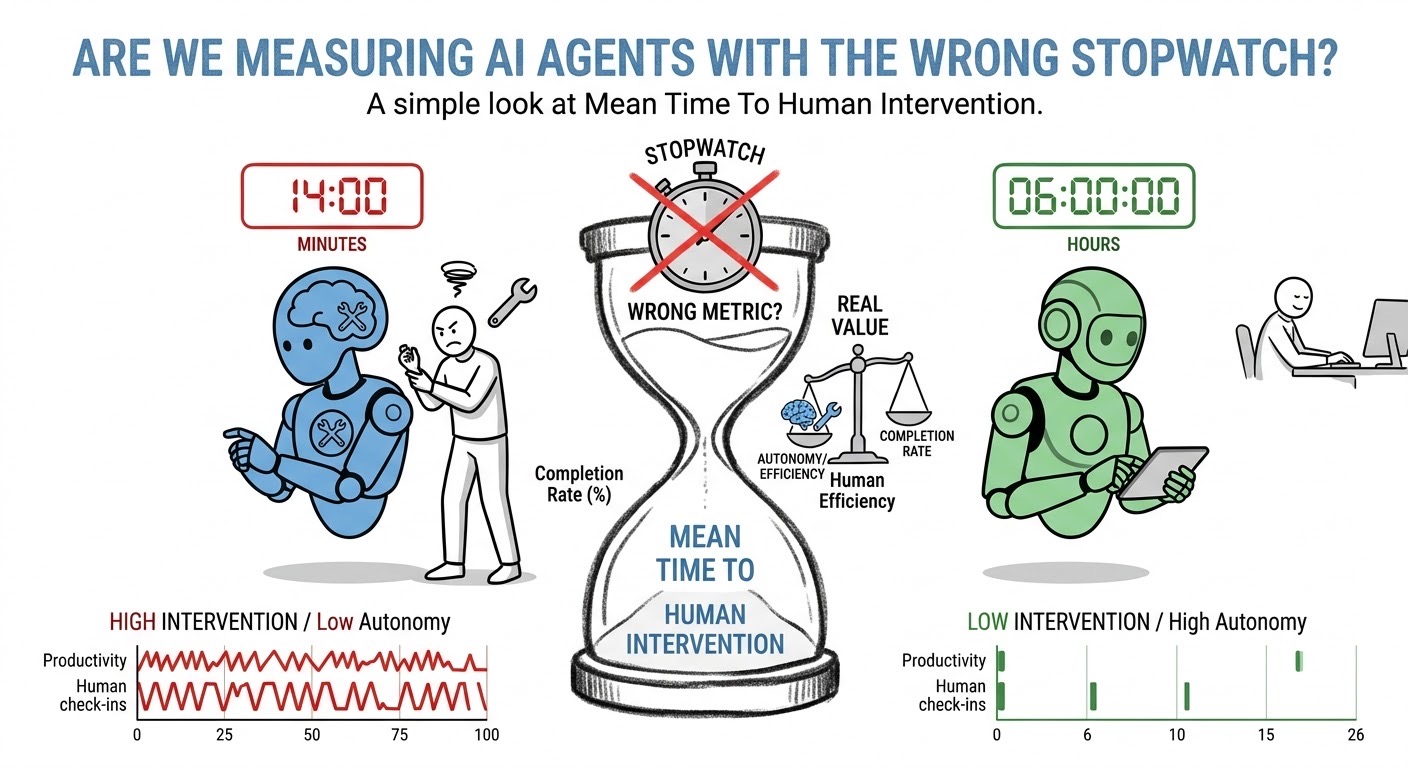
Completion rate hides something important
Imagine I give the same set of business workflows to two agents.
Agent A completes 92% of workflows successfully, but needs a human intervention every 14 minutes.
Agent B completes 86%, but can operate correctly for six hours before someone needs to intervene.
Which one would you deploy?
There isn’t one universal answer because the workflow matters, but the second agent could easily be much more valuable in production.
If I need someone watching Agent A throughout the day, I haven’t really automated the workflow. I have changed the job of the human from doing the work to supervising a machine doing the work.
Sometimes that is still useful but many other it defeats the entire point.
This becomes even more obvious when you imagine hundreds or thousands of agents running simultaneously.
A 92% completion rate sounds impressive on a benchmark.
One human interruption every 14 minutes sounds very different on an operations dashboard.
We have started measuring time, but not quite this time
There is already interesting work happening around longer agent tasks.
METR’s Task-Completion Time Horizon measures the length of tasks, based on how long a human expert would need to complete them, that an AI agent can successfully complete at a given reliability level.
The distinction matters.
METR explicitly warns that its time horizon does not represent the amount of time an agent can autonomously operate. It measures the difficulty and length of the task in human-equivalent time, rather than how long the AI itself runs without supervision.
Microsoft Research is pushing into another interesting area with SentinelBench, released in June 2026, which evaluates long-running monitoring agents that need to observe changing environments over extended periods.
These benchmarks are useful because they acknowledge something that ordinary accuracy numbers miss.
Time matters!!!!!
I think the next step is measuring time from the perspective of the person responsible for the agent.
Not just:
Can the agent complete this task?
But:
How long can this system keep producing acceptable work before somebody has to intervene?
Those are different questions.
Autonomy is an operational property
Think about how we evaluate traditional infrastructure.
We don’t only ask whether a server successfully processed a request during a test. We care about reliability over time, failure rates, recovery and how much operational attention the system requires.
Agents deserve similar treatment because persistence changes what we’re buying.
A chatbot interaction might last three minutes. An agent could eventually run for hours, days or longer, making hundreds of decisions along the way.
At that point, 92% accuracy is incomplete information.
I want to know what happened inside the remaining 8%.
- Did the agent recognize that it was uncertain and ask for help?
- Did it make one harmless mistake?
- Did it perform 47 actions based on that mistake before anyone noticed?
- Did it recover?
- Did a human have to reverse everything?
- Did it cross a permission boundary?
These outcomes can produce the same final benchmark score while creating completely different operational costs.
Mean time to human intervention
Borrowing from reliability engineering, I think we need a metric that looks something like this:
MTTHI = total autonomous operating time / number of required human interventions
Suppose an agent runs across several workflows for 60 hours and requires ten human interventions.
Its mean time to human intervention is six hours.
Now suddenly we have a number that a manager can understand.
More importantly, we can compare releases:
- Agent version 1.7: MTTHI: 43 minutes
- Agent version 1.8: MTTHI: 2 hours 12 minutes
- Agent version 1.9: MTTHI: 7 hours 4 minutes
That tells a very different story from:
92.1% → 92.8% → 93.4%.
The accuracy improvement looks incremental.
The operational improvement could be enormous.
One metric won’t be enough
Mean time to intervention would still be dangerous if we treated it as the only number.
An agent could theoretically achieve a fantastic MTTHI simply because nobody notices its mistakes.
So I would want a small family of operational autonomy metrics around it.
Time until intervention measures how long the agent can operate before a person must step in.
Actions before correction measures how much useful work happens between corrections and, equally important, how far an agent can travel in the wrong direction before being stopped.
Cost per accepted task measures the real economic cost after retries, inference, tools and human review are included.
Percentage of actions reversed tells us how much apparently completed work eventually has to be undone.
Permission violations measures how often an agent attempts or performs something outside its allowed authority.
Recovery success after failure measures whether an agent can recognize a problem, repair its state and continue without immediately escalating to a human.
Together, these tell us something completion accuracy alone cannot:
How expensive is this agent to trust?
The type of intervention matters too
There is another problem hiding inside the metric.
Not every intervention has the same cost.
Clicking “approve” after an agent correctly recognizes a sensitive action is not the same as spending 45 minutes untangling a sequence of bad decisions.
So eventually I would separate interventions into at least three categories:
- Approval interventions are expected human checkpoints designed into the workflow.
- Correction interventions happen when the agent is heading in the wrong direction and needs guidance.
- Recovery interventions happen when the agent has already failed and a human must repair the situation.
That distinction would stop us from punishing agents for asking humans to approve actions where human approval is exactly what we wanted.
Good autonomy does not mean never involving a person.
Good autonomy means involving a person at the right moment, for the right reason, with the smallest possible burden.
This changes how we compare agents
Now return to our original example.
Agent A:
**92% workflow completion
Human intervention every 14 minutes**
Agent B:
**86% workflow completion
Human intervention every 6 hours**