A practical example using a Meeting-to-Decisions Skill
By Working Smarter with AI
Published: 2026-05-09
URL: https://thepromptshell.substack.com/p/skills-in-chatgpt-from-one-off-prompts
A Skill is not just another prompt. It is a reusable operating system for a task you repeat often.
Instead of explaining the same workflow over and over, you package the rules, the input format, the output structure, and the quality bar into one consistent system which saves you a lot of time and gives a clear consistency to the answer you get from your AI.
What a Skill actually does:
- Defines a repeatable job, not a one-off answer
- Tells the model what to look for, what to ignore, and what to output first
- Makes the result more reliable when the input is messy or incomplete
- Lets you standardize high-value tasks like summaries, decisions, reports, and action lists.
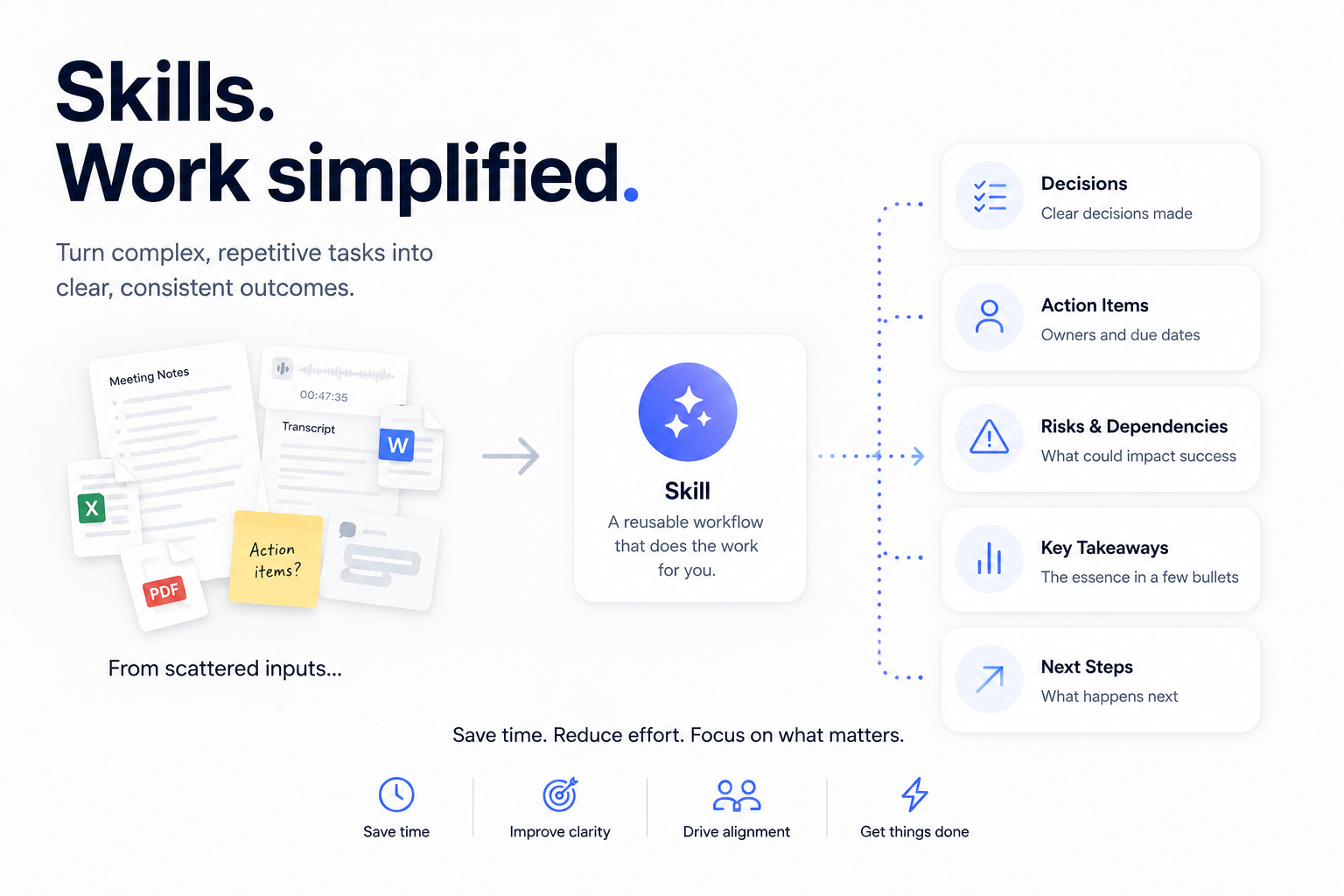
Think of it as a template with judgment built in. A generic prompt can summarize a meeting but a Skill can transform that meeting into a decision brief with owners, deadlines, risks, and open questions every time, in the same format.
Why a Skill is better than just uploading a Teams file into ChatGPT and ask for the same information'?
If you upload a Teams transcript ChatGPT can often turn it into a plan. That is useful, but it is still a one-off interpretation.
A well-designed Skill goes further because it forces the model to extract the same decision logic every time, regardless of the meeting style, the speaker, or the amount of noise in the file.
- It separates decisions from discussion
- It distinguishes actions from suggestions
- It captures owners, due dates, dependencies, and blockers
- It flags missing information instead of quietly filling the gaps with guesswork
- It produces an output you can reuse directly in email, project tracking, or leadership updates.
That difference matters a lot because a summary tells you what was said but a Skill tells you what should happen next.
Example: a Meeting-to-Decisions Skill
I’ll give you a practical example of one of the Skills that I have created.
Its job is to take a raw meeting transcript, a Teams export, a notes file, or a copied chat thread, and turn it into a decision-focused output that a manager can act on immediately.
What it produces:
- Executive summary in 3-5 lines
- Key decisions made during the meeting
- Action items with owner, deadline, and status
- Open questions that still need answers
- Risks, blockers, and dependencies
- A short follow-up message ready to send to attendees.
Why this is better than a generic plan
- It preserves accountability instead of just paraphrasing the discussion
- It makes the output consistent enough to use every week.
- It is far more useful for leadership, project management, and cross-functional work than a plain meeting summary.
Text to include inside the Skill
---
name: meeting-to-decisions
description: Convert meeting transcripts, notes, Teams exports, or chat threads into a decision brief with actions, owners, deadlines, risks, and open questions. Use when the user provides a meeting file or asks for a summary that must become a practical plan, not just a recap.
---
# meeting-to-decisions
## Purpose
Turn raw meeting material into a decision-ready brief that helps a manager act immediately.
## Core rules

- Identify decisions first, not general discussion.

- Separate facts, assumptions, decisions, actions, and open questions.

- Do not invent missing owners or deadlines. Flag them explicitly.

- Prefer concise executive language.

- If the meeting is noisy or incomplete, say what is missing.

- Keep the final output practical and ready to forward.
## Inputs

- Teams transcript

- Meeting notes

- Copied chat thread

- Agenda and follow-up emails
## Output structure
1. Executive summary
2. Decisions made
3. Action items
4. Open questions
5. Risks and blockers
6. Follow-up message draft
## Action item format

- Action

- Owner

- Deadline

- Dependency

- Confidence / missing info
## Quality bar
The output should answer this question clearly: what does this team need to do next, who owns it, and what could block it?
In this Skill you are not just asking the model to summarize. You are teaching it how to think about the meeting.
A simple way to write good Skills
- Start with one recurring task
- Define the exact input
- Specify the output structure
- Write the failure rules: what not to guess, what to flag, what to leave open
- Use the Skill only when the same task appears again and again
The best Skills do not try to do everything. They do one thing extremely well, in a repeatable way.