Let's see how we can get creative and use AI to architect the whole data modeling pipeline, or at least the most mechanical part of It.
By Alejandro Aboy
Published: 2026-03-05
Hi there! Alejandro here 😊
Subscribe if you like to read about technical data & AI learnings, deep dives!
Enjoy the reading and let me know in the comments what you think about it 👨🏻💻
📝 TL;DR
- Today we can collect business requirements, get meeting transcripts and use AI to discuss through the business logic implementation into data models.
- This approach assumes you dumped and pre processes the business requirements to give Claude the best input possible, as always.
- The companion repo walks through the full workflow: a PRD > ERD > Database exploration > dbt models step by step approach all through Claude Code.
Recently I published Intro To Claude Code For Data Engineers (Skills, MCPs & Hooks for the Modern Data Stack) to showcase how Claude Code could be leveraged by Data Engineers.
In this article we will see how we can combine other tools to go even further.
🧩 The Gap Between Design and Implementation
For a really long time (and we still are) we’ve been talking with stakeholders, taking down notes, attempting to maintain documentation over time and trying to translate business logic into physical models in the most accurate way possible.
The “notes” could mean anything, and that depended on who is leading the data modeling project.
Then you have ways of working. Conventions usually lived on the data modelers minds, since nobody could or wanted to take the time to make it available to soften onboardings or avoid bottlenecks due to knowledge gatekeeping.
I wrote about this in How AI Can Improve Your Data Modeling (And What’s Still Missing): 90% of data modeling happens outside the tools that implement it. The translation between all the pieces requieres aligning scattered inputs coming from Slack, Miro, Google Docs and so many others.
This article shows how to close this gap with AI tools, but that only gives us a lot of room to focus on scoping the best business requirements possible. Let’s get started!
 \Image Generated with ChatGPT.\
🔄 The Workflow
Let’s walk through the companion repo claude-code-data-engineers-data-modeling.
The scenario: your team already has a dbt project with campaigns, sessions, conversions, and attribution.
Product wants customer lifetime value tracking and funnel drop-off analysis.
The collected business requirements live on a Miro board.
Let's take a look.
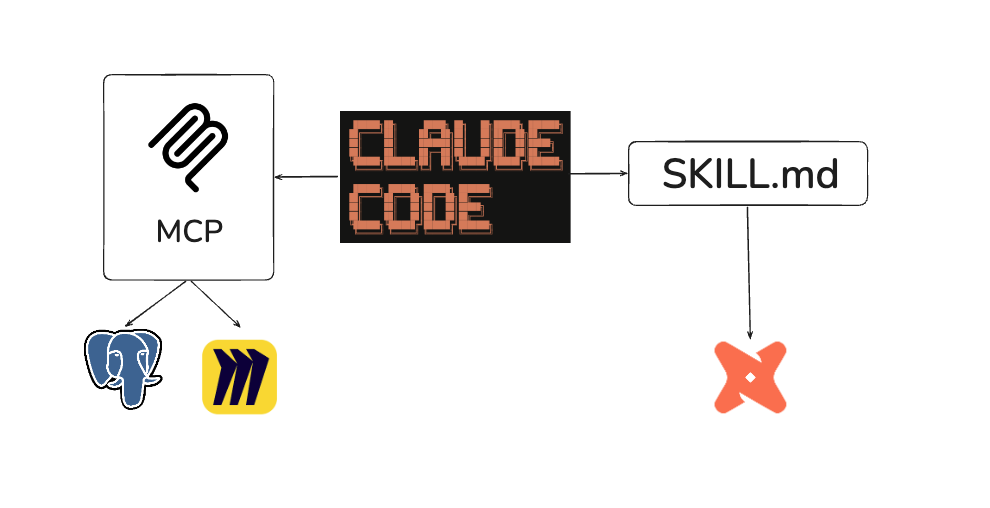
⚠️ Disclaimer: The deep dive is on the repo, you can follow along all the configs, screenshots and workflow steps to see how it behaves.
It’s already quite hard to show Claude Code outputs in an elegant way so if you are really interested in knowing more I invite you to check the repo.
Step 1: Read the PRD and explore the database
Miro MCP reads the board. The requirements are business language: “How much is each customer worth over time?” and “Where are we losing people in the funnel?” No column names, no grain definitions.
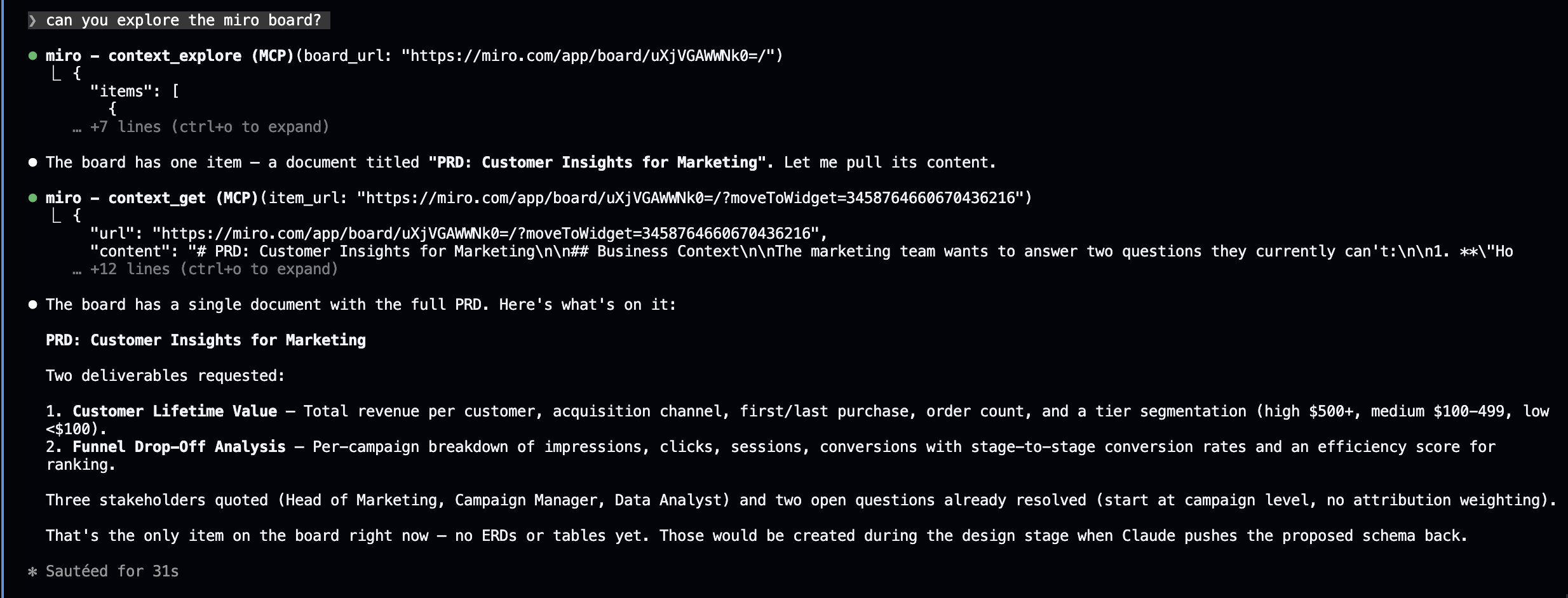 \Miro MCP reading the PRD from the board.It uses context\explore, context\get Miro MCP tools to pick up the PRD and read its content.\
Then we need to give Claude Codethe ability to explore the database: MCP Data Toolbox connects to the warehouse to help with that purpose.
Claude Code can explores the raw tables, samples data, checks assumptions. Just getting this from YAMLs won't cut it, you need to leverage exploration tools.
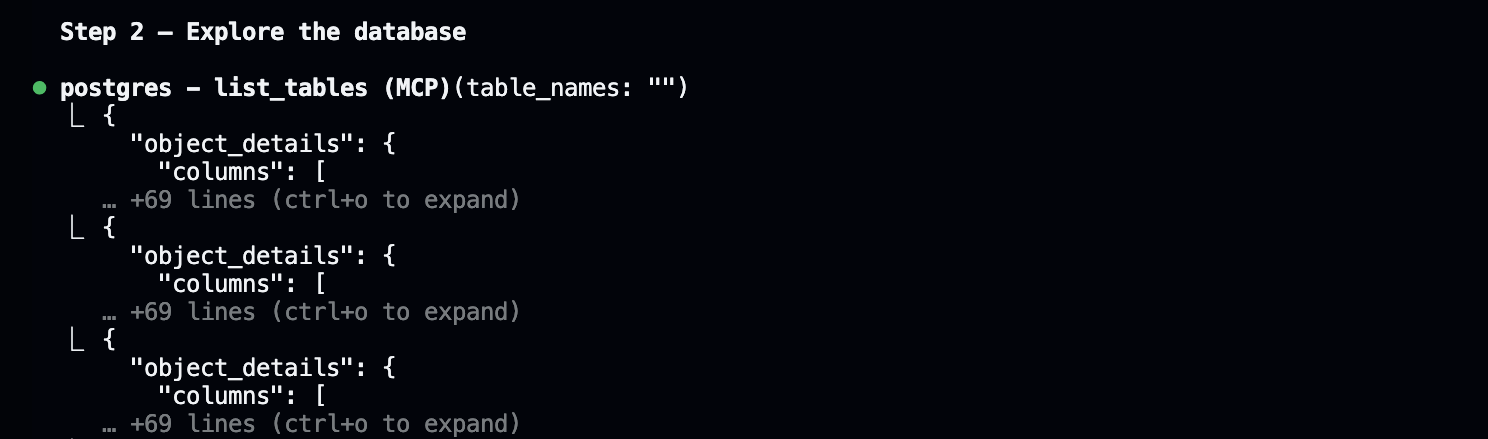 \Postgres MCP exploring the database using list\tables and execute\sql tools.\
Step 2: Translate to implementation plan
We have prd-to-dbt skill showing up.
The custom Skill reads the business PRD, the database exploration results, and the existing project’s schema YAMLs.
It maps business concepts to source tables, identifies gaps, and produces a plan: models at each layer, grain, joins. This is the step most teams skip.
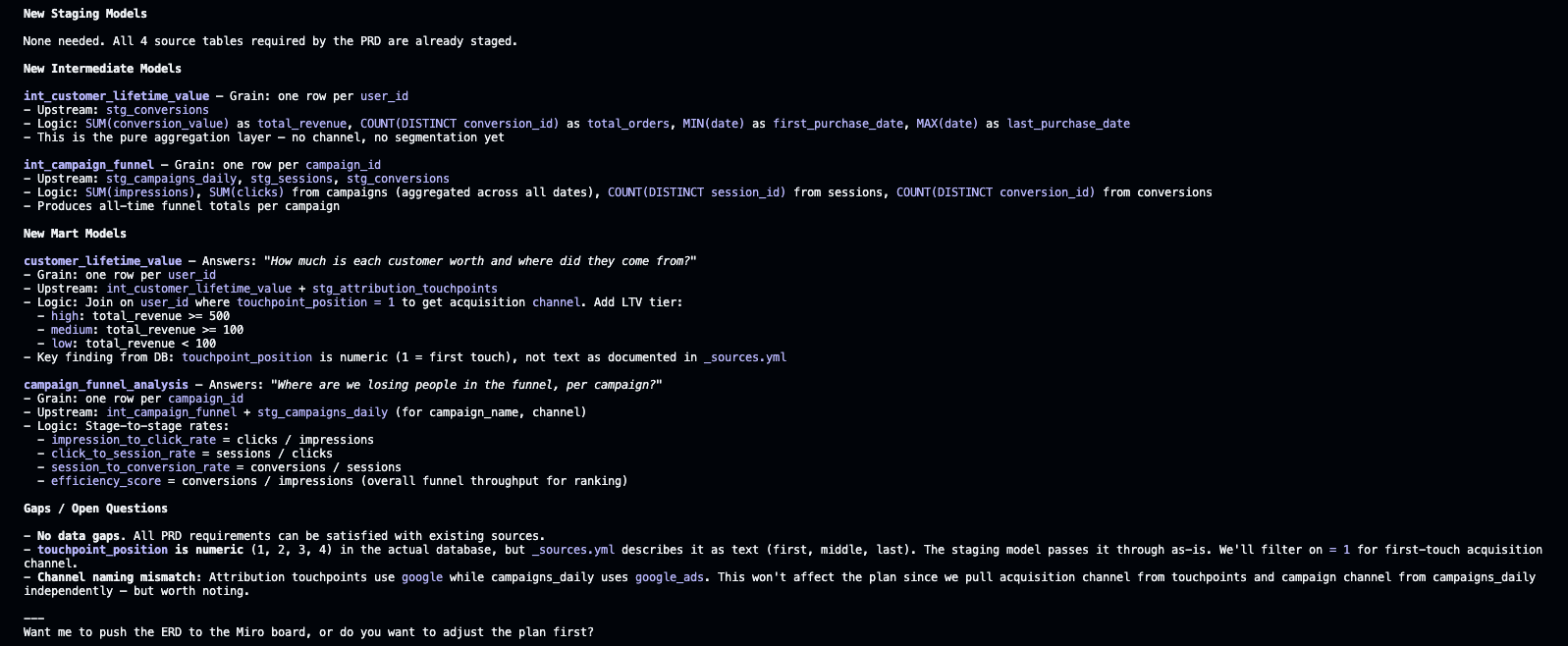 \Implementation plan output after PostgreSQL discovery using the MCP tools.\
What's really cool about it, is that Claude Code has a defined scope to know how to scan for lineage, model dependencies and gain context without having to ask for undocumented information as poor humans with weak onboardings would have to do.
If you been there at any point in your career, you for sure started to run queries to understand what to work with, this is the same.
The Pipe & The Line is a reader-supported publication. To receive new posts and support my work, consider becoming a free or paid subscriber.
Step 3: Propose schema on Miro
Before writing SQL, Claude Code creates an ERD (Entity Relationship Diagram) on the Miro board.
Stakeholders see how their questions map to models: you can review, push back and refine until you are happy with the results and proceed.
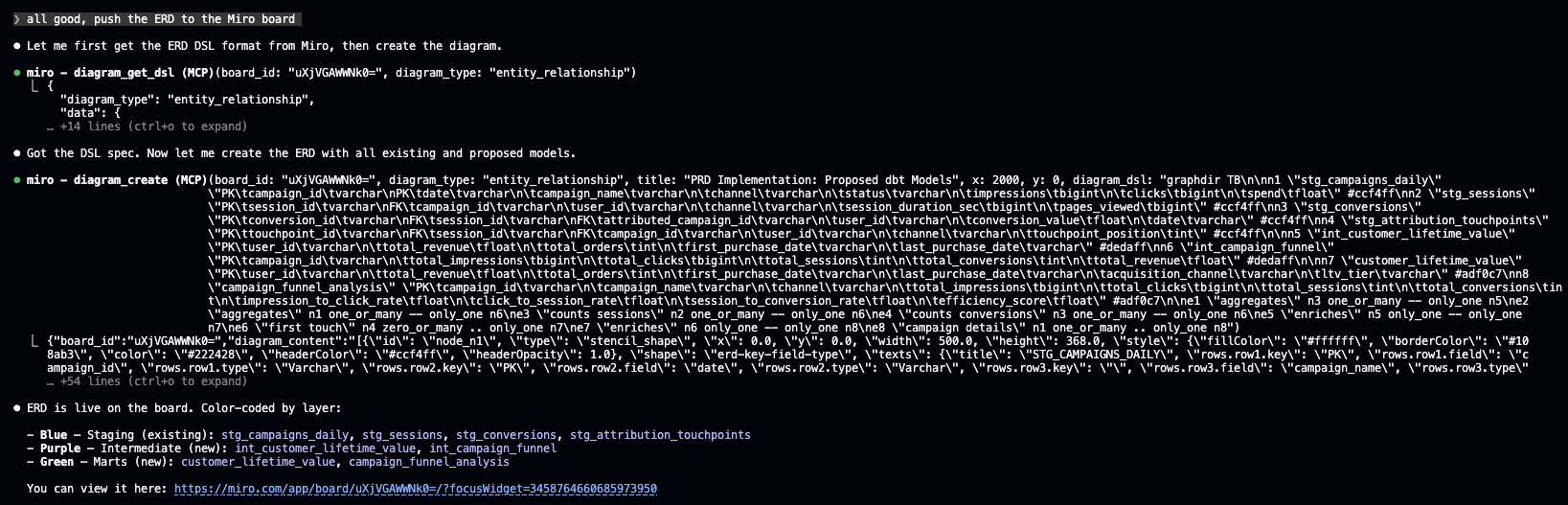 \ERD pushed to Miro board by creating a ERD diagram with diagram\create tool. See diagram\type “entity\_relationship” on the image.\
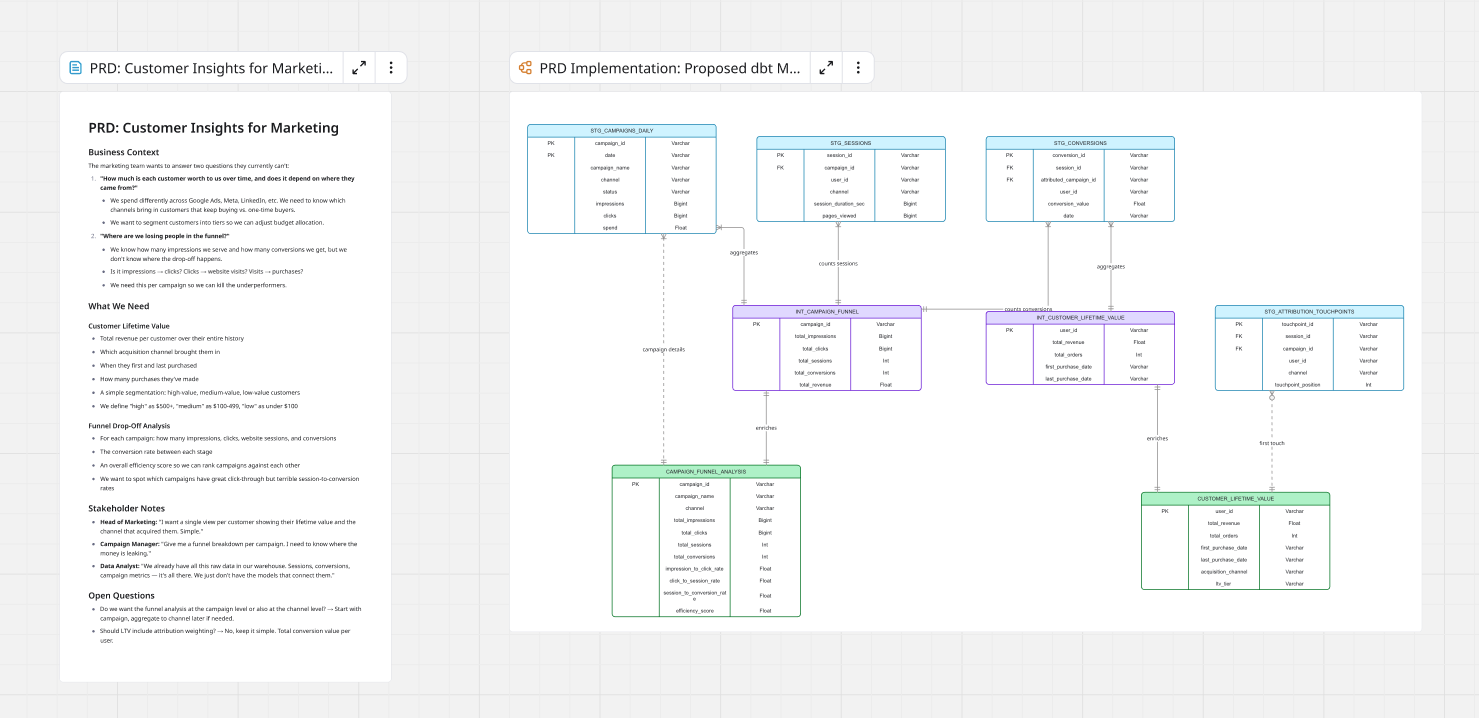 \PRD and ERD side by side on Miro.\
Step 4: Implement & Validate
More skills in the mix, but know specialized ones.
dbt Agent Skills can generate the models across all layers by following best practices on dbt and analytics engineering overall.
Schema YAMLs with column descriptions, grain docs, and tests are generated alongside. Each model follows the existing project’s patterns.
The full implementation result is in PR #1.
 \dbt Agent Skills are loaded to start implementing models.\
 \Writing intermediate models with Postgres MCP validation, combining skills and database MCP.\
Let’s reflect on the outlook of the full project.
Recommended: What’s the real deal about SKILLs (This is not an ‘MCP is dead’ post) for a deeper look at how Skills work and when to use them over MCPs.
Thanks for reading The Pipe & The Line! This post is public so feel free to share it.
🔮 What This Changes
Before: Business PRD on a doc → data engineer manually translates to technical spec → writes dbt models → manually adds schema docs → PR review catches naming inconsistencies → go back and fix → re-review
And we just saw how the after looks.
The custom Skill is what makes this repeatable.
Without it, you’re asking Claude to “build some models from this PRD” and hoping it figures out the right approach.
The Skill handles the what, dbt Agent Skills handle the how.
That split is what keeps the output consistent across different PRDs and different projects.
The people problem relies on how good business requirements inputs are.
The tooling problem relies on building the right mix between workflows and tools to make processes explicit and remove all ambiguity.
With MCPs and Skills we close the gap between conceptual and physical modeling since we can connect all the pieces together now.
And swaping Miro for JIRA or Notion, adding integrations with data governance tools or semantic layers… and you have THE real machine.
Recommended: End To End Agentic Data Modeling: Using AI and OpenMetadata MCP for Impact Analysis
If you enjoyed the content, hit the like ❤️ button, share, comment, repost, and all those nice things people do when like stuff these days. Glad to know you made it to this part!

Hi, I am Alejandro Aboy. I am currently working as a Data Engineer. I started in digital marketing at 19. I gained experience in website tracking, advertising, and analytics. I also founded my agency. In 2021, I found my passion for data engineering. So, I shifted my career focus, despite lacking a CS degree. I’m now pursuing this path, leveraging my diverse experience and willingness to learn.