MCP, RAG, longer Context Windows, a lot of improvements on AI keep coming but Data development workflows are still missing a real AI assisted context.
By Alejandro Aboy
Published: 2025-10-20
URL: https://thepipeandtheline.substack.com/p/how-ai-can-improve-your-data-modeling
Hi there! Alejandro here 😊
Suscribe if you like to read about technical data & AI learnings, deep dives!
Enjoy the reading and let me know in the comments what you think about it 👨🏻💻
📝 TL;DR
-
The tab-jumping problem is real when you switch between DBeaver, Cursor, and terminal commands all day
-
Tools like nao are promising because they combine SQL, dbt lineage, and AI in one place instead of juggling multiple apps
-
Most data modeling work happens outside your fancy tools in Miro boards, Google Docs, and Slack conversations
-
Your dbt models are just the tip of the iceberg—the real challenge is capturing company context and business decisions
-
Companies need to get their documentation and processes organized before expecting AI magic to happen
In two previous Modern Data 101 articles, I explored how AI can actually help us data folks. With all the coding and “build your app in hours” hype, it felt like we were left out 😜
I covered the Agentic Data Stack idea and Vibe Data Modeling, but mostly I reflected on the challenges companies face getting ready for AI. Modern Data 101The Vision of Vibe Data Modeling: Are Organisations ReadyThis piece is a community contribution from Alejandro Aboy, a data engineer with nearly a decade of experience across analytics, engineering, and digital tracking. Currently at Workpath, he is the main data platform stack owner, building scalable pipelines, automating workflows, and prototyping AI-powered SaaS analytics using tools like Airflow, dbt, Au…Read morea year ago · 19 likes · 3 comments · Alejandro Aboy
I also put together an approach I tested to extend AI IDEs like Cursor or Claude to boost data modeling workflows.
Connecting your database, working with dbt dependencies, checking semantic layers or catalogs for contextual modeling...
That’s quite a Frankenstein to maintain no matter how savvy you are 😂
But the worst part is telling the AI what the expected output is for an input when the samples are CSVs...
That, along with other issues, ruins the user experience for data development. It might work great for software engineering, but data still has a long way to go. Image generated by ChatGPT
🤔 What Our Team Was Doing - “The Tab Jumping”
We used a mix of DBeaver, Cursor or VSCode, and a custom Docker Compose setup. Image generated by Author ;)
The trusty DBeaver handled SQL queries and checks (before and after running dbt).
The modern data hero dbt (using custom Makefile commands) put the transformation chain together from staging to fact layers and kept our documentation up to date.
We also had the dbt catalog UI deployed for analysts to do on-demand checks, covering about 80% of what happens before the tools.
With this combo, you can imagine:
Jumping between tabs, running SQL in DBeaver and dbt in the terminal, then copy-pasting outputs into Cursor chat.
To tame the mess, we created some Cursor rules. These taught it how to scan the project and understand the context before running anything.
It wasn’t perfect, but it got the job done if you don’t model data every single day.
💡 What We Tried - “The All In One”
After that post, I kept experimenting with the frankestein.
 New AI OrderWhy Cursor doesn’t work for data teamsEvery developer has adopted their AI coding tool, first Cursor, then Claude Code…Read morea year ago · 13 likes · 4 comments · New AI Order
In simple terms, nao is a VSCode fork like Cursor or Windsurf with embedded SQL, dbt (project and lineage), and AI agent capabilities.
And that’s great on so many levels.
It can generate SQL queries, create data models, and help with documentation.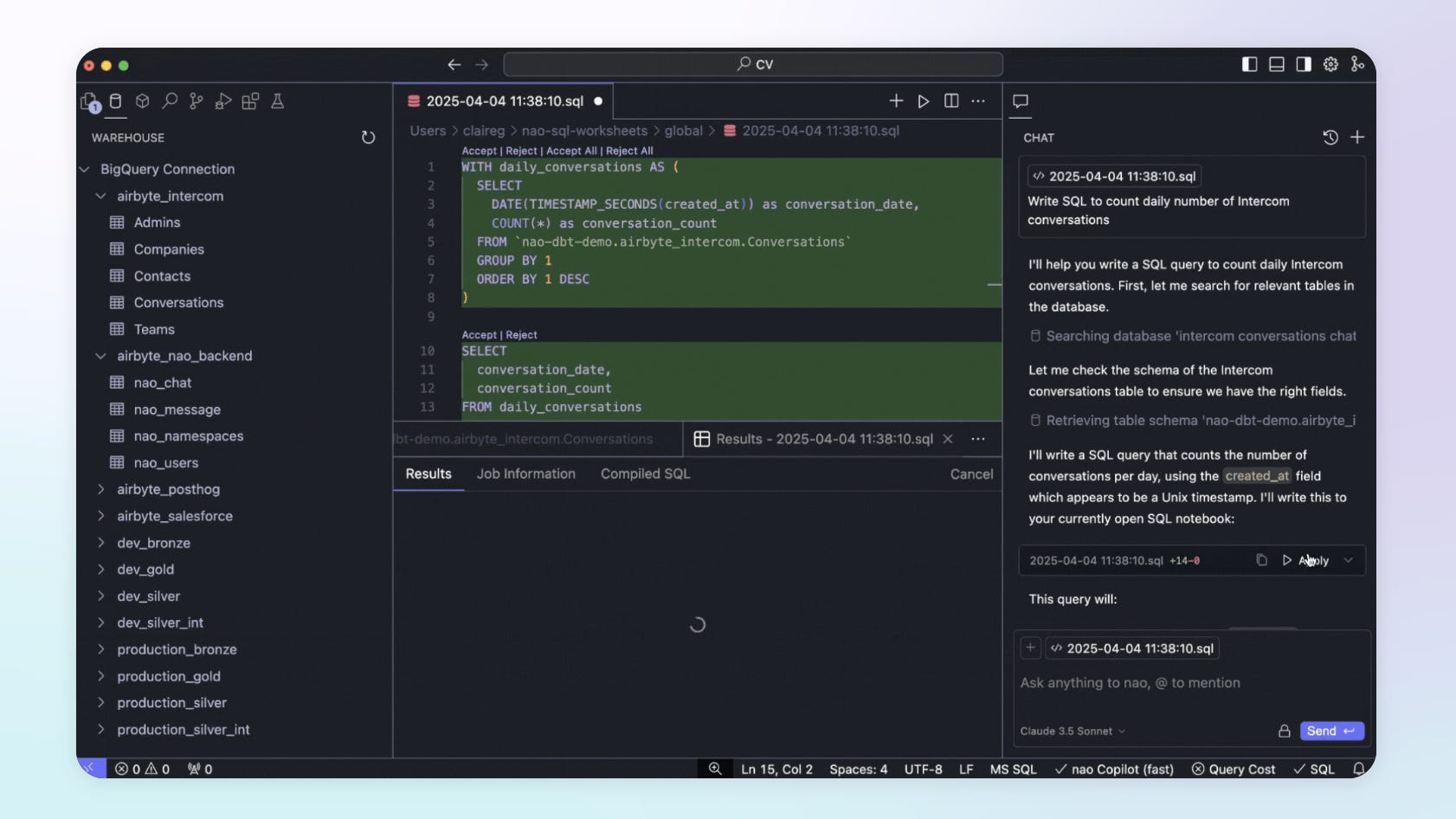 Image from getnao.io
We removed DBeaver from the equation and rarely check the dbt catalog thanks to the embedded lineage.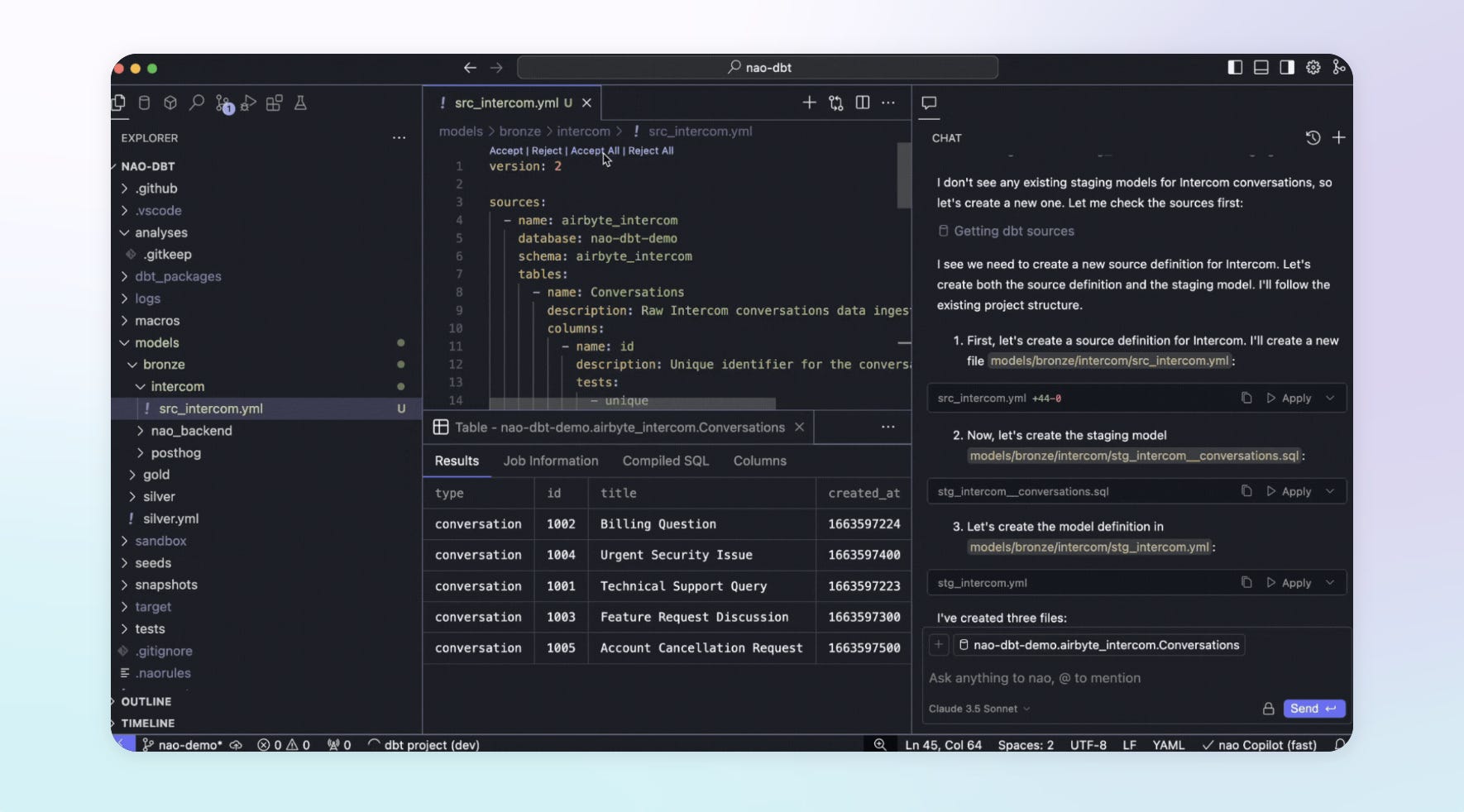
You can use the Agent to run quality checks and other boring-mechanic tasks that you usually would run on a tool like DBeaver, but all in place.
I like where this is going and how it could be extended with MCPs and other external tools to enhance it even more.
I am happy to say many of the concerns I was highlighting are covered.
Of course there are nuances were automated tab completions can failed, but every time they don’t, productivity can skyrocket.
In the next section I would like to go a little bit more skeptical on the business side, where AI still has a lot to cover to really gain agentic asssistance.
Thanks for reading The Pipe & The Line! This post is public so feel free to share it.
🔍 Your Fancy dbt Models Are Just The 10% Of A Bigger Monster
What I like about AI is how well—and how badly—it behaves when you push its boundaries.
You can learn to prompt, use context engineering techniques, even write better.
But when it comes to designing data modeling for a company, dbt models or SQL queries are just the tip of the iceberg.
90% of the process happens outside the tools.
You find those requirements scattered in Miro boards, Google Docs, Slack threads, and Google Meet (Thanks Gemini Notes).
All stakeholder conversations, caveats, considerations, decision rationale, and more aren’t available for AI when running the process.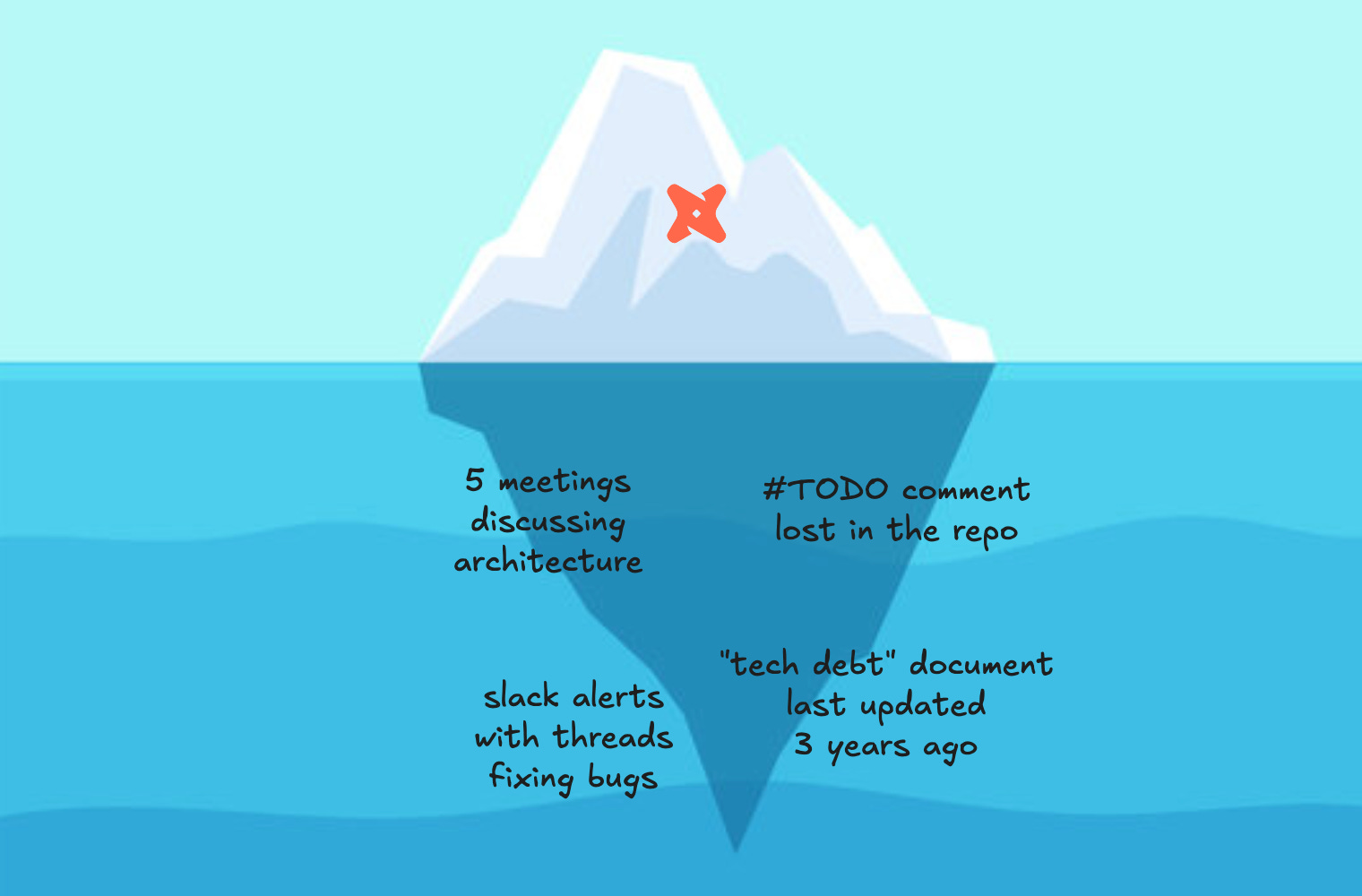 Image generated by the Author ;)
So this raises some questions:
-
How can AI use company assets in context?
-
How much company context can AI handle before giving bad-quality outputs?
These questions focus on AI’s outlook and how we can push it further so it doesn’t work in isolation.
I know we did it with RAG, MCP, and other techniques, so it shouldn’t be that far away.
But here’s a skeptical take:
Just because an MCP can read your Google Docs or Miro boards doesn’t mean it will understand your company.
It’s not just unstructured data—we mean the messy, everyday stuff that happens inside companies.
So the BIG question is: How far away are companies from really understanding their context regardless of AI?
Chances are, that super techy company you admire is still using Excel as data sources, managed by non-data folks who keep their secret knowledge to themselves 😜
The Pipe & The Line is a reader-supported publication. To receive new posts and support my work, consider becoming a free or paid subscriber.
🤝 What Can We Do - “Feeding The Machine”
These tools will evolve.
AI will evolve.
It will become faster, smarter, and handle more context.
When that time comes, we shouldn’t suffer from data quality issues, lost knowledge, or undocumented business processes.
Becoming architects who see the big picture means building the foundation to make that happen.
But how do we approach it?
-
Make documentation gathering and maintenance easier with AI
-
Give AI access to company assets with the right permissions
-
Plan ahead so tools like nao can succeed at the last mile
The goal: don’t start from scratch every single time!
AI models are hungry pattern matchers, so let’s find patterns to feed the machine first.
If you are into this, read this article in which there’s an MCP approach to catch company context and use it as a tool: The AI Bezos Mandate
People don’t realize how much you learn from internal processes the moment you try to make them AI compatible. It’s enlightening ✨
If you enjoyed the content, hit the like ❤️ button, share, comment, repost, and all those nice things people do when like stuff these days. Glad to know you made it to this part!

Hi, I am Alejandro Aboy. I am currently working as a Data Engineer. I started in digital marketing at 19. I gained experience in website tracking, advertising, and analytics. I also founded my agency. In 2021, I found my passion for data engineering. So, I shifted my career focus, despite lacking a CS degree. I’m now pursuing this path, leveraging my diverse experience and willingness to learn.