How to fast track your career in Data without following strict roadmaps.
By Alejandro Aboy
Published: 2025-08-13
URL: https://thepipeandtheline.substack.com/p/why-being-a-data-analyst-on-steroids
Hi there! Alejandro here 😊
Suscribe if you like to read about technical data & AI learnings, deep dives!
Enjoy the reading and let me know in the comments what you think about it 👨🏻💻
At the end of the day, titles are just labels.
Nobody cares if you are an engineer or an analyst; they just want you to know what problems you solve.
In big corporations, titles play a different role than they do in other companies.
SMBs and startups represent the biggest part of the market, where your career is most likely to be developed, so here’s the real deal.
I think there’s a huge opportunity in avoiding specialization in the beginning. Don’t focus on labels; focus on thinking systematically about how to solve problems and putting the pieces together to use what you know for the best possible outcome.
Seniority and experience will bring you more assets over time, but trying to stick within the same walls will only stop you from expanding your skills horizontally, which, most of the time, is what makes you a great professional and pushes your career forward.
Many of the principles from my Web Analytics previous career path brought me here:
That’s why I like to think everyone should start as a Data Analyst, but should add some extra elements along the way.
Let’s discuss the reasons why, in my opinion.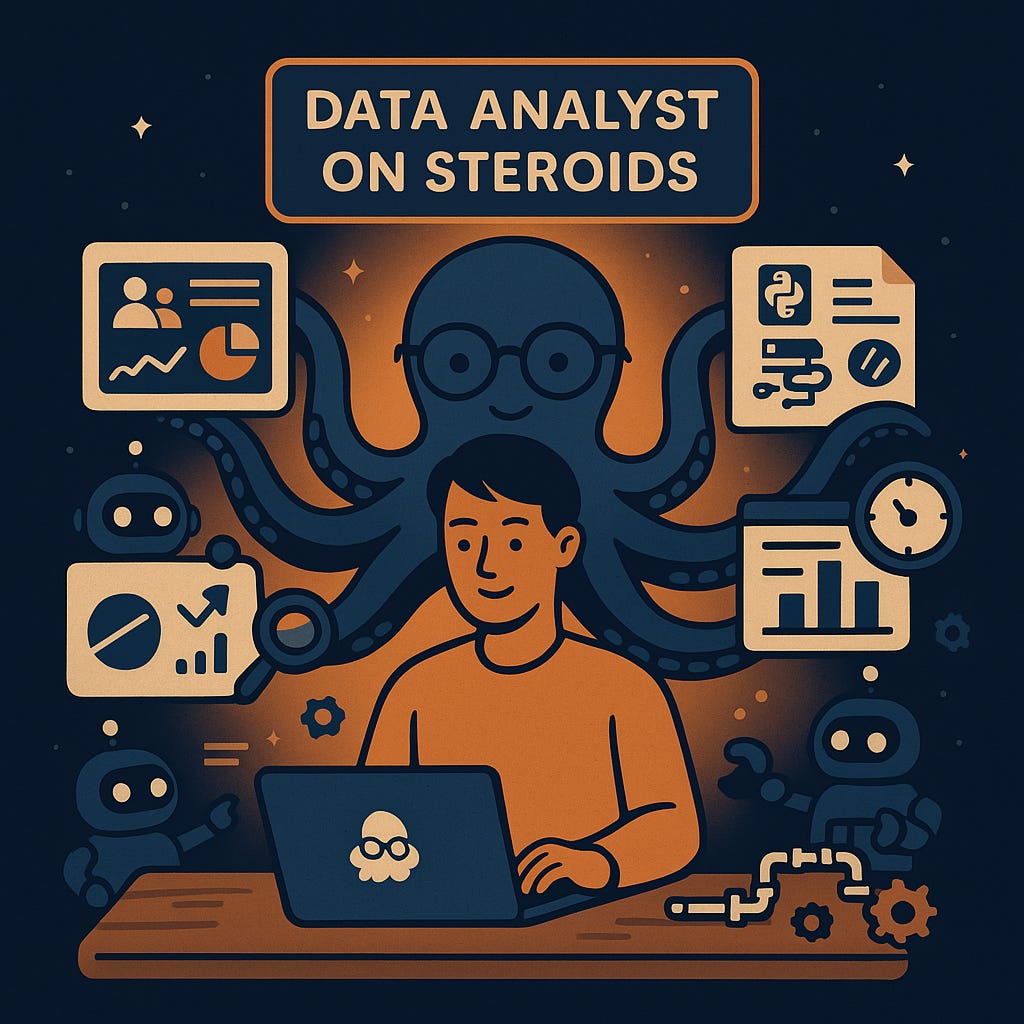 Image generated by ChatGPT.
🧑🚀 Survive and Thrive in Small Teams & Startups
If you work on small teams, one-person teams, or startups where “everyone gets to do everything,” you are in the best place to expand your skills, even though it might sound overwhelming in the beginning.
Embrace these scenarios because they will push your boundaries (in a healthy way) and encourage you to think broadly about how to approach problems.
If you learn to talk to stakeholders during this process, by the end of the experience, you will be a super data professional.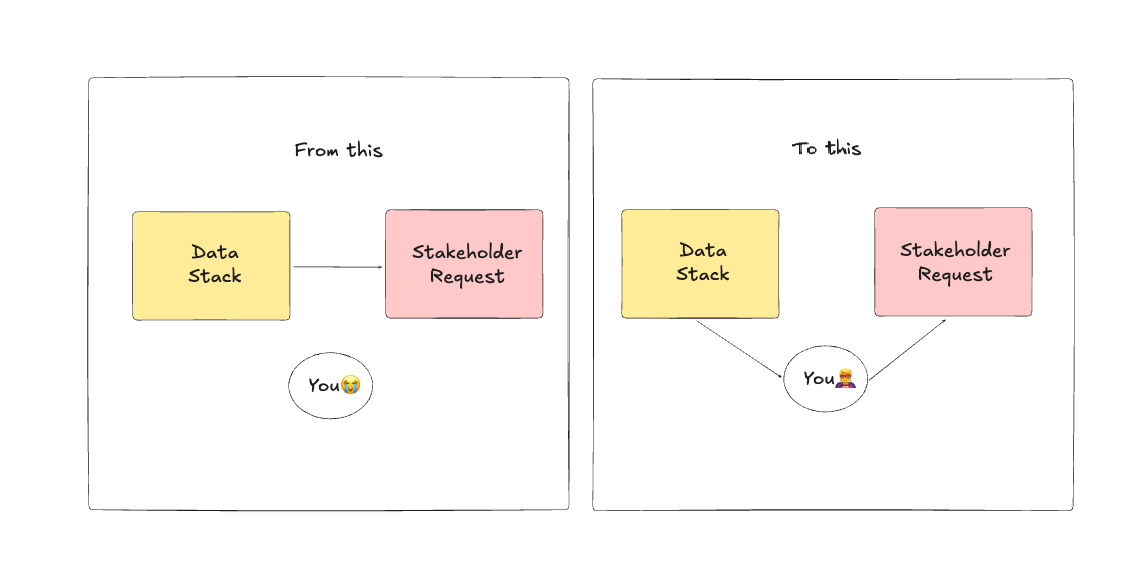 Image generated by the author.
For example, many companies end up having unconventional database setups on Google Sheets because it is faster for many stakeholders.
At some point, that is not enough, and they eventually need to put this into a more appealing visualization that gets transformed with certain logic and refreshed. Start there:
Whenever you realize it, you will be:
-
Setting up basic ETL with Python
-
Building a quick dashboard in Looker/Metabase
-
Writing a dbt model or two
-
Debugging an API connection
It won’t be perfect, but you will start working as a bridge that can fill in the blanks between technology and non-technical stakeholders in your company.
Thanks for reading The Pipe & The Line! Subscribe for free to receive new posts and support my work.
🙅♂️ Less Reliance on Technical Stakeholders
Managing requests is a problem when you need to deliver that report, answer that question, or anything else that requires extra context.
Who has that context? People who are also targeted by stakeholders different from yours, ending up in an avalanche of requests they cannot handle.
In fast-paced environments (I would risk saying in every company), priorities are never set, and everything is for yesterday, so the 1:n problem burns more than ever.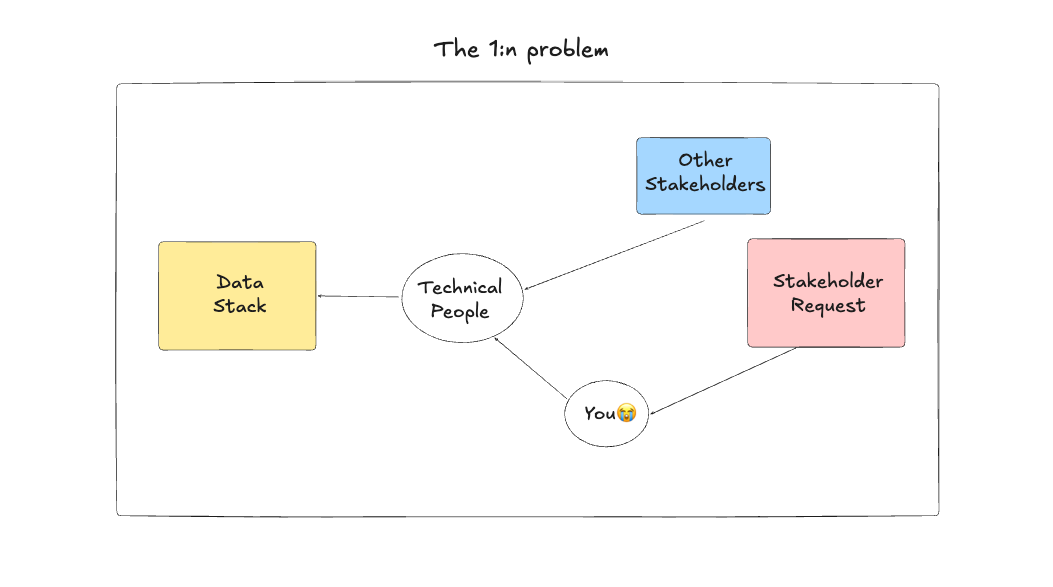 Image generated by the author.
There’s an opportunity here: when help is not an option, you survive and find a way. You either:
-
Learn the skills necessary to make requests easier for people more technical than you, so they can meet your needs faster and with better outputs.
-
Learn enough to do it yourself and ask for feedback from a technical person until you feel confident enough to push it through.
This does not mean you have to learn everything at once and avoid interacting with others entirely, but it is beneficial to push curiosity to uncomfortable levels so you don’t have to wait for “the Data Engineer to set up the pipeline.”
Your pipeline might not be great in the beginning, but it will get better with time. You don’t have to start big; you can implement lightweight tools, learn the fundamentals with small alternatives, and then keep adding complexity over time.
If you work with busy senior teammates, showing willingness to try new things and asking for feedback sometimes makes it easier for them to help you, rather than going through everything with you from scratch.
The good thing is, the internet is full of people who have faced the same problem you are facing at some point, so you don’t feel special and unique. 😂
Thanks for reading The Pipe & The Line! This post is public so feel free to share it.
💪 You Can Easily Pivot to Data Science or Data Engineering
I had the chance to experiment with this path myself.
Started as a Web Analytics specialist.
Then I discovered No Code automations.
Then SQL and dashboards.
Then Python for basic tasks in notebooks.
Then I was playing around with pipelines and complex automations.
Then AI workflows.
It took time and a lot of frustration because I was surviving most of the time, but it was fun.
Business needs will eventually push you to expand or pivot some of your skills in different directions, and you will need to adapt.
Eventually, you will find that you know enough to start exploring new angles:
-
Data Engineering: You’re already familiar with how data flows, what clean data looks like, and why pipelines break. Picking up dbt, Airflow, or even a bit of infrastructure is within reach.
-
Data Science: You already understand the business questions and have a foundation in exploratory data analysis. Learning ML, A/B testing, and other statistics-driven techniques is possible.
You don’t have to follow linear paths; you can evolve with experience and let it flow until you find your sweet career spot.
🏗️ From Jupyter Notebooks to System Thinking
We all have to go through this phase.
I remember a teacher telling me, “Think in programs; notebooks are not programs.”
Notebooks are amazing for exploration, easy to set up, but can’t survive real-life systems if you want to take things into working environments.
The most common use case I faced in my career is the “click and export” notebook type:
Someone asked for something that couldn’t be retrieved with regular SQL, and I found a way to do it with simple Python.
Every day, I click on run and export a CSV manually.
But then I went on holiday, so no report exports during my absence.
That’s when I learned about tools like Airflow, Mage, or Github Actions.
Learning to put things together to work as systematic workflows that don’t rely on you clicking the notebook is one of the greatest skills ever.
Learn to develop things that work on their own.
If this feels like a lot in the beginning, you can learn No Code tools to start smoothly and then switch to more complex Python-based scripts.
You can take a look at these articles, where with very basic tools we cover a lot of use cases.
But the situation will demand something like this sooner than you think, so learn the skill and enjoy it!
🦸🏻♂️ The Rise of Analytics Engineer Position
The concept of “Data Analyst on Steroids” already exists, and it has a much cooler name than the one I added for this article. 😂
dbt has a really good article on this position: What is analytics engineering?
For a long time, there was a blurry middle between analysts and engineers because some gaps were filled with flexibility rather than with scoped responsibilities.
Here’s how dbt presents the role as a gap filler: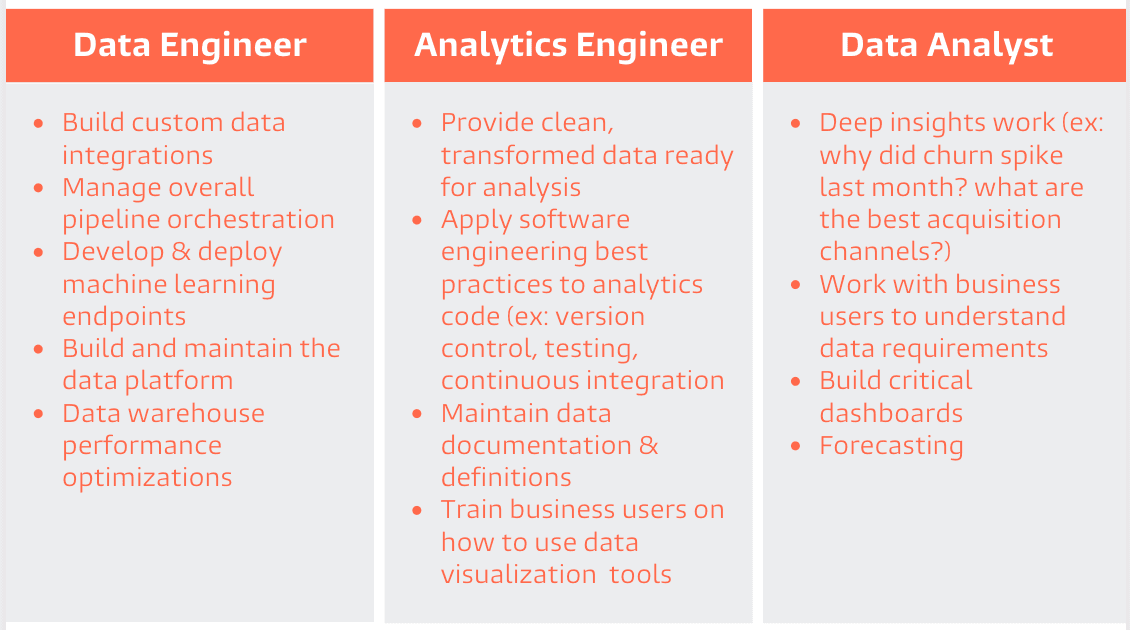 Source: https://www.getdbt.com/blog/what-is-analytics-engineering
In my mental model, engineers are closer to systems and analysts are closer to stakeholders. Analytics engineers can evolve to the point where they can mix the best of both worlds.
That’s why this role is, in my opinion, the best path to pursue if you want to grow your skills as much as possible before looking for specialization.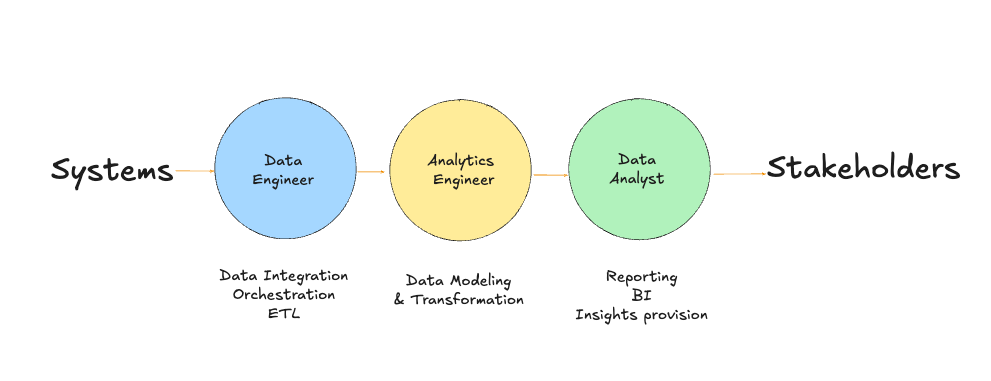 Image generated by the author.
This profile, from a technical perspective, comes with:
-
Advanced SQL skills to translate complex business logic into ready-to-use data models
-
Data modeling techniques to focus on performance and business use cases
-
Orchestration basics to ensure automated workflows
-
Version control, because using Git is non-negotiable and all data transformations should be easy to review over time
-
Knowledge of cloud data warehouses, with ecosystems such as BigQuery or Snowflake, to improve storage and compute performance
-
A data testing mindset to ensure data matches expected outcomes before stakeholders catch the weak spots
-
Documentation and communication skills, not only for technical but also for non-technical people
But don’t get confused, dbt is a great tool to add to your stack as an Analytics Engineer, but it doesn’t make you an Analytics Engineer; it’s the mindset behind it that makes it a powerful path to pursue.
I followed many of this principle when I swtiched my career focus:
📦 TL;DR
-
Data Analyst on Steroids is the most flexible, future-proof data career path
-
Perfect fit for small teams/startups: become the ultimate generalist
-
Independence from other teams: unblock yourself, own your workflows
-
Easy pivots to Data Science or Engineering: you already know most fundamentals
-
Evolve from notebook addict to system builder
-
Become an Analytics Engineer and mix the best of both worlds
If you enjoyed the content, hit the like ❤️ button, share, comment, repost, and all those nice things people do when like stuff these days. Glad to know you made it to this part!

Hi, I am Alejandro Aboy. I am currently working as a Data Engineer. I started in digital marketing at 19. I gained experience in website tracking, advertising, and analytics. I also founded my agency. In 2021, I found my passion for data engineering. So, I shifted my career focus, despite lacking a CS degree. I'm now pursuing this path, leveraging my diverse experience and willingness to learn.