I sold more than 170 books by luck. Here’s how I chose the skill to learn so I can do it on purpose.
By The Learning Strategist
Published: 2026-11-04
URL: https://thelearningstrategist.substack.com/p/you-cant-learn-everything-how-to
How I wrote this: the ideas, stories, and words are mine. AI helped me edit the English, the way an editor would.
A few years ago, over coffee, a colleague told me: “I work nonstop. Sure, I leave the office, but at home I keep thinking about bugs, about how to improve the software architecture, about the problems that could come up and the ones that are already coming up. I like my job. But there’s something unfair: even if I worked 24 hours a day, which of course isn’t humanly possible, I couldn’t earn much more than I do. Basically, I feel like I’m giving it my all and getting a good salary, because I’m not complaining. But I have no way to grow just by doing my job. I would have to become a manager, take on more responsibility, and so on. But I want to get rich by leveraging my work: doing it once and selling it 100 times, 1,000 times, a million times.”
The Learning Strategist grew out of that conversation and starts from one precise conviction. Before I talk about skills to learn, I want to state it plainly.
Employment is a phase, not a destination: this is my view. You have a contract to honor, and you honor it well, because the skill you bring every day is your reputation. But the goal that gives meaning to every hour of study is a different one: to sell your work directly to the market, as a freelancer or with a company of your own.
That is the core value of this channel, and it changes how you choose what to learn. If you study to get a raise, any in-demand skill will do. If you study to prepare for the market, every hour is an investment, and you have to choose what to invest in.
That is where this piece’s problem begins. If you work in IT, ten new hot topics arrive every week that look essential. You are competent; you don’t need anyone to explain what AI does or why the cloud matters. You are missing just one thing: time. And with the time you have, you can’t learn a little of everything.
At the end of this piece, you’ll have a clear recipe to decide what is worth learning for you to reach your goals.
1. Every skill pays you back, just not always the way you expect
Looking back over my career, I can’t find a single skill I spent time on that didn’t pay me back sooner or later. Maybe it was intuition, maybe luck, maybe both. But it didn’t always pay back in the way I expected.
I started out as a financial mathematician, writing mathematical models to price complex financial instruments. That is the skill that has cost me the most time, and I have never used it directly: I’m no longer a financial analyst. Indirectly, though, it opened my mind to thinking in terms of costs and benefits, and of return on investment. It didn’t give me a skill I could sell. It gave me the language to measure the value of every skill I acquired afterward.
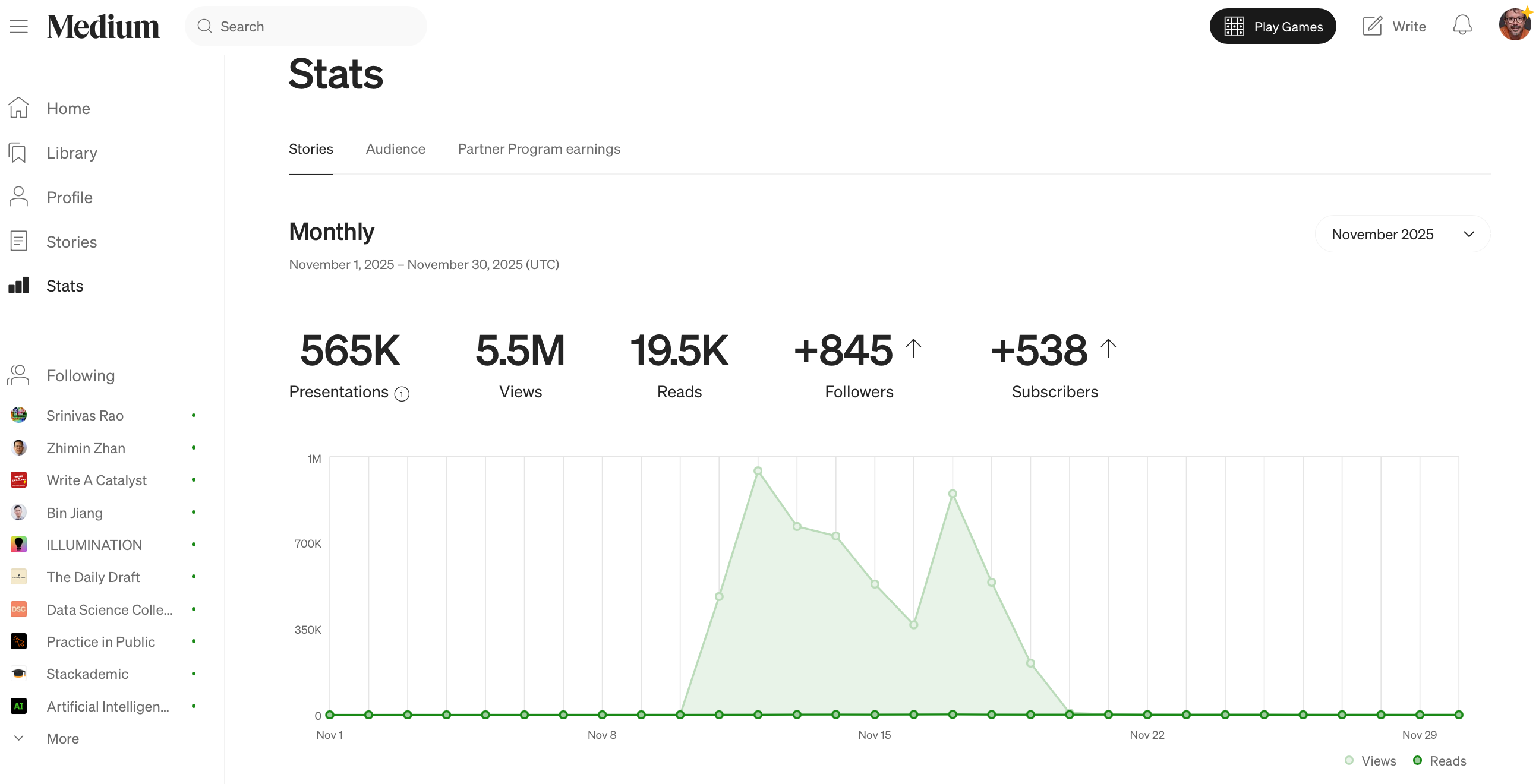
My most recent choice is digital marketing, and it comes from a gap I couldn’t ignore. Between last November and December, I sold more than 170 copies of my book The Game Changer Note-Taking Guide on Gumroad, starting from zero. But that success came from an unexpected, completely uncontrolled boost Medium gave some of my articles, The Tiny Habit That Rewired My Mind being the most read ever. In the opening image you see the November 2025 stats. I got millions of views and earned more than a thousand dollars. Everyone who read those articles was then led through a funnel, one whose name I didn’t even know at the time, to buy my book.
When I first saw the numbers of that Medium boost, going from 20 or 30 views to 100,000, then 500,000, then millions, my first thought was that it had to be a mistake. I remember running to ChatGPT, attaching a screenshot of my Medium stats, and asking: “How is this even possible?” I felt a mix of astonishment and gratitude. But what’s worse is that my mindset was like someone who'd just won the Powerball. I had no idea why that article had worked so well, or why similar articles had instead been relegated to mediocrity.
From that unplanned, unexpected, inexplicable success I took away two opposite proofs. First, that it is possible to sell online and to earn meaningful money. Second, that I had simply been lucky: a series of coincidences. That awareness drove my need to learn digital marketing. I wanted to make my ability to sell books on Gumroad systematic, or at least more controllable.
I had no intuition when I decided to learn digital marketing. It was plain logic: I sold without knowing why I managed to sell, so I clearly lacked marketing skills.
2. Three questions before you invest your time
When I decided digital marketing deserved my time, I asked myself three questions, even if I didn’t realize it then.
Q1. Does my way of making, presenting, or selling what I produce actually work? The way I describe things might not be what marketing recommends, and I’m generally not good at selling myself, or at selling well.
There are countless times when I walk into a meeting and present a winning idea, but can't convey enthusiasm. So being better at selling would benefit my experience as an employee too.
Q2. How much time does this skill take from me, and what do I take that time from? My time is very limited, so any new skill I learn comes from the time I spend doing my daily tasks.
I once had to choose between developing managerial skills and technical ones. I chose managerial skills, and as a result, I could no longer talk with the technical people. Before giving up a skill, you have to work out whether a given set of skills is necessary instead. Choosing the other way, without that check, prepares you for failure.
The lesson learned here is that choosing how to invest time in learning requires strategy. There’s no right answer. There’s the convenient answer to achieve your goals.
Q3. Is it indispensable for the goal I have ten years from now? Today, my main income comes from my job as an employee, working as a technical writer at an IT company. My goal in ten years is to become financially independent by selling my words online. That makes the ability to sell indispensable.
I knew an IT professional who planned to go out on his own within ten years, and he did it successfully. When he had to decide what to learn, he filtered over time: he acquired all the important skills, prioritizing the urgent ones as time went on. The urgent skills were managerial. He was a superb technician, but starting a company requires managerial skills.
Given that decision recipe, let’s dig into details.
3. Breadth, depth, and when to stop
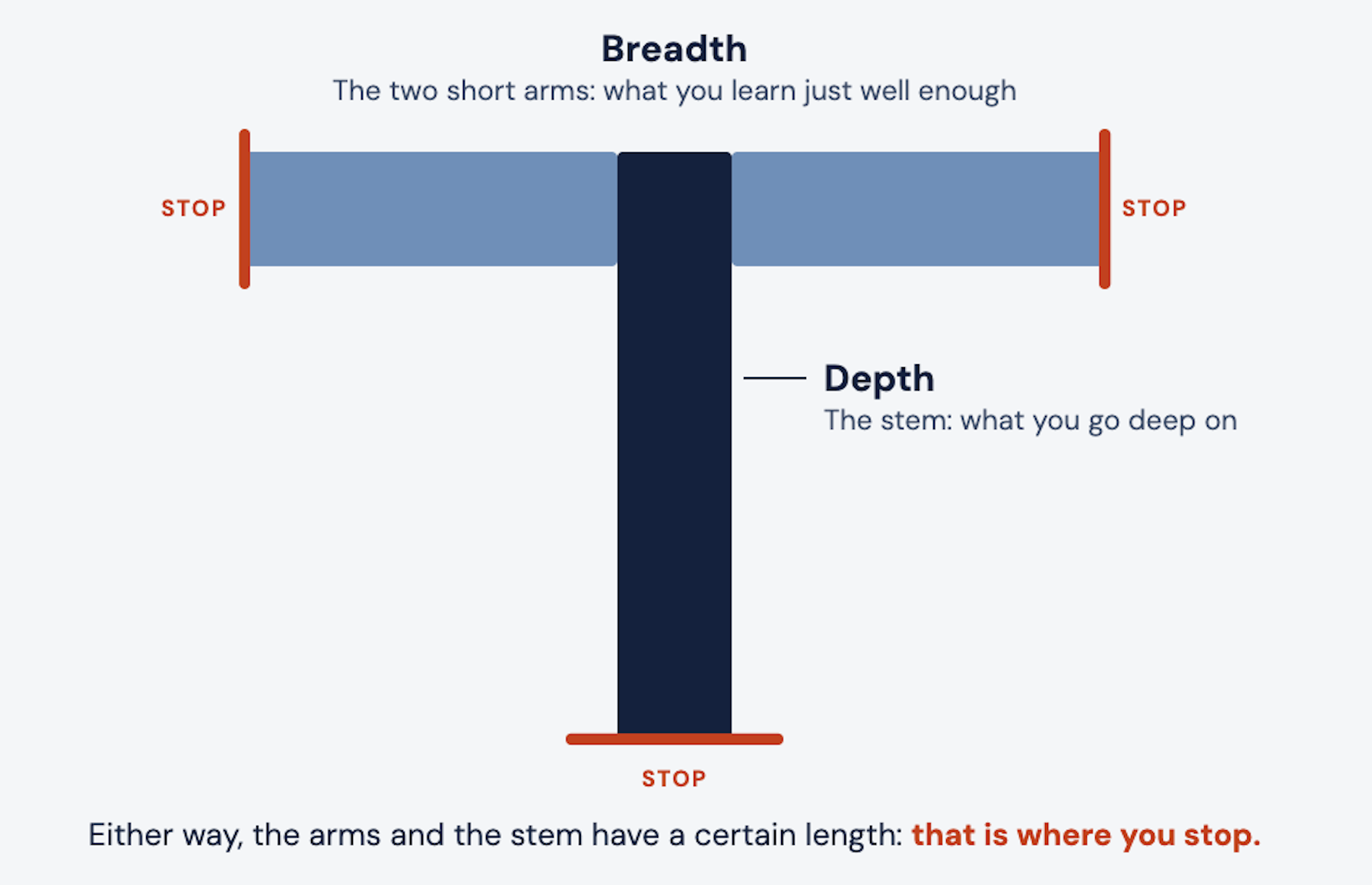
Learning does not move evenly in every direction. It comes down to deciding what to go deep on (depth) and what to know just well enough (breadth). In both cases, you have to understand when to stop. Picture your learning path as tracing a T. The two short arms are what you learn just well enough. The stem is what you go deep on. Either way, the arms and the stem have a certain length: that is where you stop.
Here is the shape of my own T. My breadth is software engineering and project management: they let me talk with the technical people and with the business side of a company. My depth is writing as a tool for learning and for transferring knowledge, from technical writing to the words I sell online.
I got to technical writing through project management and agile. My experience showed me that, despite all the practices and all the guidance on how to organize work, the problem was never what to do. The problem remained how to communicate. Knowledge transfer is the key to making your work effective in information technology. Technical writing is a bridge between different mindsets and languages, typically the technical and the business ones, so it sits exactly where the problem is. That is why I dedicated myself to it.
My criterion for turning breadth into depth is simple: I always learn with a goal in mind, a predefined objective. If no goal calls for depth, a skill stays in breadth. And once the goal is reached, I go no further.
I have caught myself going well beyond what was needed. When I was a Scrum Master, I was learning the fundamentals and practices of agile. That deep dive lasted a couple of years, but I could have stopped after the first. Not because the topic didn’t deserve it, but because, in the context I was in, the extra depth was completely wasted: it equipped me with a language, and above all with goals in mind, that couldn’t be realized in the setting where I was working as a Scrum Master. So that time was wasted tactically, because by the time I had absorbed it, it was useless there. But I treasure it, because it is now part of my managerial skills, which work inside me and let me think about a future as an entrepreneur.
Even investing too much in a skill is never a waste in the long term. In the short term, it might be, instead.
4. This week’s exercise
Ask yourself one question this week: why does my employer pay me a salary?
Answer in a single sentence, one that makes concrete your awareness of the business value of your work. Then run that sentence through the three questions above, and ask yourself to what extent the value you give your company can become the value you deliver to your own clients.
Here is my own answer. My company pays me because my work lets it satisfy its customers, win new ones, and keep the ones it already has, and in this way grow and remain a financially healthy company with a sustainable economic model. That is why my company pays me, which won’t make me rich. Why? Because it pays me for my time, not for my output.
The only way to escape the trap of exchanging time for money is to go to the market. Not easy, but feasible when starting from what you’re already good at, and what your employer is willing to pay you for.
5. Where are you on the path?
One last thing. Right now, is it more important to be a good employee because you’re not yet at the point where you can present yourself to the market? Or should you start intensely accumulating the skills that will let you enter the market independently? This is about being aware of your own path, and of the precise moment you are at in it.
Two turning points can tell you. The first signals that you need to move from employee to freelancer or business owner: you understand the profound unfairness of trading time for money. The second signals that you are ready to leave the condition of an employee: you have found and validated a problem that people are willing to pay for, and one that scales for you. You do it once, and you sell it N times.
I once knew an Android developer who didn’t feel valued in his role and in the context he was in. He resigned and founded a company that succeeded. It was tough but feasible. This was his path. What’s yours?
Closing
The choice of which skills to acquire in a limited amount of time is made by the medium- and long-term goals you set for yourself. Keep asking: Is this skill, or that other one, a piece that lets me implement my strategy to become an entrepreneur and free myself from the unfair condition of being an employee?
The takeaway is that learning is a strategic investment aligned with defined goals.
The core goal here at The Learning Strategist is to move beyond being an employee and reach the market. Your long-term goal might be different, but the recipe stays the same. Your goal is the North Star. Learning is the superpower that brings you to the destination.
— The Learning Strategist