By Mark Wils
Published: 2026-02-24
URL: https://thecreatorplaybook.substack.com/p/distribution-is-everything-in-2026
Every Sunday, I go back through the posts I bookmarked during the week, looking for ideas to inspire new content.
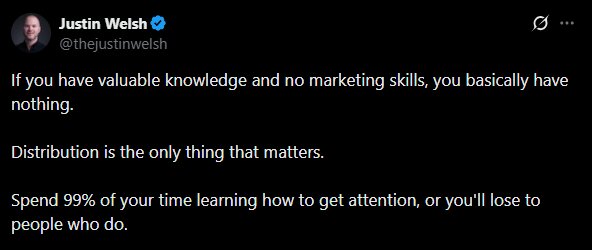
Last Sunday, I found one I really liked in my X bookmarks. It was from well-known creator Justin Welsh, and it immediately stood out.
Here’s the screenshot below.
Truly, distribution is everything in 2026.
You have to understand how important it is in the digital age.
Having skills but no audience to share your skills with is useless.
Creators that succeed online aren’t necessarily the best at what they do. They’re often the best known.
You can have the greatest service or product, but if no one knows you exist, you don’t have a business.
Your best bet is paid ads, but that isn’t cheap either.
Here’s the thing: 10/10 ability x 0/10 visibility = 0 opportunities.
On the other hand, 10/10 ability x 10/10 visbility = 100 opportunituies
If you’ve already nailed ability, visibility is the only part of the equation you need.
The good thing is, we’re living in 2026.
The platforms already exist and are mostly free to use: Substack, LinkedIn, X, YouTube, etc.
But the problem is that many creators chase ‘easy’ platform payments like YouTube AdSense, X payouts, the Medium Partner Program, etc.
They think it’s a lucrative way to monetize their content, which isn’t.
And here’s why.
1. You have zero control.
Relying on a platform for your income is no different from having a job where you can be let go without notice.
I experienced this firsthand on Medium, where I was earning around $500+ a month from the partner program.
Then, almost overnight, the platform restructured its payment model and slashed writers' earnings.
My income dropped significantly, and there was nothing I could do about it.
On top of that, platforms can suspend accounts at any time, for any reason, with little recourse. That’s not a business. That’s borrowed ground.
2. It’s a race that very few people win.
Yes, MrBeast makes millions from YouTube.
But for every MrBeast, there are millions of creators earning pennies, grinding away, and slowly burning out.
The 80/20 rule is always in effect — a small percentage of creators capture the overwhelming majority of platform revenue.
Not everyone has the combination of talent, timing, resources, and luck required to reach the top.
Building your livelihood around that lottery isn’t a strategy.
What you need to build instead
The best thing you can build in 2026 is a distribution channel. That is your email list.
If you’re already writing on Substack, you’re already building an audience that lets you collect emails.
Every subscriber who signs up is handing you their email address and saying I want to hear more from you. That’s a valuable asset you own.
This is really important in 2026 because ad costs are getting expensive by the day.
With just a few hundred subscribers, you can launch offers to your list and earn a comfortable living without relying on any platform for payment.
The mistake most Substack writers make
Here’s the distinction that changes everything: your Substack is a distribution channel, not a conversion channel.
Most creators on Substack conflate the two. They assume the natural way to monetize a newsletter is to flip on paid subscriptions.
For some, that works.
But if you have valuable skills and expertise to offer, a $5/month paywall is leaving significant money on the table and often drives away the very audience you’re trying to build trust with.
I made this mistake myself.
I spent months optimizing for paid subscribers when I should have been using my newsletter to build trust and channel readers toward higher-value offers on the backend.
The system that actually works looks like this:
Create an offer → create content for that offer → grow an audience via email → sell your offer
Following this system, you create content on Substack to attract your ideal audience, then channel that to a funnel to sell your offers.
Doing it wrong leads to frustration, burnout, and eventually giving up.
Done right, it becomes a system that consistently brings clients and customers to your business without relying on any platform’s algorithm or payments.
Once I made this shift, everything changed. I stopped chasing paid subscribers and started running a business that generates real income.
I grew my Substack to 3,000 subscribers in 12 months and turned it into a newsletter generating over $3k/month.
In this playbook, I share the exact strategies I use to grow faster, attract engaged readers, and monetize consistently on Substack.
Love this post? Please share/restack so others find it too🙏🙏