How two opposing data-flow philosophies shape scalability, freshness, and complexity in distributed systems
By The Coding Gopher
Published: 2026-11-03
URL: https://thecodinggopher.substack.com/p/push-vs-pull-architecture
Introduction
Every distributed system eventually has to answer a question that sounds trivial but rarely is: when a piece of data changes, whose job is it to move it? Does the system that produced the change reach out and deliver it, or does the system that needs it reach back and ask?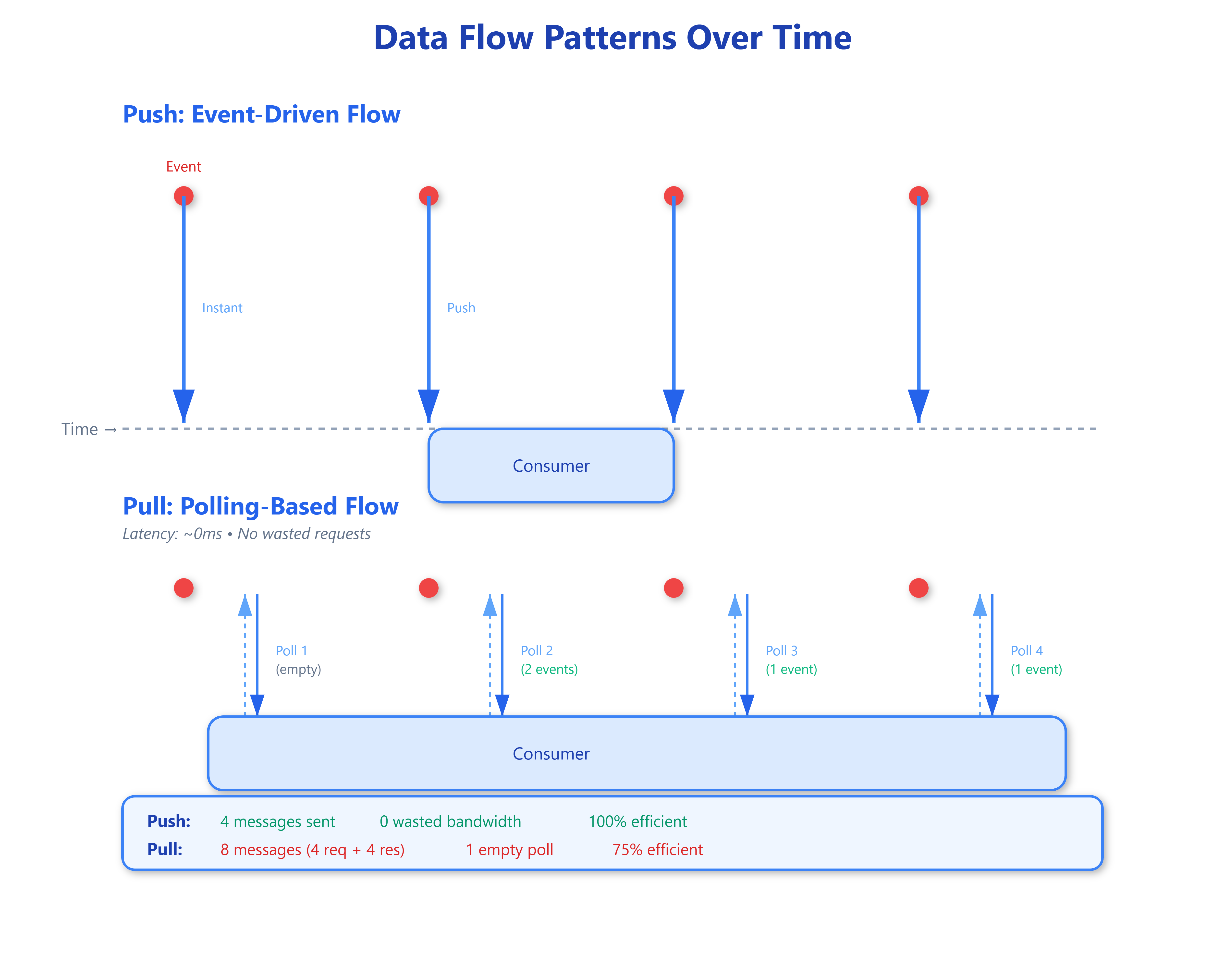 The core difference between push and pull architectures lies in which component initiates the data transfer. In a push architecture, the data producer proactively sends data to the consumer as soon as it becomes available. In a pull architecture, the data consumer explicitly requests information from the producer only when it is ready to process it.
That single decision — who initiates the transfer — is the fork in the road that separates push architecture from pull architecture. It’s not a niche implementation detail. It’s a structural choice that determines how your system behaves under load, how quickly it reacts to change, how much it costs to run, and how it fails when something goes wrong. A chat application and a nightly billing job are both “just moving data from one place to another,” but nobody would design them the same way, and the reason comes down almost entirely to this one question.
Most engineers learn the difference the hard way — by polling an API too aggressively and getting rate-limited, or by building a WebSocket service that falls over the moment ten thousand people join a livestream at once. This article is the version of that lesson you don’t have to learn in production.
Join a community of senior engineers. Subscribe and get FREE access to System Design deep dives.
Push: The Producer Takes the Initiative
In a push system, the producer doesn’t wait to be asked. The moment it has something new — a price change, a completed payment, a new chat message — it sends it. The consumer’s job is simply to be listening.
This is the architecture behind WebSocket connections that keep a trading dashboard updating in real time, Server-Sent Events that stream live scores to a browser, and webhooks like the ones Stripe fires the instant a transaction clears. It’s also the model underneath most publish/subscribe systems, where a broker takes a single event and fans it out to every interested subscriber at once.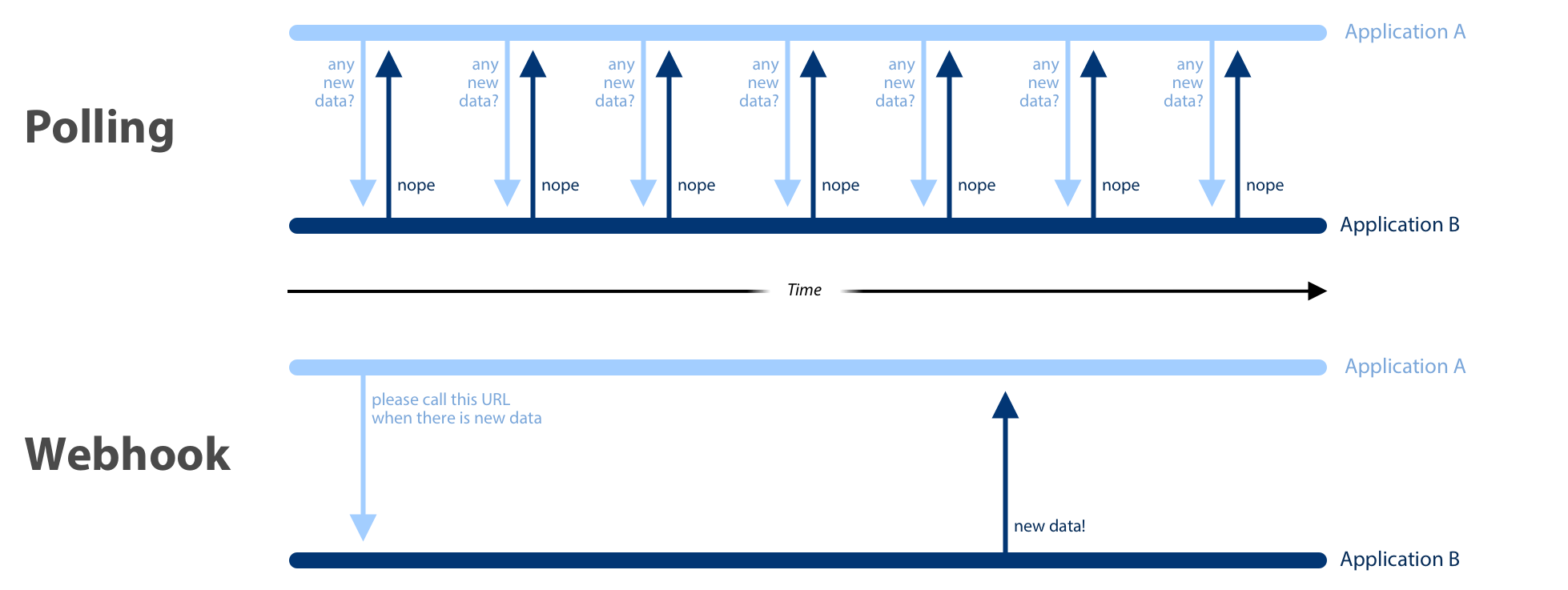 A webhook is a push-based architecture (often called a reverse API). Instead of a client repeatedly pulling or polling a server for data, the server automatically pushes an HTTP POST request to a pre-registered client URL the exact moment a specific event occurs.
The reason push exists is latency. If you want a user to see a new message within fifty milliseconds of it being sent, you cannot afford to wait for them to ask if anything happened — you have to tell them the instant it does. Push is also, in a narrow sense, efficient: it never wastes a request checking on data that hasn’t changed. Every message sent corresponds to something actually worth knowing.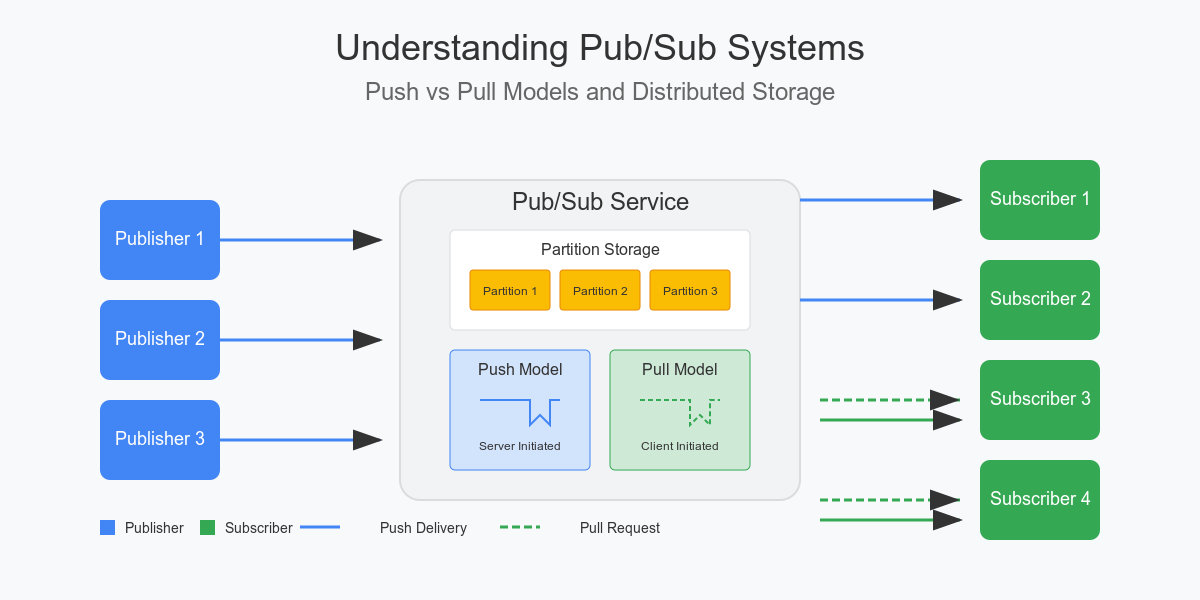
That efficiency, though, is bought with complexity, and the producer pays for it. A push system has to know who’s listening, which means managing potentially millions of open connections, each one holding memory and state. It has to decide what happens when a consumer can’t keep up — do you buffer the backlog, drop the oldest messages, or throttle the sender? This is the backpressure problem, and it has no universally correct answer, only trade-offs suited to the situation. And it has to handle consumers who simply vanish: a phone that loses signal, a browser tab that closes. If that consumer was mid-connection when an important event fired, the data may be gone unless the system was built to replay it. None of this is insurmountable, but it means a push-based producer is doing real, ongoing work to manage its audience — work a pull-based producer never has to think about.
In a push-based architecture, the back pressure problem happens when a data producer sends messages or events faster than a consumer can process them. Because the producer dictates the pace, the consumer gets overwhelmed, which causes memory exhaustion, high latency, or system crashes.
Build Redis, Git, Docker & Claude Code From Scratch
Want to become a better software engineer?
Trusted by engineers at Google, NVIDIA, and Anthropic, CodeCrafters helps you rebuild technologies like Redis, Git, Docker, and Claude Code from scratch so you can deeply understand how real systems work.
We’ve partnered with CodeCrafters to give all readers an exclusive 40% lifetime discount.
💡 Engineers may expense platforms like this through their team’s learning budget.
Start Building & Unlock 40% Off
Pull: The Consumer Sets the Pace
Pull architecture reverses the relationship entirely. The producer does nothing until asked. It sits there, holding the current state, and waits for a consumer to come and get it.
This is the world of REST APIs, where a client calls an endpoint and receives whatever the server currently has. It’s the world of scheduled batch jobs pulling last night’s transactions out of a database at 3 a.m. It’s Prometheus, scraping a metrics endpoint on a fixed interval rather than waiting for applications to report their own health. And it’s Kafka consumers, who — even though producers are pushing messages into a topic — choose for themselves when and how fast to pull those messages back out.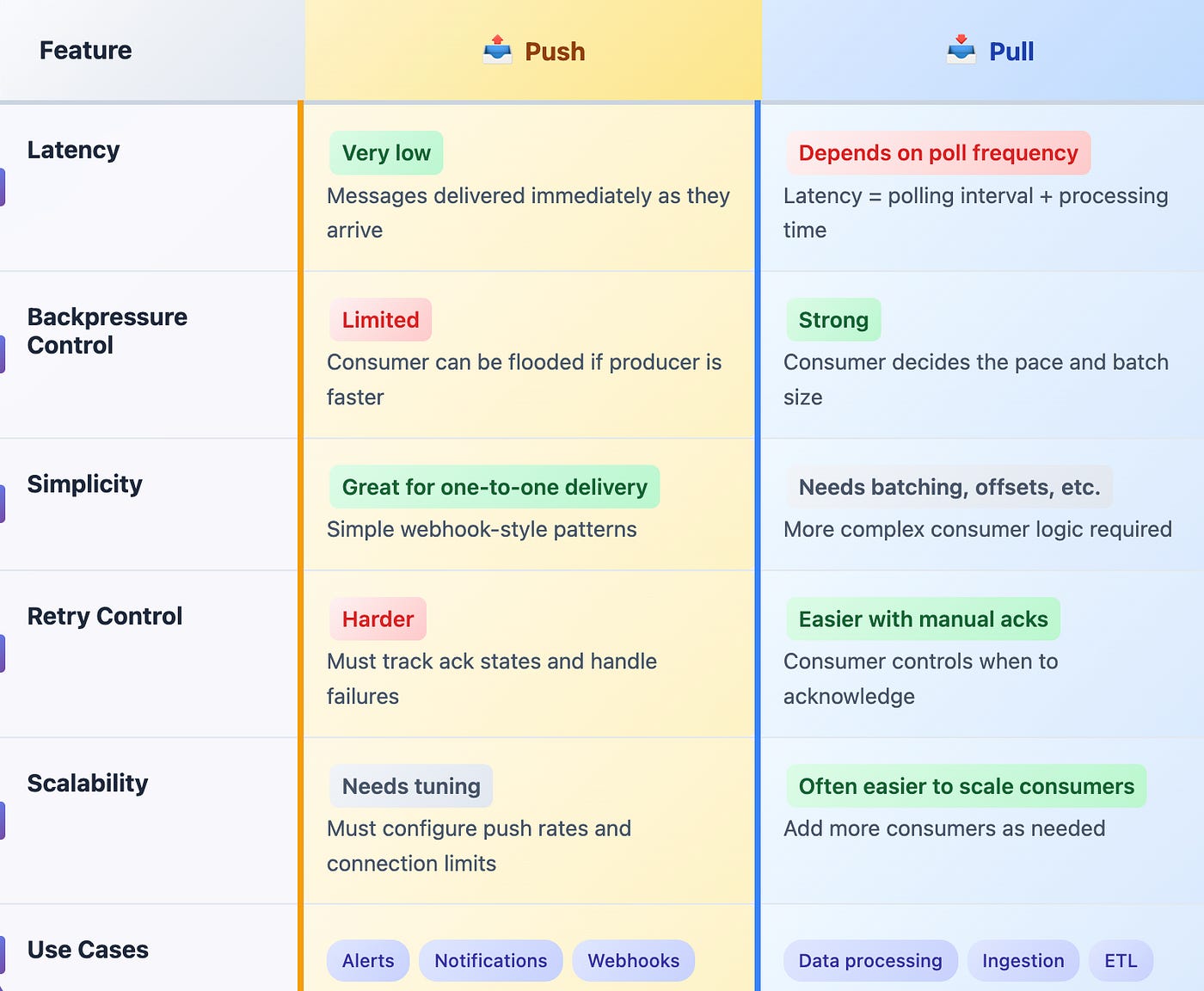
The advantage of pull is control, and control turns out to solve a surprising number of problems at once. Because the consumer decides when to ask, there’s no backpressure to manage — a slow consumer just asks less often, and nothing on the producer’s side has to change to accommodate that. Because nothing is ever “in flight” waiting to be delivered, a consumer that goes offline for an hour hasn’t lost anything; it just picks up the current state whenever it reconnects. And because the producer’s only job is to answer requests as they arrive, pull systems tend to be dramatically simpler to build — which is precisely why decades of infrastructure, from load balancers to CDNs to HTTP caching, has been built to make stateless request/response systems scale almost effortlessly.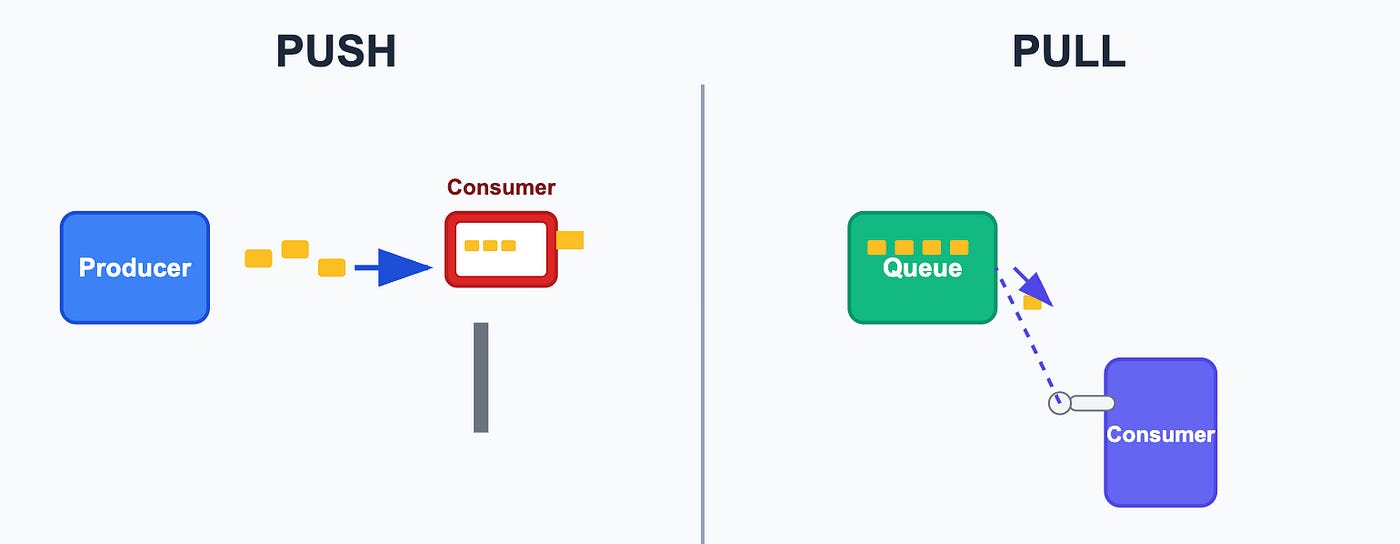 A pull-based architecture is a design pattern where the consumer (client) initiates the data transfer or work request, actively polling or fetching data from the producer (server) only when it has the capacity to process it. This contrasts with push models where the server forces data downstream.
The cost is time. Data is only as fresh as the last time someone asked for it, so there’s always a gap between when something changes and when a consumer finds out — a gap defined entirely by how often it polls. Close that gap by polling more frequently, and you pay for it in wasted requests: calls that return “nothing’s changed” far more often than they return anything useful. Pull doesn’t eliminate latency so much as let you buy it down, one API call at a time, at a cost that rises the closer you get to real time.
Join a community of senior engineers. Subscribe and get FREE access to System Design deep dives.
Two Philosophies, One Spectrum
It’s tempting to think of push and pull as two separate tools you choose between, but they’re better understood as opposite ends of a single trade-off: immediacy versus control. Push spends producer complexity to buy consumers a faster reaction time. Pull spends a little latency to buy simplicity and resilience on both sides.
Even their failure modes mirror each other. A push system’s hardest problem is fan-out — delivering one event to a huge, unpredictable population of listeners without falling over. A pull system’s hardest problem is the inverse: absorbing a huge volume of simultaneous incoming requests. Both are genuinely hard at scale, but only one of them — handling incoming requests — has forty years of caching, load balancing, and horizontal scaling techniques built specifically to solve it. That asymmetry is a big part of why pull tends to be the default choice, and push is reached for deliberately, when latency actually matters enough to justify the extra machinery.
Coupling follows the same pattern. A push producer has to know something about its consumers just to deliver to them, which binds the two together. A pull producer can remain almost entirely ignorant of who’s calling it — which is exactly the kind of loose coupling that makes systems easier to change, deploy, and scale independently over time.
Why Almost Nobody Picks Just One
In practice, mature systems rarely commit to push or pull exclusively, because most real applications have some data that needs to be instant and other data that can comfortably wait — and building the whole system around whichever one is more dramatic is usually a mistake.
Long polling is the classic hybrid: the client makes what looks like an ordinary pull request, except the server holds it open until something worth reporting actually happens, then responds. It’s pull’s plumbing wearing push’s clothes. Kafka is a hybrid in the other direction — producers push events into a topic the moment they occur, but consumers pull those events out at whatever pace suits them, which is why it comfortably supports both a fraud-detection service that needs to react in milliseconds and a data warehouse job that only cares about yesterday’s batch. Many webhook-based integrations quietly assume this duality too: a webhook delivers the fast path, but a polling endpoint sits behind it as a reconciliation mechanism, in case a delivery is dropped and the two systems drift out of sync. Even something as simple as a CDN is secretly both — origins push invalidation signals out to edge nodes the moment content changes, but the edge nodes still pull fresh copies on demand when an actual visitor shows up.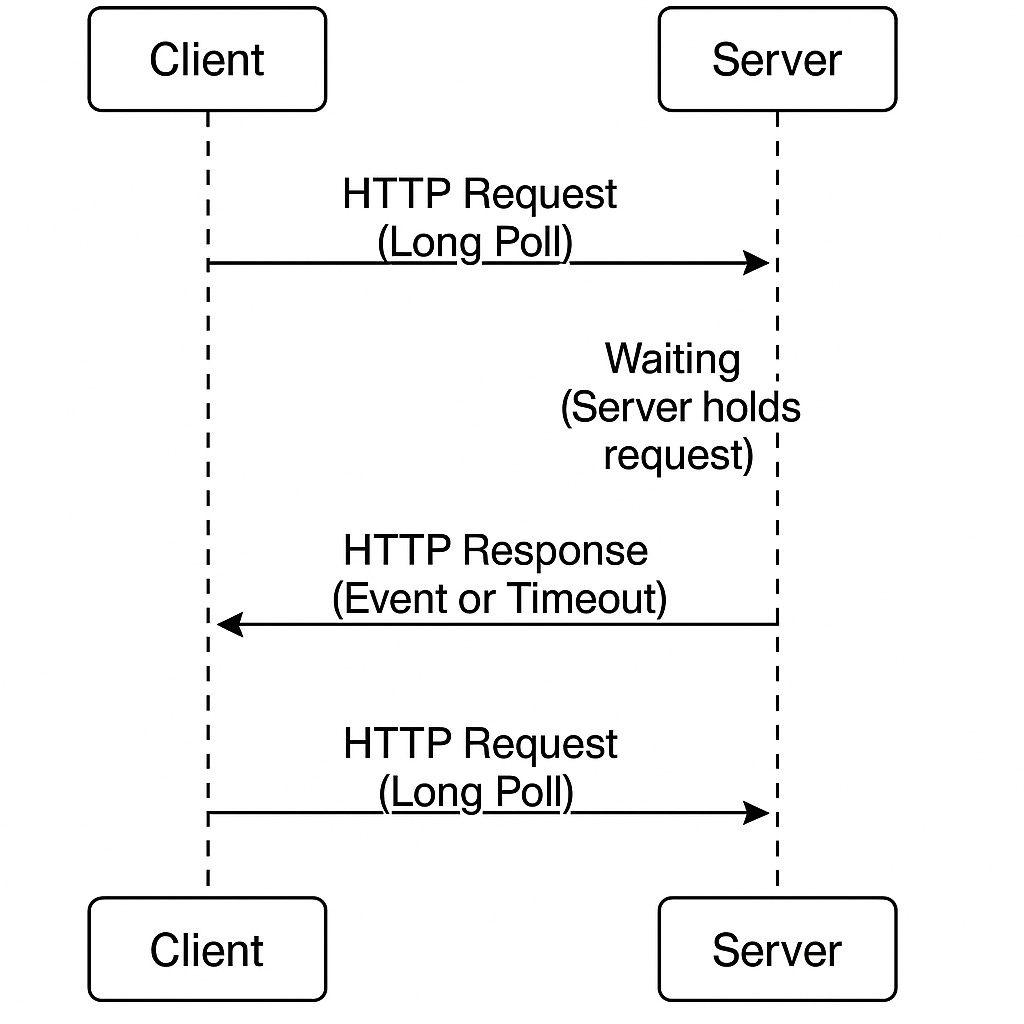 Long polling is a web communication method where the client asks the server for data. Instead of replying right away with an empty answer, the server holds the connection open until new data is ready. Once the data arrives, the server sends it, and the client instantly starts a new request.
None of these are compromises or half-measures. They’re evidence that push and pull were never really rivals — they’re tools that work best when applied to the specific slice of the problem each one is good at.
Join a community of senior engineers. Subscribe and get FREE access to System Design deep dives.
Making the Call
The most useful first question isn’t “push or pull” in the abstract — it’s how much a delay would actually cost you. A trading platform, a chat app, a fraud alert: these are systems where a few seconds of staleness is a real problem, and that’s where push earns its complexity. A nightly analytics rollup or a weekly report doesn’t have that problem — nobody is watching it in real time, so there’s no reason to build the infrastructure that would deliver it in real time.
The shape of your consumer population matters just as much as the data itself. A small, known set of consumers is something a push system can track without much strain. A sprawling, unpredictable one — mobile clients on flaky networks, third-party integrators you’ve never met — tends to behave far better under pull, where each client can retry on its own terms instead of forcing your server to babysit a fragile, long-lived connection to every single one of them.
It’s also worth asking, honestly, how often the data actually changes. Push earns its keep when updates are frequent enough that polling would mean constantly asking and rarely hearing anything new. When updates are rare, pull avoids paying for infrastructure — connection management, backpressure handling, delivery guarantees — that would spend most of its time idle.
And then there’s the question of guarantees. If a consumer being offline for ten minutes cannot mean losing data, pure push is usually the wrong instinct — you want a durable queue in between, something that lets a producer push in and a consumer pull out on its own schedule, so an offline window becomes a delay rather than a loss. That, not coincidentally, is exactly the hybrid pattern most serious event-driven systems converge on.
Conclusion
Push and pull aren’t really competing answers to the same question. They’re answers to two different questions — “how fast can this get there?” versus “how much control do I want over receiving it?” — that happen to live on opposite ends of the same design space. The systems that hold up under real-world load are rarely the ones that pick a side and apply it everywhere. They’re the ones where someone looked closely enough at the data to know which parts genuinely need to arrive the instant they exist, and which parts can simply wait to be asked for — and built each piece accordingly.