From Genoa’s docks to Harvard Yard: dockworkers refuse military cargo, graduate workers strike again, and union members fight to keep their elections. Plus, remembering Dolores Huerta.
By Alex Press
Published: 2026-11-02
URL: https://thealexpress.substack.com/p/roll-call-october-26november-1-2026
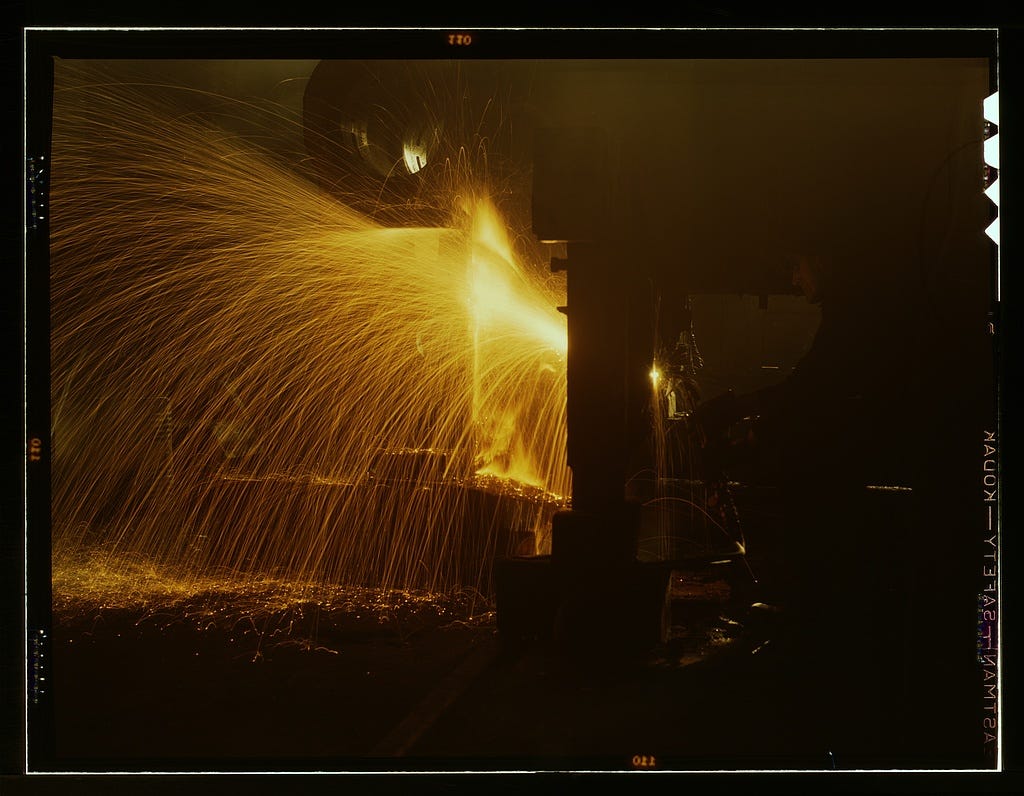 A welder at the Chicago and North Western Railroad’s Proviso yard, December 1942. Jack Delano / Library of Congress.
Welcome back to Roll Call. In June, an NLRB judge ordered Amazon to bargain with the Teamsters at its DCK6 warehouse in San Francisco. A majority of workers had signed union cards and demanded recognition. Before the board’s 2023 Cemex decision, Amazon could have refused and left the workers to petition for an election. Under Cemex, the responsibility shifted: Amazon had to recognize the union or request an election. It did neither. Amazon is challenging the ruling.
That makes litigation over the original Cemex case worth following for anyone concerned with organizing Amazon. On October 19, the Supreme Court declined to hear the concrete company’s appeal of an order requiring it to bargain with the Teamsters. But the Ninth Circuit had enforced that order under the older Gissel standard, without deciding whether the newer framework was valid. The Supreme Court’s refusal to hear the appeal leaves that question open. For Cemex’s drivers, who had majority support for their union in 2018, the bargaining order stands after nearly eight years of waiting.
Before the rest of the week’s news, an appeal: if you find Roll Call useful, become a paying subscriber. Very few people pay for this Substack. I’m finding these roundups useful myself—anyone who cares about the labor movement should be paying attention to what it’s actually up to, down to the two-person bargaining units—but they take a fair amount of time. I’m unemployed, and I’d like to keep doing this and even publish reporting here, stories that will otherwise go unwritten, but that’s hard to do when I’m writing for almost nothing. Thanks to those of you who already pay. And feel free to send tips, especially from your workplace.
Dockworkers against war. Dockworkers held strikes, blockades, and demonstrations October 30 against arms shipments, military use of civilian ports, and rearmament. Organizers reported participation at 113 ports in 22 countries and regions, with different forms of action from port to port. The mobilization grew out of a declaration agreed by Mediterranean port unions in Istanbul in May.
US participation was limited. In Oakland, ILWU Locals 10 and 34 joined the day of action with a noon rally at the port. Longshore workers and Palestinian and Filipino activists spoke against the genocide in Gaza, wars abroad, and attacks on workers at home.
Alex Colston was reporting from the picket line in Genoa, where dockworkers and students blocked roads to the terminals, burned tires, and marched through the city as part of USB’s general strike. “Today we’ll block everything, then march into the port, because the port is our home,” CALP dockworker organizer José Nivoi said. The march subsequently entered the port.
Colston’s dispatch from Livorno shows the organizing behind the international action. On October 22, Global Sumud Flotilla sailboats obstructed the arrival of the Sunaid X, which local unions identified as a supplier to the US Navy’s Sigonella base. Dockworkers picketed on land; after the ship docked, the night shift refused to service it, followed by the morning shift. Police seized the three sailboats and detained ten activists, later releasing them. The strike ended when port officials and the terminal operator agreed to meet with workers. Workers said they were promised a cargo inspection, but Colston could not establish whether it happened. Police were still holding the three sailboats. “If a ship is delayed by one day, the delays pile up, and a logistics mechanism breaks,” USB organizer Giovanni Ceraolo told him.
Dolores Huerta. The legendary farmworker organizer and United Farm Workers cofounder died October 28 at home in Bakersfield, aged 96. Before becoming an organizer, Huerta taught children of farmworkers in Stockton. “I couldn’t stand seeing the children coming to school barefoot, so hungry, so poor,” she recalled. She became active in the Community Service Organization, registering voters and challenging discrimination, and cofounded the National Farm Workers Association with César Chávez in 1962.
When Filipino farmworkers led by Larry Itliong walked out of Delano’s vineyards in 1965, Huerta’s National Farm Workers Association joined the strike, and the two organizations merged in 1966. She helped organize the national grape boycott and negotiated contracts with growers. She also lobbied for California’s 1975 Agricultural Labor Relations Act, which gave the state’s farmworkers the right to bargain collectively.
In March, Huerta said that Chávez had coerced her into sex on one occasion and raped her on another in the 1960s. Both resulted in pregnancies she concealed; she arranged for the two children to be raised by other families. She said she had kept silent for decades because she feared damaging the farmworker movement, a damning sentiment about the labor movement. It is Chávez who risked these workers’ gains with his behavior, which was a massive gift to their opponents. A good organizer empowers those around them, teaching them all they know; Chávez did the opposite, preferring to use his power to commit horrific acts of violence guaranteed to cow those around him.
I don’t want what Chávez did to Huerta to become the last word on her life. She was organizing until the very end. At 95, she spoke at the June 2025 Los Angeles rally demanding the release of SEIU California president David Huerta and other ICE detainees. This August, at 96, she was still at rallies at the California Capitol, opposing food-aid cuts, calling for pesticide controls, and pressing lawmakers to rein in corporate power. May we all demonstrate such steadfast commitment.
Strikes and Bargaining
Harvard, again. Graduate workers went out October 27 for the second time this year, after their spring strike ended without a contract. “The richest university in the world can afford to pay its workers,” union vice president Evan Lemire said.
HGSU–UAW represents more than 4,000 student workers. They want higher pay, protections for noncitizens, and a way to take harassment and discrimination complaints to an independent arbitrator. Harvard says the second walkout over the same demands is an “intermittent” strike and therefore unprotected by labor law. The union says this is a separate, legally protected strike.
The Crucible. The industrial arts school in West Oakland, CA, abruptly closed October 25, after employees received emails the previous afternoon citing financial problems. The shutdown interrupted classes in blacksmithing, glassblowing, welding, and other crafts while faculty and staff, organized as The Dedicated Cru with AFSCME Council 57, were bargaining. Students’ artwork was left inside. Employees also worried about Nopal, the very cute shop cat, who one employee ended up taking to live with them.
“How could you know we were headed in this direction for so long and not have a plan in place?” development manager Olivia Hara asked. Workers say management ignored union proposals to reduce contracting and spread staffing cuts across all levels; they want a say in how the school reopens. The board’s October 30 update said it had paid all earned wages and PTO and had warned the union that the financial problems could force a closure. It did not say whether the school would reopen.