Park Mi-sook came to New York to tell Americans about the death of her son at the “Amazon of Korea.”
By Alex Press
Published: 2026-10-02
URL: https://thealexpress.substack.com/p/please-remember-my-son
In the window of Chinatown Soup, a tiny gallery on Orchard Street, a message attributed to Coupang founder Bom Kim was printed in a blue speech bubble: “Why would he be a hard worker!?” Inside were photographs of Jang Deok-jun as a baby, in his military uniform, and with his family; notebooks filled with his mother’s handwriting; drawings of the warehouse where he worked; and a screen playing surveillance footage. On a table beside the notebooks sat a packet of vanilla wafers.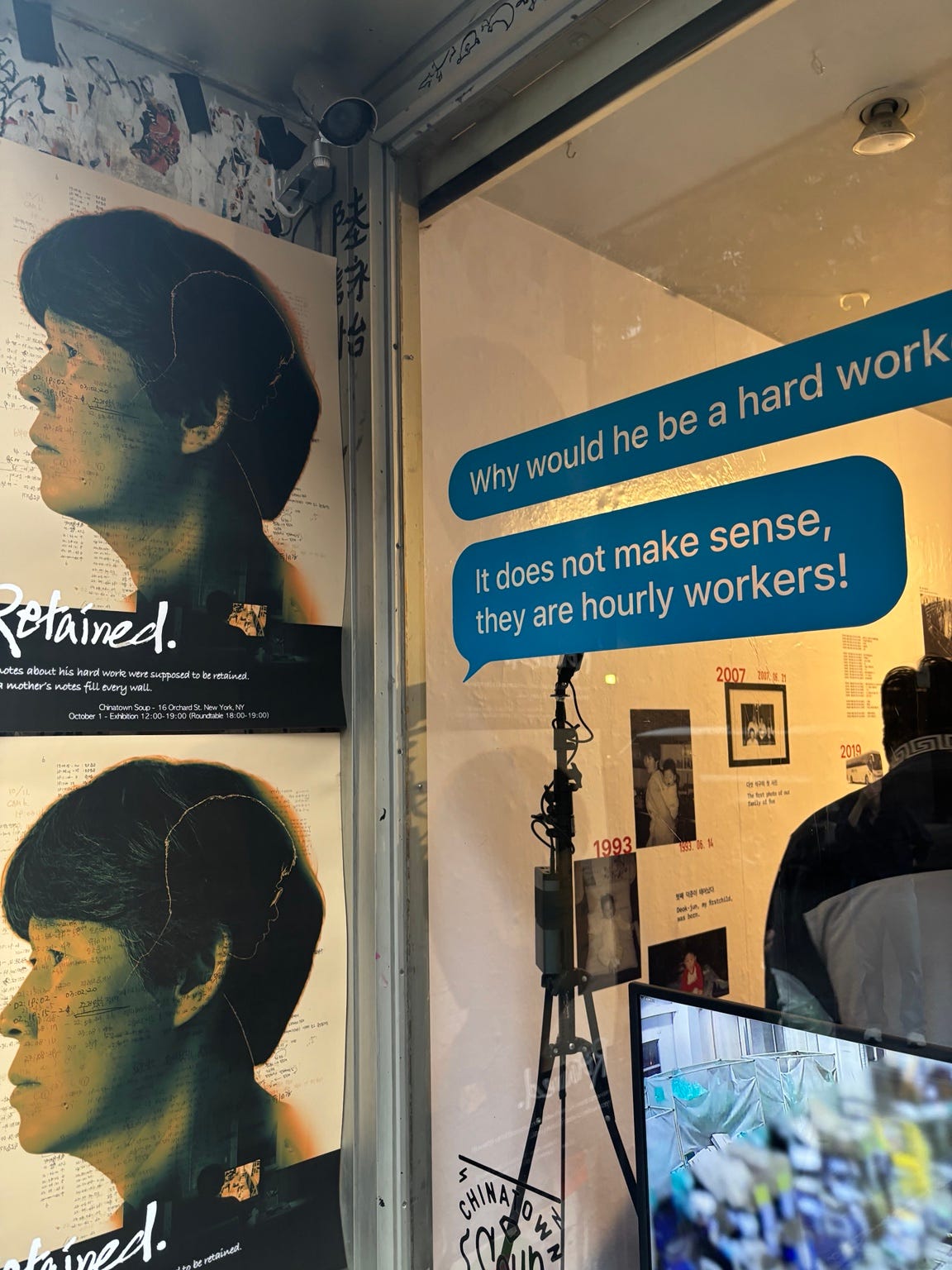 The window at Chinatown Soup, October 1.
“Not understanding the reason he had to die, I spent the past six years retracing his footsteps,” his mother, Park Mi-sook, told the people crowded into the gallery Thursday evening, speaking in Korean through an interpreter. A crew from MBC, the South Korean broadcaster, was filming a documentary about her efforts to hold Coupang accountable. “I watched all the surveillance footage of him returning home, holding a wafer snack for his younger sister, and of him getting off the bus and sharing food with a colleague or coworker at the convenience store, and of him walking out of the door to go to work. Nothing in those videos of my son seemed unusual.”
The Alex Press is a reader-supported publication. To receive new posts and support my work, consider becoming a free or paid subscriber.
Jang was twenty-seven when he died of a heart attack at home after an overnight shift on October 12, 2020. He had spent sixteen months working nights at the Chilgok logistics center of Coupang, the online retailer and delivery company often called the “Amazon of Korea.” In February 2021, the Korea Workers’ Compensation and Welfare Service recognized his death as work-related, citing excessive hours, night shifts, and heavy lifting. He had averaged 58 hours and 38 minutes of work a week in the preceding three months.
Park reviewed hundreds of hours of warehouse surveillance footage, drawing maps and recording her son’s movements. The exhibition, Retained, took its name from another message attributed to Kim, disclosed by South Korean news outlets in December 2025: “Make sure no notes about him working hard are retained!” He disputed the description of Jang as a hard worker: “It does not make sense, they are hourly workers! Paid per hour, not performance!”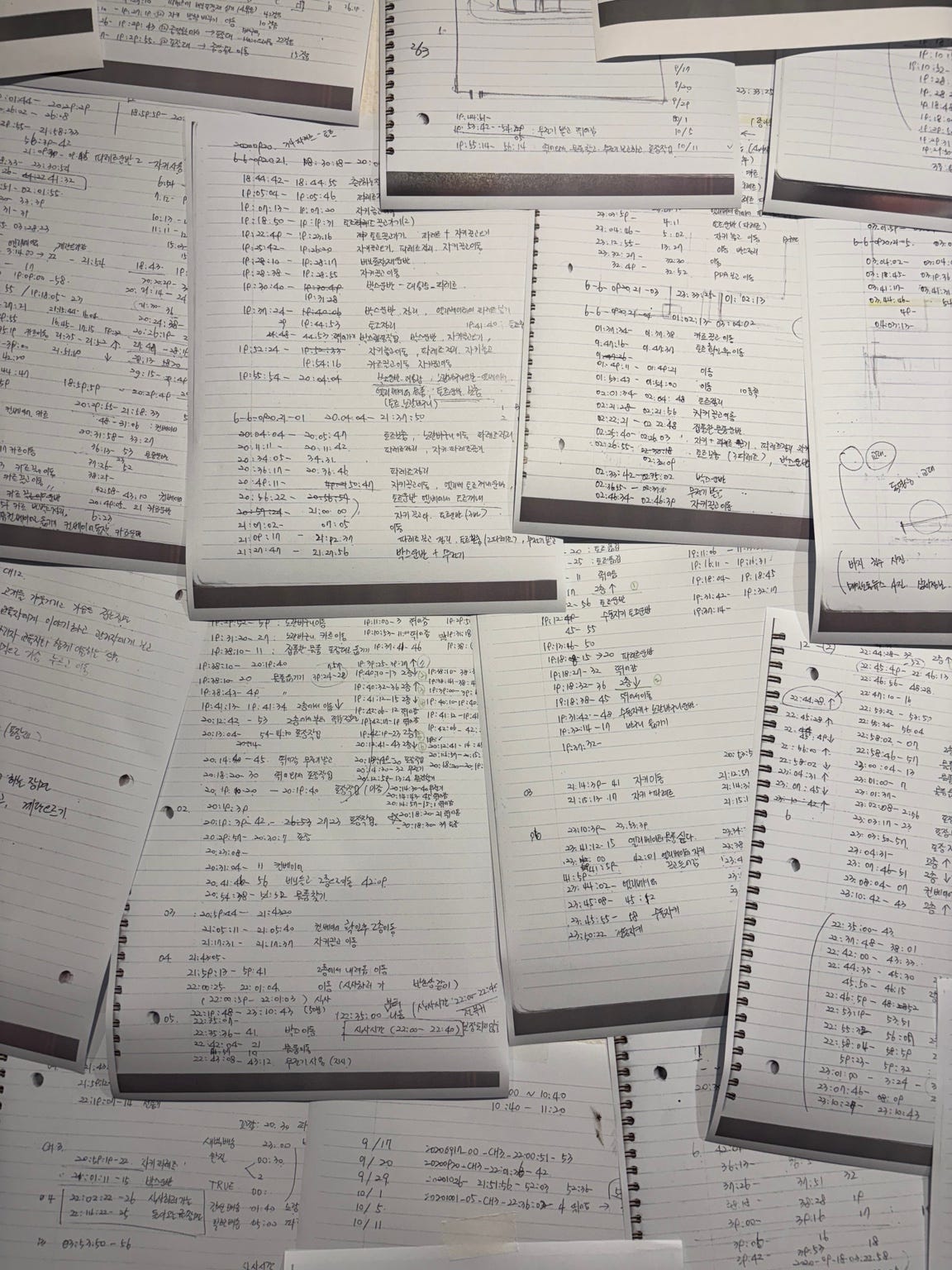 Park’s records of her son’s work, reproduced on the gallery wall.
The reported exchange, reproduced in the exhibition, shows Kim seeking footage of Jang drinking water, waiting, using the bathroom, and walking without a load. “This is not going to help us in the National Assembly TOMORROW MORNING!” reads one message. Coupang denied the cover-up allegations, saying the records were distorted and supplied by a former executive dismissed for workplace misconduct. A union filed a criminal complaint against Kim, and Park appeared before police as a witness in January.
“Rather than creating a safe working environment, Coupang focused on drafting the cover-up guidelines,” Park said Thursday. “This procession of death must stop now.” She wants Kim to acknowledge responsibility, apologize for the alleged cover-up, and take measures to prevent other deaths. Coupang executives publicly apologized for Jang’s death at a National Assembly hearing last December, while declining to address the cover-up allegations.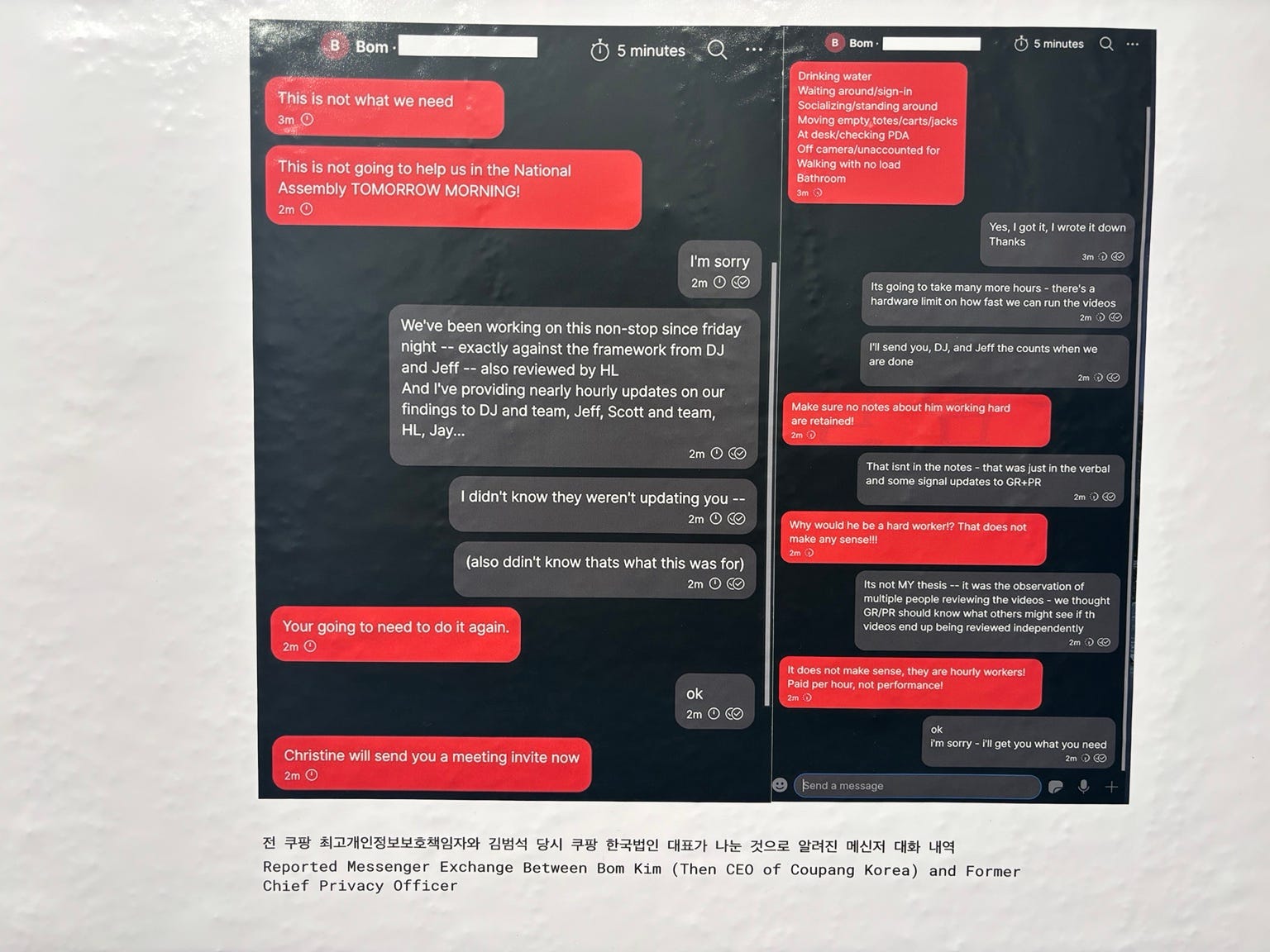 The reported exchange between Bom Kim and a former Coupang chief privacy officer, reproduced in the exhibition.
Minju Bae, a historian and professor at New York University, moderated Thursday' night’s discussion with Park. Bae questioned the term “industrial accident,” saying it failed to capture “the kind of structural conditions of how capitalism works.” “This isn’t really an accident at all,” she said. Coupang’s parent company is incorporated in Delaware, headquartered in Seattle, and listed on the New York Stock Exchange. “The way that global capitalism functions is intentionally layered,” Bae said. “That layering makes it impossible for us to look to the right entity to demand justice.”
US officials have intervened on Coupang’s behalf in other South Korean investigations, including one into a massive customer-data breach. In July, House Judiciary Republicans issued a report calling the scrutiny a “whole-of-government assault on Coupang.” Citing testimony from Coupang executive Harold Rogers, the report included hundreds of labor-ministry inspections among its examples of allegedly abusive treatment.A White House official accused South Korea of singling out Coupang; the Korean government said it was enforcing its laws. In April, SBS reported that Washington had asked Seoul to guarantee Kim would not be arrested or detained if he visited Korea. SBS reported that Washington had made further security talks—including negotiations over nuclear-powered submarines—conditional on that guarantee.
Park said the pressure was obstructing the investigation into her son’s death.“But all I wanted to know is the truth. That’s all I want to know.” She said she had done everything she could in Korea, but if the company claims to be American, she would come tell Americans about it. “And after I came to the States, the more I stay here, the more I feel about this is not just a Coupang problem. This is not just labor issue. This is about lives. This is about how we respect lives.”
Among those in the room were Amazon Teamsters, members of the Korean diaspora organization Nodutdol, and Korean American Civic Empowerment. “What I’ve learned about Coupang so much resonates about what Amazon is doing right here, right here in New York City, right here across the country, and around the world,” said Daisy Chung, campaigns director at ALIGN, a New York labor, community, and environmental alliance. Speaking about injuries at Amazon, she described workers who “can no longer do the duties of their job position.” “Workers are being pushed to their limits for corporate profits,” she said.
Nantina Vgontzas, a CUNY labor studies professor who has worked at Amazon, spoke about workers fighting warehouse heat in India and overwork in Poland. “These international connections are being made by workers around the world,” she said. In India, complaints about warehouse conditions prompted a human rights inquiry. In a 2025 union survey, three-quarters of respondents said they or a coworker had needed medical attention because of the heat.
Vgontzas read from a message Coupang workers sent to Amazon Workers International in July 2020: “We are workers at a Korean e-commerce firm called Coupang. Coupang uses a similar business operation method and market dominant strategy as Amazon. We recently heard the news that Amazon workers and their families tested positive for coronavirus. We couldn’t hide the feelings of sorrow since the situations are so much alike.” The message continued: “Since the outbreak of the COVID-19 pandemic, the demand for delivery service has increased worldwide. Labor intensity increased as order quantity increased, and state guidelines for social distancing were meaningless.” A week later, Vgontzas said, Amazon workers read the message during a walkout at a delivery station in San Leandro, California. “Although we are of different nationalities,” the Coupang workers wrote, “we feel so reassured that we are working together across borders for the rights of logistics workers.”
The discussion turned to conditions for Amazon workers in New York when a delivery driver described coworkers bringing their children along on their routes. “My coworkers were bringing their kids to work. The kids inside the van working with the moms because they can’t miss a day of work,” he said. “A seven-year-old girl was inside an Amazon van because her mother couldn’t afford daycare or couldn’t afford a day off.”
Asked what Coupang workers were demanding, Park spoke about protection from extreme heat and cold and the right to speak out about conditions without losing their jobs. “The workers are demanding that at least get a ten-minute break every two hours,” she said. She described finding other bereaved families, sharing information, and keeping records together. “We just record everything, and we deal with this together,” she said. “Against Coupang, we feel small sometimes.” When someone in the crowd asked what people here could do, she said, “Please remember my son.”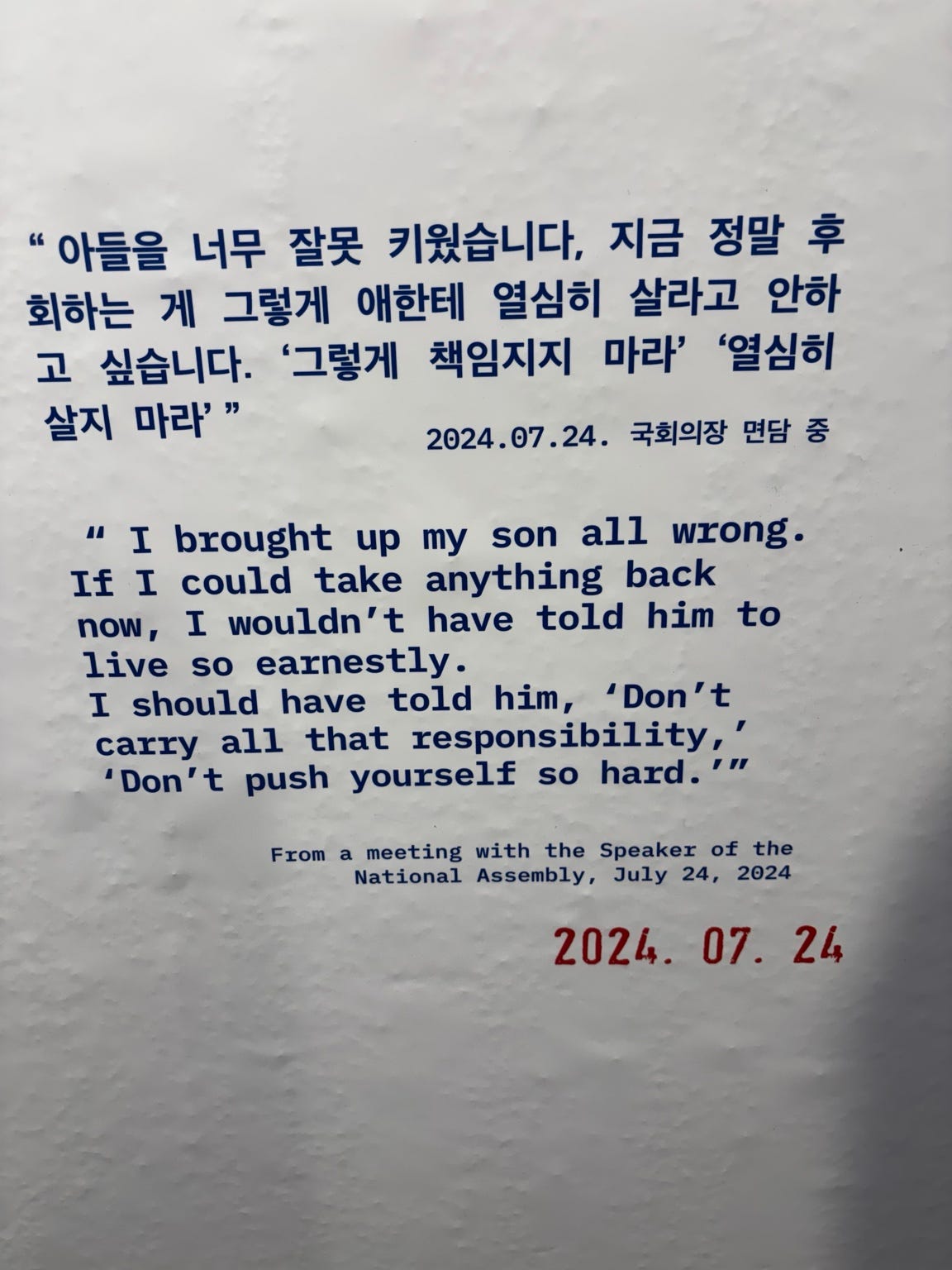 Park’s statement during a July 24, 2024, meeting with the speaker of South Korea’s National Assembly, reproduced in the exhibition.
The exhibition included a statement Park had made during a July 2024 meeting with the speaker of South Korea’s National Assembly. “I brought up my son all wrong. If I could take anything back now, I wouldn’t have told him to live so earnestly. I should have told him, ‘Don’t carry all that responsibility,’ ‘Don’t push yourself so hard.’”
“I earnestly hope that workers, including Coupang, all those workers will work in safety,” she told the crowd on Thursday night, “and I pray from the bottom of my heart that a death like my son will never ever happen again.”
The Alex Press is a reader-supported publication. To receive new posts and support my work, consider becoming a free or paid subscriber.