A trip into some obscure Hollywood labor history: 2,445 pages of congressional hearings, disputed shadows and tombstones, and a fight over the meaning of the word “erection.”
By Alex Press
Published: 2026-08-23
URL: https://thealexpress.substack.com/p/who-owns-a-shadow
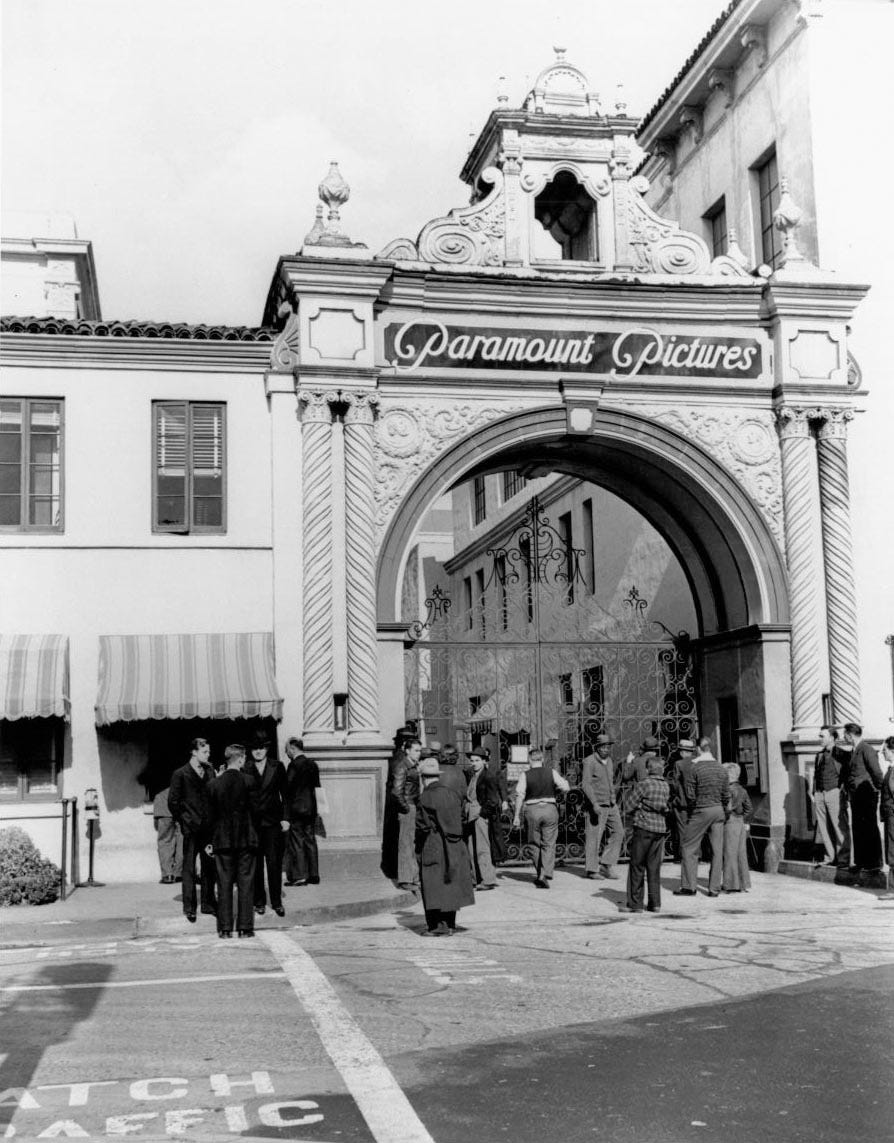 Paramount Pictures studio gate, c. 1940. LIFE Magazine. via Wikipedia Commons
In 1946, Columbia Pictures needed the shadow of an elevated train. The train itself would not appear onscreen. A silhouette and some mechanical apparatus would send its shadow through the shot. This presented a problem: whose job was it to make the shadow?
The prop shop had built the apparatus and begun operating it. The grips objected: shadows were their jurisdiction. The grips won and took over. The dispute survives in evidence later submitted to a congressional investigation of Hollywood jurisdictional fights, along with dozens of others. A mirror appearing in a scene was a prop, which put it under the jurisdiction of the property department. But mirrors reflect light, and grips claimed the control of light. Canvas and veils might belong to the prop department until they started diffusing light, at which point they became the grips’ concern. There were disputes over who moved a wild wall—a removable section of a set—to make room for the camera, who built the platform the camera sat on, who constructed catwalks, who put up a set and who took it down.
The Alex Press is a reader-supported publication. To receive new posts and support my work, consider becoming a free or paid subscriber.
In 1947, a special House Education and Labor subcommittee convened hearings on jurisdictional fights in the motion-picture industry. The resulting Jurisdictional Disputes in the Motion-Picture Industry ran to 2,445 pages. Congress had more elementary questions, too. Representative John McCann once stopped Pat Casey, the studios’ longtime labor representative, to ask what everybody was talking about.
“This ‘grips’ is a funny name,” McCann said. “Will you tell me what it stands for?”
Casey explained that scenery was first constructed, after which the grip handled it: putting the pieces together, bracing them, taking them down, storing them and bringing them back when needed. In the studios, he said, the grip handled sets “after they are made.”
This distinction became important because Hollywood was then having considerable trouble deciding when, exactly, a set had been made.
In the 1930s, a group of set decorators broke away from the International Alliance of Theatrical Stage Employees, or IATSE. By the following decade, seventy-seven of them were represented by the Conference of Studio Unions, a federation of Hollywood craft unions led by Herb Sorrell, a former painter who had already led strikes at Disney and elsewhere. A dispute over recognition of the decorators helped set off a strike in March 1945 that eventually involved roughly ten thousand workers.
There was quite a bit of history behind the hostility between the CSU and IATSE. The latter had only recently emerged from one of the more spectacular corruption scandals in American labor. Its former leaders George Browne and Willie Bioff had received enormous payments from the studios. The studios later described the payments as extortion; the CSU argued that they were bribes, part of an arrangement in which IATSE leaders delivered labor peace in return. Under Roy Brewer, IATSE shed the Bioff-Browne leadership but remained the more conservative force in Hollywood labor and became increasingly anti-Communist.
The CSU was the more militant alternative. Its enemies increasingly described it as Communist-controlled, though the Communist Party itself initially opposed the 1945 strike. Gerald Horne, who examined the allegations against Sorrell at length in Class Struggle in Hollywood, concluded that Sorrell was not a Communist. (Horne’s book is a classic; when I sat down with Teamsters Motion Picture Division head Lindsay Dougherty during the 2023 strikes, we realized we were both reading it.)
The studios refused to recognize the CSU’s claim to the set decorators despite the union having produced authorization cards from the workers. The jurisdictional dispute wound through the NLRB and War Labor Board before helping trigger the 1945 strike. IATSE members were instructed to cross the picket lines, though some refused. The strike lasted more than six months. The decorators ended up with the CSU, but other jurisdictional disputes remained.
The strike became extraordinarily violent. On October 5, 1945, CSU members massed outside Warner Bros. in Burbank, where they confronted people crossing the picket line, studio security and police. The day became known as Black Friday, or Bloody Friday. Horne describes strikers being “knifed, clubbed and gassed,” others knocked down by fire hoses, with smashed windshields, tear gas and overturned cars. Dozens were injured.
The American Federation of Labor appointed three men to sort them out: William Doherty, Felix Knight and William Birthright, leaders of unions representing postal workers, barbers and railroad trainmen, respectively. They were given thirty days. The three visited one studio, Paramount, for several hours.
Among their decisions was one assigning “all trim and millwork on sets and stages” to the carpenters and the “erection of sets on stages” to IATSE grips.
Now there was another problem. What did erection mean?
Carpenters built the scenery. Grips took over once it reached the stage, bracing and moving the pieces, taking them down and putting them back up. Both used hammers and nails. So what, exactly, had the arbitrators meant by “erection”? They later said they meant assembling completed sets on stages or locations; construction remained the carpenters’ work. IATSE stuck to the original ruling. Producers sided with IATSE. The carpenters refused to work on sets they believed had been improperly constructed by IATSE workers. These became “hot sets.”
Harry Beal, a carpenter foreman at Columbia, was asked about the workers doing the disputed work.
“These men are not carpenters,” he said.
Brewer had a different view. During the earlier strike, discussing painters, he observed that “in an emergency anybody can use a brush.” An emergency, in this case, meant that the painters had stopped using theirs.
“That’s not my job” is not something a boss generally wants to hear. If you can do something that needs doing, you’re supposed to do it. Union work rules often said otherwise: there were things you did not do because they were someone else’s job.
Hollywood’s jurisdictional rules could be extraordinarily fine. Carpenters and prop makers often worked in the same shops, with many of the same tools. Generally, carpenters built full-sized stationary objects while prop makers handled movable or miniature ones. A tombstone fit both descriptions; both unions claimed the right to build one. Boats, railway cars, signs, sign frames, crates and temporary barriers meant to simulate a bridge blockade caused similar problems. A near-contemporary study of Hollywood labor relations put the problem plainly: when a prop man did carpenter’s work, there was less employment for carpenters, and vice versa.
The fight over erection was an argument over hundreds of jobs. Horne cites an estimate that winning the set-erection work would have meant additional employment for 500 carpenters, with another 250 jobs dependent on how property work and miniature sets were classified. In 1946, moving a job from carpenter jurisdiction to grip jurisdiction also moved it between two rival labor organizations. The CSU was attempting to build a militant federation of Hollywood crafts; IATSE, under Brewer, was the more conservative alternative.
In September 1946, the major studios began sending CSU carpenters home. Andrew Mackay, a member of Carpenters Local 946, testified that he was ordered to leave before he even had a chance to say whether he would work on one of the disputed “hot” sets. Another Local 946 carpenter, James Skelton, told Congress that by September 24 or 25, “all of our men had been locked out by the major studios.” They were “not asked to work on hot sets,” he said; they were simply “fired.” “We never called a strike.”
Horne finds evidence that this was planned. Brewer acknowledged meeting with studio executives, SAG leader Robert Montgomery and others in September 1946 while plans involving hot sets were discussed. Paramount’s Y. Frank Freeman later conceded the integrity of notes from those meetings. Paramount vice president Charles Boren acknowledged that the CSU carpenters’ final checks had already been made out before they were asked to work on the hot sets. Horne argues that the studios were deliberately forcing a confrontation with the CSU.
The CSU lost it. IATSE was strengthened, while its principal militant rival in the studios was badly weakened. The fight also helped make an anticommunist out of Ronald Reagan, at least in Reagan’s later telling. Looking back on Black Friday and the violence of the CSU fight, he said the experience had “a profound effect on me.” More than anything else, Reagan claimed, the supposed Communist attempt to take over Hollywood led him to become president of the Screen Actors Guild and “indirectly at least, set me on the road that would lead me into politics.” Horne is skeptical of the chronology: as late as the fall of 1946, he notes, Reagan was still dismissing some anticommunist claims. By 1947 he was cooperating in Hollywood’s anticommunist campaign. Reagan would later describe Communists as using “minor jurisdictional disputes as excuses” in an effort to gain control of the industry.
Minor jurisdictional disputes was one way to describe them. Who made a tombstone? Who moved a wall? Who got to hammer which nail? Who operated the device that made the shadow of an elevated train move across a set?
Some jurisdictional rules were easier to defend than others. Nobody wanted an untrained worker rewiring a light. It was harder to explain why one worker could hammer a nail into a wall but another had to move it. Employers called rules like these featherbedding: keeping workers around for work management thought could be done with fewer of them. Hollywood unions gave them plenty to complain about. Productions got hung up on tiny distinctions, and unions raided one another’s work. In the CSU-IATSE fight, workers wound up beating and scabbing on one another.
Still, the work they were fighting over amounted to jobs. Five hundred carpenter jobs depended on what erection meant, by one estimate Horne cites. Another 250 depended on property work and miniature sets. Give some of that work to the grips and there was simply less carpenter work to go around.
Technology regularly threw these arrangements into question. Sound brought its own jurisdictional fights. Television and videotape brought more. New equipment changed what people did and sometimes who did it. Some of the divisions fought over in the 1940s are still recognizable on sets today.
Which is where AI comes in. Hollywood unions have understandably worried about whether it will eliminate entire jobs. There is also the question of all the smaller bits of work that can be reassigned. Software makes some of that especially easy. What used to be somebody else’s job becomes one more thing you do yourself.
It is easy enough to bargain over a job that disappears. It is harder to bargain over twenty minutes of work that used to belong to somebody else, then another twenty minutes, then another. Eventually it is simply understood to be part of your job.
The Alex Press is a reader-supported publication. To receive new posts and support my work, consider becoming a free or paid subscriber.