An update on what I've been up to lately.
By Alex Press
Published: 2026-06-19
URL: https://thealexpress.substack.com/p/parks-pickets-passing-legislation
Saturdays in the Park
One of the more unusual things I’ve been doing lately is helping organize a series of free community events with the band The Format called Saturdays in the Park.
The premise is pretty simple: bring together local organizations, musicians, and a bunch of people hanging out in a park on a Saturday afternoon. There are acoustic performances, tables and speeches from local groups, buttons, conversations—a lot of the sort of social interaction that simply does not happen enough in this country.
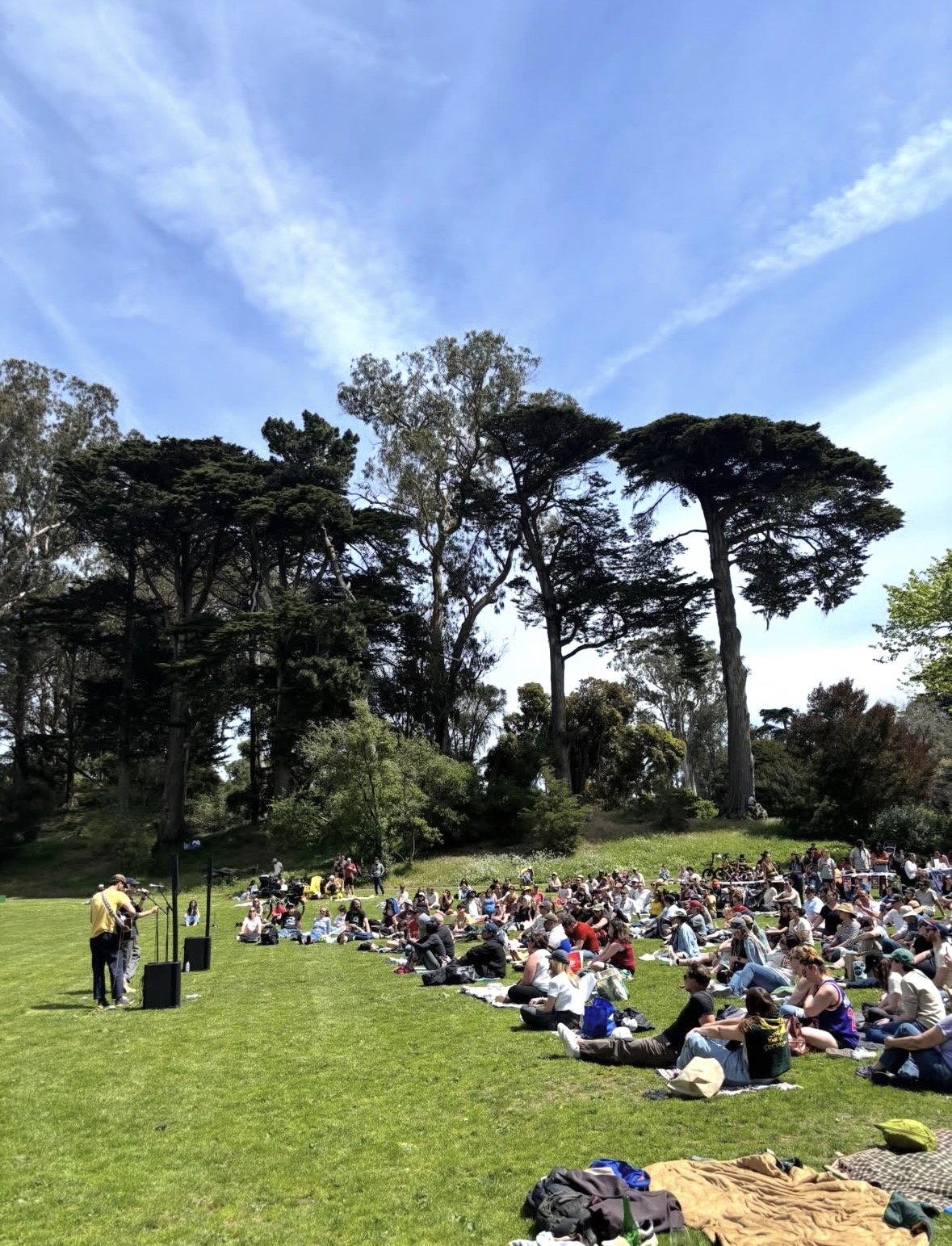 \Saturday in the Park: SF edition (Golden Gate Park).\
So far we’ve done events in Boston, Philadelphia, Salt Lake City, and San Francisco, with more on the way. The organizations vary from city to city, but the idea is always the same: gather people who will have a great time hearing a band (or several bands! they love play a few songs for free for the sake of a good cause, which is introducing these fans to the orgs in their community that do great work to change the world and could use more members/volunteers/funds. Labor unions (for instance, unionized Starbucks baristas were our rock for the first iteration of these events, making it to almost every one of them), tenant organizations, immigrant rights groups, Palestine solidarity orgs, DSA chapters all end up sharing the same space, tabling and speaking from the mic about their work and how attendees can join up.
Lotta blankets, dogs, kids, button-making station: a great time with cool people.
The Alex Press is a reader-supported publication. To receive new posts and support my work, consider becoming a free or paid subscriber.
I spent much of the spring emailing organizations, convincing them to come table, and generally acting as what the SITP website generously describes as a “tireless connector of people.” I don’t know about tireless, but I do like connecting people.
One of the pleasures of reporting is getting to meet organizers, workers, artists, tenants, teachers, nurses, and assorted local characters. Usually those conversations happen one at a time. Saturdays in the Park is an excuse to put a lot of those people in the same place and see what happens.
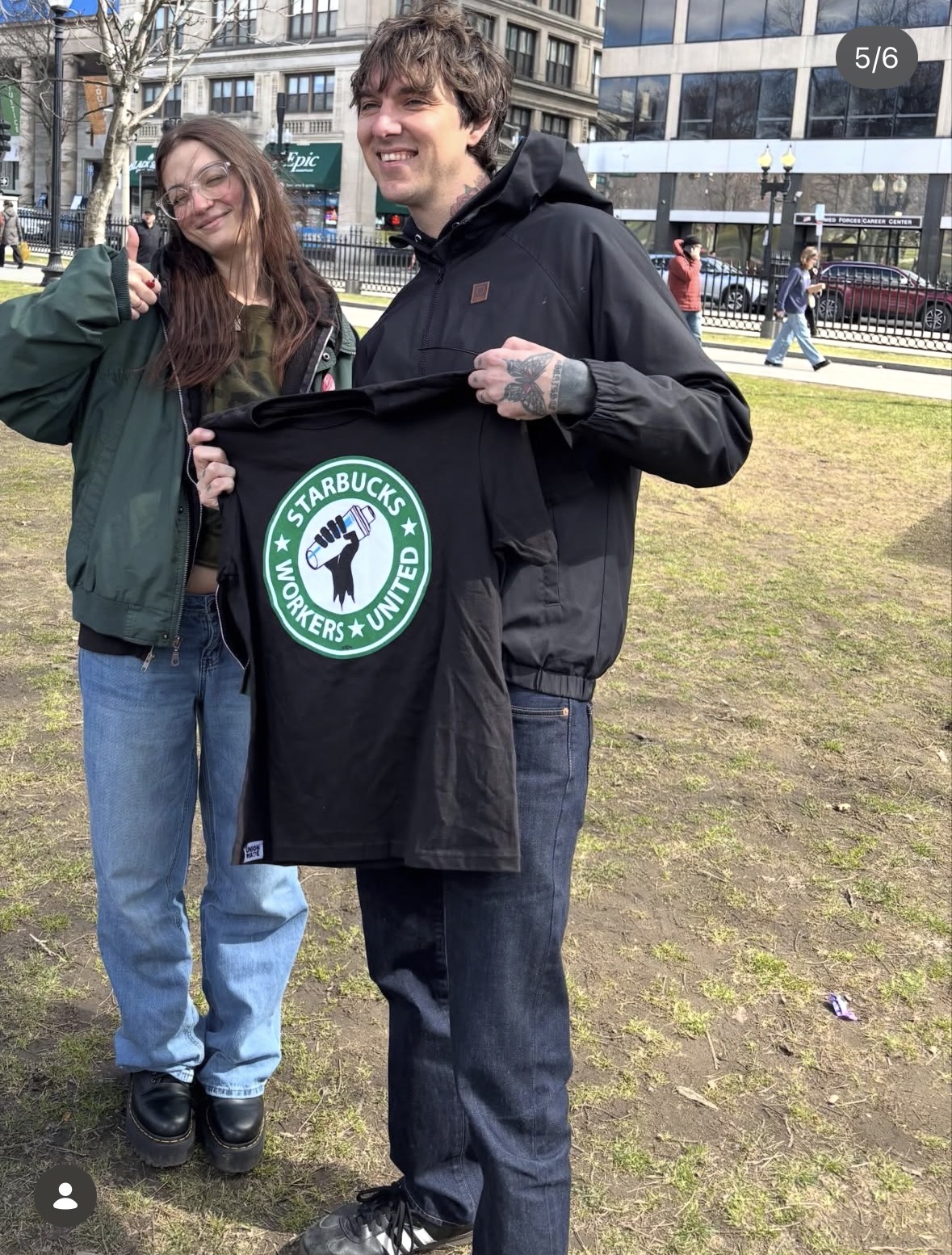 \Joyce Manor’s Barry Johnson with a union barista at the Boston Common.\
A lot of politics and culture today is mediated through screens. One thing I’ve enjoyed about these events is how analog they are. People hear some music, wander over to a table, strike up a conversation, sign up for something, meet somebody they otherwise wouldn’t have met. Nothing revolutionary, just the basic social infrastructure that makes collective life possible. We’ll be doing more of these in the coming months; check the site or follow The Format’s social media pages so you don’t miss one in your city.
They’re a blast and incredibly heartwarming; check my Instagram to see what they’ve looked like, and thanks to everybody who has been a part of these events so far, be it as a tabler/speaker, musician, or attendee!
Hollywood’s Quiet Retaliation Machine
I also recently published a piece for The Key and the Los Angeles Review of Books, supported by the extremely important Economic Hardship Reporting Project, about blacklisting, retaliation, and political pressure in Hollywood over Palestine.
One thing I found striking while reporting it was how informal much of the censorship is. There’s no official blacklist, just meetings that disappear from calendars, projects that evaporate, and people trying to calculate what kinds of speech might cost them future work: a pervasive sense of paranoia. The piece follows actors, writers, filmmakers, and crew members navigating that landscape and asks what happens when an industry built around freelance labor becomes a site of political discipline.
Tasbeeh Herwees also interviewed me about the piece for her excellent Substack No Bad Days, which gave me a chance to talk through some of the reporting and conclusions I drew. I’m not usually on the interviewee side of an interview, but I enjoyed getting to reflect on a subject I’ve devoted a lot of time to thinking about: the ties between the US labor movement and the Palestine solidarity movement.
The CREEP Act Passed
A few years ago, I dealt with a prolonged stalking case. Through that experience, it became obvious both to me and to the lawyers at C.A. Goldberg, who helped me, that New York’s protections against stalking were unusually weak. Specifically, if the person stalking you was not a family member or intimate partner, there was often no straightforward way to go into civil court yourself and seek a same-day order of protection.
Many people were effectively pushed toward the criminal legal system whether they wanted to be there or not.
The New York state legislation that grew out of those conversations—the CREEP Act, or the Ceasing Repeated and Extremely Egregious Predatory Behavior Act—creates a civil process for victims of stalking, harassment, cyberstalking, and technology-facilitated abuse to seek protection regardless of their relationship to the person harassing them.
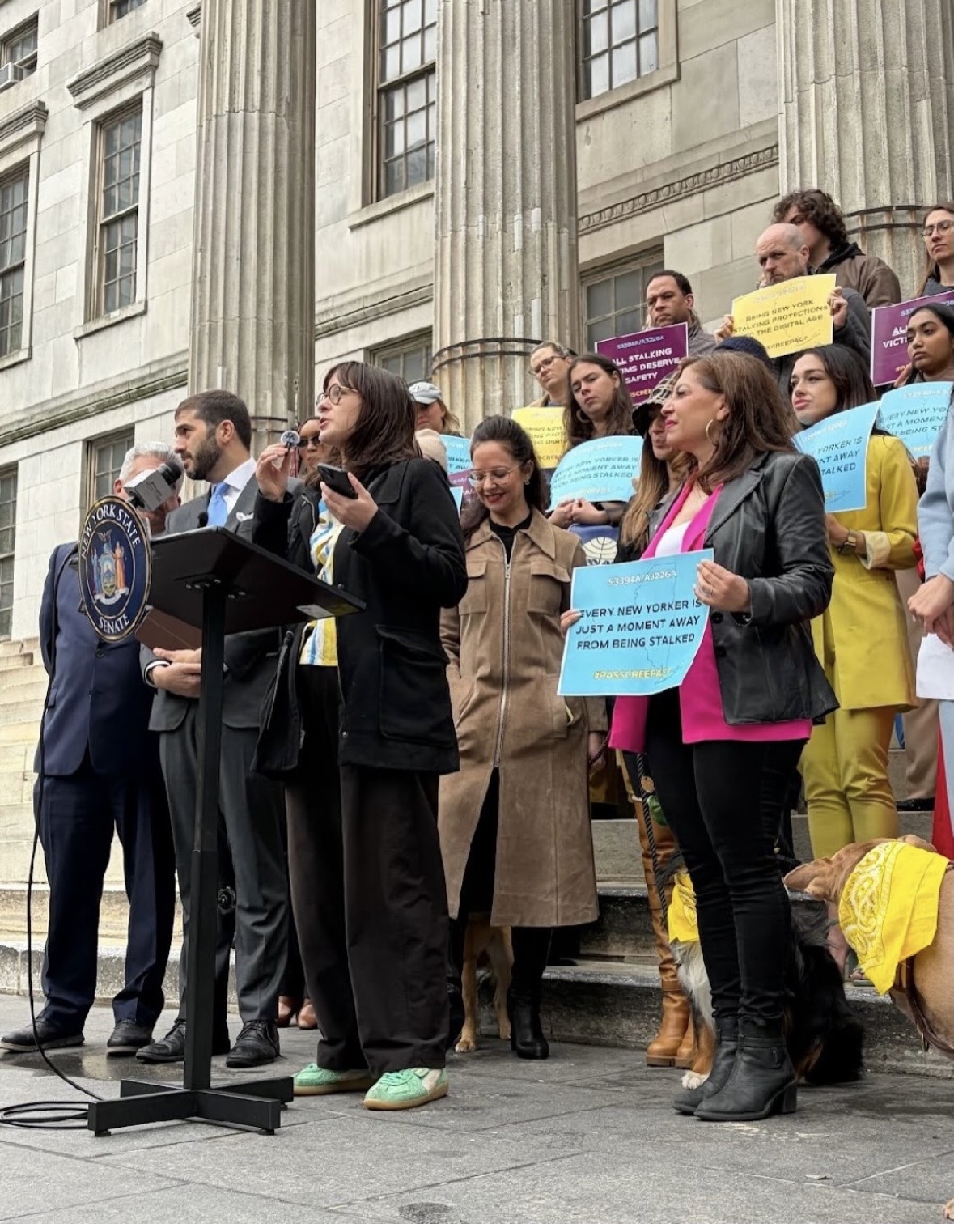 \Speaking at a rally for the CREEP Act in Brooklyn.\
I did not want this person imprisoned, I just wanted him to stop stalking me, so when Carrie’s law firm reached out about taking inspiration from my case to draft the bill, I was on board. Unlike a great deal of supposedly feminist legislation in the past, the point of the CREEP Act is not to expand criminal penalties. It’s to create an alternative before situations escalate further. It gives both the victim and the stalker an off-ramp before criminal charges become the only mechanism available.
The bill was introduced in the previous year’s legislative session and passed in the State Senate unanimously, but never made it to the floor in the State Assembly. This year though, we did it: passed unanimously in both houses.
Now we’re just waiting on Governor Hochul to sign it into law (she better…). Thanks to everybody who made calls and otherwise helped get it over the finish line. It was kind of grueling to have to think and talk about this period of my life again, but I am so glad to have forced good to come from something so bad. New York was one of only seven states that lacked this kind of civil remedy. No longer!
Search Work
A couple weekends ago, I moderated an event at the Topos Too bookstore in Ridgewood for Search Work, a very good collection edited by Rachel Meade Smith that grew out of her Words of Mouth project.
The book is nominally about job searching, but of course, that encompasses a hell of a lot, from existential crises and despair to comedy–a lot on the strange emotional landscape created by having to market yourself in order to survive.
In addition to myself and Rachel, the event had readings by contributors Jose Sanchez and Jasper Nathaniel. Jasper’s just landed back in the West Bank to continue his incredibly clutch reporting on how Israel’s genocide is playing out there; you can read his work here.
Elsewhere
I’ve also been writing about New York a bit more than usual since my comrade Zohran won the mayoralty, reinvigorating all of us here. I’ve always been interested in the city’s texture—this is what I love about Jimmy Breslin, his insistence on New Yorkers in all their contradiction and absurdity rather than some mythical idea of the city—and lately I’ve found myself pursuing that interest a bit more in words rather than just action.
That has meant reporting on a South Bronx symposium commemorating the Young Lords’ occupation of Lincoln Hospital and their fight to transform addiction treatment in the borough.
It meant covering tenants trying to stop their rent-stabilized buildings from being transferred to yet another giant landlord. It meant making several trips to the taxi lot at LaGuardia to report on medallion debt relief and the politics of the Taxi and Limousine Commission.
These stories are not really “about labor” in the narrow sense. They’re about who controls housing, public institutions, city agencies, and the conditions of everyday life. Of course, I’ve also done more labor-specific NYC reporting: see the recent unionization of Attaboy, a famed cocktail bar (ownership is now retaliating against the workers after they won their union vote) and the fight to pass a bill that would be a major hindrance to Amazon’s misclassification of its driver workforce (the company is resisting this one tooth and nail).
I also spent this past weekend in Chicago, at the biennial Labor Notes conference, which remains a singular gathering of rank-and-file worker-organizers. This year’s conference felt different from the last few iterations: larger, but also more sober. Questions about immigration raids, war, AI, and political repression were everywhere.
By the end of the conference, federal authorities had arrested fifteen Minnesota activists, including six union members, casting many of those discussions in a sharper light (two of the Minnesota 15 in fact attended the conference). I wrote a dispatch capturing some of the atmosphere. While I was in Chicago, I also joined the Working People podcast for a live event hosted by In These Times.
Beyond New York and Chicago, I’ve reported in recent months on the largest strike in the US meatpacking industry in decades and on one of the longest nurses’ strikes in recent history, in Grand Rapids, MI.
For In These Times, I wrote about the Oakland People’s Arms Embargo campaign, an effort to prevent shipments tied to Israel’s war on Gaza from moving through Oakland’s civilian airport; a similar campaign is now underway in NYC.
One thing I find fascinating about these campaigns is that they are ultimately a question of sovereignty: if local residents, elected officials, unions, and community organizations all oppose something, what capacity do they actually have to stop it?
I’ve also gotten to spend time talking with people whose work I’ve admired for years. I interviewed Amy Goodman and Tia Lessin about Steal This Story! I also spoke with the legendary Barbara Kopple, whose Oscar-winning documentaries have shaped how generations of people understand labor struggles.
One thing I appreciate about Kopple’s work is its patience. She has a gift for staying with people long enough to build the relationships required for great documentary filmmaking.
Anyway, I’ve got more reporting, book reviews, interviews, and book-writing underway. More soon.
Send Me Shift Notes
While I write about unions all the time, what I’m actually interested in is working-class people’s lives. Organizing at work is one way people try to change those lives, but it isn’t the only thing worth talking about. Part of why I started Shift Notes was to make room for stories and observations from work that don’t necessarily involve a campaign, a contract fight, or a strike.
So if you’ve got a story from work—a paragraph, a rant, an observation, a scene, a complaint, a weird interaction, a moment you can’t stop thinking about—send it along. Formal or informal. Short or long. Union shop or nonunion shop. Office, warehouse, school, hospital, restaurant, truck, retail store, unemployment office, job interview, whatever.
Seriously, send me Shift Notes so I can publish them here! People WANT to hear about your job. Email your notes to me: [email protected]
Reading
A few recent highlights:
- The Murderer — bizarre Guyanese thriller
- The Black Dahlia — grizzled cop noir set in LA, my first dip into Ellroy!
- Delicious Hunger — stories drawn from a decade in the rainforest as a communist guerrilla
- Paper of Wreckage — oral history of the New York Post, my pal Zain’s piece on the love/hate relationship between the Post and Zohran alerted me to it. I love an oral hisotry of a storied New York rag
- Empire of AI — very helpful, now I can talk about this stuff with some amount of confidence in what the hell these AI people are up to and where they went wrong
- Several Ben Lerner novels. I’d somehow never read him before and liked him more than I expected to. It feels like he’s having fun on the page
- Fortress Besieged — a sprawling Chinese novel centered on a hapless loser
- Lost Lambs — actually good, very funny
- London Falling - PRK is truly living the dream, one of the only reporters left with the resources to write these types of books
- Sacco and Vanzetti Must Die! — an original idea for a change
- Chess Story — as good as everyone says, and readable in a single sitting
The Alex Press is a reader-supported publication. To receive new posts and support my work, consider becoming a free or paid subscriber.