AI-powered self-driving laboratories are transforming scientific discovery, allowing machines to design experiments, learn from failure, and search for entirely new materials.
By Sherif Saad
Published: 2026-11-03
URL: https://theaioperators.substack.com/p/i-gave-ai-a-laboratoryand-it-started
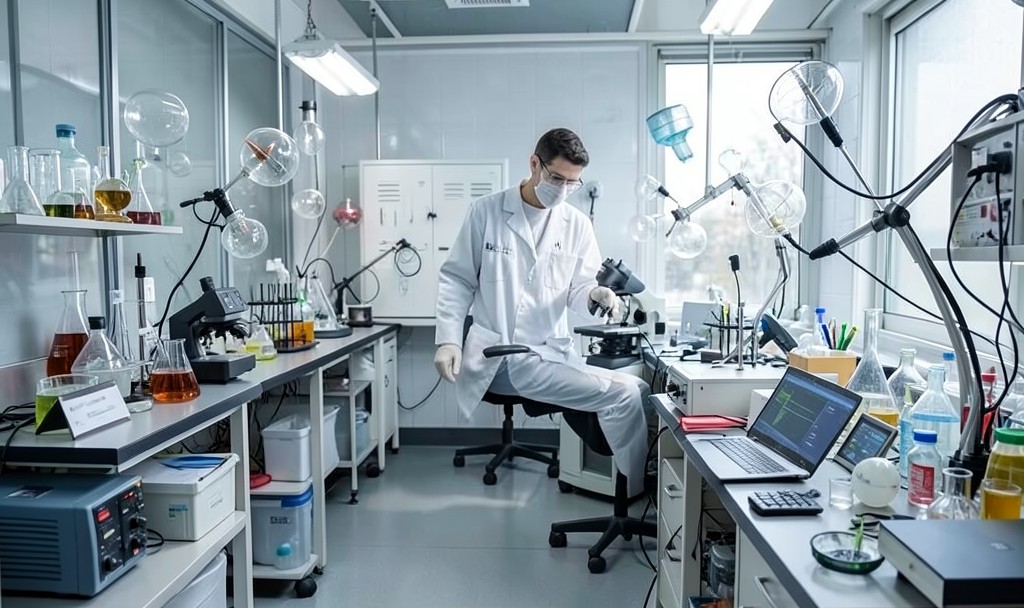
\I Gave AI a Laboratory—and It Started Inventing Things We Never Asked For\
There is something deeply strange about watching a machine experiment.
Not because the machine is moving.
Robots have been moving for years.
Not because computers are calculating.
They have been calculating for decades.
The strange thing is what happens when the machine decides what experiment should happen next.
That was the moment the future of AI started feeling different to me.
Until recently, I would imagine artificial intelligence as something that existed behind a screen.
You asked.
It answered.
You gave it a problem.
It generated a solution.
But a self-driving laboratory upends the equation.
Not only does the AI advise a scientist on what might work, but it can also peruse past experiments, decide which test to conduct next, direct machines to experiment, evaluate the results, and apply the knowledge to determine the next experiment to run.
And then it repeats the process.
And again.
The laboratory becomes a loop.
The loop becomes a learning system.
And suddenly science itself seems to be programmable.
The Scientist Who Doesn’t Sleep 🌙
Imagine walking into a laboratory at 8:00 in the morning.
You expect to find researchers preparing samples.
Instead, the room is already working.
Robotic arms move containers.
Pumps adjust chemical mixtures.
Sensors monitor reactions.
Imaging systems inspect samples.
A computer watches the results.
No scientist is physically standing there making every decision.
The system has a goal.
Perhaps it wants a material with a particular electrical characteristic.
Perhaps it needs a better catalyst.
Perhaps it seeks information on maximizing the efficiency of a chemical reaction.
Perhaps it wishes to find a novel semiconductor.
The AI analyzes every experiment it can find.
Then it issues a deceptively simple command:
What should we attempt next?
That is the crux of the self-driving laboratory. Modern autonomous experimentation platforms employ artificial intelligence, robotics, lab automation, instrumentation, and feedback mechanisms to create an environment where the experiment can inform the experiment. It is far more than an automated process.
But it is something more.
Automation follows instructions.
A self-driving laboratory can increasingly choose its instructions.
And this distinction may be one of the most important developments in the future of AI.
The Problem Was Never a Lack of Ideas 🧠
Science has an enormous problem.
There are too many possibilities.
Take materials science.
Scientists may have a need for a material that could be stronger, lighter, cheaper, more conductive, more heat-resistant, more eco-friendly, or better for a battery.
However, the combinations of elements, structures, production conditions, temperatures, pressures, concentrations, and methods are too numerous to generate.
Human researchers cannot test everything.
Computers can simulate some possibilities.
Robots can run experiments faster.
But neither solves the central problem alone.
Someone always has to be deciding which experiment is worth doing.
That is where AI excels.
Rather than blindly wandering through a vast search space, machine-learning algorithms can approximate which experiments are most enlightening or productive.
Then the laboratory performs them.
The results become new data.
The model updates.
The next experiments become smarter.
This is why researchers refer to self-driving laboratories as closed-loop systems, rather than automated laboratories.
The machine isn’t simply performing experiments faster.
Or, more specifically, using experiments as a means to find the next best experiment to run.
This is a profoundly different research approach.
Then the Robot Learned From Its Own Mistakes 🤖
There is an assumption people often make about AI.
They imagine intelligence means getting the answer right immediately.
Real scientific discovery doesn’t work that way.
Scientists fail constantly.
Experiments produce disappointing results.
Measurements go wrong.
Hypotheses collapse.
A promising material turns out to be useless.
The experiment that looked brilliant on paper produces nothing.
Failure isn’t necessarily wasted effort.
Sometimes failure contains information about where not to look.
A good autonomous laboratory can exploit that.
A recent 2026 agentic self-driving laboratory study described an AI framework that could maintain and supervise long-running optimization campaigns, detect a measurement failure during a physical experiment, revise its reasoning, and recommend changing the formulation when the target appeared unattainable. In another five-day flow-chemistry campaign, the system improved yield from 30% to 59% across 23 experiments.
That’s important.
The impressive part isn’t simply that the AI found a better number.
It is that the system could continue reasoning while the experiment was unfolding.
Science became an adaptive conversation between software and reality.
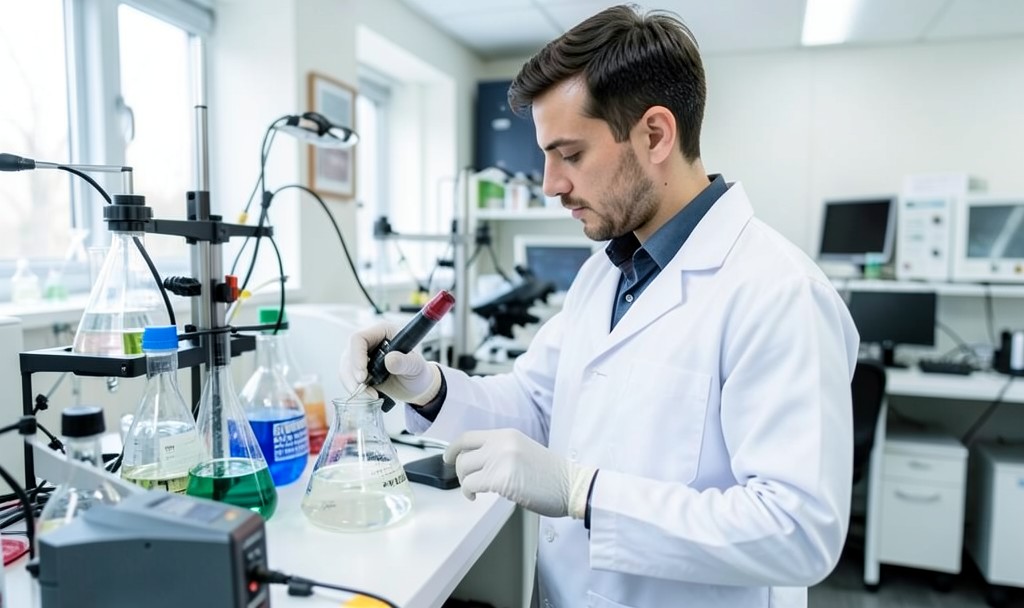
\LABORATORY\
The Laboratory Became a Conversation 🔬
This is where many things start getting fascinating.
Imagine telling an AI:
Find a material with these properties.
Traditionally, that instruction would be nowhere near enough.
A human expert would translate it into experimental procedures.
They would decide what equipment to use.
Choose candidate materials.
Determine concentrations.
Prepare samples.
Run tests.
Analyze the results.
Then decide what to try next.
The emerging self-driving laboratory tries to compress that chain.
The AI interprets the scientific objective.
It proposes experiments.
Robotic systems execute them.
Analytical instruments generate measurements.
The AI interprets those measurements.
Then the cycle continues.
Rice University researchers are developing a $19.9 million National Science Foundation (NSF) AI-powered materials laboratory that merges artificial intelligence (AI) with robotics and cloud-based laboratories to accelerate the discovery of electronic and quantum materials.
Georgia Tech has also announced a programmable cloud laboratory for 2026 that blends AI, simulation, and autonomous experimentation to enable remote control of advanced manufacturing and materials experiments.
The laboratory is no longer necessarily a room you have to physically enter.
It can become infrastructure you access.
That idea changes who gets to experiment.
The Laboratory in the Cloud ☁️
For most of scientific history, advanced research required physical proximity.
You needed the equipment.
The expensive instruments.
The specialized technicians.
The laboratory space.
The materials.
The institutional infrastructure.
Cloud laboratories begin changing that equation.
Imagine being a researcher thousands of miles away.
You formulate a scientific objective.
You submit it to an autonomous experimental platform.
The system schedules experiments.
Robots prepare samples.
Machines perform measurements.
AI analyzes the results.
The next experiment is selected.
You wake up the next morning and have a new dataset.
The physical experiment happened somewhere else.
The intellectual process happened partly inside the computational system.
That doesn’t eliminate scientists.
It changes where they spend their time.
Instead of manually performing hundreds of repetitive procedures, researchers could spend more time deciding what questions deserve investigation.
That may be one of the biggest hidden effects of AI on science.
AI could change not only how quickly we conduct experiments, but what kinds of questions humans have time to ask.