AI is beginning to remove the first rung of the career ladder. The immediate productivity gains are attractive. The long-term consequences could be profound.
By Raffaela Rein
Published: 2026-09-08
URL: https://theaileadershipedge.substack.com/p/the-ai-talent-crisis-boards-arent
Hi, I’m Raffaela, and welcome to AI Leadership Edge, the best newsletter for board directors, whether you are an independent director, VC, PE, or GP.
Subscribe for free and get the AI Strategy and Governance Certification. Join a community of 41,000 board directors and leaders.
If you have been subscribed for a while and would like to take the certification, please dm us for your complimentary access
AI is beginning to remove the first rung of the career ladder. The immediate productivity gains are attractive. The long-term consequences could be profound.
Palantir CEO Alex Karp recently offered one of the more provocative predictions about careers in the age of AI.
There are, he argued, “basically two ways to know you have a future”:
-
Acquire a vocational skill.
-
Be neurodivergent.
It is a deliberately extreme claim.
Most people will not need to become electricians. And neurodivergence is not a corporate synonym for creativity.
But beneath the provocation sits an important economic argument.
AI is making standard cognitive output extraordinarily cheap.
A first draft. A routine analysis. A block of code. A summary of a meeting. A comparison of competitors. A standard legal document. The transfer of information from one system to another.
Work that once required a trained knowledge worker can increasingly be produced in seconds.
This is usually presented as a productivity story.
It is also becoming a talent crisis.
Because the work AI is beginning to absorb is often the same work through which people learn to become good.

This edition is powered by BoardLens. Most boards have an NPS of -43. We are in times of AI, yet board meetings have been run the same way for the last 40 years. It is time to change that. BoardLeans brings your board to the AI era, with better intelligence for more productive meetings, better outcomes, and stronger relationships.
Start free at boardlens.ai.
AI is not eliminating every job
The labour-market evidence does not support the simplistic claim that AI is already destroying employment across the economy.
PwC’s analysis of close to one billion job advertisements found that employment and wages were still growing across most AI-exposed occupations. Industries with greater exposure to AI also experienced three times the growth in revenue per employee and twice the wage growth of less-exposed industries.
The more immediate shift is happening inside jobs.
The skills requested by employers are changing 66% faster in the occupations most exposed to AI than in the least exposed occupations. In 2024, the difference was only 25%.
AI is not simply eliminating professions. It is changing which parts of those professions still require a person. PwC, 2025 Global AI Jobs Barometer
A company may still require senior software engineers, lawyers, analysts and consultants.
It may simply require fewer juniors to produce the work surrounding them.
And that appears to be where the first visible pressure is emerging.
Researchers at the Stanford Digital Economy Lab found employment declines concentrated among workers aged 22 to 25 in highly AI-exposed occupations such as software development, customer service and clerical work.
Within the same companies, employment among young people in AI-exposed jobs declined 13% relative to less-exposed jobs following the widespread arrival of generative AI. The effect appeared in occupations where AI was being used to automate work, but not where it was primarily augmenting people.
The researchers remain appropriately cautious: the aggregate effect of AI on employment is still small, and the evidence does not prove that AI caused every decline.
But the age difference is difficult to ignore. Experienced workers in the same exposed professions have been considerably more resilient. Stanford Digital Economy Lab
AI may not be eliminating the profession.
It may be eliminating the apprenticeship.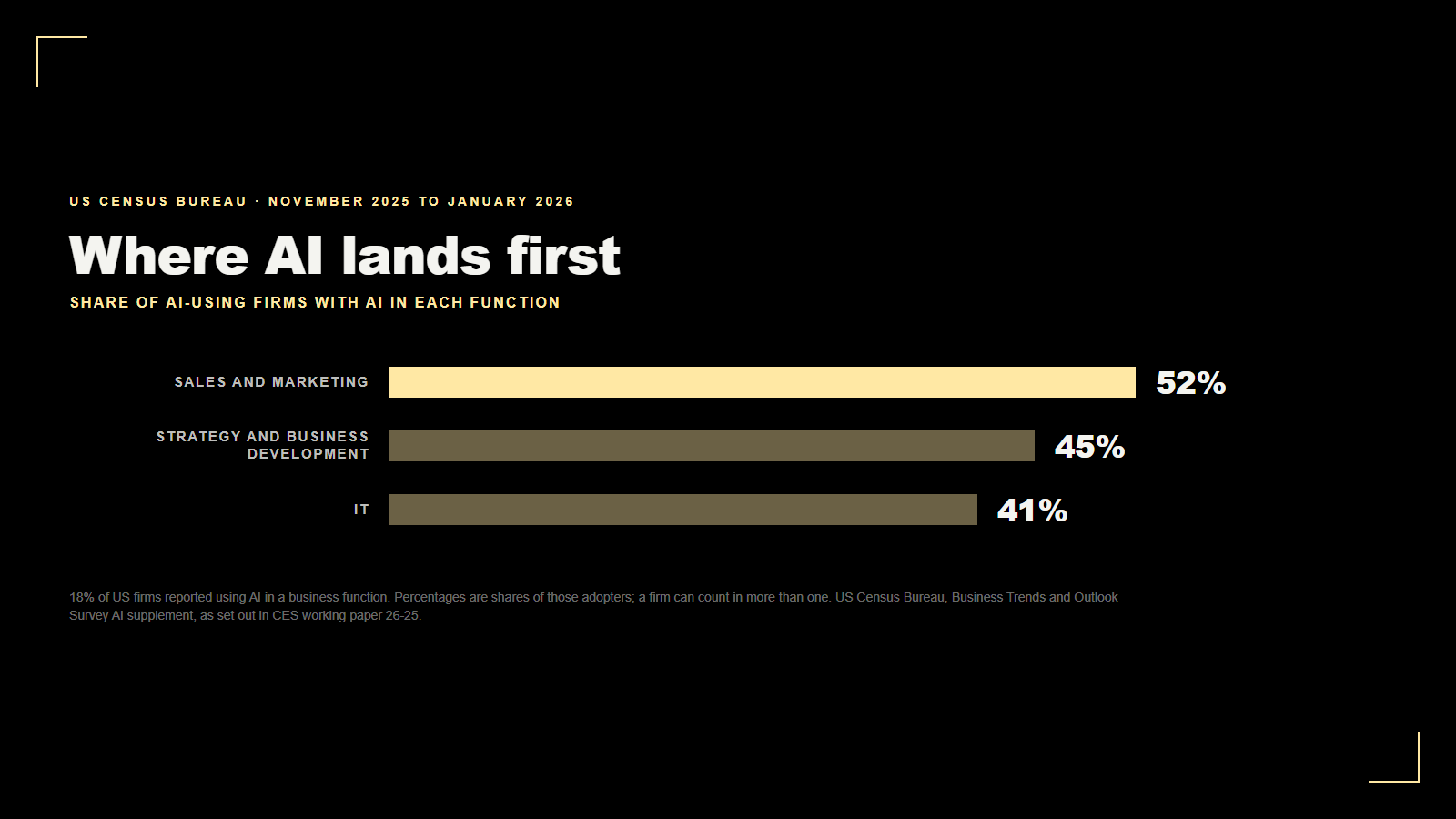
Why the electrician may have an advantage
Karp’s first category is relatively straightforward.
AI can generate an electrical plan. It cannot reliably enter an unfinished building, negotiate its physical constraints, install the system and take responsibility for its safety.
Work performed in unpredictable physical environments remains difficult to automate.
The irony is that the digital economy is becoming more dependent on precisely this kind of labour.
AI needs data centres. Data centres need power generation, transmission, cooling, construction and maintenance. The infrastructure boom is intensifying competition for electricians and other skilled workers just as large parts of the existing workforce approach retirement.
The US Bureau of Labor Statistics projects approximately 72,700 electrician openings every year between 2025 and 2035. Data scientists are among the fastest-growing occupations, but so are solar installers, wind-turbine technicians and several hands-on healthcare roles. US Bureau of Labor Statistics
Karp’s larger point is not that everyone should learn a trade.
It is that economic value may increasingly concentrate around two kinds of scarcity:
-
The ability to operate in the physical world.
-
The ability to exercise differentiated human judgment.
The second may prove even more important for today’s knowledge workers.
When the standard answer becomes free
Karp uses “neurodivergent” unusually broadly. He has spoken about his own dyslexia, but he also applies the label to entrepreneurs and others who reject conventional career paths.
Clinically, neurodivergence encompasses a wide variety of conditions and experiences. It should not be romanticised as an automatic professional superpower.
The useful idea here is not a diagnosis. It is cognitive variance.
The ability to notice an anomaly.
To question the framing everyone else has accepted.
To connect developments across different domains.
To resist a polished consensus.
To recognise that the apparently obvious answer is wrong.
These capabilities become more valuable when AI can produce the conventional answer on demand.
That creates an uncomfortable question for leaders.
Companies have spent decades standardising how talent is selected, trained and promoted. They recruit from the same institutions, reward fluency in established frameworks and promote people who reliably reproduce recognised forms of excellence.
What happens when AI becomes exceptionally good at producing exactly the kind of standard answer those systems reward?
The risk is not that AI does all the thinking.
It is that people gradually stop doing enough of it themselves.
Microsoft’s 2026 Work Trend Index found that the human capabilities AI users now consider most important are quality control of AI output and critical thinking. Yet only 43% of the most advanced AI users intentionally perform some work without AI to keep their skills sharp.
The research also found that only 19% of AI users operate in organisations where individual capability and organisational readiness reinforce one another. Employees are often learning to use AI faster than their companies are redesigning the work around it. Microsoft 2026 Work Trend Index
The technology is advancing quickly.
The talent system surrounding it is not.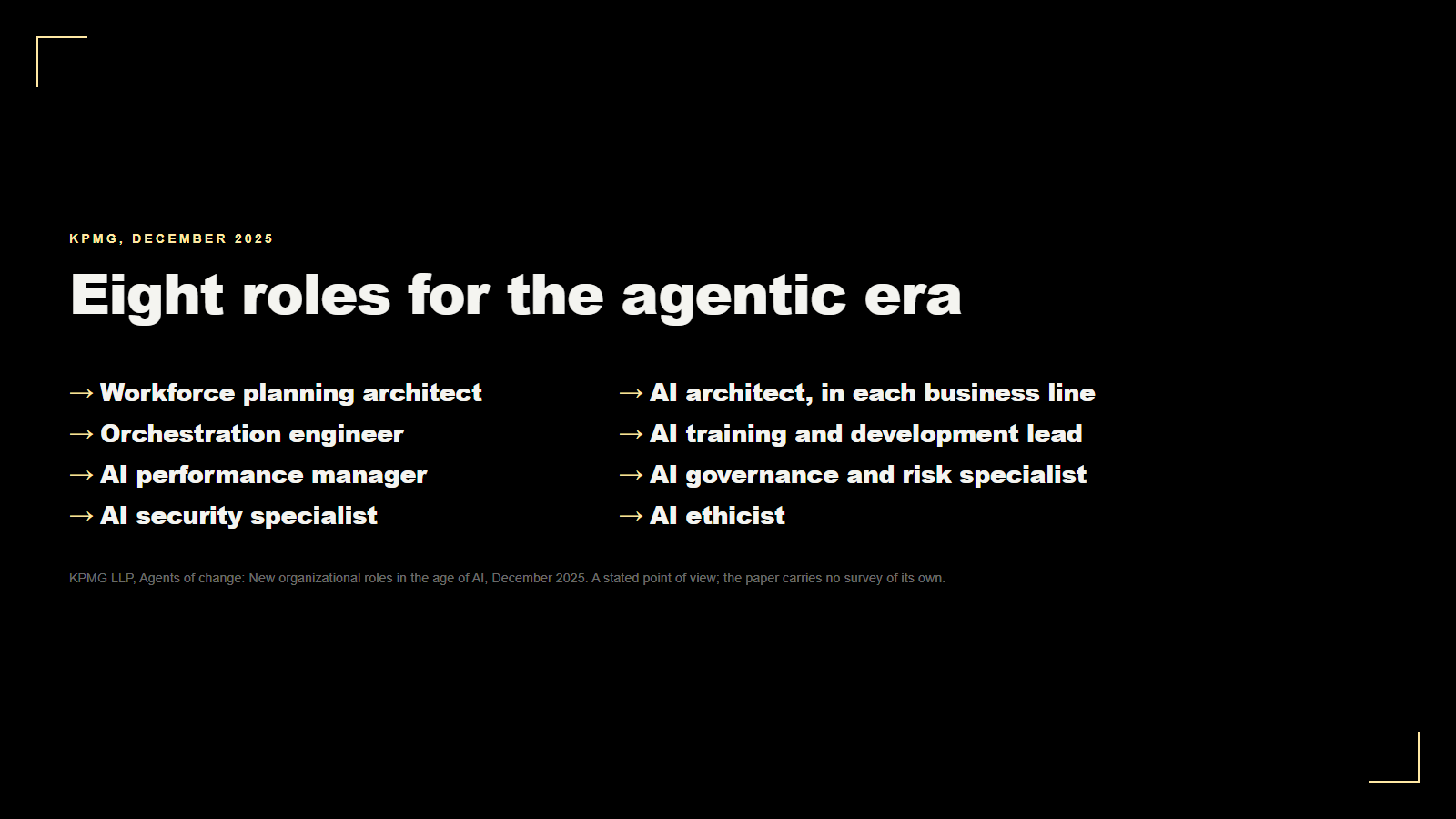
The rise of judgment debt
Consider how expertise is traditionally developed.
A junior analyst does not only build the spreadsheet. She learns which assumptions are fragile.
A young lawyer does not only review contracts. He learns which clause will later cause the negotiation to collapse.
A new manager does not only prepare the operating report. She learns which metrics disguise a deeper problem.
A developer does not only write routine code. He learns how systems break.
These tasks may be repetitive. They may also contain thousands of small encounters with reality through which pattern recognition, context and judgment are formed.
AI can remove the task without automatically replacing the learning.
That creates what I would call judgment debt.
A company accumulates judgment debt when it automates foundational work without rebuilding the mechanism through which its people develop expertise.
Like technical debt, it may initially be invisible.
The organisation becomes faster. Costs fall. Output rises. Senior people supervise increasingly capable AI systems while a smaller number of junior employees enter the organisation.
The consequences appear later:
-
A weaker succession pipeline.
-
Greater dependence on a handful of experienced people.
-
Managers who can present conclusions but cannot interrogate them.
-
Professionals who can supervise a model under normal conditions but lack the underlying experience to recognise when it is wrong.
-
Institutional knowledge that never develops because the work generating it has disappeared.
This is not a theoretical concern.
A 2026 World Economic Forum and PwC study found that 37% of young workers globally are already employed in occupations with medium-to-high exposure to AI-driven task change.
Entry-level occupations in the highest-exposure group are experiencing approximately 2.2 times as much change in required skills as those in the lowest-exposure group.
Most strikingly, 28% of entry-level workers believe that no more than half of their current skills will remain relevant in three years. World Economic Forum and PwC
The challenge is no longer simply to teach young people how to use AI.
It is to decide how they will develop the judgment required to supervise it.
The barbell-shaped organisation
Taken far enough, the economics of AI could produce a barbell-shaped company.
At one end sits a relatively small group of highly experienced people. They frame problems, set direction, manage exceptions and retain accountability.
At the other sits an expanding digital workforce completing large amounts of analysis, production and coordination.
Human entry-level and middle layers become thinner.
This can be an extraordinarily productive operating model.
It can also be brittle.
The senior layer possesses experience but has limited capacity. The AI layer possesses scale but no accountability. The layer in which future leaders would traditionally develop has been compressed.
This changes the nature of key-person risk. A company may appear to have reduced its dependence on labour while becoming more dependent on a small number of people capable of recognising when its automated systems are wrong.
It also creates a problem for succession planning.
The leaders required in five years cannot simply be hired in five years. They need to acquire commercial context, technical intuition, relationships and judgment somewhere.
If every company removes the entry-level work, the whole market may eventually discover that there are fewer experienced people available to recruit.
This is now a board issue
Most board discussions about AI and the workforce still focus on three questions:
-
How much productivity can we capture?
-
How many roles will change or disappear?
-
How quickly can we reskill employees?
Those questions are necessary. They are no longer sufficient.
Boards need to understand whether management is improving the company’s operating model—or harvesting short-term efficiencies at the expense of future capability.
There is an important governance distinction here:
Workforce reduction is a management decision. The erosion of the company’s future capability is a board concern.
That should change the questions being asked.
Seven questions for the next board discussion
1. Which tasks are disappearing first—not merely which jobs?
Job titles conceal the real transformation. Boards need visibility into which layers of analysis, production and coordination are moving to AI.
2. Which of those tasks currently build judgment?
Some low-value work is genuinely disposable. Other tasks are repetitive but developmentally important. Management should know the difference.
3. What replaces the apprenticeship?
If juniors no longer produce the first analysis, draft the basic code or review the underlying documents, how will they acquire the knowledge needed to evaluate AI-generated work later?
4. Where are productivity gains coming from?
There is a material difference between a redesigned workflow that creates more value and a temporary improvement achieved by reducing junior hiring.
5. Are we creating new concentrations of key-person risk?
As the organisation becomes leaner, the board should understand how many people can operate critical processes when AI fails or produces a plausible but incorrect result.
6. Do our talent systems reward independent judgment?
Companies cannot claim to value non-linear thinking while recruiting, assessing and promoting almost entirely for conformity, polish and pedigree.
7. What will our succession pipeline look like in five years?
The relevant metric is not only today’s headcount saving. It is whether the organisation is still producing people capable of assuming senior responsibility.
The answer is not to preserve obsolete work
Companies should not retain inefficient processes merely because they once served as training.
They need to build a better apprenticeship for the AI era.
Entry-level employees can be moved closer to customers and operating environments. They can investigate anomalies rather than compile standard reports. They can compare competing AI-generated conclusions, participate in decision reviews and study cases in which automated systems failed.
AI can also accelerate development. A junior employee with a capable AI system can attempt work that previously required years of experience—provided the organisation supplies context, feedback and accountability.
The objective should be to compress the apprenticeship, not eliminate it.
That requires deliberate choices:
-
Redesign entry-level roles around investigation, verification and outcomes.
-
Give younger employees exposure to customers and operational reality.
-
Use decision simulations and post-mortems to build pattern recognition.
-
Make employees defend recommendations rather than merely present AI output.
-
Preserve selected forms of unassisted work where underlying capability matters.
-
Measure time to proficiency, decision quality and succession depth—not only hours saved.
-
Hire for cognitive difference and create a culture in which informed disagreement is safe.
The best organisations will not ask people to compete with AI at producing standard work.
They will develop people who know how to direct it, challenge it and take responsibility for what follows.
The real post-AI career advantage
Alex Karp is probably wrong that only two kinds of people have a future.
But he may be right that the market will increasingly reward two capabilities our institutions have traditionally undervalued: the ability to operate in the real world and the ability to think beyond the standard answer.
The leadership challenge is not to protect every task AI can perform.
It is to preserve—and redesign—the experiences through which humans learn judgment, accountability and original thought.
Paid subscribers also get The AI Frontier Certification Course, the Top 10 Prompting Hacks, and The AI Leadership and Boardroom Toolkit, plus two full editions like this every week. Many subscribers expense it as professional development.
💭 Remember!
As a paid subscriber, you get every playbook in this series. The 5 most worth reading alongside this one:
1️⃣ Boards and CEOs disagree about almost everything on AI Read here ->
2️⃣ 100 Questions every Leader should be asking about AI Read here ->
3️⃣ The Most Expensive AI Governance Fails Read here —>
4️⃣ The Boardroom in 2030 Read here ->
5️⃣ The Most Popular AI Leadership Takes of Q2 2026 Read here ->
🗣 Or invite a friend: refer 1 friend and you get The AI Leadership Prompt Library plus the Practical AI for Leaders course.
A community of 41,000 board directors and leaders. 14,000+ newsletter subscribers are already inside.