25 prompts that turn a 300-page board pack into 5 sharp questions
By Raffaela Rein
Published: 2026-07-06
URL: https://theaileadershipedge.substack.com/p/the-board-directors-ai-prompt-library
Hi, I’m Raffaela, and welcome to AI Leadership Edge, a newsletter for investors and business leaders who want to gain leverage with AI.
Join 13,500+ leaders, boards and GPs. Subscribe free and get The AI Edge 5-Day Crash Course. Paid subscribers get every playbook in full, plus The Executive AI Index, the Top 10 Prompting Hacks, and The AI Leadership and Boardroom Toolkit. Refer a friend and unlock the full AI Leadership Prompt Library.
The board had the documents. It did not have the question.
From Wirecard to Silicon Valley Bank, the governance post-mortems rhyme, and neither was a reading failure alone: one was fraud, the other a structural risk-governance gap. The quieter truth sits in ordinary board packs. The signal is often there, and the right question does not get asked. The board was not short of smart people. The documents were all there. The question was not.
I have spent enough time in boardrooms to know how that happens. The number that matters is buried on page 211, the meeting is in 48 hours, and the pack landed on Friday. Whether you sit on two boards or carry a portfolio of thirty, the shape is the same: 80 to 2,000 pages per company, per quarter, and personal liability riding on what you catch.
Here is what nobody puts in the minutes. More reading does not fix this. The directors who get blindsided are rarely the ones who read too little. They are the ones who read all of it, overwhelmed by the information overload, and ran out of time to cut through the noise. Volume is not the job. Judgment is. Private markets hold $13T+ today, and in a cycle where returns come from operating improvement, not cheap leverage, the boardroom is where that judgment pays or costs.
You do not need to read every page first. You need the five questions that change the decision, and the evidence behind them. This is triage, not permission to skip: your duty to be reasonably informed stands. The method points your real reading at the pages where the decision lives.
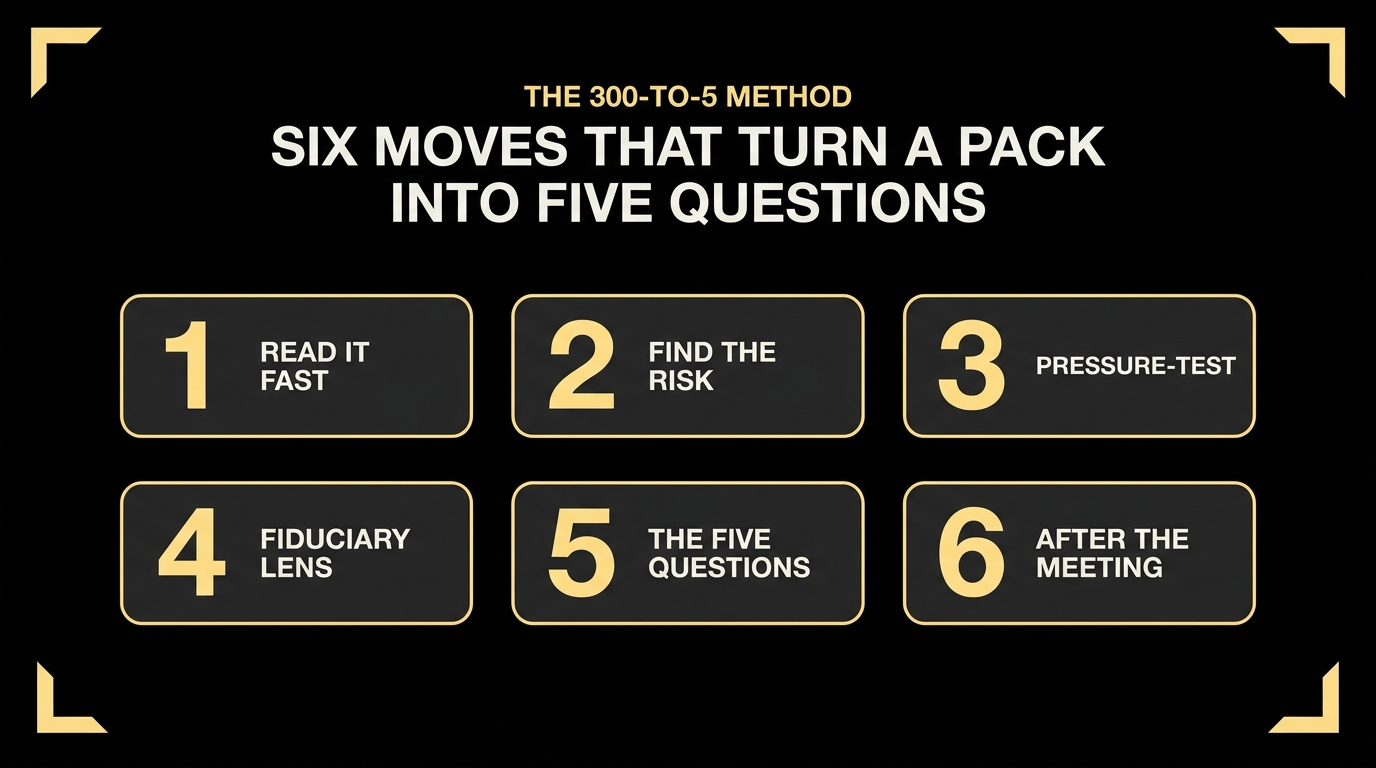
That is a fifteen-minute job if you put the work to a capable analyst and keep your judgment on top. I call it the 300-to-5 method: six moves that turn any pack into five sharp questions. Below are the 25 asks that make it run, what each one is for, and why it earns its place. The first move is free. The rest are for paid subscribers.
Why structured asks beat winging it
Most directors who try AI on a board pack type something like "summarise this" and get a competent, generic summary that tells them what they already knew. The edge is not in having AI. It is in asking it the questions a sharp analyst would ask, in the order a sharp analyst would ask them. Each ask below is tuned to one job a director actually has: catch the risk, test the plan, protect yourself, walk in with the five questions. Run as a sequence, they turn a pack into a decision. Run at random, AI just gives you a faster version of the reading you were already drowning in.
Rule 0: Where you run these
Before the first prompt, one rule governs the other 25. A board pack never goes into a public chatbot. Confidentiality binds you, whether you sit as an independent director or an investor governing your portfolio companies, and it is not negotiable. So every prompt in this library is built to run on your own materials, in a private workspace where the pack never leaves the room and is never used to train a model. That is not a footnote. It is what separates a real method from a party trick. You will see this rule again, because it is the one that makes the other 25 work.
And run everything through your lens. Begin each ask with who you are: as an experienced [sector] board director or investor with a [your thesis] lens. The same pack read through a finance lens and an operating lens produces different questions. Yours is the one that matters, and it is the one a generic summary will never give you.
Move 1: Read it fast (free)
Run it in your private workspace, never a public chatbot.
The first hour of board prep is pure orientation: what is this, what changed, what are we deciding. It is necessary, and it is the easiest hour to give back. These five asks compress it to minutes, so you arrive oriented with your thinking time still in front of you instead of behind you.
1. The two-minute summary.
Summarise the board pack in 10 bullets a director can read in two minutes: the decisions on the table, the headline numbers, and the single most important development this quarter. Plain English, no jargon.
Why it is useful: you walk in knowing the decision and the one number that matters, instead of hunting for them while the meeting starts.
2. What changed since last quarter.
List exactly what changed since last quarter: every number that moved more than 10%, new risks, dropped initiatives, and any shift in management's tone or confidence. Flag anything promised last quarter that is missing.
Why it is useful: boards drift one quarter at a time. The delta, not the snapshot, is where the story is.
3. The five pages that matter.
Tell me the five pages I must read in full before the meeting and why each matters to the decision on the table. Summarise the rest in one line each.
Why it is useful: it tells you where to spend your real reading, so the 295 pages you skim cost you nothing.
4. Translate the financials.
Explain this quarter's financials as if I am a sharp non-finance director: revenue, margin, burn, runway, and the one number management would least like me to ask about. Show the math.
Why it is useful: it closes the gap non-finance directors are most exposed by, and names the number management hopes no one raises. Verify the output: every figure must carry its source page.
5. Decode the jargon.
List every acronym, metric and technical term with a one-line plain-English definition. Flag any metric defined differently from last quarter.
Why it is useful: a metric redefined between quarters is how a miss hides in plain sight. This catches the relabel.
Boardroom takeaway: the first hour of prep is the easiest to hand off and the least valuable to do by hand. Win it back, then spend your judgment where it counts.
🔒 Below the paywall, the other 20 asks, the why behind each, and the one-pass master ask:
→ Move 2: find the risk management did not put on the page
→ Move 3: pressure-test the plan and the claims
→ Move 4: your fiduciary lens, conflicts, and what you are actually approving
→ Move 5: the five questions, and the commitment tracker
→ Move 6: the post-meeting note, plus the one-pass master ask
Upgrade to read the full library
Paid subscribers also get access to The AI Edge Executive Course, the Top 1% of Playbooks for Leaders, GPs and Boards (updated monthly), plus a weekly premium deep dive.
Most subscribers expense or tax deduct this as personal development.
💭 Remember!
As a premium subscriber you get access to every playbook in this series. The 5 most worth reading alongside this one:
1️⃣ The top 1% AI Playbooks for Leaders, GPs and Boards Read here ->
2️⃣ The Top 10 Prompting Hacks for Leaders, Investors and Boards Read here ->
3️⃣ AI: A tool that thinks for you, or a tool that makes you think? Read here ->
4️⃣ How to track AI productivity Read here ->
5️⃣ Build your own chief of staff with AI. Save $160,000 and 10 hours a week. Read here
🗣 Or invite a friend and earn rewards along the way:
→ 3 friends = 1 month free
→ 5 friends = 3 months free
→ 25 friends = 6 months free
Over 13,500 leaders, boards, fund managers, and sponsors are already inside.