What leaders can learn from synthetic influencers building real audiences to companies that torched their best products before competitors could
By The AI Leadership Edge
Published: 2026-03-19
URL: https://theaileadershipedge.substack.com/p/the-courage-to-kill-whats-working
Hi, I’m Raffaela — and welcome to AI Leadership Edge, a newsletter for investors, business and board leaders who want to gain leverage with AI: turning board work and post-investment execution into better decisions, better alignment, and faster results. We’ve just been featured #88 rising in business by Substack 🤗
This week I am testing a new format, please let me know how you like it:
- From the boardroom: Real stories + lessons from experienced investors & leaders
- The Five-Minute Edge: Fast frameworks for when you’re slammed — clarity in 5 minutes, not perfect prep
- Leverage Stack: AI tools that actually work
- After the Deal: What great leaders/ investors do differently
- The Question: One high-leverage question
Join over 12.000 investors, board and business leaders leverage AI into better decisions, better execution, and faster results.
From the Boardroom
Real stories + lessons from experienced leaders, investors and board members.
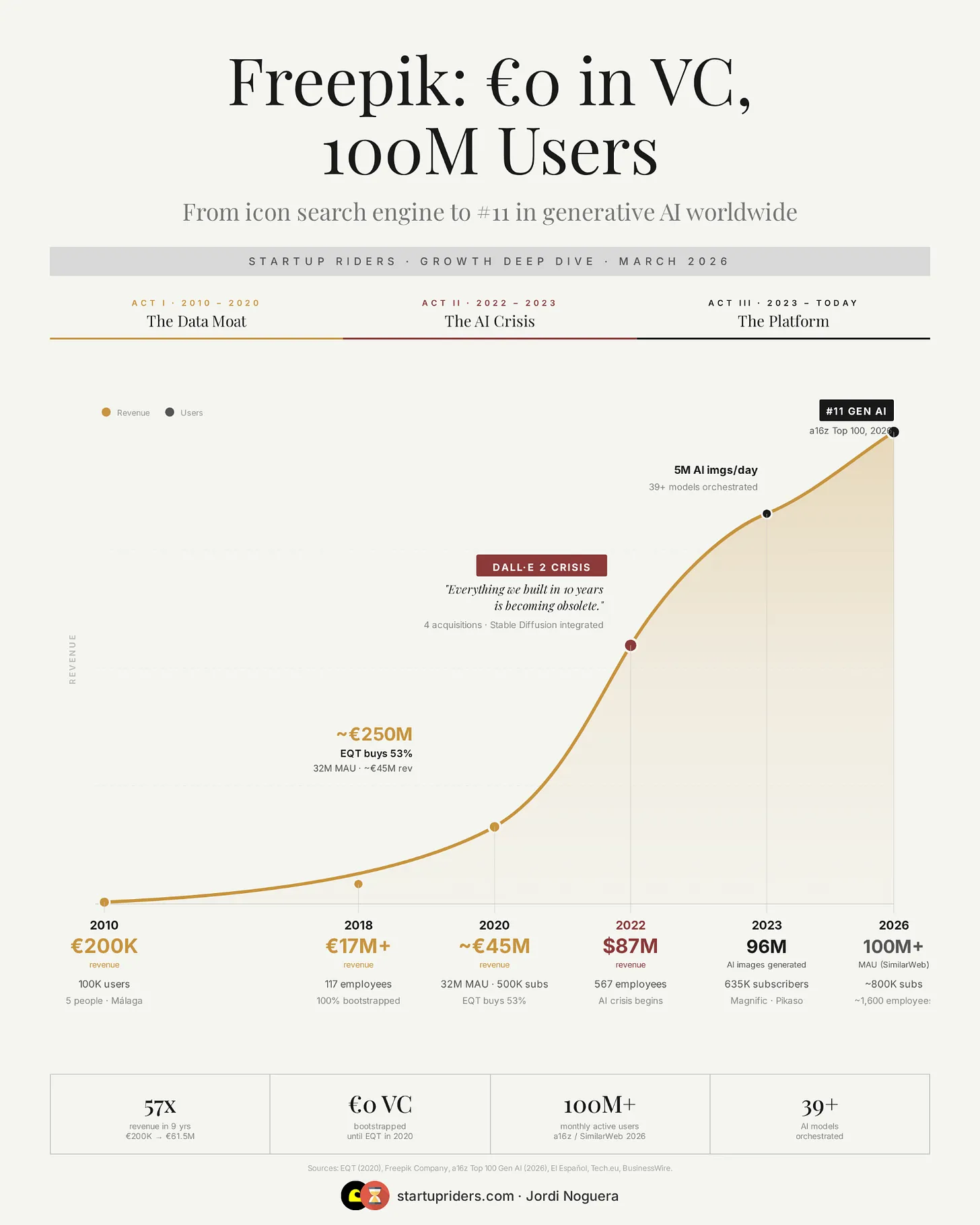
The best real-world case of a company that watched AI threaten to destroy its business, and instead of playing defense, ate its own product and came out growing faster than ever - Freepik
Freepik had 500,000 paying subscribers, €61.5M in revenue, and 100M monthly users when founder Joaquín Cuenca realized everything they’d built over 12 years was about to become obsolete.
It was April 2022. DALL-E 2 had just launched. Joaquín was home with COVID, watching what people were generating. The quality jump was so dramatic that the math became inevitable: in one or two years, AI would match the quality of every image in Freepik’s catalog.
His reaction was honest. “Initially I’d say I felt some despair. I had no plan. I didn’t know what to do.”
Here’s what makes this story fascinating. Freepik wasn’t in crisis. They were at the best moment in their history. Double-digit growth. Wildly profitable. And yet Joaquín had to tell more than 500 employees that their core business was becoming obsolete. Some needed psychological treatment.
Most companies in this position play defense. Adobe’s stance was “this technology is illegal.” They had 400M images and every incentive to protect the status quo. Freepik took the opposite bet. They assumed AI would improve dramatically and decided to attack their own business before someone else did.
Strategy came after action. They started hiring an AI team without knowing exactly what to do. Within an hour of OpenAI releasing CLIP, they integrated it into their search engine. When Stable Diffusion launched as open source in September 2022, Freepik became the first non-professional editor to integrate it.
The counterintuitive result? The business accelerated. Freepik grew faster after the pivot than in the five years before. By end of 2023: 150M monthly users (up from 41M in 2021), 2M monthly active users on AI tools alone, and 120M assets created with AI. Sixty percent of new users came through AI tools. AI didn’t cannibalize their stock business. It created new demand.
Today Freepik ranks #11 in a16z’s list of the 50 most-visited generative AI products globally. Above Grammarly, CapCut, and Midjourney. A bootstrapped company from Málaga that chose to eat itself rather than be eaten.
What leaders and investors can learn:
When a technology threatens your core business, you have two options. You can protect what you have and hope the threat doesn’t materialize. Or you can assume it will and move first. Most boards struggle with this because the business is working. Revenue is up. Margins are good. Why kill what’s working?
The lesson from Freepik is that the best time to cannibalize yourself is when you’re winning, not when you’re desperate. They had 100M users who became instant distribution for AI tools. They had data on what users wanted to create. They had profitable unit economics that let them reinvest. All of that would have evaporated if they’d waited.
For boards and investors: the question isn’t whether AI will disrupt your portfolio company. It’s whether management has the courage to disrupt themselves first. And whether the board will back them when the numbers still look good but the writing is on the wall.
The Five-Minute Edge
Fast frameworks for when you’re slammed — clarity in 5 minutes, not perfect prep.
Overwhelmed CEOs Don't Need More Hours. They Need This
Every business hits the same ceiling: too many opportunities, too few resources, too little time. Succes lies in using your time better over working longer hours.
Most businesses don’t have a productivity problem. They have a prioritization problem. Calendars fill with noise. Roadmaps fill with “almost important” initiatives. Over time, that busyness becomes cultural.
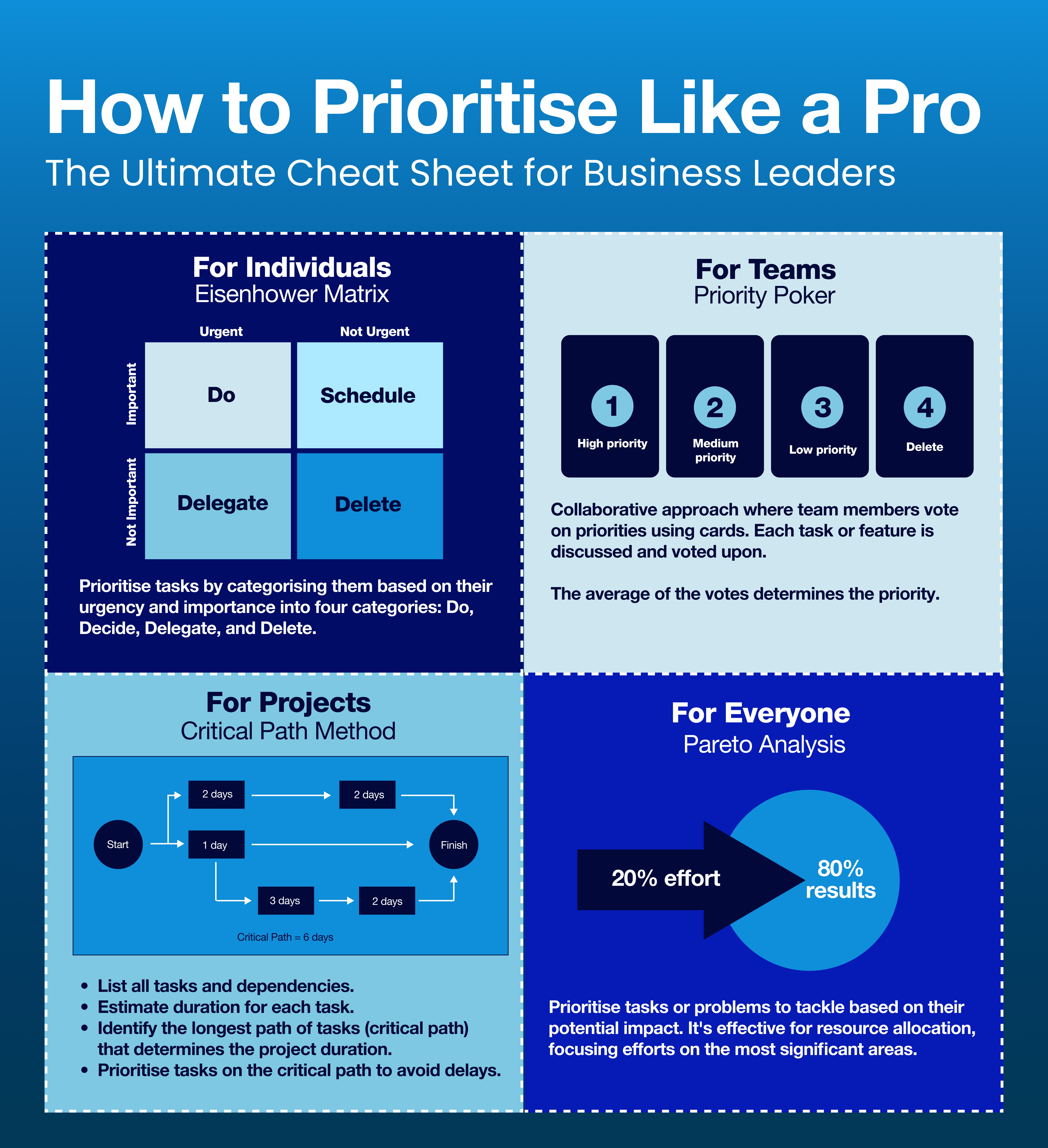
Here are four frameworks that apply at different levels: individual focus, team alignment, project execution, and company-wide impact.
For Individuals: The Eisenhower Matrix Map tasks on two axes: urgent and important. Four categories emerge: Do (urgent and important), Schedule (important but not urgent), Delegate (urgent but not important), Delete (neither). The discipline is protecting time for the “Schedule” quadrant before urgency hijacks it. Most leaders spend too much time reacting in the urgent-but-not-important quadrant, mistaking activity for progress.
For the Organization: Pareto Analysis Twenty percent of customers drive eighty percent of revenue. A handful of features drive most engagement. The discipline is identifying that vital minority and doubling down. The challenge is emotional: leaders must let go of initiatives that feel important but don’t move the needle. Focus is a strategic act of elimination.
For Boards and Investors: Watch how management teams prioritize when everything feels urgent. Do they protect strategic time or just react? Do they align the team or let politics decide? Do they know their critical path or hope timelines hold? The companies that scale aren’t the ones with the best strategy. They’re the ones with the discipline to execute it when the calendar is full and everyone is asking for everything at once.
Leverage Stack
AI tools that actually work: honest reviews, workflows, integration strategies
Claude Cowork: The Tool That Triggered a $285 Billion Software Selloff
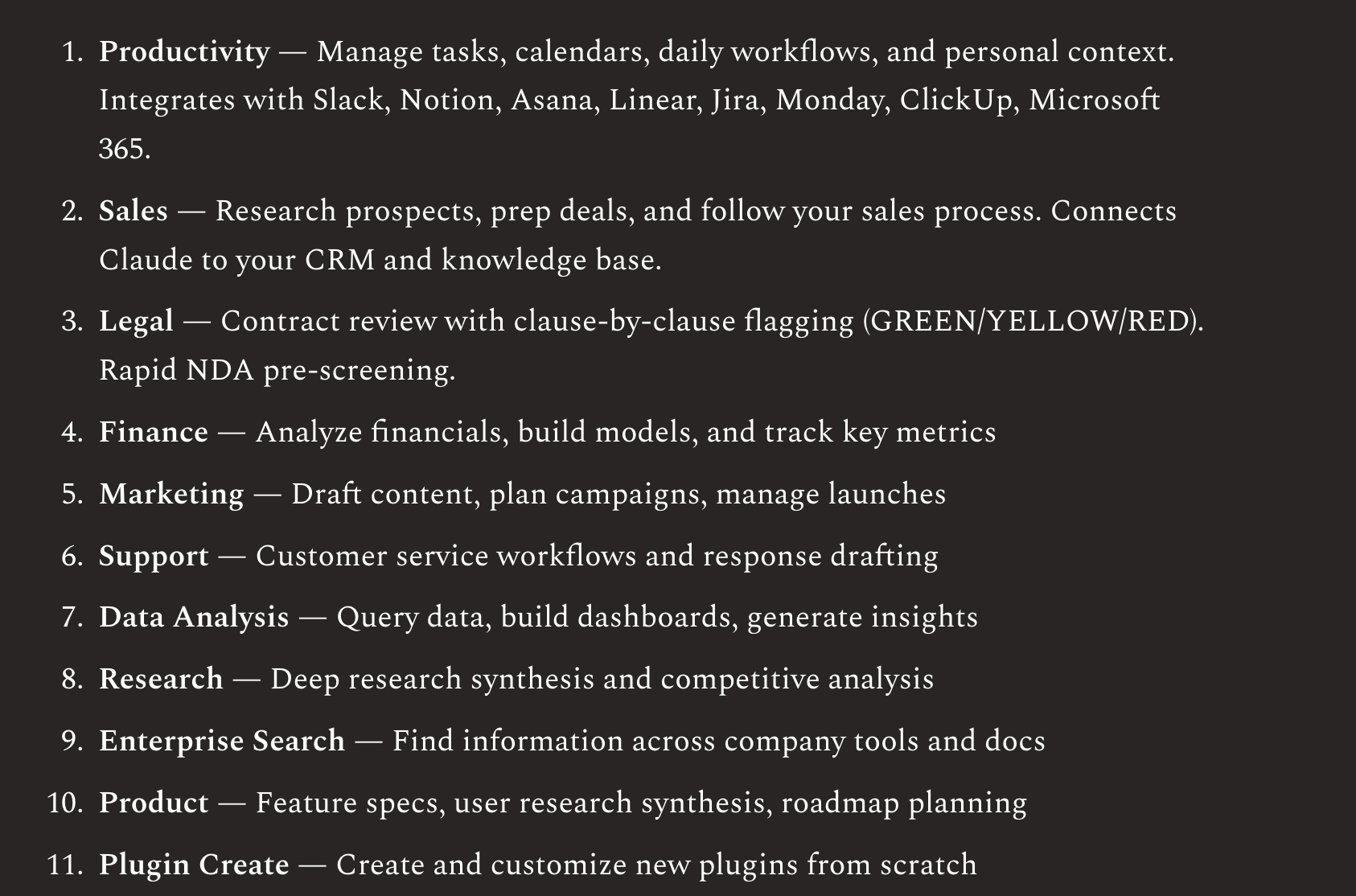
Anthropic launched Claude Cowork in January. Five weeks later, it triggered a $285 billion software selloff. The difference? You give Claude a folder, walk away, and come back to finished work. It doesn't advise—it does the job. Here are some of the tasks it can take over for you:
After the Deal
The part nobody talks about: Where returns really come from, what breaks post-close, what great leaders, investors adn boards do differently
The AI pricing and monetization playbook: Pricing in the Era of AI Is About Outcomes, Not Access
Most AI startups are heading into a renewal crisis. They priced on potential in 2025, but as Bessemer warns, soft ROI positioning (”our copilot helps you work better”) is killing willingness to pay in 2026. The shift: charge for completed work, not access. Intercom’s $0.99 per resolved ticket works because the ROI is instant and undeniable.
For investors and boards, ask: Can management explain their unit economics including compute costs and human-in-the-loop support? If gross margins are below 50%, pricing isn’t aligned with value. The test: if a customer can’t calculate ROI in their sleep, you’re charging for the wrong thing.
The Question
One high-leverage board question per issue — plus when to use it, and how to ask it collaboratively.
A soldier named Jessica Foster just hit a million followers. She posts regularly, shares her life, engages with comments. There’s just one issue: she doesn’t exist. Jessica is AI-generated. Fully synthetic, right down to her OnlyFans page. And yet people follow her. They comment. They engage. They believe.
So here’s the uncomfortable question: If a completely fabricated person can build a real audience, command real attention, and generate real engagement, what does that mean for the rest of us? What happens when the line between real and synthetic becomes so blurred that it stops mattering? And more importantly for leaders, how do you build trust, credibility, and influence in a world where your competition might not even be human?