What building Nereksys with ChatGPT and Codex taught me about human expertise, software development, and the possibilities of AI.
By The Agentic Teacher
Published: 2026-11-24
URL: https://theagenticteacher.substack.com/p/how-i-turned-20-years-of-knowledge
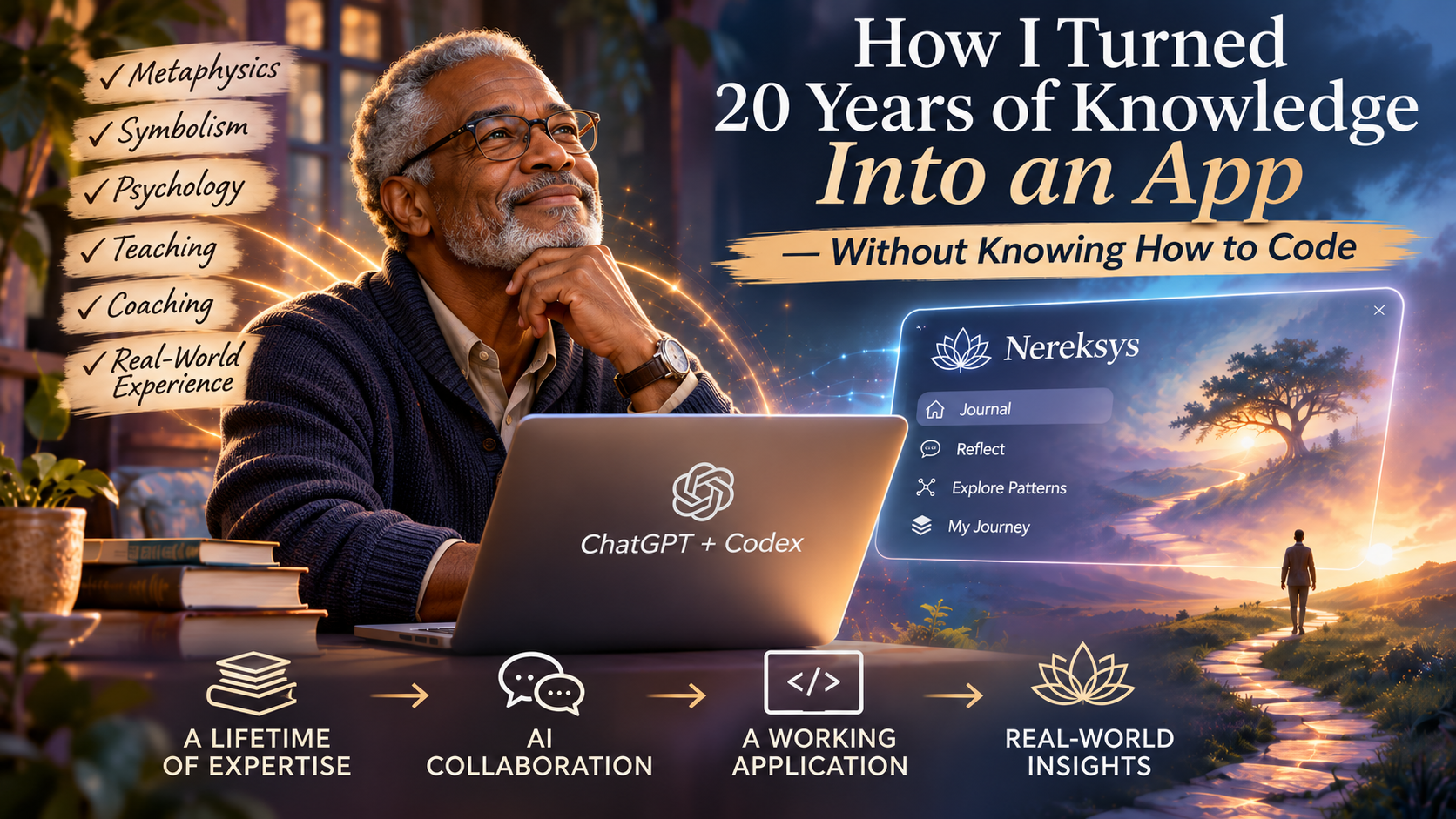
I’m a former schoolteacher, not a software developer. Yet I recently built an AI-powered application that involved work across approximately seventeen different specialties, including software architecture, database design, artificial intelligence integration, user authentication, interface design, cloud deployment, and product development.
The application is called Nereksys, and its origins go back much further than my experience with artificial intelligence.
For more than twenty years, I’ve studied and taught metaphysics, symbolism, and the relationships between our inner and outer experiences. My background in psychology also influenced how I understood the connections between what people experience, how they interpret those experiences, and what they come to believe about themselves.
Over those years, I developed my own conceptual frameworks, teaching methodologies, and ways of recognizing patterns in human experience.
After leaving school teaching, I built a successful business around that knowledge. Through coaching, courses, workshops, educational videos, and other content, I spent years helping people understand and apply these ideas in their own lives. Much of the knowledge I would eventually bring to Nereksys had been developed and refined through that work.
What I wanted to do was take that accumulated knowledge and create an application that could help other people recognize those patterns in their own lives.
I knew what I wanted the application to accomplish. What I didn’t know was how to build it.
Working with ChatGPT and Codex gave me an opportunity to explore whether that gap between what I could envision and what I could technically implement was still the limitation I had always assumed it to be.
What followed was an education in software development, knowledge architecture, product design, and business strategy. But perhaps the most consequential thing I learned was something about the knowledge and capabilities I already possessed.
What I Was Actually Trying to Build
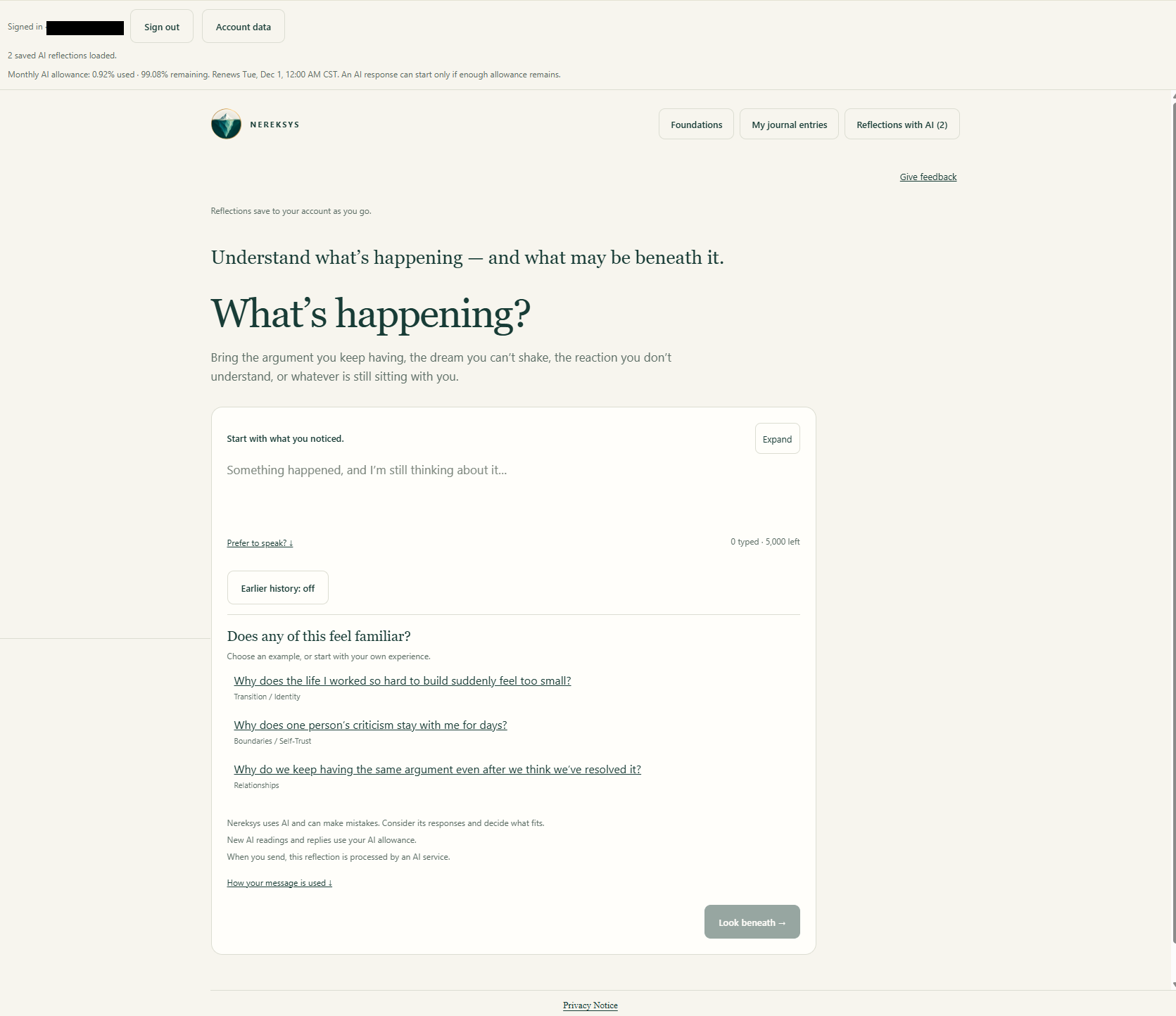
To appreciate the undertaking, it helps to understand what Nereksys was designed to do.
Imagine that you have a dream about being unable to find your way out of an unfamiliar building. A few days later, you find yourself frustrated by a situation at work in which you feel your options are limited. You also notice that you’ve been having difficulty making a decision about a relationship.
You might ordinarily consider these three separate experiences. You might look up the meaning of your dream, talk to a friend about your job, and spend some time thinking about your relationship.
But what if there were something connecting those experiences? What if different circumstances were revealing a similar underlying pattern in how you experience choice, possibility, or uncertainty?
And what if recognizing that pattern gave you a different way of participating in your life?
That was the kind of exploration I wanted Nereksys to facilitate.
The application allows someone to bring a dream, a waking experience, an emotional reaction, a relationship dynamic, a symbol, or a recurring pattern into an interactive conversation. They can explore possible meanings, question interpretations, introduce new information, and examine connections that may not have been immediately apparent to them.
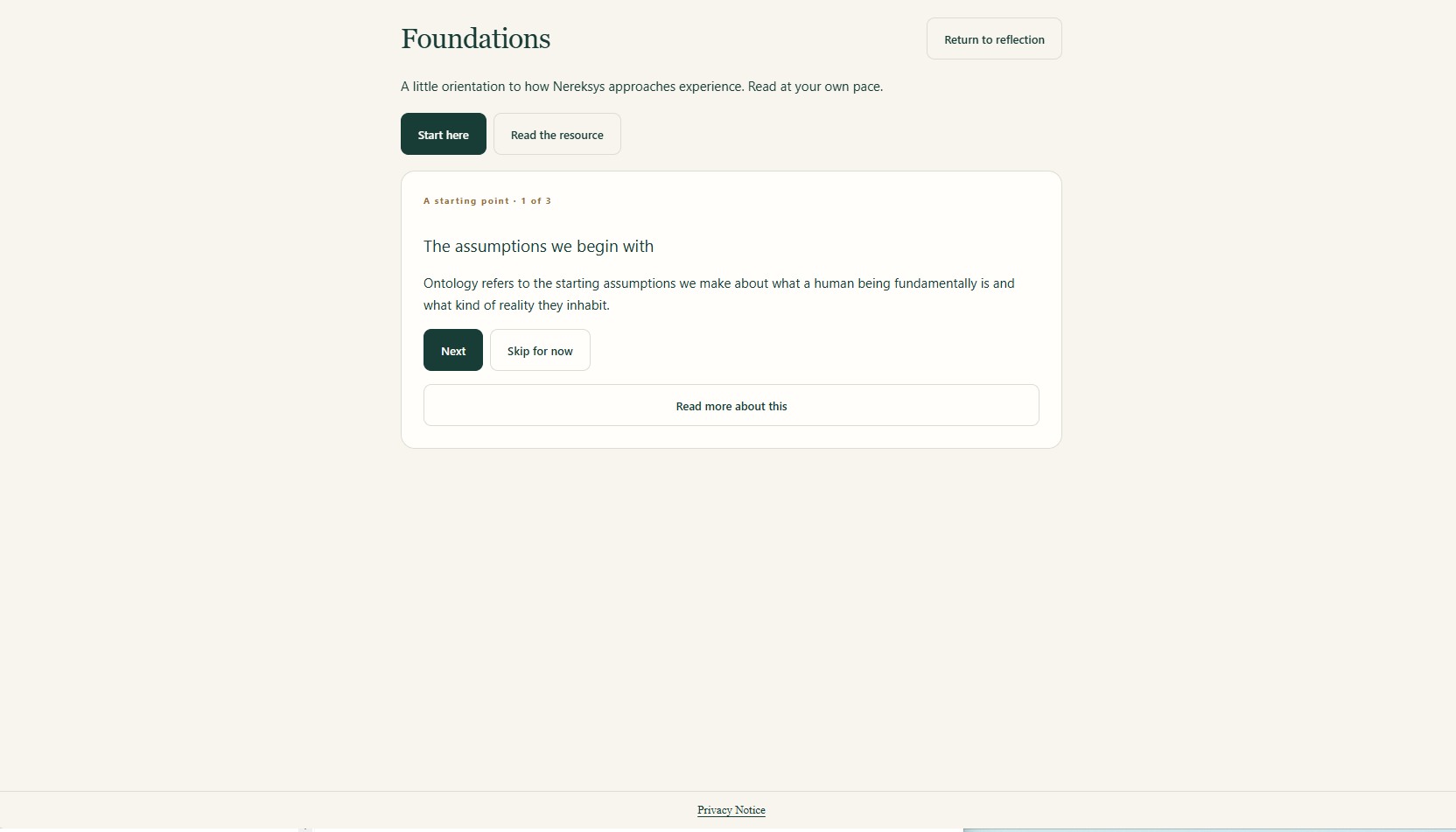
They can also maintain a journal, initiate AI-assisted reflections from their entries, revisit previous conversations, and, with their permission, allow the application to draw upon relevant experiences they’ve shared before.
That last capability was particularly important to me. Our understanding of an experience often changes as we have subsequent experiences. Something that seemed insignificant three months ago may take on an entirely different meaning in light of what is happening today.
I wanted Nereksys to support that continuity.
The journal, therefore, wasn’t the defining feature of the application. It was part of the infrastructure that made a more expansive exploration of someone’s life possible.
I also wanted the application to operate from a particular philosophical foundation: human wholeness.
One of the principles I’ve developed through my teaching is that brokenness turns life into a verdict, while wholeness turns life into information.
An unsuccessful business venture, for example, can become a verdict about someone’s intelligence, worth, or ability to succeed. From another perspective, that same experience contains information about their decisions, assumptions, circumstances, and possibilities for moving forward.
I wanted that distinction to influence how Nereksys engaged with the people using it.
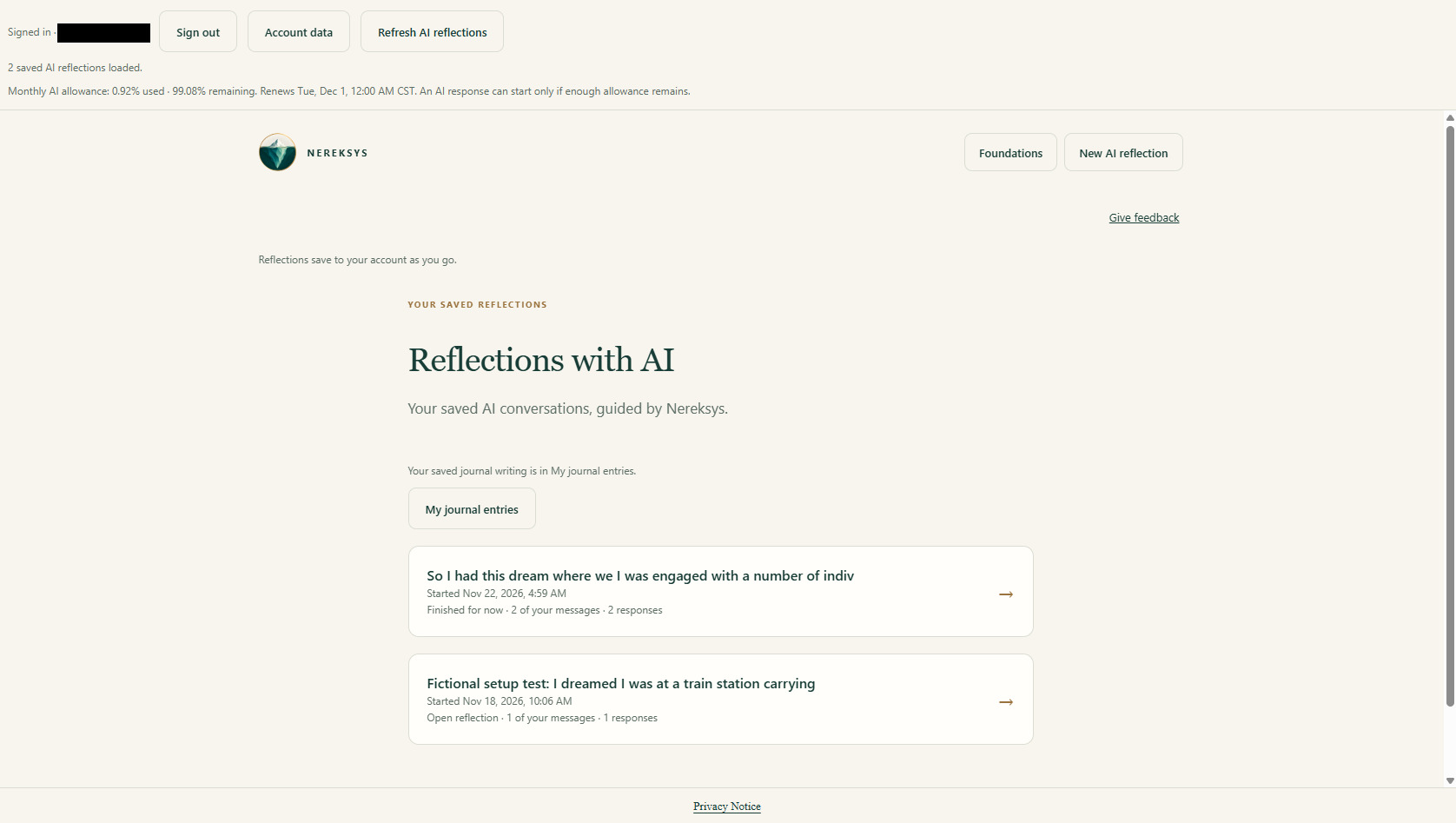
The objective was to help people develop their own capacity to recognize patterns, understand relationships, and derive wisdom from their experiences.
Getting an AI to engage with someone from that foundation presented an entirely different challenge from simply building an application that could generate responses.
Teaching AI What I Had Spent Twenty Years Learning
One of the most intellectually demanding aspects of building Nereksys was something that, initially, had very little to do with writing software.
I had to make my own knowledge explicit.
When you’ve spent years developing expertise in a particular field, much of what you do becomes intuitive. You may recognize a meaningful connection, notice an inconsistency, or ask a particular question without consciously walking through every principle that informed your decision.
I experienced this as a teacher. You can sometimes recognize that a student doesn’t understand a concept even though they’ve given you the correct answer. That recognition comes from more than the answer itself. It comes from years of observing how people learn, communicate, and demonstrate understanding.
The same thing happens in my metaphysical and symbolic work. When someone describes an experience, there are relationships I pay attention to, distinctions I make, and assumptions I know to question.
Much of that had become tacit knowledge — knowledge I possessed and used but hadn’t necessarily documented in a form that another person, much less a machine, could consistently follow.
Building Nereksys required me to begin externalizing that knowledge.
What principles were informing my interpretations? What made a symbolic connection meaningful rather than speculative? How did I distinguish between the different dimensions of an experience? Under what circumstances should an interpretation change?
How could I help the AI recognize a pattern without allowing it to impose a meaning that wasn’t supported by what the person had shared?
Through conversations with ChatGPT and development work in Codex, I began translating these questions and principles into what became the Nereksys interpretive runtime.
A runtime, in this context, is the operational framework that guides how the underlying AI processes information and responds within the application.
It included the philosophical foundation of the system, interpretive principles, relationships between concepts, behavioral guidance, and boundaries around how the AI should engage with the person.
One principle, for example, was to examine the function of something within an experience rather than assume that a particular symbol always carries a predetermined meaning.
A house appearing in someone’s dream might be significant. But understanding its significance requires paying attention to what happened in that house, the person’s relationship to it, the emotions associated with it, and the circumstances surrounding the dream.
Simply assigning a universal meaning to the house could obscure the very information we were trying to understand.
Translating distinctions like that into an operational framework required me to examine my own thinking at a level I hadn’t always needed to when working directly with people.
At one point during development, we discovered that the instructions governing how the AI should format its answers were more developed than the instructions governing how it should actually understand someone’s experience.
The application could produce a well-organized response that appeared to be consistent with my methodology without necessarily demonstrating the depth of understanding I wanted.
That was an important discovery.
It also brought into focus a distinction between two very different kinds of development work I was doing.
When we were building the technical infrastructure of Nereksys, many of the problems had outcomes we could objectively verify. A journal entry either saved successfully or it didn’t. The application either retrieved the requested information or it didn’t. We could establish what was supposed to happen, run a test, and determine whether the software was functioning as intended.
Developing the interpretive runtime presented a different kind of challenge.
There isn’t necessarily one correct interpretation of a dream or a waking experience. Two interpretations might both be plausible, yet one might reveal a meaningful relationship that the other completely overlooks. Determining the difference requires an understanding of the context, the underlying principles, and the significance of the relationships being explored.
The fact that an interpretation is subjective doesn’t mean that every interpretation is equally insightful or well-supported.
A response can look right without being right. It can use the appropriate terminology, follow the expected format, and still miss the most significant relationship in someone’s experience.
What made this part of the development process particularly interesting was that, although I didn’t know how to write the code for Nereksys, I possessed the specialized knowledge required to help construct its interpretive framework.
My role extended beyond telling AI what I wanted the application to do and evaluating whether it worked. I was actively working with AI to articulate the principles, develop the reasoning framework, and establish the standards by which its interpretations could be evaluated.
A software developer might have been able to construct the entire technical infrastructure of Nereksys without possessing the metaphysical and symbolic knowledge required to develop its interpretive framework.
I had the opposite situation. I possessed that domain knowledge but lacked the technical expertise to turn it into a functioning application.
Working with ChatGPT and Codex allowed me to bring those two domains together.
I had to return to the underlying principles, refine the guidance, and evaluate whether those changes actually improved the interpretations.
This became an ongoing process of development, testing, correction, and refinement.
And it revealed a possibility that extends far beyond Nereksys.
Consider how much knowledge resides in the heads of experienced business owners, educators, consultants, and other professionals. They know things about their work that they’ve acquired through years of experience, but much of that knowledge has never been systematically documented.
An experienced business owner might know exactly how to handle an unusual customer request. A consultant might instinctively recognize the real problem beneath what a client initially describes. A teacher might know how to introduce a difficult concept to different kinds of learners.
What could happen if those professionals began working with AI to make that knowledge explicit, organize it, and turn it into systems that other people could use?
Nereksys was my own experience of exploring that possibility.
Becoming the General Contractor of a Software Project
Of course, having an interpretive framework was only one part of building Nereksys.
I still needed an application.
There had to be an interface through which someone could engage with the AI, a database to retain information, a way for users to create accounts and securely access their own records, and mechanisms for retrieving previous experiences.
The application needed to be hosted somewhere. Its components needed to communicate with each other. There had to be provisions for backups, recovery, testing, and managing the costs associated with using the underlying AI models.
As a non-coder, I had to figure out how to coordinate all of this.
One of the most useful ways I’ve come to understand my role is through the analogy of a general contractor.
A general contractor overseeing the construction of a house may coordinate the work of electricians, plumbers, roofers, carpenters, and other specialists. Each specialty requires a body of technical knowledge. But someone also has to understand the overall objective, coordinate the various parts of the project, inspect the work, and ensure that what is being constructed conforms to the blueprint.
That is similar to the role I occupied while building Nereksys.
When I later went back and examined the project, I identified approximately seventeen different specialties that had been involved. They ranged from intellectual framework development and product management to frontend and backend development, database architecture, security, deployment, quality assurance, branding, and launch preparation.
I wasn’t personally performing all those jobs in the traditional sense. I was directing and coordinating the work through AI.
ChatGPT was a thinking partner that helped me explore ideas, examine assumptions, articulate requirements, and work through conceptual problems. Codex was the development environment through which those decisions could become functioning software.
Over time, I developed a way of working in which I could describe the outcome I wanted, allow Codex to investigate how to achieve it, and then evaluate the result.
Sometimes I also used one AI model to perform development work and another to independently examine what had been done.
I didn’t have to know the programming language required to implement a particular feature before I could begin thinking about what that feature needed to accomplish.
But I did have to think.
I had to understand why the feature belonged in the application, how someone would use it, what information it needed, what could go wrong, and how we would know whether it was functioning as intended.
I also had to learn when to ask Codex to investigate rather than immediately implement a solution, when to request independent verification, and when to revisit a decision I had previously approved.
AI gave me access to technical capabilities I didn’t possess. My responsibility was to supply direction, context, standards, and judgment.
That division of labor became increasingly important as the application grew more complex.
When Functionality Isn’t Enough
One of the more interesting experiences I had during development involved something as seemingly straightforward as the journal.
I opened the journal in Nereksys and found myself overwhelmed.
I could write an entry, search previous entries, open a connected conversation, and navigate among different parts of the application.
I knew why every feature was there. I remembered the conversations that led to its development, the decisions behind it, and the functionality each element provided.
But when I tried to use the page as someone who simply wanted to write down what had happened that day, I realized how much I was asking that person to figure out before they could write a few lines.
My familiarity with the application had made it difficult for me to recognize a problem in its design.
From a development perspective, the features were working. From a user’s perspective, they were competing for attention.
I worked with Codex to simplify the experience, giving people a clearer place to write and a separate place to retrieve previous entries. We also introduced suggested questions to help someone get started and checked that selecting one of those questions wouldn’t erase anything the person had already written.
That experience helped me appreciate the difference between evaluating software functionality and evaluating a human experience.
Codex could help implement the changes and test whether the individual features worked. But I still needed to recognize that the original experience wasn’t accomplishing what I intended.
There’s something here that applies to almost anyone building with AI.
As AI makes it easier to create features, there is a temptation to keep adding them. Something that might previously have required a significant development investment can now be relatively accessible.
But the ability to add functionality doesn’t establish a need for that functionality.
Sometimes the most valuable contribution you can make to a product is recognizing what should be simplified, removed, or reorganized.
That requires looking beyond what you’ve built and considering what someone is actually trying to accomplish when they use it.
Taking Nereksys Outside My Own Environment
Getting Nereksys to work for me was one milestone. Getting it ready for other people introduced an entirely new set of considerations.
What happened when someone created an account? Would they receive the appropriate email? Could they sign in, write an entry, initiate a reflection, leave the application, and find everything again when they returned?
What responsibilities came with allowing people to share potentially sensitive personal experiences?
How would their information be retained? What provisions were needed for deletion, backups, and recovery? How could I manage the costs associated with their use of AI?
We tested the hosted application using a test account, walking through the experience from signup to retrieving saved information.
I also established usage limits and set aside a budget for a small, controlled beta program.
I made up to ten places available and began inviting people I knew and trusted, followed by outreach to some of my Substack subscribers.
Preparing those invitations introduced another challenge: communicating what Nereksys actually was.
I had spent so much time inside its conceptual and technical architecture that I could readily explain why its various components mattered. But someone encountering it for the first time didn’t have that background.
How could I communicate the value of an application designed to help people explore the relationships among their experiences when the most recognizable feature might be a journal?
Calling it a dream interpretation app would have made it easier to categorize, but that would have substantially misrepresented its purpose. Calling it an AI journal would have presented a similar problem.
I had come to describe Nereksys as a wholeness app. But creating a new product category also meant helping people understand why that category should matter to them in the first place.
I was no longer simply thinking as the creator of the application. I had to think as a product designer, a marketer, an entrepreneur, and a potential customer.
The beta was intended to help test the technology and gather feedback about the experience of using it. It wasn’t a large-scale market validation exercise.
Nevertheless, moving toward a potential commercial launch forced me to examine questions that had very little to do with whether the software worked.
Testing the Assumptions Behind the Product
Throughout the development of Nereksys, I was evaluating more than the application’s technical functionality.
I also needed to understand how much value its custom interpretive runtime was contributing.
I had invested considerable time developing the principles and guidance that informed the application. But I couldn’t simply assume that the existence of that framework meant the AI would consistently produce better interpretations.
So I conducted comparative evaluations.
I tested different ChatGPT thinking levels (Astra, Sol, Terra, and Luna) operating within the Nereksys framework, examining their ability to recognize meaningful relationships, interpret experiences coherently, and communicate their understanding in a way that was useful to the person.
Those last two considerations were particularly important to me.
A model could demonstrate considerable interpretive depth but communicate its understanding so poorly that the person struggled to benefit from it. Conversely, a model could produce an eloquent response that didn’t reveal much about the experience itself.
I needed both.
Some earlier comparisons suggested that the runtime helped the AI stay closer to the information provided and avoid unnecessary speculation.
But AI models were also continuing to improve.
As I evaluated newer models, I began asking a more consequential question: how much additional value was Nereksys providing beyond what an increasingly capable general-purpose AI could already accomplish?
I ran some of the same interpretive scenarios without the Nereksys runtime and compared the results.
In several of those comparisons, the differences were less substantial than I had anticipated.
That didn’t mean the runtime had no value. Nor did it eliminate the usefulness of having a dedicated environment with journaling, persistent records, contextual memory, and the ability to revisit previous experiences.
But it did challenge one of the assumptions behind commercializing the application.
If the underlying AI models could already provide much of the interpretive quality I was seeking, what would constitute sufficient differentiation to justify developing Nereksys into a sustainable business?
That was a different question from whether I had successfully built what I envisioned.
Ultimately, I decided not to pursue a commercial launch. I chose instead to retain Nereksys as a personal, cloud-based application that I could access from my computer and phone.
I still find value in what I’ve created. It serves a purpose in my own life, and I can continue using and developing it.
But I didn’t have sufficient evidence that its differentiation justified the investment required to turn it into a commercial product.
Building an application and deciding whether to build a business around that application are two distinct undertakings.
AI has significantly expanded what’s technically possible for someone like me. It hasn’t eliminated the need to make sound business decisions about those possibilities.
The Capability I Didn’t Realize I Was Developing
Something interesting happened when I began looking back over the development of Nereksys.
I had been so occupied with creating the application that I hadn’t fully considered what I was learning to do in the process.
I had taken an idea rooted in more than twenty years of accumulated knowledge, worked through its conceptual architecture, translated that architecture into operational instructions, coordinated the technical development, evaluated the results, prepared the application for users, and examined its potential as a business.
When I mapped the work afterward, I could begin separating the capabilities I had developed from the particular artifact I had created.
That distinction opened up an entirely new set of possibilities for me.
The ability to externalize tacit knowledge, for example, isn’t limited to developing a metaphysical application.
A business owner who has spent twenty years developing expertise in their industry may possess an enormous amount of undocumented operational knowledge. They know how to evaluate opportunities, handle difficult situations, recognize exceptions, and make decisions that inexperienced employees may struggle to make.
What if we could take that knowledge and develop workflows that their employees and AI systems could both follow?
What if we could create training tools, operational guides, or specialized AI assistants that reflected the actual judgment and standards of that particular business?
And what if we could teach the business owner how to manage and refine those systems themselves?
The underlying process wouldn’t be fundamentally different from some of what I had done with Nereksys.
The domain knowledge would change. The technical implementation might change. The desired outcome would change.
But the methodology of identifying the goal, externalizing knowledge, establishing standards, directing AI, evaluating results, and refining the system would remain relevant.
As a former schoolteacher who has also spent years developing courses, curricula, workshops, and learning tools, that’s an especially exciting possibility for me.
I’ve since begun documenting and mapping these processes so that I can teach other people how to develop similar capabilities within their own areas of expertise.
What interests me is helping people become increasingly self-sufficient in their work with AI — capable of directing it, evaluating what it produces, and developing systems that serve their actual needs.
What Might You Already Know That AI Could Help You Build?
Before building Nereksys, I had never developed an application of this complexity.
But I had spent decades developing the knowledge that made this particular application possible.
I think that’s an important distinction for people who are exploring what they might be able to accomplish with AI.
When we concentrate on the capabilities of artificial intelligence, it’s easy to overlook the capabilities we bring to the relationship.
You may have spent years operating a business, developing a teaching methodology, solving a particular kind of problem, managing projects, or understanding the needs of a particular group of people.
You may possess knowledge that has never been documented because you’ve never had a reason or an accessible means to translate it into something more operational.
Perhaps there’s an application within that knowledge. Perhaps there’s a training system, a specialized AI assistant, a more effective business workflow, or an entirely different kind of product or service.
You don’t necessarily have to begin by learning how to code.
You can begin by examining what you already know, what problems that knowledge helps you solve, and what might become possible if you could make that knowledge available in a different form.
That’s what I did with Nereksys.
I began with something I knew deeply and something I didn’t know how to build. Working with ChatGPT and Codex allowed me to bring those two things together.
And although I ultimately decided not to commercialize the application, the capabilities I developed didn’t disappear with that decision. I can apply them to the next application, the next business problem, the next workflow, and the next idea I want to bring into existence.
For me, that may be one of the most consequential possibilities artificial intelligence has introduced.
It gives us new ways to convert what we know into what we can do.
This Substack is reader-supported. To receive new posts and support my work, consider becoming a free or paid subscriber.