Agent tools will keep changing. The durable advantage is knowing how to brief, guide, and judge the work they produce.
By The Agentic Teacher
Published: 2026-08-13
URL: https://theagenticteacher.substack.com/p/the-5-part-ai-briefing-stack-for
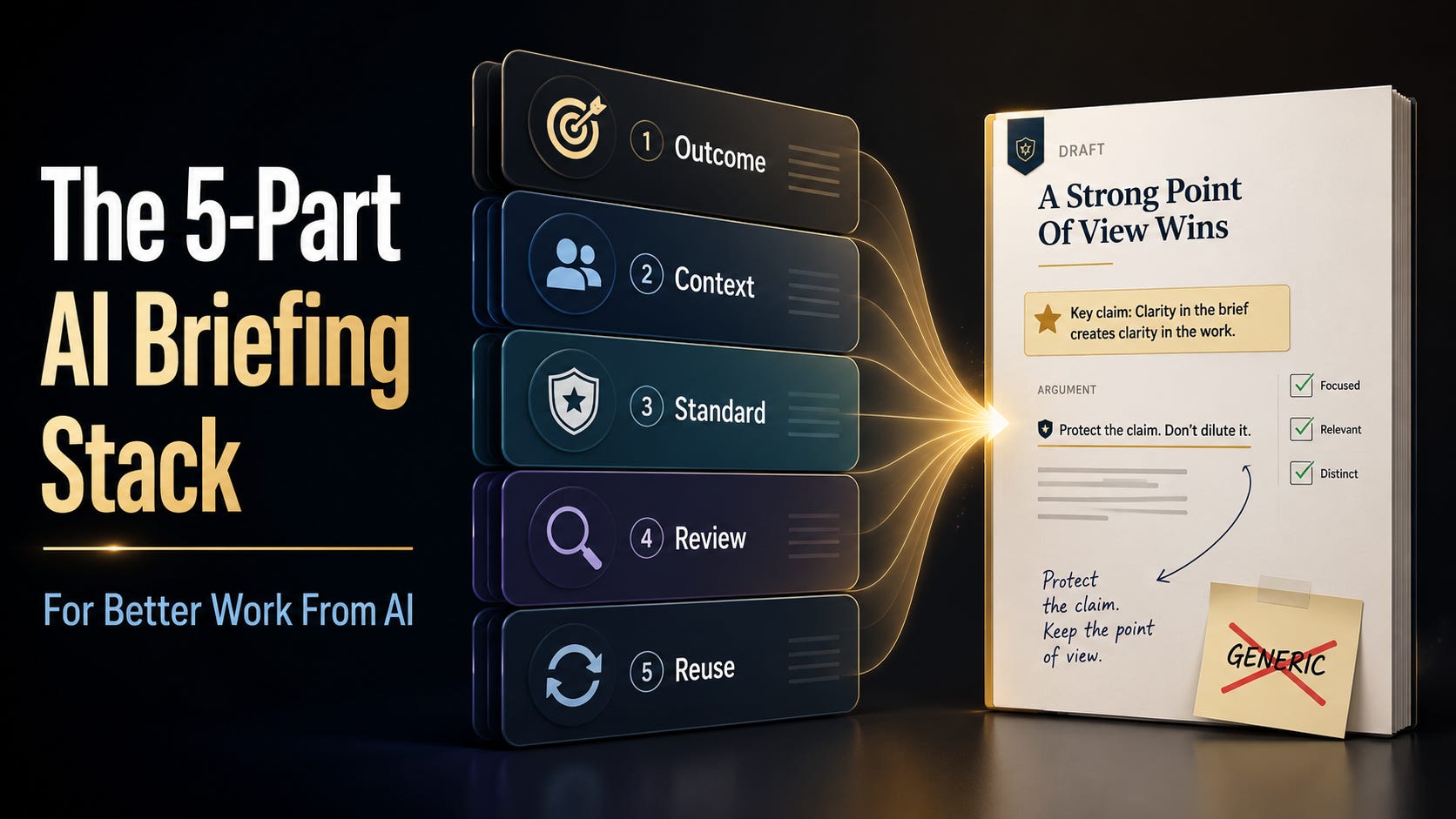
You ask AI to help with a serious piece of writing.
It gives you something clean. The structure makes sense. The language is smooth. The draft looks finished.
Then you read it closely and realize the problem: it flattened the thinking.
The argument is more generic than what you meant. The examples are safe but forgettable. The voice sounds like everyone else who writes about the topic. Nothing is exactly wrong, but the work no longer carries the weight of your judgment.
That is the quiet danger of getting better at AI.
The tools can help you produce more, faster. But if you have not defined what good work means before the work begins, they can also help you produce polished waste.
The useful shift is this: as AI gets easier to command, the advantage moves away from prompt tricks and toward judgment.
The problem is underdefined briefing.
Early AI advice often treated prompting like a secret language. Use the right phrase. Add the right role. Include the right magic words. Get the right output.
That was useful when the tools were unfamiliar. People needed handles.
But the more capable AI becomes, the less durable those little tricks are. The durable skill is briefing the work clearly.
There is a big difference between asking AI to “write something about this topic” and briefing it with:
Here is the audience.
Here is the problem they already feel.
Here is the decision I want them to make.
Here is what must not be assumed.
Here is the standard the answer has to meet.
Here is what I will use it for next.
That is not just prompting. That is briefing.
And this is where many knowledge workers quietly struggle. They know good work when they see it, but they have not translated their standards into a form AI can use before it starts.
So the AI produces something plausible. The human either accepts it too quickly or spends the next hour correcting a draft that was aimed in the wrong direction from the start.
The problem was not that the prompt lacked flair. The problem was that the work was under-briefed.
A nonfiction writer’s problem is not blank-page speed.
Take a nonfiction writer working on an essay, book chapter, or Substack article from a real body of expertise.
They do not merely need words. They need the piece to preserve an argument.
They may have a hard-won distinction, a personal framework, a contrarian read on their industry, or a sequence of ideas that only makes sense in a particular order. If they ask AI to “turn these notes into an article,” the result may be organized and readable while quietly sanding down the very thing that made the work worth reading.
The AI may turn a sharp claim into common advice. It may replace a specific example with a generic one. It may smooth out the tension because tension feels less tidy. It may make the writer sound balanced when the actual point needed to be decisive.
That is not a writing problem only. It is a briefing problem.
The writer did not just need to ask for an article. They needed to define what the article had to protect before the draft began:
The claim.
The audience pressure.
The point of view.
The examples that carry authority.
The standard for what counts as too generic.
The next use of the draft.
Once those pieces are named, AI becomes more useful. It is no longer guessing what kind of writing the author wants. It is operating inside the author’s judgment.
The 5-Part AI Briefing Stack.
A useful starting point is to define five things before handing meaningful work to AI:
Download the Judgment Stack Cheat Sheet
Before you trust an AI output, you need a way to test the judgment underneath it.
Download the Judgment Stack Cheat Sheet here:
This post has bonus content for paid subscribers. Upgrade to get full access.
Use it before publishing, sending, teaching, or building from AI-generated work.