Turn your sources, standards, and decisions into a repeatable brief-to-review workflow—even if you don’t code.
By The Agentic Teacher
Published: 2026-07-27
URL: https://theagenticteacher.substack.com/p/how-to-stop-rebuilding-every-article
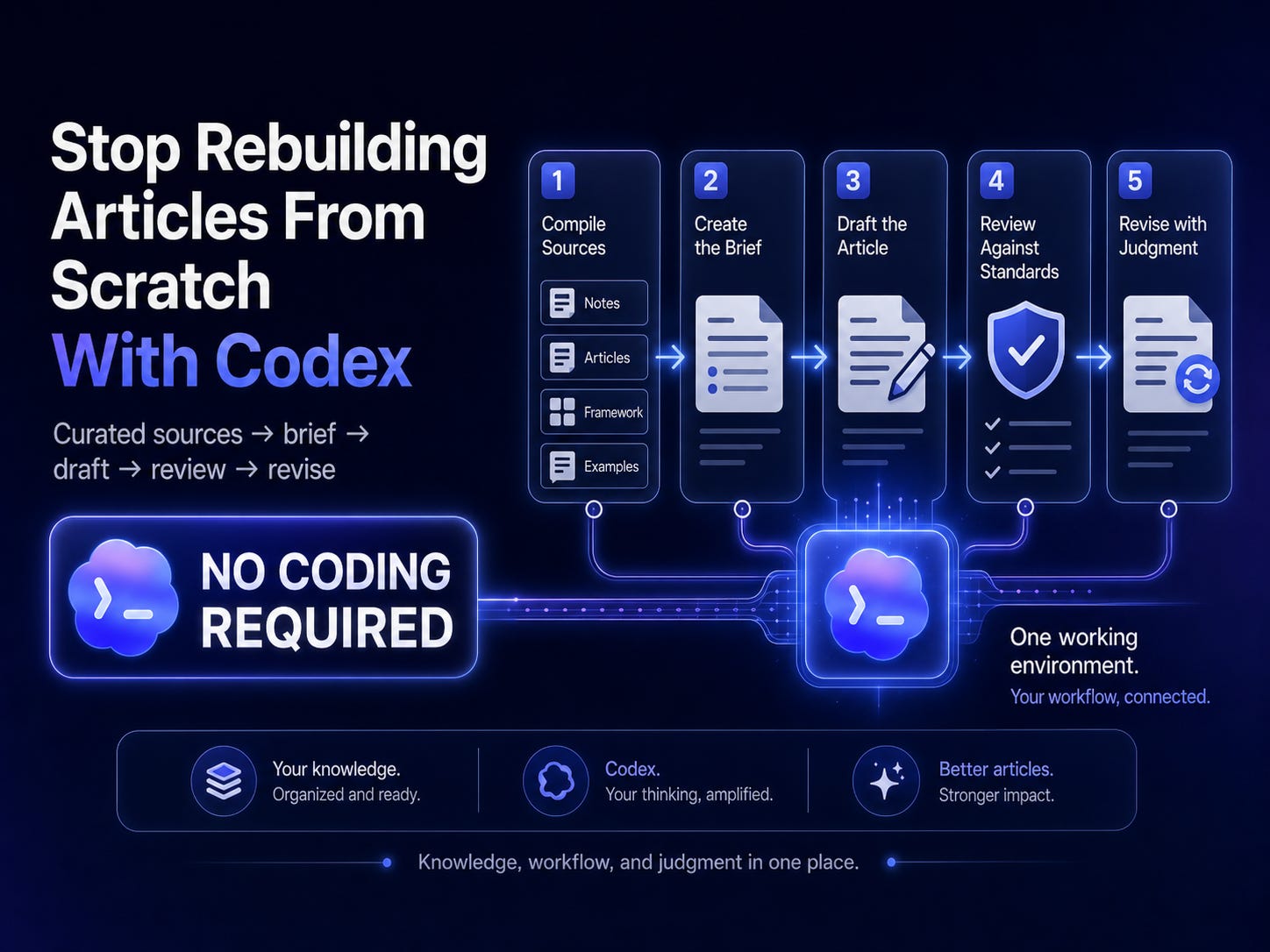
If every article begins with finding the right sources, rebuilding the context, and re-explaining your standards to ChatGPT, you are not just writing an article. You are rebuilding the production process every time.
Creating one good article used to take me days.
I had to find the right articles, notes, frameworks, examples, and audience language. Then I had to explain the context to ChatGPT, describe what I wanted the article to do, ask for a draft, read the draft, point out what felt generic or misaligned, explain the perspective again, and ask for another revision.
ChatGPT could help with every stage, but I was still carrying the workflow. The sources lived in one place, the conversation lived in another, the standards lived in my head, and the next revision depended on whether I could remember what I had already decided.
I created the workflow because the manual process was inconsistent
When I drafted too early, I had to hold too much in my head at once: the audience, the source material, the central idea, the promise, the structure, and the perspective I wanted the article to take.
Some articles would start with a clear direction. Others would drift into a generic version of an idea I had already developed.
Why I create a brief before I create a draft
The brief comes first because drafting before the idea is properly shaped creates expensive confusion later.
The brief gives the article a job. It gathers the relevant material, clarifies the audience problem, establishes the angle, and makes the intended outcome visible before the first paragraph is written.
Before I had this step, I was trying to discover the article and write the article at the same time. That made the draft carry decisions it should not have been responsible for carrying.
Now the brief externalizes those decisions. I can inspect the direction before I spend time revising prose that was built on a weak or unclear foundation.
Why the draft comes before the review
I do not have to imagine whether the article works. I can look at the actual language, structure, emphasis, omissions, and transitions.
The review is also sharper because the draft was created from my curated knowledge base. Codex has more than a general pattern to imitate; it has my language, distinctions, examples, and developed thinking to work from. I spend less time asking why the draft misunderstood the subject or inserted a generic point. I can focus on whether the perspective is strong, whether the article extends my work, what is missing, and what needs to be refined.
That does not eliminate generic language or mistakes. It reduces the basic misalignment, so my review can concentrate on meaning, judgment, and quality.
Why I use a structured review process
Without a repeatable review filter, I would read the article differently every time and rely on whatever weakness happened to catch my attention.
I created a structured quality process to give the article a consistent first pass. Codex can apply that process, surface the parts that need attention, and help narrow the revision work.
It is not the final authority. It is a filter that helps me focus and sharpen the strongest aspects of the article instead of rereading the whole piece without a clear target.
None of this required code. I was creating a knowledge-work workflow: a repeatable path from curated material to a reviewed article. Codex gave me an environment where it could run.
What Codex changed for me
I created the process and operating environment. Before Codex, NotebookLM could gather sources, but I still copied context, moved files, and carried the production stages manually. In Codex, I built one environment where the sources, briefs, drafts, reviews, and decisions stay connected. Codex did not create it; it gives me a place to run it, with the files, decisions, and standards I curate available each time so the process can compound instead of reset.
I critique the direction, decide what is valid, and direct the next revision. Codex carries out the targeted changes instead of making me carry every stage between disconnected conversations.
I used this same process to create this article. I gave Codex the series context and curated files; it shaped the brief, created the draft, and ran the audit. I challenged the wording, corrected the perspective, added the workspace bridge, and directed the next revision. Codex carried out the changes; I judged what remained.
The workflow now lives outside my head
The workflow is simple: curated sources feed a brief; the brief feeds a draft; a filter surfaces weaknesses; my critique sets the perspective; Codex revises.
I no longer have to reconstruct the sequence from memory before I begin. The process is available each time.
What I had to create
I curated the files, created the standards, defined the perspective, and decided what I am willing to stand behind. The environment preserves that structure; Codex works from it but did not create it.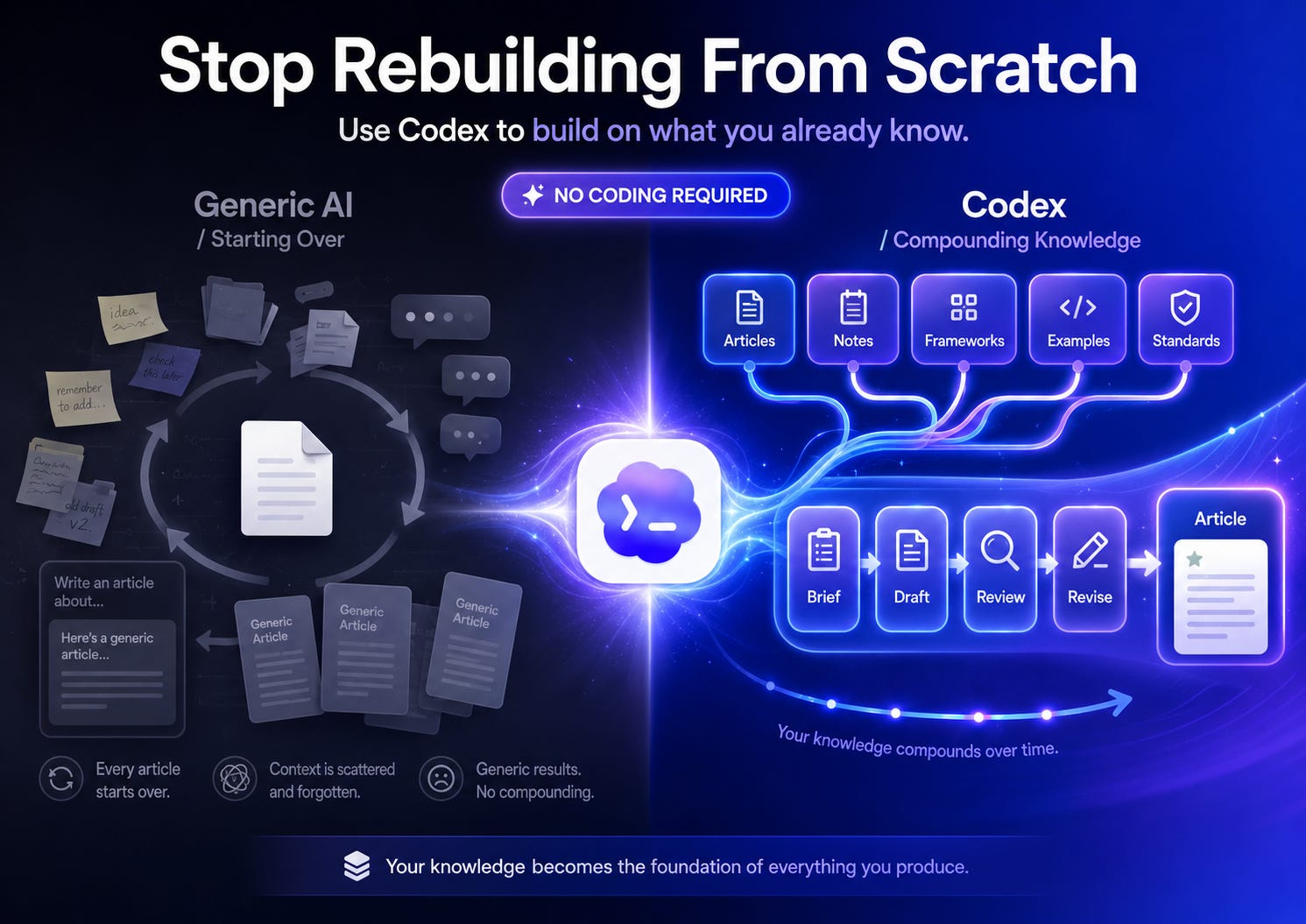
The same structure applies to other knowledge work
The profession changes, but the pattern is similar: marketers turn campaign research into briefs and assets; coaches turn notes into resources; consultants turn research into recommendations; teachers turn curriculum into lessons. Curated knowledge goes in, a reviewed artifact comes out, and the practitioner decides.
Try mapping one workflow you repeat
Useful ideas should be easy to come back to.
Subscribe free to access the Free Resource Hub: practical articles, guides, and starting points that help you think more clearly, make better judgments, and move your AI-supported work forward.
Join free and give yourself a dependable place to return when you need the right idea again.
Choose one kind of work you do repeatedly and ask:
-
What files and source material should the AI work from?
-
What should it create first: a brief, outline, draft, or analysis?
-
What structured filter would help you focus your review?
-
Which decisions must remain yours?
Start with one workflow that currently depends on you remembering every step, then move that structure into an environment where Codex can help carry it forward. That is the beginning of an operating system for knowledge work: curated sources, connected stages, explicit standards, and your judgment still at the center.
If your AI work is still scattered across chats and files, the first step is not to build an elaborate system. Set up one Codex workspace for one real project, give it clear boundaries, and run one safe task from start to finish. That is how the workflow gets a home.
If you want help with that first step, start here: Set Up Your First Codex Workspace Without the Guesswork.
This Substack is reader-supported. To receive new posts and support my work, consider becoming a free or paid subscriber.