Turn your past articles, notes, frameworks, and client questions into your next article, PDF, or course outline.
By The Agentic Teacher
Published: 2026-07-22
URL: https://theagenticteacher.substack.com/p/how-to-use-codex-to-create-from-your
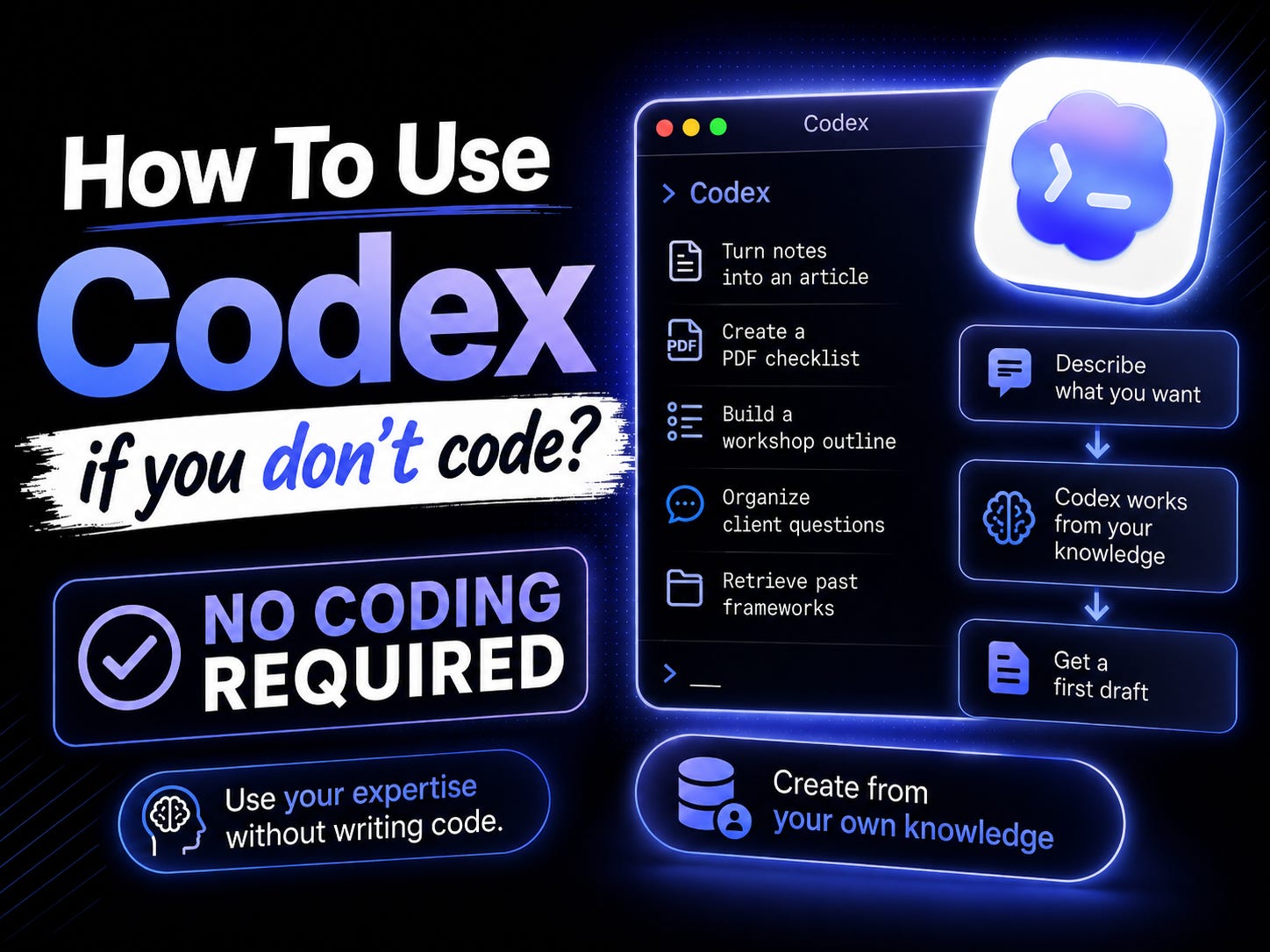
Codex can sound like a tool for programmers.
If you do not code, it is easy to assume it is not for you. You may use AI to brainstorm, but when it is time to create something substantial, you still do the same hidden job yourself.
You search through old folders. You try to remember what you wrote before. You locate the framework you know belongs somewhere. You rebuild the context behind the idea before you can even begin the article, PDF, workshop, or course outline.
That is not a lack-of-ideas problem. It is a start-from-scratch problem.
Codex can help with that—without you writing code.
Your next idea does not have to begin with a blank page
Imagine you want to create a PDF resource for your audience.
You already have useful material: past articles, teaching notes, a framework, client examples, and recurring questions. But it is not sitting in one document called “the PDF I need to write today.”
The manual approach is to hunt down the relevant pieces, cut and paste them into a new document, explain to AI how they should flow, then correct what it missed, flattened, or made generic before you even have a usable first draft.
With Codex, I do not have to begin that way. I can bring it a YouTube video link with an idea I want to expand on. Codex can retrieve the transcript, give me a synopsis through the Agentic Teacher perspective, explain why the idea matters for my audience, and identify different angles I could take.
Once I choose the angle, I can have Codex create the article and a downloadable PDF checklist or step-by-step guide for the workflow.
The same pattern applies when you want to create:
-
a new article from ideas you have already explored;
-
a workshop outline from your teaching materials and recurring learner questions;
-
a course outline from your existing frameworks and examples; or
-
a client resource from prior decisions, research, and proven language.
The point is not that Codex has a clever answer. The point is that it can create from the knowledge already behind your work.
This is more than asking AI a question
When you ask a general AI tool a broad question, it has to fill in the gaps. It can offer useful patterns, but it does not automatically know the distinctions you have made, the examples you trust, the language your audience uses, or the decisions that shaped your work.
A prompt gives Codex a task. Your articles, examples, decisions, and frameworks give it knowledge to query.
That changes the starting point. Instead of asking AI to invent a course outline from a one-sentence description, you can ask it to help create one from the teaching, questions, and framework you have already developed.
Instead of prompting, “Give me ideas for a lead magnet,” you can ask it to examine the articles and client questions that already show what your audience needs—and create the first guide from that material.
You are not asking AI to replace your expertise. You are giving it the work that explains what your expertise actually is.
Codex cannot curate your work for you
This part matters.
Codex does not magically turn every file you have ever saved into a reliable source of truth. It cannot know on its own which old draft still represents your thinking, which example is outdated, which decision has changed, or which standard should govern a new piece of work.
You do not need to code to use Codex this way. But you do need to create a body of work it can reliably work from.
That means deciding what belongs in the environment: the current framework, the useful articles, the examples you want to preserve, the audience language that matters, and the standards you want the work to meet. In other words, you curate the knowledge. Codex helps you find it, connect it, think with it, and create from it.
When you give Codex a body of work to query, you give it something to work from instead of something to guess about.
You still make the call
The goal is not to hand over authorship or judgment.
Codex can create the first article draft, the first PDF, or the first course outline. But you decide whether it is accurate. You decide whether it reflects what you mean. You decide what needs correction, what should be removed, and whether the result is ready to use.
That is a better role than having to carry every file location, past decision, and first-draft task in your head.
Your job becomes direction and judgment. Codex can take on more of the retrieval, connection, structuring, and first-version creation.
Start with one artifact you already need
Choose one thing you want to create in the next month: an article, a PDF resource, a workshop, or a course outline.
Then ask yourself:
-
What work have I already done that should inform it?
-
Which articles, notes, examples, decisions, or client questions belong in that source set?
-
What would I want Codex to create after it has worked from that material?
You do not need to turn your entire business into a technical system before you begin. Start by making one useful body of work available for one real task.
But if you want Codex to keep helping you create from your expertise over time, your knowledge needs a reliable home. That is the deeper work behind AI Command Center OS: creating a curated working environment where your files, decisions, examples, and standards can support the next thing you make.
Your expertise should not be trapped inside files you have to remember to search. It should be something you can query, think with, and create from.
This Substack is reader-supported. To receive new posts and support my work, consider becoming a free or paid subscriber.