Use lighter models for execution inside a stable system. Save stronger reasoning for decisions that change the system itself.
By The Agentic Teacher
Published: 2026-07-04
URL: https://theagenticteacher.substack.com/p/the-simple-rule-i-use-to-stop-burning
I started paying closer attention to model choice for a very practical reason:
I did not want to keep running out of Codex usage.
When you begin using Codex or agentic AI for real work, usage limits stop being abstract. They become part of how you manage the work.
You start noticing when a task burns more reasoning than it probably needed. You start wondering whether you should have used a lighter model. You start asking whether every job really needs the most powerful option available.
At first, the question sounds technical:
Which model should I use?
But that is not the best question.
The better question is:
What job am I giving the model?
Because not every AI task carries the same level of responsibility.
Some tasks are routine execution. Some tasks change the system future work depends on. Those should not be treated the same.
A Better System Makes Model Choice Easier
One thing I have learned from building a more developed Codex workspace is that I can be more selective about which model I use.
Not because the lower models suddenly become more powerful.
Because the system gives them more support.
Earlier, when my workspace was less developed, Codex had to do more searching and interpreting before it could even begin the real work. It had to figure out where files lived, which standards applied, what had already been decided, and what kind of output I wanted.
That burns usage before the actual task begins.
Now, when the folders are clearer, the source material has a predictable home, the standards are written down, and the workflows are already defined, Codex does not have to figure everything out from scratch.
It can follow the system.
That matters.
A well-structured system saves usage in two ways.
First, you do not need the strongest model for every task. If the job is simply to apply an existing template, summarize notes, format a file, or run a known workflow, a lighter model can often handle it.
Second, the model wastes less time searching for context. If the files are named clearly and stored in predictable places, Codex does not have to spend as much effort hunting, guessing, or reconstructing the logic of your workspace.
The better organized your AI workspace is, the less intelligence you waste finding the work before doing the work.
That is the hidden benefit of a system.
It does not just make your work cleaner. It makes your AI usage more efficient.
The Simple Rule
Here is the model-routing principle I use:
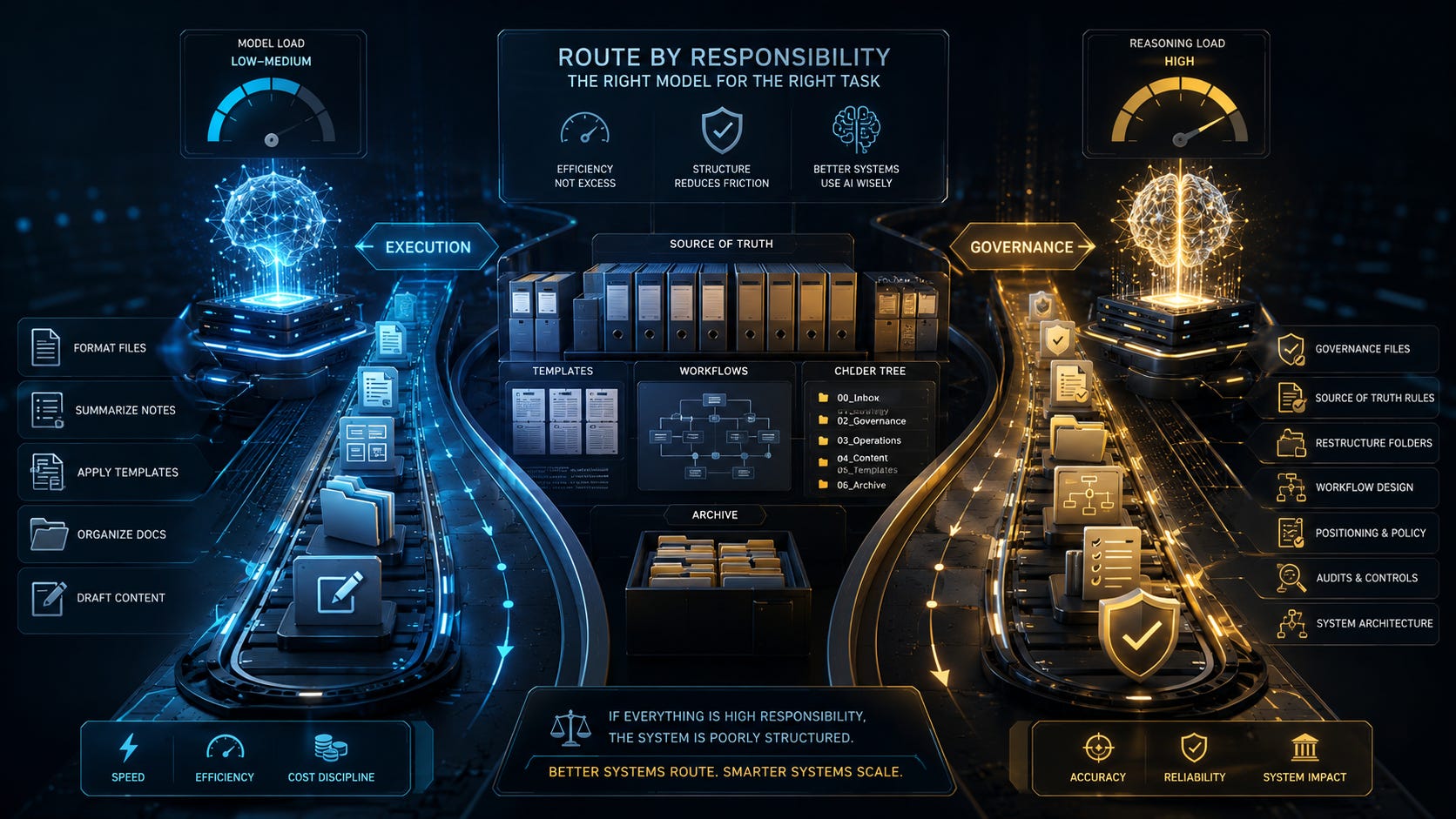
Use lighter models for execution inside a stable system. Use stronger models when changing the system itself.
In my current Codex workflow, I think about this as the difference between GPT-5.4 and GPT-5.5.
GPT-5.4 helps me execute work. GPT-5.5 helps me govern work.
Those model names will change over time. There will be newer versions, stronger versions, and different pricing structures.
But the management principle will not change.
The question is not only “Which model is smarter?”
The question is:
How much responsibility does this task carry?
Think of it like assigning work to different levels of staff.
You would not ask a senior strategist to alphabetize folders.
You would not ask an intern to rewrite company policy.
You would not bring in your most expensive advisor to format a document.
You would not hand your operating system redesign to someone who does not understand the business.
AI model choice works the same way.
When GPT-5.4 Is Usually Enough
For me, GPT-5.4 is usually enough when Codex is working inside a system that is already clear.
That means the model is not being asked to rethink the work. It is being asked to execute inside decisions that have already been made.
Examples include:
-
formatting files
-
applying templates
-
summarizing existing notes
-
moving content into approved folders
-
creating routine drafts from established standards
-
running an existing workflow
-
cleaning up a document
-
organizing supplied material
In these cases, the system carries much of the intelligence.
The model needs to follow instructions, preserve structure, and complete the task.
This is where cost discipline matters.
If you use your strongest model for every small task, you train yourself to treat all work as equally important. But all work is not equally important.
Some work is maintenance.
Some work is production.
Some work is load-bearing.
A mature AI operator learns the difference.
When GPT-5.5 Is Safer
GPT-5.5 becomes more useful when the model is changing the system itself.
That includes work like:
-
changing governance files
-
restructuring folders
-
updating source-of-truth rules
-
revising positioning
-
creating new workflows
-
resolving conflicts between standards
-
auditing important changes
-
making decisions that affect future work
This kind of work has more consequence.
If Codex formats a file badly, you can usually fix it quickly.
If Codex changes a source-of-truth rule badly, future work may start drifting.
If it restructures folders without understanding why they exist, your workspace can become harder to use.
If it revises positioning carelessly, your message can become less coherent.
If it creates a new workflow that duplicates an existing one, your system gets heavier instead of clearer.
That is governance work.
Governance work deserves more reasoning because it affects what happens next.
The Model Names Will Change
This is why I do not want to turn the lesson into a permanent rule about one specific model version.
Today, the practical distinction might be GPT-5.4 versus GPT-5.5.
Later, it may be GPT-5.5 versus GPT-5.6.
After that, the names may change again.
That is fine.
The model names will change. The responsibility levels will not.
There will probably always be some version of this decision:
-
use the lighter model for stable execution
-
use the stronger model for system-changing judgment
-
use the highest reasoning only when the stakes justify it
That is the durable skill.
You are not trying to memorize a model chart.
You are learning how to route work.
A Simple Way To Think About Codex Reasoning Levels
You do not need to think about Codex settings like an engineer.
Think about them like levels of responsibility.
Low is for mechanical work.
Use it for simple, bounded tasks that are easy to check: formatting, renaming, cleanup, sorting, or applying a very clear instruction.
Medium is for routine workflow execution.
Use it when Codex needs to follow an established process, summarize material, draft from known standards, or produce something inside a structure that already exists.
High is for system-changing or load-bearing decisions.
Use it when the task affects governance, positioning, structure, workflow design, source-of-truth rules, or future routing.
Extra High is rare.
Use it for major redesigns, high-risk audits, complicated conflicts between systems, or decisions where a mistake could create a lot of downstream confusion.
This is not absolute. There will always be judgment involved.
But that is the point.
You are not just using AI.
You are managing AI.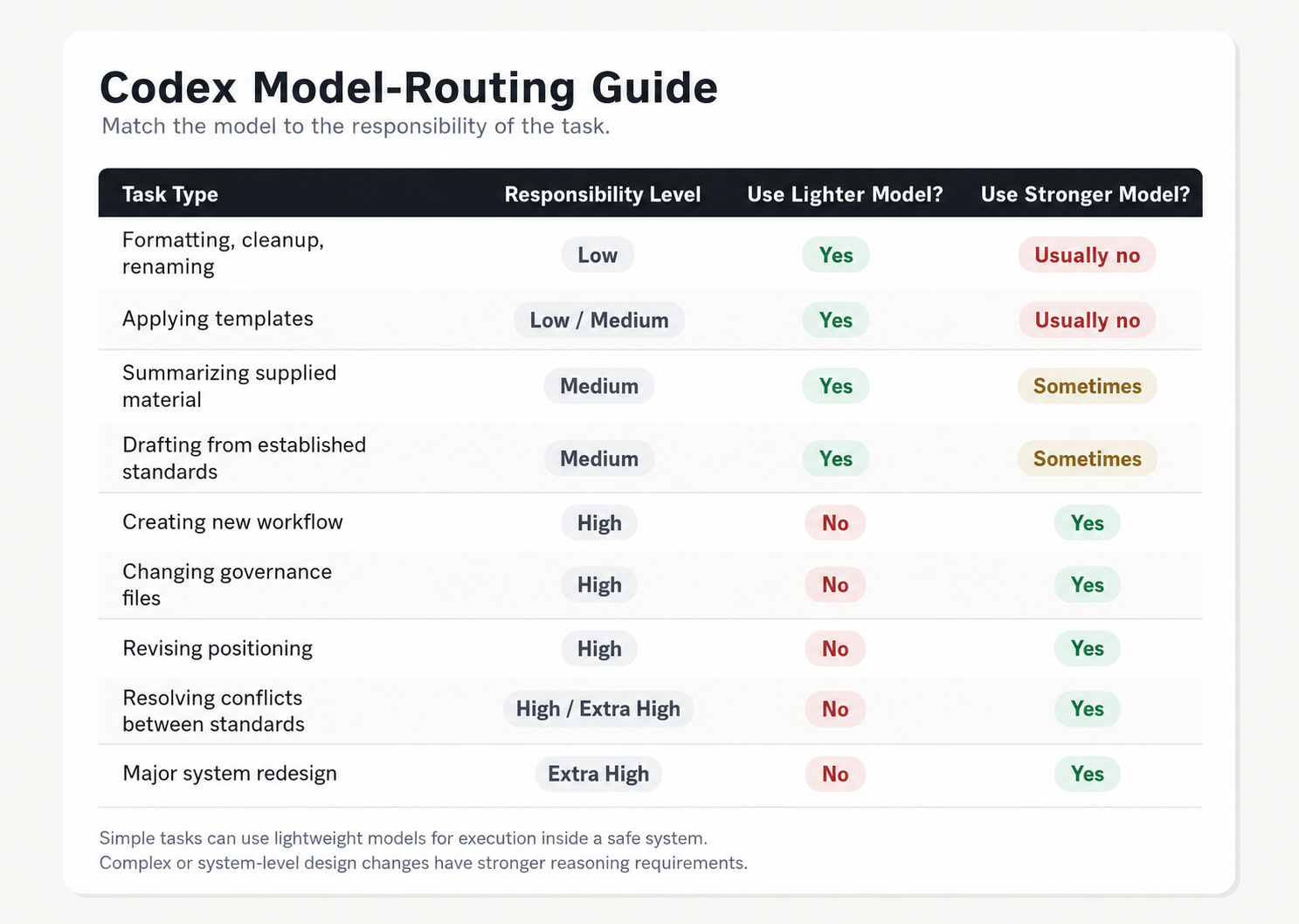
If Every Task Needs the Strongest Model
There is another lesson hidden inside this.
If every task feels like it needs the strongest model, the issue may not be the model.
The issue may be that the work is not structured enough yet.
When your files are scattered, your standards are unclear, your workflows live only in your head, and your source material has no stable home, every task becomes harder than it needs to be.
Codex has to search more.
It has to infer more.
It has to ask more.
It has to reconstruct decisions that should already be available.
That burns usage twice.
First, you spend usage helping the model find the work.
Then, because the work is poorly structured, you feel pressure to use a stronger model just to make the task feel safer.
A stronger model can sometimes compensate for a weak system, but that does not mean it should have to.
The more structured your workspace becomes, the more you can reserve stronger reasoning for the work that actually deserves it.
Speed Is Not the Whole Story (Stripe as a case study)
Nate B. Jones made an important point using Stripe as an example. The headline was that Stripe reportedly ran a migration across 50 million lines of code in one day.
But the speed was not the real story.
The real story was that Stripe had already built the systems needed to judge the output. They had task coverage, verification processes, review structures, and people who knew how to work with the model at that level.
Without that review infrastructure, the same AI capability would not have created leverage. It would have created a pile of changes nobody could confidently approve.
That is the lesson for Codex users too.
A stronger model can produce more. But if your workspace has no source of truth, no review rules, no governance standards, and no way to tell whether the output belongs, speed turns into risk.
The question is not just:
How fast can AI produce?
The better question is:
Do I have a system mature enough to evaluate and absorb what AI produces?
That is why model routing matters.
Use lighter models for stable execution. Use stronger models for system-changing decisions. But in both cases, the real advantage is not only the model.
The real advantage is the system that helps you judge the work.
The Better Question
The beginner question is:
Which AI model is best?
The operator question is:
What kind of responsibility am I assigning?
That one shift changes how you use Codex.
If the work is already defined, use a lighter model and let the system carry more of the load.
If the work changes the system, use stronger reasoning and give the decision more care.
That is how you avoid wasting expensive intelligence on routine tasks while still protecting the decisions that matter.
The goal is not always to use the strongest model.
The goal is to give the right level of intelligence to the right level of responsibility.
If this made you realize you are using strong models to compensate for a scattered workspace, start with the free AI Command Center OS Checklist.
Use it to identify where your source material, decisions, standards, examples, reusable instructions, and useful AI outputs are still scattered.
The goal is not just to organize your files.
The goal is to build a system clear enough that Codex does not have to rediscover your work every time it helps you.
This Substack is reader-supported. To receive new posts and support my work, consider becoming a free or paid subscriber.