A useful AI conversation should become source material, not disappear into chat history.
By The Agentic Teacher
Published: 2026-06-26
URL: https://theagenticteacher.substack.com/p/your-ai-chats-are-not-disposable
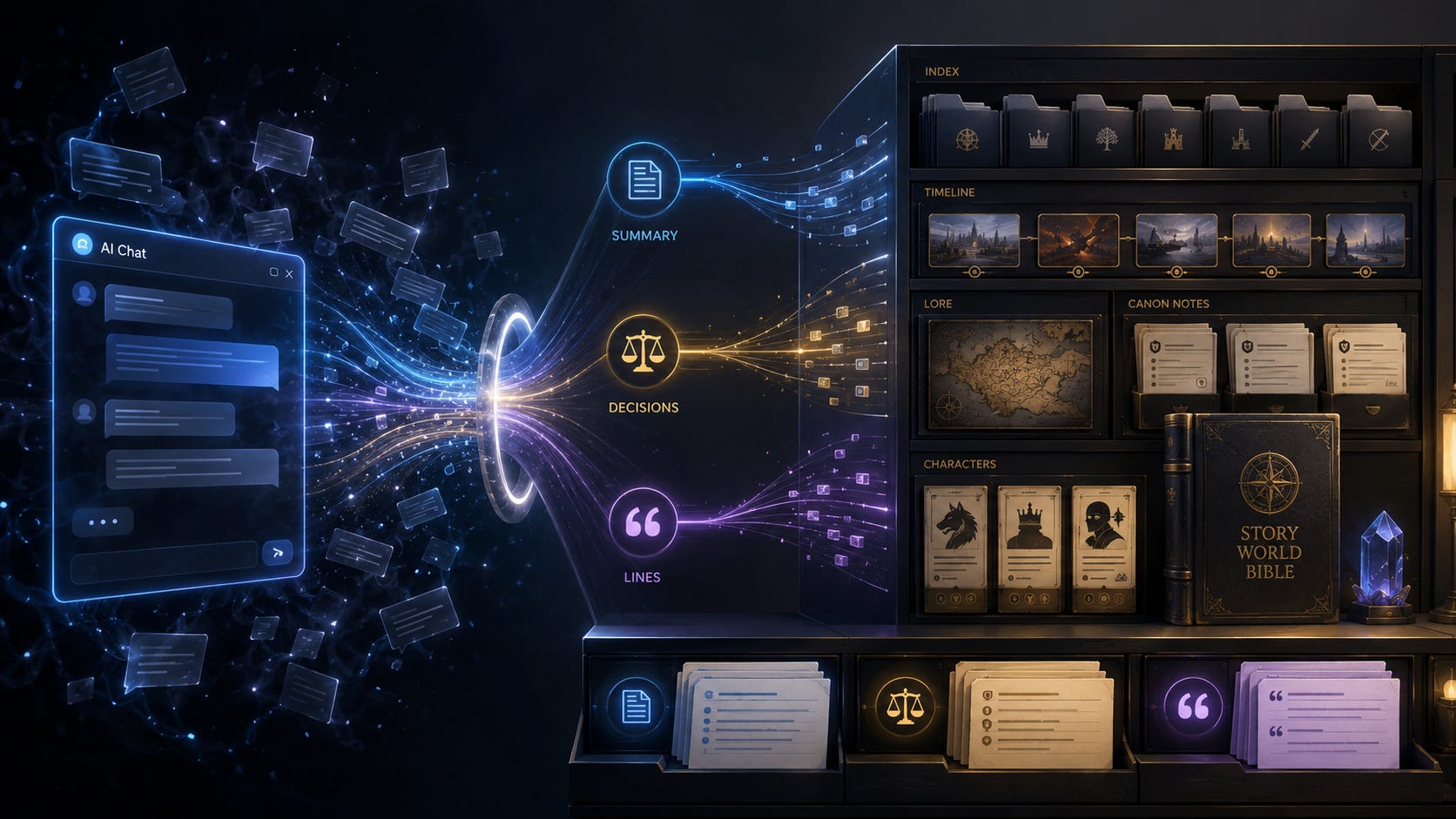
Week 3 of 4: Codex for non-coders. Mine one useful conversation before it disappears.
If you have ever had a strong AI exchange that helped you clarify a character, untangle a timeline, explain a lore rule, or name a contradiction, you already know the pattern.
The value is real.
But it is easy to lose.
The chat helped in the moment. Then the window stayed behind while the story moved forward.
Later, you have to remember what was decided, where the idea came from, which version was canon, and what still needed review.
That is the problem.
A useful AI conversation is not the finish line.
It is often the beginning of source material.
The question is not whether the conversation was good.
The question is whether you saved the useful parts in a form your future self can actually use.
A strong story-world conversation usually contains three kinds of material:
-
what the conversation was about,
-
what became clearer,
-
and what language or details are worth reusing.
That is the heart of the conversation-mining habit.
1. Conversation Summary
Start by writing a short summary of what the conversation was actually about.
Do not try to preserve every sentence.
Capture the purpose, the problem, the decision, and the result.
For example:
This conversation helped clarify why Mara cannot know who opened the gate before Chapter 12. It also identified two timeline risks and one unresolved question about her brother’s motive.
That summary gives the conversation a job.
Now it is not just an old chat.
It is a piece of story-world context you can return to.
2. Story-World Decisions
Next, pull out the decisions or useful ideas worth keeping.
This is where you save what became clearer:
-
a canon decision,
-
a possible future direction,
-
a character-state update,
-
a timeline clarification,
-
a lore rule,
-
a contradiction to review,
-
or an open question that still matters.
This part is important because not everything in a chat belongs in canon.
Some things are settled.
Some things are still possible.
Some things were rejected.
Some things need review.
If those distinctions stay trapped inside the chat, you have to remember them later. A Story World Bible gives them somewhere reliable to live.
3. Usable Lines
Finally, save the exact lines you may want to reuse later.
These are not full transcripts.
They are the phrases, sentences, names, descriptions, or explanations that were especially clear.
A useful line might become:
-
a lore note,
-
a character description,
-
a section header,
-
a worldbuilding principle,
-
a future scene reminder,
-
or a phrase that helps you explain the world more clearly.
This is often the part people skip.
But strong language is part of the world too.
If a line helps you understand your own story better, do not leave it buried in a chat.
A Simple Example
Imagine you ask AI to help you think through why your timeline feels tangled.
The conversation gives you three things:
-
a summary of the timeline problem,
-
the decision that one event must happen before the city falls,
-
and a clear line: “The rebellion did not begin with the fire. The fire revealed it.”
If you leave that in the chat, you may remember the feeling of clarity but lose the usable material.
If you save it, the conversation becomes part of your Story World Bible.
The summary helps you remember what happened.
The decision protects continuity.
The line gives you language you may want to build from later.
That is the point of the mining habit.
You are not preserving the chat because the chat is sacred.
You are preserving the parts of the conversation that help your world stay coherent.
Why This Matters
When useful AI chats stay trapped in the chat window, the writer has to carry too much.
That means:
-
the same canon gets explained again,
-
the same timeline problem gets reopened,
-
the same character state has to be reconstructed,
-
the same useful line disappears,
-
and the next session starts from memory instead of source material.
That is exhausting.
It also makes the world easier to distort.
When you mine a conversation into a summary, decisions, and usable lines, the next task starts with something reusable.
The system begins to hold what the writer should not have to keep carrying alone.
That is a different relationship with AI.
AI is not writing the story.
The writer is actively building the source system that helps guide the work.
Your First Workflow
You do not need to mine every chat.
Start with one conversation that was genuinely useful.
Save:
-
a short summary of what happened,
-
the story-world decisions or open questions worth keeping,
-
the strongest lines or details worth reusing.
Then put those notes where you can find them again.
The goal is not perfect organization.
The goal is to stop losing useful thinking.
What To Do Next
The next time a chat helps you see your world more clearly, do not let it sit there as a one-time event.
Turn it into source material.
That is how your Story World Bible starts to become more than storage.
It becomes the place where your world remembers what you have already figured out.
The Next Step
If you want a ready-made way to do this faster, the AI Conversation Mining Sheet gives you a simple structure for turning useful chats into reusable source material without guessing what to save.
Part of the Codex for Non-Coders Series
This article is part of a four-week Agentic Teacher sequence on using Codex as a non-coder.
The series moves from understanding what Codex is, to organizing reusable context, to building your first Codex-usable knowledge repo.
The goal is simple: help you turn scattered AI use into a working system Codex can actually use.
Next in the series: Personalization Settings Are Not a Story World Bible
This Substack is reader-supported. To receive new posts and support my work, consider becoming a free or paid subscriber.