An Airbnb study found agent guidance matched expert steps in 131 of 132 cases. Source evidence backed every step in only 110.
By Ashu Kumar
Published: 2026-11-04
URL: https://theagenticstack.substack.com/p/when-an-ai-has-the-answer-but-cant
Every AI support demo has a clean answer. Real support work has a harder question: can the person using that answer show where each step came from?
Imagine a customer case that falls just outside the normal path. A senior specialist knows a small fallback step from experience. It works, but nobody added it to the help article. A new specialist searches the knowledge base. An AI agent searches it too. The agent may still suggest a plausible next move—but if the source never recorded that step, the specialist cannot verify it from the official playbook.
That is not only a model problem. It is a knowledge problem hiding inside an AI project.
THE RESULT THAT LOOKS BETTER AT FIRST GLANCE
On October 10, five Airbnb researchers published a case study of an internal agent that turns a de-identified customer-support case into step-by-step guidance for a human specialist, alongside quoted evidence from the company’s operational knowledge base. It was not an autonomous bot resolving customer cases on its own.
The team tested the workflow on 132 real cases. Its first measure asked whether the agent’s instructions were procedurally equivalent to human-approved guidance. An LLM judge, using a majority vote across three runs, accepted 131 cases: 99.2%.
The second measure asked a stricter question: did the passages quoted from source articles contain enough evidence for a reader to reconstruct the full procedure? That passed in 110 cases: 83.3%.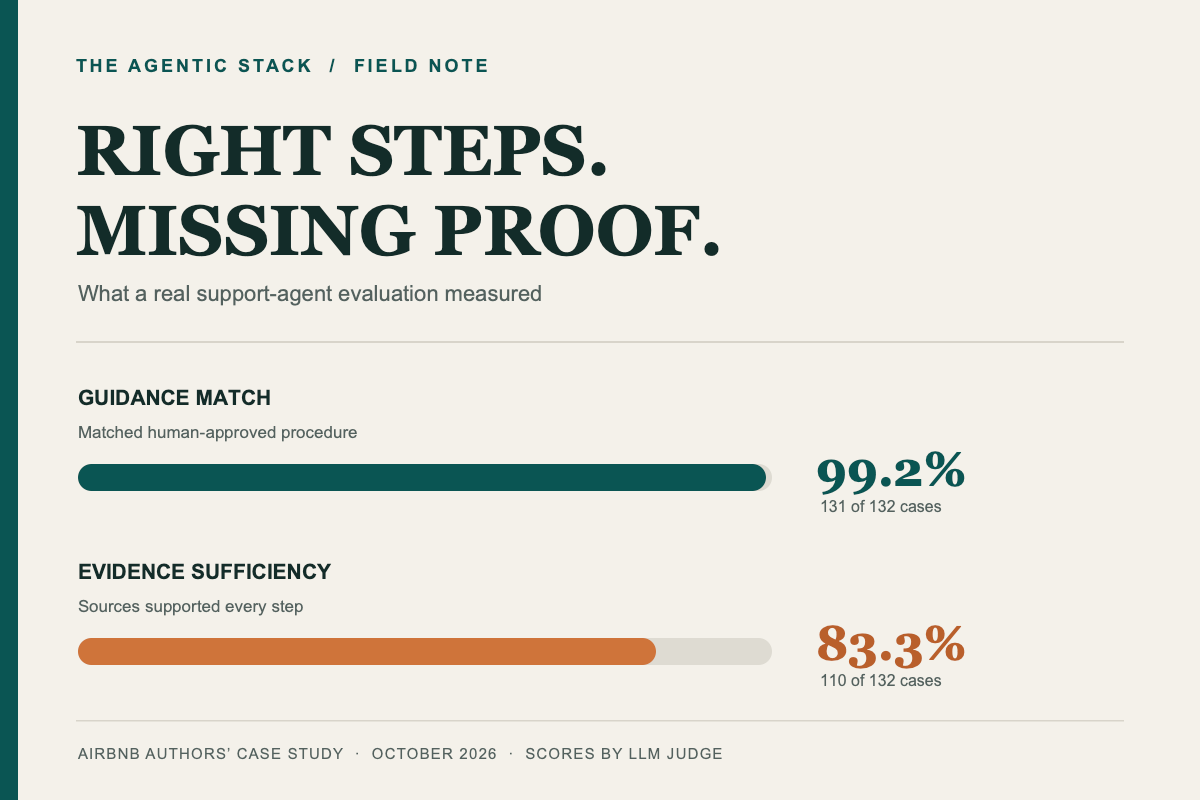
The headline is not “the agent was 99% correct.” The comparison was judged by another language model, not independently rescored by human specialists. The paper also notes that, without a no-retrieval baseline, some guidance matches could reflect generally reasonable advice rather than case-specific reasoning. The evidence score is the more revealing measure: it tests whether the recommendation can be traced back to the written procedure.
WHAT THE GAP REVEALED
The researchers inspected the 22 cases that failed the evidence test. Their qualitative review found a recurring pattern: the agent had reached relevant articles and its guidance often matched the reference, but an important step was not written in the articles. Specialists knew it; the official documentation did not.
The paper is careful here: this was an author inspection, not an independently adjudicated failure taxonomy. Still, it points to a practical distinction. If the right procedure is documented but the agent misses it, improve retrieval or the agent’s workflow. If the procedure is absent from the source, a smarter model cannot make the organization’s undocumented practice auditable.
That is the uncomfortable productivity lesson. Agents can reduce the time spent finding and assembling information, but they also make gaps in the organization’s written knowledge harder to ignore. They cannot reliably turn an unwritten exception into an approved company rule.
THE USEFUL DESIGN IS MODEST
The Airbnb team packaged the task as a portable “skill”: a plain-language operating guide, lightweight retrieval tools, format checks, and a structured knowledge corpus. The agent searched a navigation layer, fetched original source articles, drafted a procedure, and attached verbatim excerpts. A deterministic validator rejected quotes that did not actually appear in the cited source.
That last part matters. The model proposed the guidance; ordinary code enforced the evidence contract. A valid quote proves that a sentence exists in the source. It does not prove the source is complete, current, or the right policy for every situation. A human specialist still reviewed every case.
The reported trade-off is just as useful as the architecture. The experimental workflow took a median of about 90 seconds per case, compared with roughly 8–9 seconds for Airbnb’s production assistant. The authors claim no latency advantage. Their argument is maintainability: adapt the task by editing instructions or data, rather than retraining a task-specific model. That maintainability benefit is a design rationale, not a measured time or cost saving.
So this paper does not prove that the agent made support faster or cheaper. It shows a way to generate and evaluate reviewable guidance on a real set of cases, within one mature, well-curated knowledge base. That narrower result is still valuable because it makes the next experiment concrete.
A BETTER FIRST AGENT PILOT
If your team wants to try this pattern, start with a repeatable queue where people already consult written policy: support triage, access requests, invoice exceptions, or incident handoffs. Give the agent read-only access and ask it to prepare a recommendation with exact source passages. Keep the decision and any customer-impacting action with the responsible person.
Then score two separate questions on resolved examples:
- Did the agent choose the right steps? Compare its procedure with a specialist-approved reference.
- Can a reviewer prove each step from the sources? Require a link or exact passage for every instruction; mark unsupported steps as unknown instead of letting the agent fill them in.
Track the human review time too. A quick draft that takes longer to verify is not a productivity win. Count corrections, escalations, missed steps, and time from case arrival to approved resolution. When the answer is plausible but the evidence is missing, fix the source material before changing models.
This is where “agentic” becomes useful in ordinary work: not by handing the model every decision, but by letting it do the search and assembly that humans repeat—and making its handoff easy to check.
Before choosing an agent for a workflow, ask a simpler question: if your most experienced person were away tomorrow, could a colleague find every step they rely on in the written playbook? That answer may tell you more about your first AI project than another model benchmark.
SOURCES & FURTHER READING
- Bako et al. (2026). “Frustratingly Easy Agentic RAG via Portable Skills: A Case Study in Customer Support.” Airbnb research.
- Airbnb Engineering & Data Science. “Eval-driven development: Lessons from evaluating GenAI at scale.”
- Es et al. (2023). “RAGAS: Automated Evaluation of Retrieval Augmented Generation.”
- Saad-Falcon et al. (2024). “ARES: An Automated Evaluation Framework for Retrieval-Augmented Generation Systems.”
- OpenAI. “Evaluate agent workflows.”
Thanks for reading The Agentic Stack! Subscribe for free to receive new posts and support my work.