Anthropic, OpenAI, Hugging Face, and Alibaba have moved four agent projects under neutral governance. Here is what Agent Skills, Open Responses, OpenEnv, and OpenSandbox could change for production te
By Ashu Kumar
Published: 2026-10-23
URL: https://theagenticstack.substack.com/p/the-agent-stack-just-got-four-new
Yesterday’s most interesting agent announcement was not a new model.
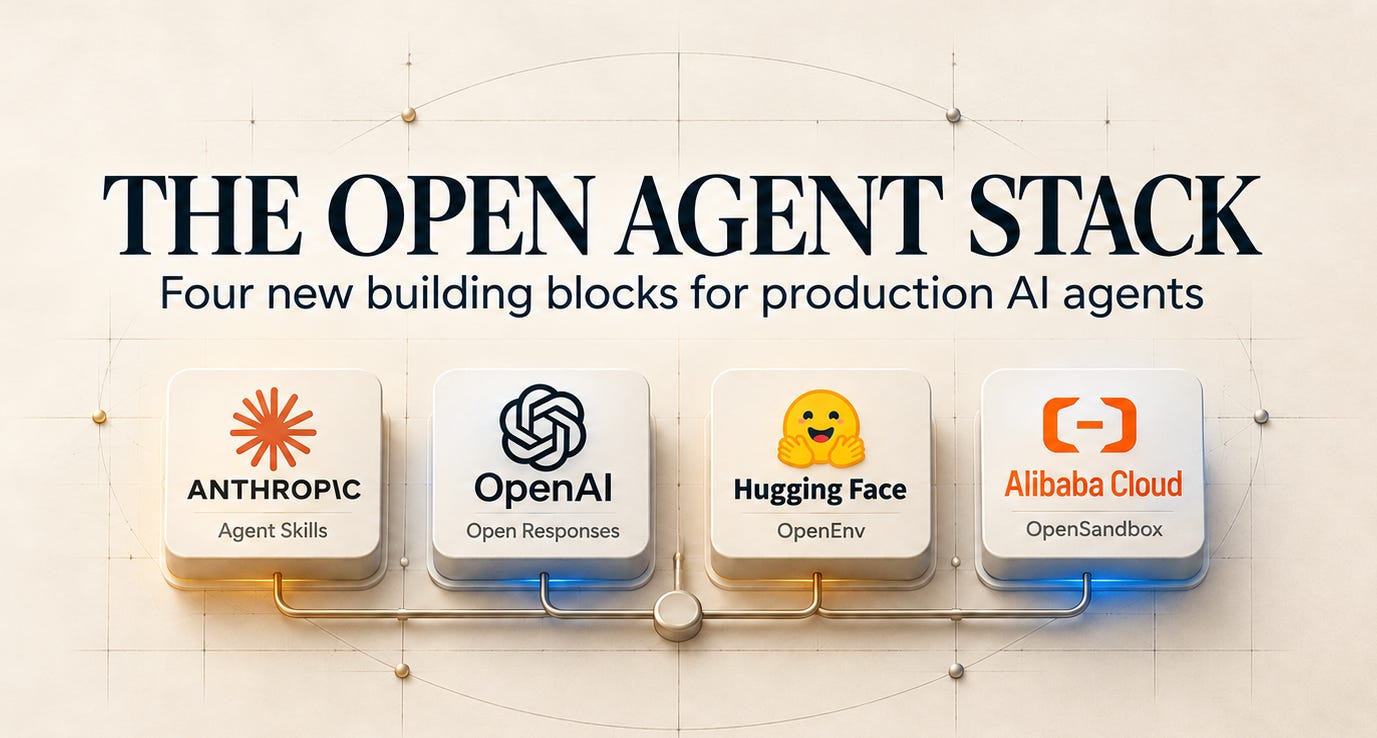
On October 22, the Agentic AI Foundation announced four new open-source projects: Agent Skills from Anthropic, Open Responses from OpenAI, OpenEnv from Hugging Face, and OpenSandbox from Alibaba.
Thanks for reading The Agentic Stack! Subscribe for free to receive new posts and support my work.
The projects now sit under the Linux Foundation alongside MCP, A2A, AGENTS.md, and other agent infrastructure.
At first, this looks like four unrelated project donations. It is more useful to read it as an early map of the agent stack.
-
Agent Skills describes how an agent receives a reusable procedure.
-
Open Responses describes how an application exchanges structured work with a model.
-
OpenEnv describes an environment in which an agent can train or be evaluated.
-
OpenSandbox provides an isolated place where the agent can act.
Together, they address a problem that model releases cannot solve: production agents need stable interfaces around the model.
This is not a finished universal stack. The projects are at different stages, and shared governance does not make them instantly compatible. But the direction matters.
Agent infrastructure is starting to separate into layers that teams can test, replace, and govern independently.
1. Agent Skills turns a good prompt into a reusable capability
A production agent needs more than a system prompt.
It may need a review checklist, a company policy, a script, a template, or a sequence of steps refined over time.
Agent Skills packages this material in a folder. The required SKILL.md file contains a name, description, and instructions. The folder can also include scripts, references, templates, and other assets.
The useful design choice is progressive disclosure.
An agent can initially see only the names and descriptions of available skills. It loads the complete instructions when a task matches, then reads supporting files only when needed.
That keeps the base context smaller while making detailed procedures available on demand.
For a team, the skill becomes a versioned operating artifact.
A contract-review skill can be reviewed by legal. A data-analysis skill can include an approved query pattern. A presentation skill can carry the company’s actual brand template.
The procedure can move with the application instead of remaining buried inside one vendor’s prompt configuration.
Portability does not guarantee quality. A skill can still contain outdated instructions, unsafe scripts, or excessive tool access.
Skills need owners, versions, tests, and a review process—just like code.
2. Open Responses targets the model integration layer
Most multi-model systems are portable only in the simplest cases: text goes in and text comes out.
The differences become visible when an application streams structured events, sends tool results back to a model, carries reasoning items across turns, or uses provider-specific tools.
Open Responses is an open specification inspired by OpenAI’s Responses API.
It defines a shared request-and-response model, semantic streaming events, and patterns for tool calls. It also includes extension points for provider-specific capabilities and a compliance test suite.
If this contract gains adoption, it could make model routing less painful.
An application could preserve the same broad event structure while changing the provider behind an endpoint. Observability systems could record common event types. Evaluation tools could compare providers without translating every trace into a new schema first.
There are already early implementations. The AAIF’s Open Responses overview points to Databricks Model Serving and Vercel AI Gateway as services that accept the shared format.
That is a start. It is not proof of universal interchangeability.
Providers will continue to expose different tools, state behavior, limits, and model capabilities. A common protocol can reduce integration work, but it cannot make unlike models behave alike.
3. OpenEnv gives agents a repeatable world to work in
An agent evaluation is difficult to trust when every run starts from a slightly different state.
The database may have changed. A browser session may already be logged in. Expected files may be missing. A tool may return different data.
OpenEnv provides a common client-server pattern for agent environments.
A client can reset an environment, submit an action, and receive an observation, reward, and current state. Environments can be packaged as Docker images and run locally, in cloud sandboxes, or as Hugging Face Spaces.
This matters for training and evaluation.
A calendar agent can face the same starting state across models. A coding agent can receive the same repository and tests. A browser agent can repeat a known task without depending on the public web remaining unchanged.
OpenEnv also includes hooks for rewards and evaluation, plus integrations that capture traces from real agent harnesses.
In production terms, that creates a path from a failure trace to a replayable task—and from that task to a regression test.
The environment does not make the evaluation valid by itself.
Teams still have to decide whether the task resembles real work, whether the reward measures the right outcome, and whether the environment hides important production complexity.
4. OpenSandbox separates the agent from the machine
Once an agent can run code, install packages, edit files, or operate a browser, the model is no longer the main security boundary.
The runtime is.
OpenSandbox provides APIs for creating an isolated environment, executing commands or code, managing files, and destroying the environment when a task ends.
It can run with Docker or Kubernetes and provides SDKs for several programming languages.
The architectural benefit is simple: the agent gets a workspace without receiving access to the host machine.
A coding task can have its own filesystem, resource limits, network policy, and lifetime. When the task ends, the environment can be removed.
Calling something a sandbox does not automatically make it safe.
Production teams still need minimal credentials, outbound network restrictions, patched runtimes, trusted images, resource limits, and logs stored outside the sandbox.
Isolation is a control surface, not a security conclusion.
The interesting part is how these layers connect
Consider a procurement agent asked to compare supplier proposals.
Its skill contains the approved scoring procedure and report template.
Open Responses carries model output, tool calls, and tool results through a shared interface.
OpenEnv recreates known procurement cases for training and regression testing.
OpenSandbox gives document parsers and analysis scripts an isolated place to run.
MCP can connect the agent to tools and data. A2A can let it delegate work to another agent. The four new projects fill different gaps around those existing protocols.
This separation could also improve operations.
A trace can identify the skill version, model and provider, protocol version, environment image, sandbox policy, tool calls, latency, token usage, and cost.
When a result changes, the team has somewhere to look besides the prompt.
It also creates more useful model evaluations.
Instead of asking which model has the highest general benchmark score, a team can replay its own environment using the same skill and tool contracts.
The comparison can include completion rate, unsafe actions, recovery behavior, latency, and total task cost.
What I would test before calling this a stack
The announcement is a governance milestone. The engineering proof still has to come from implementation.
Over the next few months, I would look for five things:
-
Cross-client skills: Can the same non-trivial skill run in two agent products without being rewritten?
-
Protocol conformance: Do two Open Responses endpoints emit events that the same client can consume without special cases?
-
Replayable failures: Can a real production failure become an OpenEnv task that fails before a fix and passes after it?
-
Enforced isolation: Can an OpenSandbox policy prevent credential access, unexpected network calls, and resource abuse—even when the agent tries?
-
End-to-end provenance: Can one trace connect the skill, model, environment, sandbox, tools, result, and cost?
These tests reveal the difference between projects that share a foundation and components that work together.
The larger signal is still encouraging.
Anthropic, OpenAI, Hugging Face, and Alibaba have each placed a different piece of agent infrastructure under neutral governance. That gives developers somewhere to negotiate shared interfaces without asking one vendor to define the entire system.
The agent ecosystem does not need every team to use the same framework.
It needs dependable boundaries between capabilities, models, environments, and execution.
If these projects succeed, the result will feel less like a product launch and more like ordinary infrastructure.
That is exactly the point.
References
-
Linux Foundation — Agentic AI Foundation Announces Four New Projects
-
Agent Skills — Specification and documentation
-
Open Responses — Specification and compliance tools
-
OpenEnv — Agentic execution environments
-
OpenSandbox — Sandbox runtime for AI agents
Thanks for reading The Agentic Stack! Subscribe for free to receive new posts and support my work.