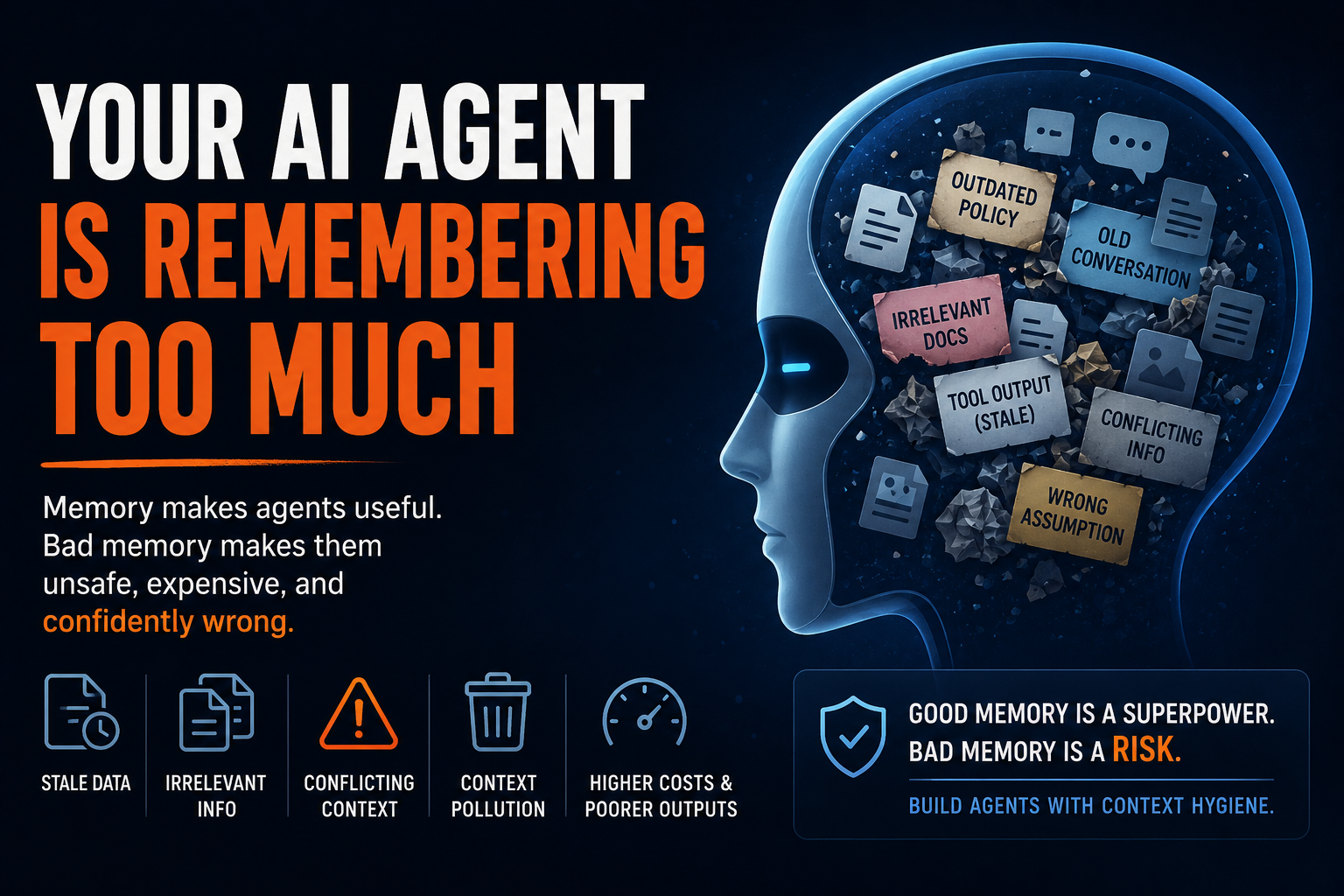
Memory makes agents useful. Bad memory makes them unsafe, expensive, and confidently wrong.
By Ashu Kumar
Published: 2026-05-21
URL: https://theagenticstack.substack.com/p/your-ai-agent-is-remembering-too
Everyone wants AI agents with memory.
A support agent that remembers the customer. A sales agent that remembers the account. A coding agent that remembers the codebase. A research agent that remembers previous findings. A personal agent that remembers preferences, habits, and goals.
Thanks for reading The Agentic Stack! Subscribe for free to receive new posts and support my work.
Memory makes an agent feel less like a chatbot and more like a co-worker.
So teams add more of it.
More conversation history. More retrieved documents. More user preferences. More prior decisions. More tool outputs. More summaries. More context.
And for a while, the agent looks smarter.
Then production happens.
The agent remembers an outdated policy. It retrieves the wrong customer context. It carries forward a bad assumption. It mixes information from two workflows. It cites stale documentation. It uses old tool output as if it were current. It becomes more expensive with every task. It gets harder to debug because nobody knows which piece of context influenced the answer.
This is not just a memory problem.
It is a production failure mode.
I call it context pollution.
What is context pollution?
Context pollution happens when stale, irrelevant, conflicting, low-quality, or unauthorized information enters an agent’s working context and influences its behavior.
The dangerous part is that the agent may still sound confident.
The answer may be fluent. The reasoning may look plausible. The workflow may complete. The user may not notice the issue immediately.
But the agent is operating with contaminated context.
In traditional software, bad data often breaks something visibly. In agentic systems, bad context often produces a polished answer with hidden corruption.
That makes context pollution one of the most underrated risks in production AI agents.
The context window is not a trash can
Many early agent systems treat the context window like a dumping ground.
Add the user request. Add the system prompt. Add conversation history. Add retrieved documents. Add previous tool results. Add memory summaries. Add policies. Add examples. Add outputs from other agents.
Then hope the model figures out what matters.
That works in demos because the environment is small and controlled.
It fails in production because real systems are messy.
Documents conflict. Policies change. Users switch topics. Tools return partial results. Memory becomes stale. Summaries lose nuance. Agents hand off incomplete state. Old assumptions survive longer than they should.
The model does not automatically know which context is sacred, stale, suspicious, or irrelevant.
If you give the agent polluted context, expect polluted behavior.
Memory is not just a feature. It is a permission surface.
Teams often talk about memory as a UX feature.
“Let’s make the agent remember the user.” “Let’s make it remember previous tasks.” “Let’s give it long-term memory.”
That sounds harmless.
But memory is not just personalization.
Memory decides what information can influence future behavior.
That makes memory a permission surface.
Every memory item raises hard questions:
- Who created this memory?
- When was it created?
- Is it still valid?
- Which user or tenant does it belong to?
- Can it be reused across sessions?
- Can it influence automated actions?
- Can the user inspect or delete it?
- Should the agent trust it?
If your system cannot answer these questions, it does not have memory architecture.
It has context accumulation.
And context accumulation eventually becomes context pollution.
Where context pollution enters
Context pollution usually enters through five paths.
1. Conversation history
The agent keeps carrying forward old conversation turns even when they are no longer relevant.
A user starts by asking about pricing, then switches to security, then asks for implementation guidance.
If the agent treats the entire conversation as equally relevant, it may blend unrelated goals into one answer.
Conversation history is useful. But not every previous message deserves to influence every future action.
2. Long-term memory
Long-term memory is powerful because it lets the agent personalize behavior across sessions.
It is also risky because memory can become outdated, inaccurate, or over-applied.
Example:
“The user prefers short answers.”
That may be true for casual usage. But when the same user asks for an architecture review, a short answer may be harmful.
A memory that is useful in one context can be wrong in another.
Production memory needs scope.
3. Retrieval systems
RAG can reduce hallucinations, but only if retrieval is clean.
If the agent retrieves outdated docs, duplicate pages, conflicting policies, or irrelevant chunks, the model may still produce a confident answer.
Bad retrieval is just hallucination with citations.
4. Tool outputs
Tool outputs often enter the agent’s context as raw text: API responses, database results, logs, tickets, CRM records, error messages.
But not all tool outputs should be treated equally.
Some are current. Some are cached. Some are partial. Some are permission-sensitive. Some should only be used for one step and then discarded.
If tool output stays in context longer than it should, the agent may reuse it incorrectly.
5. Agent-to-agent handoffs
Multi-agent systems create a new pollution path.
One agent summarizes a task. Another agent receives the summary. A third agent acts on it.
Every handoff can lose context, distort intent, or preserve the wrong detail.
If agents pass around unstructured summaries, the system becomes a game of telephone.
Agent communication needs contracts, not just messages.
The symptoms of context pollution
Context pollution usually shows up in patterns like these:
The agent becomes confidently inconsistent. It gives different answers depending on which stale memory or retrieved chunk appears in context.
Costs keep increasing. More memory, more retrieval, and more history mean larger prompts and higher token usage.
Debugging becomes painful. When the agent fails, nobody knows which context item caused the failure.
Evals become unstable. The same test behaves differently because memory or retrieval state changed.
Security risk increases. The agent may retrieve or reuse information outside the correct user, tenant, or permission boundary.
User trust drops. The agent remembers things users did not expect it to remember, or forgets things they assumed it knew.
Context pollution is not always dramatic.
Sometimes it slowly turns a useful agent into an unpredictable one.
The fix: context hygiene
Production agents do not just need memory.
They need context hygiene.
Context hygiene is the discipline of controlling what enters the agent’s context, how long it stays there, how much the model should trust it, and when it must be forgotten.
A clean context system defines:
- Scope
- Freshness
- Provenance
- Permissions
- Relevance
- Conflict handling
- Memory write rules
- Deletion rules
- Observability
The goal is not to give the agent less context.
The goal is to give it the right context at the right time with the right trust level.
A bigger context window does not solve relevance. Long-term memory does not solve permissioning. RAG does not solve freshness. Summaries do not solve provenance. Tool outputs do not solve trust.
More context is not more intelligence.
Sometimes, it is just more surface area for failure.
Treat memory writes like database writes
Most teams are too casual about writing memory.
The agent observes something and stores it.
That sounds convenient.
It is also dangerous.
A memory write should be treated like a database write.
Before an agent stores something, ask:
- Is this fact or inference?
- Is it stable or temporary?
- Who does it belong to?
- How long should it live?
- Can the user inspect it?
- Can the user delete it?
- What permission scope applies?
- Should this memory affect future actions?
- What happens if this memory is wrong?
For low-risk preferences, automatic memory may be fine.
For anything involving identity, money, health, legal, employment, security, or customer data, memory writes need stricter rules.
The agent should not silently build a permanent profile just because it saw something once.
Subscriber resource: Memory Hygiene Checklist
For subscribers, I’m sharing a practical Memory Hygiene Checklist you can use before shipping an agent with memory.
Use it to review:
- What the agent remembers
- What it forgets
- What it retrieves
- What it can reuse
- What users can inspect or delete
- What memory can influence future actions
- What gets logged for debugging
Simple rule:
If you cannot inspect, expire, correct, or delete memory, do not use it for production decisions.
The consultant question
For AI consultants, this is one of the best client conversations to have early.
Do not ask:
“Do you want the agent to have memory?”
Most clients will say yes.
Ask this instead:
“What should this agent be allowed to remember, forget, retrieve, reuse, and act on?”
That question reveals the real architecture.
It opens the right conversations around data governance, compliance, user trust, tenant boundaries, security, audit logs, cost, evaluation, and escalation.
Memory is not just an AI feature.
It is a business, security, and product decision.
Final thought
Your AI agent does not need to remember everything.
It needs to remember the right things, forget the risky things, retrieve the current things, ignore the irrelevant things, and expose enough traceability that your team can debug what happened.
That is context hygiene.
Without it, memory becomes pollution.
The agent may look smarter at first.
But slowly, quietly, and expensively, it becomes harder to trust.
Discussion prompt
Where do you see the biggest memory risk in AI agents today?
User memory, retrieval, tool outputs, conversation history, or agent-to-agent handoffs?
Thanks for reading The Agentic Stack! Subscribe for free to receive new posts and support my work.