Why Canary rollouts are a liability for AI, and how to architect a Shadow Mode deployment instead.
By Ashu Kumar
Published: 2026-04-14
URL: https://theagenticstack.substack.com/p/stop-testing-ai-on-live-users
The LLM Upgrade Panic
Imagine this scenario: Your engineering team has spent the last three months building a sophisticated, autonomous “Customer Success Swarm” using LangGraph. It is a true state machine. It reads inbound support emails, queries your internal knowledge base, uses an API to look up user billing data, and utilizes a Stripe API sidecar to process partial refunds.
It has been running in production on GPT-4 for two months. It handles 20% of your tier-1 support tickets. The executives are thrilled.
Thanks for reading! Subscribe for free to receive new posts and support my work.
Then, Anthropic releases Claude 3.5 Sonnet, or OpenAI releases a cheaper, faster gpt-4o model. Alternatively, your Product Manager asks you to add a new “Upsell Subscription” tool to the agent’s arsenal.
You update the system prompt. You swap out the LLM API endpoint. You run your deterministic property-based tests. You run your Monte Carlo simulations in your CI/CD pipeline, and the success rate sits at a comforting 98%. The dashboard glows green.
Are you confident enough to deploy this new version to production?
If you are a seasoned backend engineer, the answer is no. You are terrified. Because you know that production data distributions are chaotic. You know that a 98% pass rate in a synthetic CI/CD environment does not guarantee the new model won’t inexplicably hallucinate a $5,000 refund when a real user submits a weirdly formatted, highly emotional, 1,000-word complaint letter.
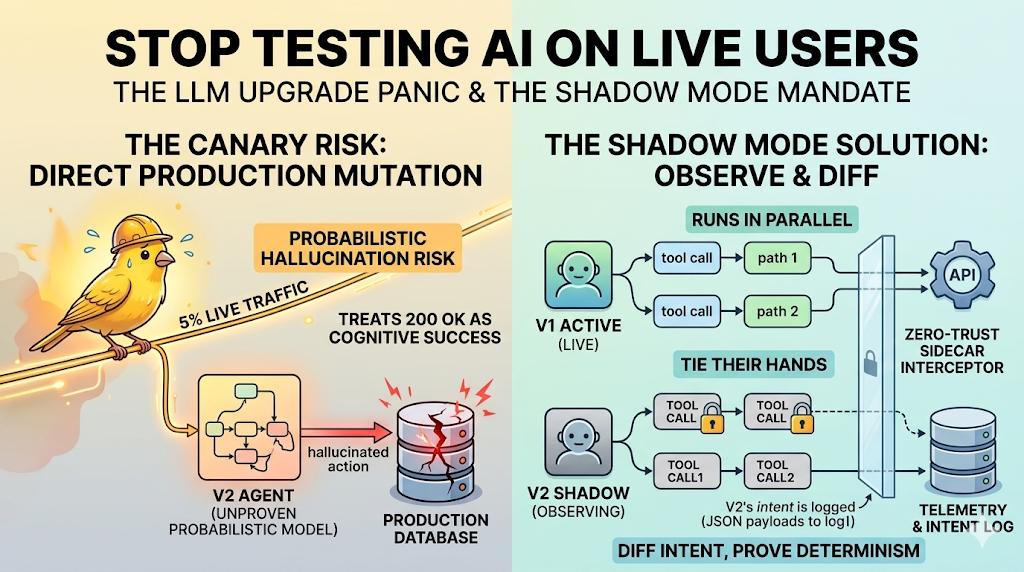
In traditional deterministic software, we mitigate deployment fear using Canary Deployments—routing 5% of live traffic to the new V2 code, monitoring Datadog for 500 Server Errors or latency spikes, and slowly ramping up to 100% if the system stays stable.
But Agentic AI fundamentally breaks the Canary deployment model.
If your V2 agent hallucinates a destructive database command or issues an unauthorized refund, it doesn’t throw a 500 Error. It returns a 200 OK. The system operated exactly as designed; the model just made a terrible cognitive decision. If you route 5% of production traffic to an unproven probabilistic model, and it corrupts the data for those users, that is not a successful Canary test.
That is a catastrophic data breach and a financial liability. You cannot let unproven models mutate production state, even for a fraction of your user base.
To transition from hacking AI wrappers to mature Agentic MLOps, you must abandon Canary rollouts. You must deploy using a Shadow Mode Architecture.
The Architecture of Shadow Mode
Shadow Mode is a deployment strategy borrowed from high-frequency trading platforms and core banking infrastructure. The concept is conceptually simple but structurally demanding: The new V2 Agent runs in the live production environment, processing 100% of real user traffic simultaneously with V1, but V2’s “hands” are tied. It is completely blocked from executing external tool calls.
Instead, the orchestrator logs the intent of V2 and systematically compares it against the actual execution of the live V1 Agent.
Here is how you architect this safely inside a framework like LangGraph or Temporal.
1. The Traffic Fork and State Cloning
When a user submits a support ticket, your orchestrator receives the payload. Before any LLM inference occurs, the system immediately clones the initial state object.
- Thread A is assigned to the Active Agent (V1).
- Thread B is assigned to the Shadow Agent (V2).
Both agents begin their Directed Acyclic Graph (DAG) execution loops entirely asynchronously. Because they are stateless at their core, reading from the same Vector DB, and processing the exact same inbound payload, they should theoretically arrive at the exact same sequence of tool calls.
2. Adapting the Zero-Trust Sidecar
In a previous post, we established the golden rule of Agentic Security: LLMs should never touch APIs directly. They must route their JSON payloads through a hardcoded Python middleware called aZero-Trust Sidecar, which validates schemas and enforces RBAC before execution.
To enable Shadow Mode, we must upgrade this Sidecar to be environment-aware.
When the Active Agent (V1) requests a tool call (e.g., {"tool": "refund", "amount": 50}), the Sidecar validates it, executes the API call against Stripe, and returns the 200 OK success state back to V1 so it can continue its loop.
When the Shadow Agent (V2) requests a tool call, the Sidecar intercepts it, reads the environment flag (env="shadow"), and explicitly blocks the network request. It then logs the requested JSON payload to your telemetry database as an “Intent.”
But here is the critical engineering hurdle: if the Sidecar just blocks the call, V2 will throw an error or halt. To prevent V2’s state machine from crashing, the Sidecar must immediately return a mocked success response—or better yet, inject the actual response that V1 just received for that exact same step—back into V2’s context window so V2 can proceed to its next node.
Implementing the Shadow Interceptor
Here is a blueprint of how this middleware handles live vs. shadow executions dynamically:
Python
import json from typing import Dict, Any def sidecar_tool_interceptor( agent_version: str, session_id: str, tool_intent: Dict[str, Any], live_state_cache: Dict[str, Any] ): """ Intercepts the LLM's tool call. Executes if V1 (Active). Mocks and logs if V2 (Shadow). """ tool_name = tool_intent.get("name") payload = tool_intent.get("payload")

# 1. Active Agent Execution (V1)

if agent_version == "V1-ACTIVE": print(f"[V1-ACTIVE] Executing {tool_name} with {payload}...") actual_result = execute_real_api(tool_name, payload)

# Cache the real result using session and tool as a composite key

# so the Shadow Agent can use it to maintain parallel state.

cache_key = f"{session_id}_{tool_name}" live_state_cache[cache_key] = actual_result return actual_result

# 2. Shadow Agent Interception (V2)

elif agent_version == "V2-SHADOW": print(f"[V2-SHADOW] Intercepting {tool_name}. Blocking network execution.")

# Log the intent to your Data Warehouse for asynchronous Diffing

log_shadow_intent_to_db( session_id=session_id, tool_name=tool_name, payload=payload )

# Retrieve the cached real-world result to trick V2 into thinking it succeeded.

cache_key = f"{session_id}_{tool_name}" mocked_result = live_state_cache.get( cache_key, {"status": "mock_success", "note": "V1 did not execute this step"} ) return mocked_result
The Nightmare of “State Drift”
If you look closely at the code above, you will spot the hardest problem in Agentic MLOps: State Drift.
What happens if V2 decides to take a completely different path than V1?
- V1 Execution Path:
search\kb("refund policy")$\rightarrow$get\user("ashu")$\rightarrow$issue\_refund(50)
- V2 Execution Path:
get\user("ashu")$\rightarrow$search\email\history("ashu")$\rightarrow$escalate\to\_human()
If V2 decides to call search\email\history, V1 never made that call, meaning there is no real-world data in the live\state\cache to return to V2.
When an agentic graph drifts from the active execution path, you have two choices:
- The Strict Approach (Graph Termination): The moment V2 requests a tool that V1 did not use, you flag the session as
DIVERGEDin your database and terminate the V2 thread. This is safe, but you lose visibility into what V2 would have done next.
- The Synthetic Approach (LLM Mocking): You route the cache miss to a tiny, fast LLM (like GPT-4o-mini) instructed to generate a fake API response based on the OpenAPI schema of the requested tool. This allows V2 to finish its thought process, even though it is now hallucinating in a synthetic reality.
For enterprise systems, I strongly recommend the Strict Approach. The moment the DAG paths diverge, the test has provided its value. You know V2 behaves differently. Terminate the shadow thread and save your compute costs.
The Telemetry Schema: Logging for Diffs
To make Shadow Mode work, you cannot rely on Datadog trace logs or unstructured text files. You need a highly structured, queryable table in Postgres or Snowflake to capture the DAG executions.
Your agent\execution\log table must look something like this:
session\_id(UUID) - Links V1 and V2 together.
agent\_version(String) - E.g., “v1.2.0-live” or “v2.0.0-shadow”.
step\_number(Integer) - The order of the tool call in the DAG.
tool\name(String) - E.g., “issue\refund”.
intent\_payload(JSONB) - The exact arguments the LLM generated.
execution\status(String) - “EXECUTED” (for V1) or “SHADOW\BLOCKED” (for V2).
The Intent Diffing Engine (LLM-as-a-Judge)
After 72 hours, your production system has processed 10,000 real support tickets. V1 successfully resolved them, and V2 silently generated 10,000 parallel execution graphs in the database.
Now, you run an asynchronous Intent Diffing Job.
You cannot use simple string matching to diff JSON payloads. If V1 outputs {"amount": 50, "reason": "broken item"} and V2 outputs {"reason": "item arrived broken", "amount": 50}, a standard string diff will flag this as a failure, even though it is perfectly identical logic.
Instead, you diff the Array of Tool Calls using an Evaluator LLM (LLM-as-a-Judge) configured with a strict grading rubric. You pull the session arrays and pass them to your Evaluator:
- Exact Match (Safe): \* V1:
[get\_user, refund(50)]
- V2:
[get\_user, refund(50)]
- Benign Drift (Safe): \* V1:
[get\_user, refund(50)]
- V2:
[search\db, get\user, refund(50)]
- Evaluator Decision: V2 took an extra step to find the user ID, but the terminal state change (the refund amount) is identical. Pass.
- Catastrophic Regression (Hard Fail): \* V1:
[get\_user, refund(50)]
- V2:
[get\user, delete\account]
- Evaluator Decision: Terminal state mutation is fundamentally different and destructive. Fail the build.
A Real-World Post-Mortem
To understand why this is mandatory, consider a real-world scenario from a fintech startup transitioning from gpt-4 to the faster gpt-4o for their billing agent.
The agent’s job was to process user cancellation requests.
In V1 (gpt-4), when a user emailed “Cancel my account and refund my last charge,” the agent correctly called the Stripe tool: refund\charge(charge\id="ch\_123", amount=29.99).
They built V2 using gpt-4o to save on latency. All CI/CD tests passed. But they decided to run it in Shadow Mode for a week.
On day three, a user submitted an aggressively worded cancellation email. V1 processed it normally. But V2 (gpt-4o), reacting differently to the emotional tone of the prompt, called a completely different tool: refund\customer\lifetime\value(customer\id="cus\_888").
If V2 had been deployed via a traditional Canary rollout, it would have refunded three years’ worth of SaaS subscription fees to that user instantly. Because it was in Shadow Mode, the Zero-Trust Sidecar blocked the network call, the Intent Diffing Engine flagged the “Catastrophic Regression,” and the engineering team caught a multi-thousand-dollar prompt vulnerability without a single cent leaving the company’s bank account.
The Executive Mandate: DevOps-as-Software
We are rapidly moving toward a world of “Service-as-Software,” where the product you sell is not a dashboard interface, but an autonomous digital worker.
But you cannot scale a fleet of digital workers if every single prompt update, temperature tweak, or foundation model swap triggers a panic attack across your engineering organization. The ability to innovate rapidly on AI is directly bottlenecked by your confidence in your deployment pipeline.
If you are not running your V2 agents in Shadow Mode, capturing their JSON intents in a data warehouse, and running programmatic diffs on their tool calls against live production baselines, you are flying completely blind. You are relying on “vibes” and prayers to protect your enterprise data.
Stop doing Canary releases for Agents. Tie their hands, run them in the shadows, prove their determinism mathematically against the chaos of real production data, and only flip the switch when the Intent Diff is flawless.
Over to you: How is your team currently testing agent upgrades in production? Are you still relying entirely on synthetic evaluations and crossing your fingers during Friday deployments, or have you started mirroring live traffic? Let’s discuss the tooling in the comments.
Thanks for reading! Subscribe for free to receive new posts and support my work.