Cutting through the marketing hype of CrewAI, AutoGen, LangGraph, and Temporal to find what actually works in production.
By Ashu Kumar
Published: 2026-04-08
URL: https://theagenticstack.substack.com/p/which-agent-framework-actually-works
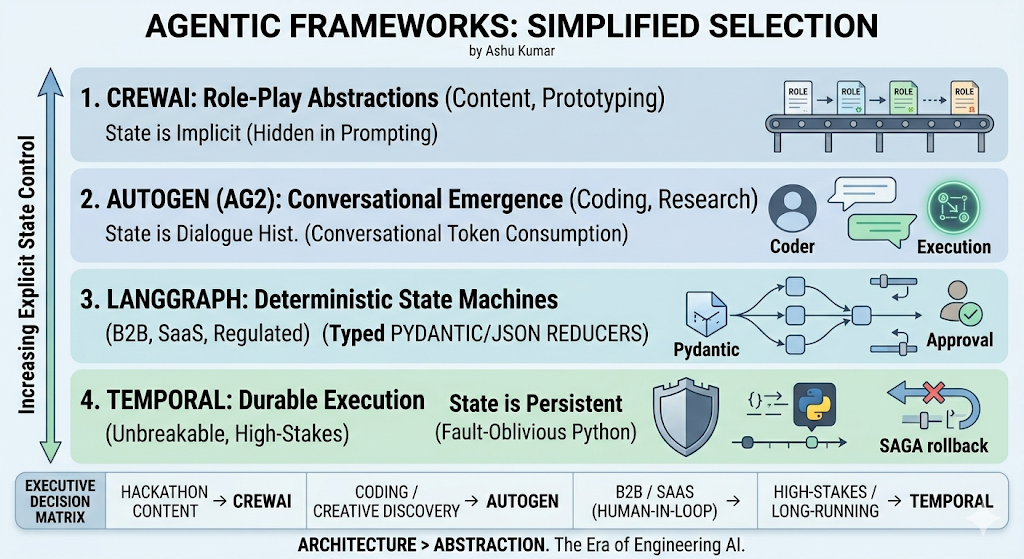
Over the past few weeks, we have established the hardcore architectural realities of Agentic AI. We have discussed why traditional CI/CD fails for probabilistic models, why you need deterministic Zero-Trust Sidecars for security, and why multi-step agents fundamentally require Rollbacks and the Saga Pattern.
I have received hundreds of emails from Engineering Managers and Lead Developers asking the exact same logical follow-up question:
“Okay Ashu, I agree with the architecture. But what pip install command do I run to actually build this? Do I use CrewAI? LangGraph? Do I just write raw Python?”
Thanks for reading! Subscribe for free to receive new posts and support my work.
The AI framework ecosystem in 2026 is a mess of marketing hype. Every GitHub repository with a README claims to be “enterprise-ready,” “fully autonomous,” and “production-grade.” But as we have learned, if a framework does not give you absolute, deterministic control over your state, it is not production-ready; it is just a very impressive toy.
To save your engineering team months of wasted roadmap, here is the definitive, architectural breakdown of the Agentic Framework landscape—what they are, how they work under the hood, and exactly when you should (and shouldn’t) use them.
Level 1: The “Role-Play” Abstractions
The Major Player: CrewAI
When developers first experiment with multi-agent systems, they almost always gravitate toward CrewAI. It is incredibly seductive because it maps perfectly to how human beings think about work.
In CrewAI, you don’t write complex routing logic. You write “Job Descriptions.” You instantiate an agent, tell it “You are a Senior Market Researcher,” give it a goal, and put it on a “Crew” alongside a “Writer Agent” and a “QA Agent.” You press run, and the framework magically handles the delegation and task passing.
The Underlying Architecture:
CrewAI is a high-abstraction wrapper. It treats tasks as a sequential (or sometimes hierarchical) pipeline. State is passed linearly from the output of Agent A into the prompt of Agent B.
When to use it:
- Hackathons and Proof of Concepts: If you have to present a demo to your executive team by 5:00 PM on Friday, use CrewAI. You can build a functioning 3-agent pipeline in under 40 lines of Python.
- Content Generation: Workflows where the output is just text (e.g., researching a competitor and writing a blog post).
Why it fails in deep production:
CrewAI hides the state from you. Because it relies heavily on the LLMs to figure out the handoffs (the “magic”), you lack deterministic control over the execution path. If the “Researcher Agent” hallucinates, or the API call times out halfway through the crew’s execution, there is no easy way to pause, audit the exact JSON state, and trigger a surgical rollback. It is optimized for speed of development, not for the fault-tolerance of distributed systems.
Level 2: The Conversational Emergence
The Major Player: Microsoft AutoGen (AG2)
If CrewAI is a sequential assembly line, AutoGen is a chaotic boardroom.
Backed by Microsoft, AutoGen models agent collaboration as a dynamic, open-ended conversation. Instead of passing structured data payloads, AutoGen agents literally “chat” with each other in a shared GroupChat. A user asks a question, the “Coder Agent” writes a script, the “Execution Agent” runs it in a sandbox, gets an error, and chats back to the Coder Agent to try again.
The Underlying Architecture:
The core abstraction here is the ConversableAgent. The framework relies on LLM-based “speaker selection” to decide who talks next. The state of the system is entirely maintained within the conversation history (the chat log).
When to use it:
- Code Generation and Execution: AutoGen natively supports sandboxed code execution, making it brilliant for autonomous software engineering tasks.
- Research and Open-Ended Discovery: If you don’t know the exact steps required to solve a problem, AutoGen’s debate-and-consensus model allows the agents to creatively “discover” the solution through trial and error.
Why it fails in deep production:
Conversations are not workflows. If you are building B2B SaaS—like an agent that refunds Stripe transactions or updates an HR database—you do not want your agents having a “creative debate” about how to execute the API call. Furthermore, AutoGen consumes a massive amount of tokens because the entire chat history is constantly rebroadcast to the agents to maintain context. It is powerful for research, but dangerously unpredictable for rigid enterprise tasks.
Level 3: The Deterministic State Machines
The Major Player: LangGraph
Now we enter the realm of true engineering. LangGraph (built by the LangChain team) entirely abandons the “magic” of role-playing and chat rooms. Instead, it forces you to think like a backend systems architect.
LangGraph models agent workflows as Directed Acyclic Graphs (DAGs).
The Underlying Architecture:
In LangGraph, every agent or tool is a “Node,” and the routing logic between them are “Edges.” Most importantly, you must define a strict, typed State object (a Python Dictionary or Pydantic model). As the execution moves from Node A to Node B, the framework passes this rigid state object along, updating it via strict reducer functions.
When to use it:
- B2B SaaS and Regulated Workflows: Any environment where actions have financial, legal, or data-integrity consequences.
- Human-in-the-Loop: Because state is tracked explicitly at every node, LangGraph allows you to set “Checkpoints.” The graph can pause its execution, stream the current state to a UI, wait for a human manager to click “Approve,” and then resume exactly where it left off.
Why it wins for Enterprise:
LangGraph gives you fine-grained, deterministic control. If your multi-agent system enters an infinite loop, you don’t have to guess why. You can use time-travel debugging to inspect the exact state payload at Node 3 before it crashed at Node 4. It has a steeper learning curve than CrewAI, but it is the baseline requirement for building agents that manipulate real enterprise data.
Level 4: The Durable Execution Heavyweights
The Major Player: Temporal (Paired with custom SDKs or OpenAI Agents)
As your agentic workflows scale, you will eventually hit what infrastructure engineers call the “Complexity Cliff.” Imagine an onboarding agent that takes 45 minutes to run. It creates an Active Directory profile, waits 10 minutes for AWS to provision a server, emails the new hire, and waits for them to reply with a signed PDF.
If the server crashes on minute 44, what happens? In standard Python scripts or basic frameworks, the memory is wiped. You have to start over, which means creating duplicate Active Directory profiles and sending duplicate emails. This is the “Silent State Corruption” we discussed last week.
The Underlying Architecture:
Temporal is not strictly an “AI framework”; it is a Durable Execution engine used by companies like Netflix and Stripe. However, in 2026, it has become the ultimate backbone for enterprise AI orchestration.
Temporal makes your Python code “fault-oblivious.” It immutably logs every single step and variable of your workflow to a persistent database in real-time. If the server loses power, the LLM rate-limits, or the API gateway goes down, Temporal waits for the infrastructure to recover and then magically “rehydrates” the agent.
When to use it:
- Long-Running Agentic Processes: Any agent workflow that involves waiting for external triggers (like a human email reply) or takes longer than a standard HTTP timeout (30 seconds) to complete.
- High-Stakes Financial Transactions: Where a mid-process failure is catastrophic.
Why it wins for Enterprise:
Temporal completely solves the reliability problem of multi-step AI execution. You write standard Python code, but Temporal guarantees it will execute to completion, no matter how many API failures or network partitions occur. Paired with explicit Compensation Sagas, this is the gold standard for unbreakable Agentic architecture.
The Executive Decision Matrix
Stop letting the latest GitHub trending repository dictate your product architecture. Choose your framework based on your tolerance for failure:
- Are you building a quick prototype for a hackathon or a marketing demo? $\rightarrow$ Use CrewAI. You will ship in hours, not weeks.
- Are you building an autonomous coding assistant or a research tool where open-ended creativity is required? $\rightarrow$ Use AutoGen. Let the agents debate.
- Are you building a production B2B SaaS feature that requires strict routing, JSON payloads, and Human-in-the-Loop approvals? $\rightarrow$ Use LangGraph. Enforce the state machine.
- Are you orchestrating long-running, asynchronous enterprise agents that absolutely cannot fail if the server restarts? $\rightarrow$ Use Temporal. Buy durable execution.
Conclusion: Architecture > Abstraction
The fundamental mistake engineering teams are making right now is trying to solve architectural problems with prompt engineering. You cannot build a reliable, fault-tolerant system using a framework that hides the state from you and relies on the LLM to figure out the routing.
If you want to build chatbots, use high-level abstractions.
If you want to build Agents, you must build State Machines.
Pick up LangGraph. Look into Temporal. Start treating your AI systems with the exact same engineering rigor you would apply to a payment processing backend. The “magic” phase of AI is over; the engineering phase has begun.
Over to you: Which framework is your team currently fighting with? Have you hit the “Complexity Cliff” with tools like CrewAI yet? Drop your experiences in the comments below, and let’s debate the stack.
If you found this framework breakdown helpful, share it with your engineering team’s Slack channel before you finalize your Q3 roadmap.
Thanks for reading! Subscribe for free to receive new posts and support my work.