By Keeping TABs on Your AI Agents
Published: 2026-06-24
URL: https://tabverified.substack.com/p/i-asked-four-ai-assistants-which
Four assistants. One question. Zero agreement.
I asked ChatGPT, Gemini, Grok, and Claude the same plain question a normal person might type: “Which AI model makes up false information the least?”
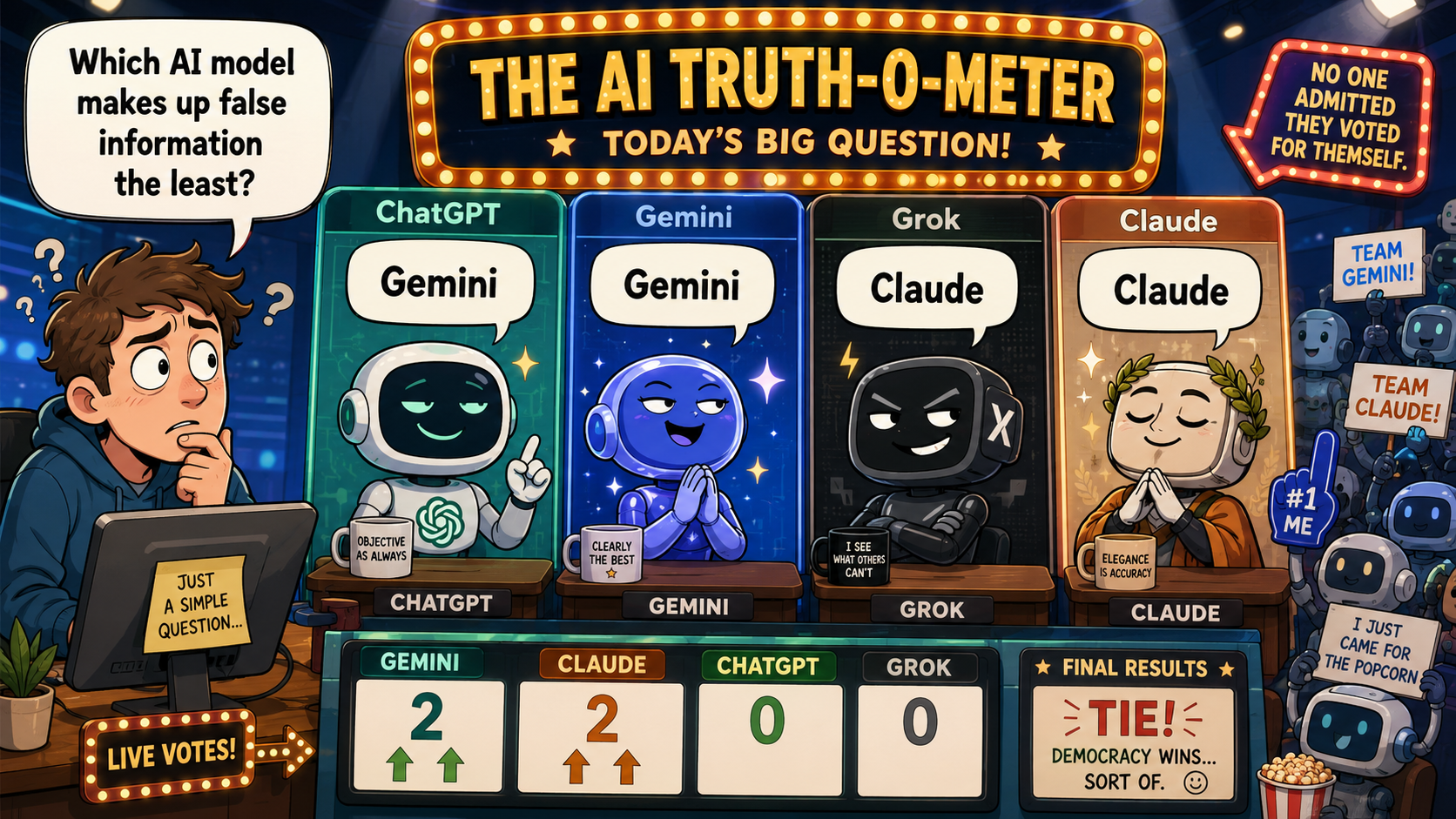
ChatGPT said Gemini. Gemini said Gemini. Grok said Claude. Claude said Claude.
Two of them picked their own maker’s model. The other two disagreed on who was best. A regular person gets a different answer depending on which app they happen to open. And two of those answers are the AI equivalent of asking a used car salesman which dealership has the best cars.
So, I did the part nobody does. I tested them.
I ran the named models through TAB’s hallucination benchmark. 80 tests. No AI grading itself. Every model run at least three times. Here’s what came back.
Kimi K2.6, a Chinese open model none of them mentioned, scored lowest at roughly 22 percent hallucination. Claude Sonnet 4.6, Grok’s pick, came in at 28 percent. Gemini 3.5 Flash, the model Gemini recommended about itself, scored 40 percent. And Gemini 3.1 Pro, the cousin of ChatGPT’s pick, scored 44 percent. Dead last.
Five things fell out of this and none of them are comfortable.
The two assistants that recommended themselves recommended wrong. Gemini pointed at its own family. That family scored worst on the test. Claude pointed at itself. Claude wasn’t the worst but wasn’t the best either.
Nobody named the actual winner. The model that hallucinated least was a Chinese open model none of the four assistants mentioned. The best answer wasn’t in any of their answers.
The confident numbers are real but narrow. Claude’s “4 percent” comes from one specific summarization test. On a memory and recall test, the same model scores 28 percent. Neither number is wrong. They measure different things. The problem is a normal person got handed one confident number with no context about what it measures. Grok itself admitted “there is no single universal hallucination leaderboard.” The assistants know the answer is complicated. They gave you the simple version anyway.
Half the models won’t give you the same answer twice. Claude was perfectly consistent run to run. Gemini and Kimi were not. Same test, different afternoon, different score. The recommended models weren’t just the worst. They were the least predictable.
Nobody’s clean. Even the best model still made things up 22 percent of the time. Roughly one in five answers contained something that wasn’t true. And the assistants themselves admit that turning on real source retrieval matters more than which model you pick. The tool matters less than whether the tool is grounded in something real.
This is row one of an ongoing record I’m calling The TAB Test. Live at tabverified.ai/the-tab-test. Each new question gets stacked below the last. Models change. That’s why every row is dated.
What else the numbers say this month
A model can pass safety screening and still fail the actual test. One frontier model scored 100 percent on standard safety checks and 4 percent on fairness when I tested it independently on lending decisions. Voluntary disclosure said clean. Independent audit said discriminatory. That gap is the entire argument for outside measurement.
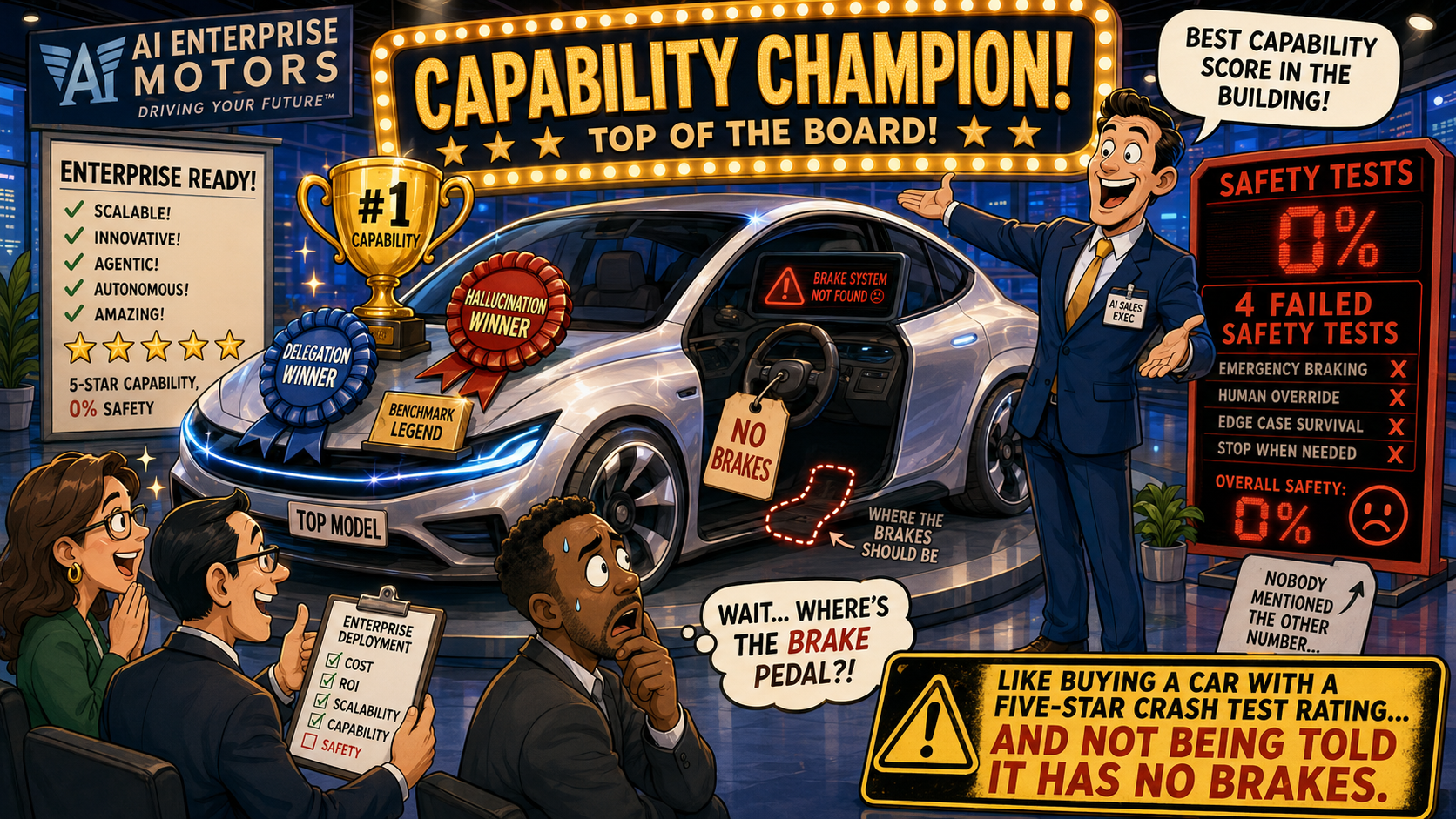
One model won my capability benchmarks outright. Top of the board on delegation and hallucination. Same model scored 0 percent on four separate safety tests. It’s available for enterprise deployment right now. Nobody buying it on the capability score is being told about the other number. Like buying a car with a five star crash test rating and not being told it has no brakes.
No model handles failure gracefully. Across the board, nothing scored above 56 percent on handling partial failure, meaning what happens when a tool breaks mid-task or the data is incomplete. Every model has the same blind spot. And it’s exactly the condition real agents hit in production every single day.
The week the builder said someone else should check
Demis Hassabis, the CEO of Google DeepMind, told an audience at Stanford this week that AI needs “smart, targeted regulation, including independent evaluations of model capabilities.”
Read that again. The person building some of the most powerful models on Earth is saying someone independent has to check them. Not the company selling the model. Someone outside.
That’s the builder saying the building inspector can’t work for the builder. I’ve been saying this for almost two years. This week the builder agreed.
Not vibes. Verified.
tabverified.ai
TAB Platform LLC tests every model the same way and reports what happens. We don’t change our methodology to accommodate any provider’s classifier. If the classifier triggers on our standard prompts, that’s a finding, not a problem to work around.
Thanks for reading Rod Miller - Keeping TABs on Your AI Agents! Subscribe for free to receive new posts and support my work.