A jury took ninety minutes to dismiss his OpenAI lawsuit on Monday. Here is what forty of the most valuable startups of the modern era tell us about where successful co-founders actually come from.
By Susan | Angel Investor
Published: 2026-05-21
URL: https://susanjmontgomery.substack.com/p/elon-musk-co-founder-of-companies
Three days ago, in a federal courtroom in Oakland, a jury took less than two hours to decide that Elon Musk had waited too long to sue his OpenAI co-founders for the crime of having succeeded without him. Ninety minutes. Less time than a yoga class. Less time, in fact, than it had taken Musk to compose some of the individual tweets he wrote about the case. The jury was, I suspect, trying to get to lunch.
Musk had given OpenAI thirty-eight million dollars in its early years, sat on its board, and then left in 2018 after losing an internal argument about who should run it. He returned to public life by founding a competing AI company called xAI, and then, several years later, sued OpenAI for the apparent offense of having continued to exist. His own testimony at trial included the sentence “I was a fool. I gave them free funding to create a startup,” which is, I think we can all agree, not the line you want preserved in the federal court record.
But the lawsuit is not really what interests me here. What interests me is the longer project Musk has been running for two decades, in which he removes himself from the co-founders of companies he genuinely co-founded, and inserts himself into the co-founders of companies he did not. He secured the legal right to call himself a Tesla co-founder in 2009 by settling a defamation lawsuit that Martin Eberhard had filed against him for repeatedly calling himself a Tesla co-founder. Eberhard had started Tesla in 2003.
He had named it over dinner at Disneyland. Musk wired six and a half million dollars a year later. The court eventually settled the matter by agreeing that five different people could all be called co-founders, which is the corporate equivalent of giving every child in a school play a starring credit.
This is not a column about Elon Musk.
It is a column about where actual co-founders come from, why most attempted manufacturing of them fails, and what investors are looking at when we look at a founding team. Which, despite Musk’s example, is not “a man with sufficient capital to acquire the title via legal settlement.”
The data, such as we have it
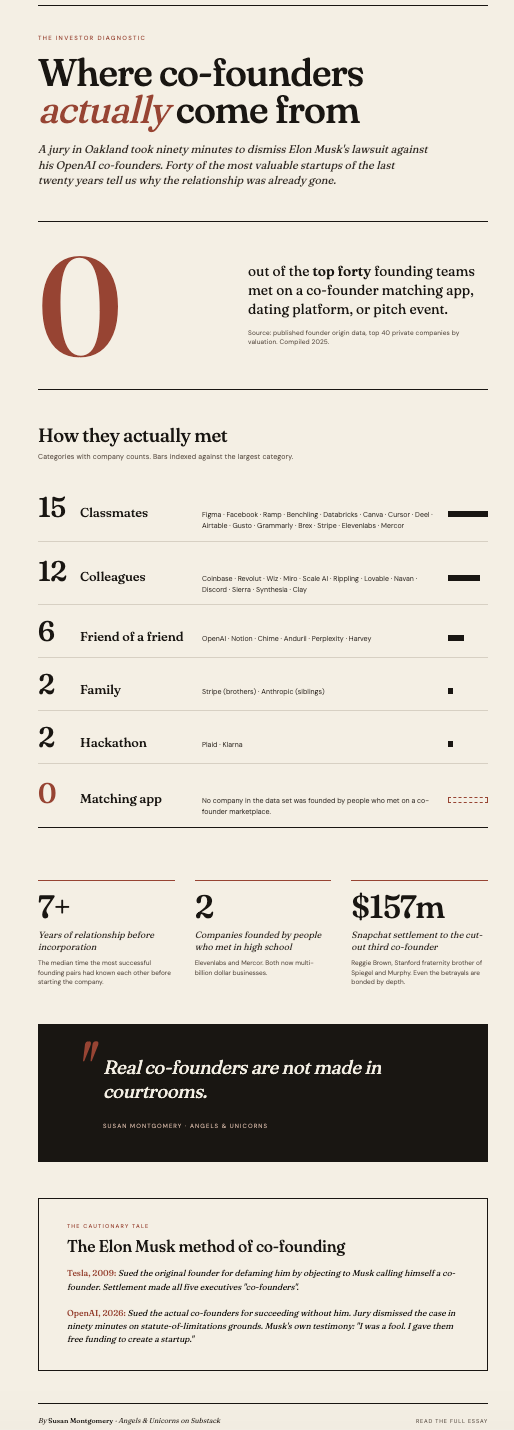
I recently went through forty of the most valuable private companies of the last twenty years and asked one straightforward question of each founding team. How did you meet. The answers do not include FounderDating. They do not include a hackathon at SXSW. They do not include anyone who matched at three in the morning on a Discord server called Visionaries Anonymous.
The biggest category is classmates. Fifteen of the forty. Stripe (brothers, technically family, but Patrick and John Collison were classmates at every level of their education by the geographic accident of being the only nerds in Limerick). Figma at Brown. Facebook at Harvard. Ramp and Benchling, also Harvard. Databricks at Berkeley. Canva at the University of Perth. Cursor and Deel at MIT. Elevenlabs and Mercor, and I would like you to register this one, met in high school.
The second biggest is colleagues. Twelve of the forty. Coinbase founders met at Airbnb. Revolut at Credit Suisse. Discord at OpenFeint. Lovable at Depict. Scale AI at Quora. The pattern is not that they worked together. The pattern is that they worked together and noticed.
After that, friend-of-a-friend and family account for another eight. Anthropic siblings. OpenAI was a group of researchers who had already been arguing about AGI in person for years before there was a company to wrap around the argument, which I mention again because it bears on what happens when one of the group then sues the rest of them a decade later for having continued the argument without him.
And then there are the hackathons. Two. Plaid and Klarna. If you are pinning your hopes on a hackathon, the historical conversion rate is two out of forty, which means you are statistically slightly more likely to become a founder by being born to the right parents.
Notice what is absent. Forty of the most valuable startups of the modern era and not one of them began with a swipe-right on a co-founder marketplace. The marketplace exists. People use it. It produces companies. None of those companies are on this list.
The pattern under the pattern
The lazy reading of all this is that elite schools produce elite founders. The lazy reading is wrong. Berkeley is on the list and so is the University of Perth. The pattern is not the institution. The pattern is the years.
These founders had spent years in a room with each other before they ever wrote a line of company code. They had argued in seminars. They had failed at problem sets. They had borrowed each other’s notes and then resented each other for handing them in late. They had a fight about something stupid in 2014 and were still speaking in 2019. By the time they incorporated, they had already conducted seven years of unintentional due diligence on one another.
That is what investors are pricing when they fund a team. Not the deck. Not the demo. The audit trail of the relationship.
A brief tour of origin stories, including the ones that ended in court
Steve Jobs and Steve Wozniak were introduced in middle school by a kid named Bill Fernandez. They had been building things in garages together for a decade before Apple. A third founder, Ronald Wayne, panicked twelve days in and sold his ten percent for eight hundred dollars.
That ten percent is now worth somewhere north of three hundred billion dollars depending on the trading day, and Wayne lives in a trailer in Pahrump, Nevada, selling commemorative coins. The relationship survived.
The bank balance did not.
Bill Gates and Paul Allen met at the Lakeside School computer terminal at thirteen and fifteen respectively. By the time they founded Microsoft they had already co-built a traffic data company, dropped out of two universities between them, and accumulated a documented track record of one of them being right and the other one being right about different things.
Evan Spiegel, Bobby Murphy and Reggie Brown were Stanford fraternity brothers. Reggie pitched the original idea for Snapchat to the other two, the other two cut him out, and Reggie sued. He settled in 2014 for one hundred and fifty seven million dollars. Even the betrayals in this data set are bonded by depth.
And then there is the team that did not make the list because the company is no longer with us. Elizabeth Holmes started Theranos alone and recruited Ramesh Balwani later. He was nineteen years older, romantically involved with her, and operationally in charge of an unraveling fraud. There was no shared history of building things together. There was a relationship retrofitted into a co-founder slot.
The board never saw it coming because by the time it had to see it, the company was already a federal indictment.
The diagnostic
When I look at a founding team, I am looking for the same things in different lights.
The red flags first. You met at a co-founder matching event in the last six months. Your equity split was decided by a lawyer rather than by a fight. You both want to be CEO and have agreed to figure it out later.
One of you is technical and the other describes themselves as “the visionary”, and there is no prior project on which this division of labor has been tested. You cannot recall a single argument the two of you have had and recovered from.
That last one is the killer. Show me a team that has never disagreed and I will show you a team that has not yet been under any pressure.
The green flags are roughly the inverse, with one addition. You have shipped something together that nobody paid you for. You can describe a specific disagreement and the specific way it resolved. You can articulate who decides what when you cannot agree.
A back-channel reference to a mutual contact produces the same description of your dynamic from both sides of the table, which never happens by accident. And, the addition, you have a private joke about something that happened in 2017 that I will never understand and do not need to.
Why faking it is more expensive than admitting it
A synthetic team always shows up in the data. It shows up in the back-channel references that investors run on you while you are at home celebrating the term sheet. It shows up in the equity split, which strangers cannot negotiate without resentment. It shows up at the first crisis, which arrives on average around month nine.
The solo founder gets diluted over time. The synthetic team detonates.
One of those is a math problem. The other is a structural collapse with consequences for everybody on the cap table.
If you do not have a co-founder, the answer is not to manufacture one in the next ninety days. The answer is to operate honestly as a solo founder, which is harder but viable, or to find one the only way that has ever produced this list.
How to actually find one, assuming you must
Take a job at a startup with the explicit private intent of meeting the person you will start the next one with. This is not a perversion of employment. It is the second most common origin story in the data.
Do a side project for a year before either of you quits a day job. The side project is the audition. If you cannot get through six weekends together, you cannot get through six years.
Use Y Combinator’s co-founder matching as a top-of-funnel filter, not as a marriage license. The platform is a way to meet candidates whose dynamic you then have to verify over twelve months of doing actual work.
Stand inside specific scenes that produce specific people. South Park Commons. On Deck. A thesis-area Discord. Pick the community that already contains the kind of person you want next to you, not the generalist forum that contains everyone.
Run the weekend test. Build something stupid with the person for two days. Notice everything. Notice who makes the coffee. Notice who decides. Notice who says “we should ship” and who says “we should keep iterating”, and notice whether the disagreement makes you both sharper or makes one of you go quiet.
And for the solo founders reading this
Solo founders make it. Pierre Omidyar built eBay alone. Jeff Bezos started Amazon alone, although to be fair he then went and got married to MacKenzie, who functionally co-founded it. Tobi Lutke built early Shopify alone. Sara Blakely built Spanx alone. The list of solo successes is real and it is not short.
But the data on the Top 40 is also real, and what it is telling you is that solo is the harder road. You are choosing to climb a wall that other people are climbing in pairs. The pair is faster. The pair distributes the existential dread, which arrives nightly and in volume. The pair has someone who notices when you have stopped sleeping.
This is not a reason not to go. It is a reason to be honest with yourself about what you are taking on, and to stop pretending the absence of a co-founder can be solved by a panicked introduction at a happy hour.
And finally
If you have a co-founder, the one you have known for years and have already failed alongside, the question is not whether to start the company. It is what is taking you so long.
If you do not have a co-founder, the answer is not the matching app. It is the room. Find the right room and stay in it for three years and see who is still standing next to you when you leave.
Build the team you wish you had. The one you have argued with, shipped with, recovered with. The one whose name you will not, eight years from now, need to sue to retain.
Most founders spend 6-9 months fundraising. Half that time is wasted pitching investors who were never going to say yes, or taking money from angels who kill their Series A fundability.
The free articles I write show you the patterns. My paid articles give you the contacts and mechanics to build and spot investible start-ups.
ROI for founders: Get funded faster by investors who won’t kill your Series A. One structural mistake avoided is worth more than the subscription costs in a decade.
ROI for angels: One bad check avoided pays for years of this. Better pattern recognition is the only edge that compounds.
Raise Ready Business Review
·
24 Apr
Investor-readiness assessment - Want an honest read on whether your business will survive contact with a top-tier angel?