AWS Well-Architected Agent can turn cloud findings into prioritized fixes and ready-to-review infrastructure changes. The harder problem begins when advice moves closer to action.
By Sumant Thakur
Published: 2026-10-21
URL: https://sumantthakur.substack.com/p/the-cloud-found-the-problem-should
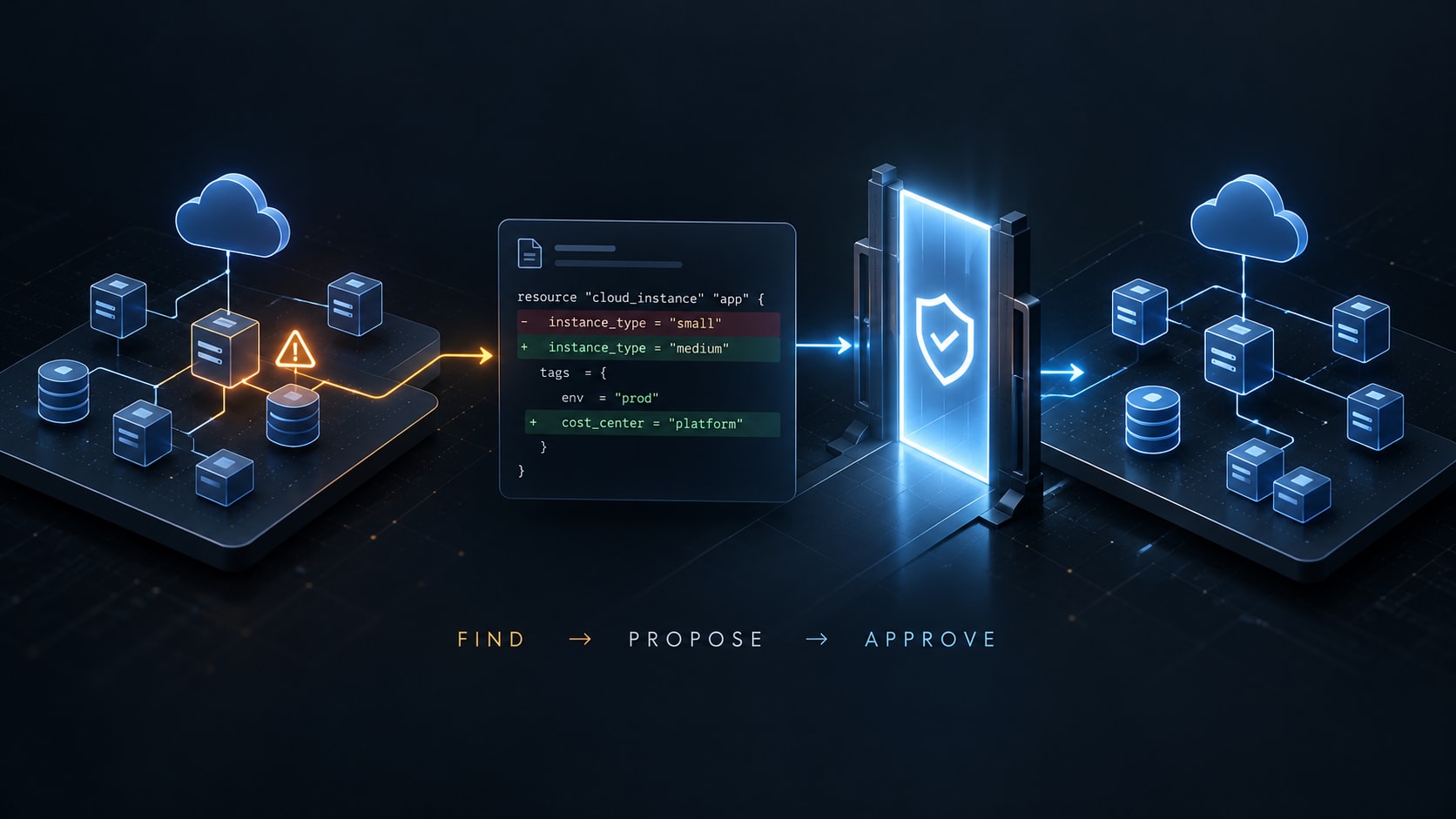
Cloud platforms have been telling us what is wrong for years.
AWS is now moving toward something more consequential: preparing what should change next.
Of all the recent AWS announcements, the Well-Architected Agent preview was the one I kept returning to.
Partly because of what it does.
Partly because I have spent the past year building Flurit around a related question:
Can software understand an application well enough to propose its infrastructure, explain the trade-offs, and turn an approved decision into governed code?
Flurit approaches that question from the beginning of the infrastructure lifecycle. It starts with an application repository or stated intent, develops an infrastructure blueprint, and turns an approved plan into Terraform.
AWS is approaching the problem from the other direction.
It starts with infrastructure and Infrastructure as Code that already exist. It examines the current environment, relates findings to business goals, prioritizes what should change, and can include implementation material with its recommendations.
What caught my attention was not that AWS called it an agent.
It was that the architecture review no longer has to end with a report.
It can end with the code for the next proposed change.
I have not tested the preview yet. Access currently requires an AWS Business+ support plan or higher, which is not enabled on our account. This analysis is based on AWS’s announcement and public documentation rather than hands-on usage. AWS says Developer and standard Business support customers are not currently eligible for the preview. AWS Documentation
From periodic review to continuous recommendation
The traditional Well-Architected process is familiar to many cloud teams.
You define a workload, examine it against architectural principles, identify risks, and create an improvement plan.
That process is valuable, but it is usually periodic.
The review captures the architecture at a particular moment. The resulting findings then compete with incidents, product work, migration projects, cost initiatives, and every other demand on the engineering team.
The new AWS Well-Architected Agent changes the operating model.
AWS says the service continuously analyzes deployed environments and refreshes scheduled recommendations weekly. It produces recommendations at three levels:
-
individual resources,
-
groups of resources associated with an application,
-
and broader architectural patterns discovered through IaC reviews.
Those recommendations can be ranked against business goals, describe cross-pillar trade-offs, and include implementation guidance such as updated Infrastructure as Code or automation scripts. The agent currently evaluates cost optimization, security, resilience, and performance.
This moves the review from:
Here are the weaknesses in your architecture.
toward:
Given your goals and current environment, here is the change you should consider next, why it matters, and how it could be implemented.
That is not merely a faster checklist.
It is the beginning of an architectural control loop.
The emerging architecture loop
I think this category of tooling is moving through five stages:
Observe → Understand → Prioritize → Propose → Govern
Each stage sounds straightforward.
None of them is.
1. Observe what actually exists
The first task is discovering the deployed environment.
Resources, configurations, utilization, dependencies, cost data, security findings, and application topology all contribute to the picture.
Cloud platforms have been collecting this information for years through monitoring, configuration, advisory, security, and cost-management services.
AWS Well-Architected Agent builds on those existing signals. It can ingest findings from services such as Trusted Advisor and add goal-aware prioritization and remediation guidance.
But resource inventory is only the beginning.
A list of load balancers, databases, queues, clusters, buckets, and functions does not automatically explain the application they form.
It tells us what exists.
It does not necessarily tell us why.
2. Understand the application
Architecture rarely lives in one source.
The cloud account contains deployed reality.
The repository contains implementation behaviour and application dependencies.
Infrastructure as Code contains one representation of the desired infrastructure.
Metrics reveal how the system behaves under real traffic.
ADRs, tickets, and documentation contain earlier decisions.
Product and engineering leaders hold business constraints that may never have been written down.
No single source contains the complete architecture.
This makes application context one of the hardest problems in any system that attempts to recommend architectural change.
Suppose an agent finds an underutilized database.
At the resource level, downsizing may appear sensible.
At the application level, that database may support a year-end workload spike, a regulatory reporting window, an internal recovery process, or a product launch scheduled for next week.
The resource configuration shows the present.
The recommendation requires an understanding of the expected future.
AWS addresses part of this through agent profiles, application context, and natural-language business goals. A profile defines the accounts and regions to monitor, the optimization pillars to consider, and the goals against which recommendations should be ranked.
Its application-level recommendations attempt to consolidate related resource findings into a wider application view. AWS explicitly labels that recommendation format as beta and advises customers to review AI-generated recommendations carefully before taking action.
That caveat points to the real frontier.
The difficult problem is not generating another cloud best-practice suggestion.
It is reconstructing enough application intent to know whether the suggestion is appropriate here.
There is no universally correct architecture
A recommendation engine also needs to understand that cloud architecture is an exercise in trade-offs.
A startup may accept lower resilience to preserve runway.
A payments platform may prioritize security and availability even when that increases cost.
A batch-processing workload may tolerate latency that would be unacceptable for a user-facing transaction.
A product approaching a major launch may temporarily overprovision.
A system nearing retirement may not justify an expensive redesign, even when the redesign is technically superior.
The same infrastructure finding can therefore lead to different decisions under different business conditions.
This is why goal-aware prioritization matters.
AWS says customers can define business goals for the four optimization pillars, and the agent uses those goals to prioritize recommendations by expected impact and effort. Recommendations also expose trade-offs and possible effects across pillars.
That represents an important shift from undifferentiated findings.
Traditional cloud tooling often produces a crowded room of alerts:
-
reduce this cost,
-
enable this control,
-
change this configuration,
-
improve this recovery posture,
-
upgrade this resource,
-
alter this network path.
All may be reasonable.
The problem is deciding which one matters now.
Architecture is not the accumulation of every available best practice. It is the selection of appropriate trade-offs for a particular system under particular constraints.
An architecture agent becomes useful only when it can distinguish between:
technically desirable
and:
strategically appropriate now.
The recommendation is becoming executable
The next stage is where this becomes especially interesting.
AWS says Well-Architected Agent can attach ready-to-implement remediation material to recommendations. Depending on the finding, this may include updated IaC, an AWS Systems Manager runbook, command-line guidance, or another guided implementation path. It can also conduct on-demand architecture reviews of Terraform, CloudFormation, and CDK templates.
At that point, architectural advice becomes more than description.
It becomes a proposed state transition.
That changes the nature of the review.
A written recommendation asks:
Is this idea reasonable?
An implementation-ready recommendation asks a longer set of questions:
-
Is the inferred application boundary correct?
-
Is the business goal current?
-
Was the recommendation generated against the latest environment?
-
What resources will change?
-
What is the blast radius?
-
Does the proposed code preserve existing organizational policies?
-
How will it interact with another planned change?
-
Has it been tested against realistic conditions?
-
Can it be rolled back?
-
Who has the authority to approve it?
-
How will we know whether the expected benefit appeared after deployment?
The closer architecture tooling gets to execution, the less it resembles advisory software.
It begins to resemble change-management infrastructure.
Code is not approval
This is the boundary I find most important.
A system can generate technically valid Terraform and still propose the wrong change.
The syntax may be correct.
The provider versions may be valid.
The plan may contain no obvious errors.
The recommendation may align with a published best practice.
Yet the change may still be inappropriate because the system misunderstood the application, the current business priority, or another dependency outside its view.
Generated code does not eliminate architectural judgment.
It moves judgment to a new boundary.
Instead of asking an architect to discover every issue and write every remediation manually, the system can prepare a candidate change. The human reviewer then evaluates:
-
the evidence behind it,
-
the assumptions it made,
-
the trade-offs it selected,
-
and the consequences of applying it now.
The unit under review is no longer just a recommendation.
It is a package:
Current state + inferred context + business objective + proposed change + expected impact + supporting evidence
That package needs a governed lifecycle.
A mature flow might look like:
Observation → recommendation → proposed diff → policy checks → cost and risk analysis → approval → deployment → outcome verification
The final step matters.
If a recommendation predicts lower cost or greater resilience, the platform should later verify whether that outcome occurred.
Otherwise, the loop stops at execution and never learns whether its architectural reasoning was useful.
Where Flurit and AWS approach the same loop
AWS Well-Architected Agent and Flurit currently enter the lifecycle from different points.
AWS begins with the deployed AWS estate or an IaC template:
Existing infrastructure → analysis → prioritized recommendation → remediation material
Flurit begins with the application or intended system:
Repository or intent → infrastructure blueprint → approval → Terraform pull request
One starts primarily from the current state.
The other starts primarily from the proposed future state.
But both directions eventually encounter the same problem:
How do we connect application intent, infrastructure reality, architectural policy, and authorized change?
A repository alone is insufficient.
It may reveal a database dependency, queue usage, environment variables, scheduled jobs, or storage requirements. It rarely contains the complete operational context.
A cloud account alone is also insufficient.
It shows deployed resources, but not always why they exist, which application requirement produced them, or whether their current shape remains intentional.
The architecture system of the future will need both views:
-
what the application appears to require,
-
and what the environment currently contains.
It must understand the difference between them and decide whether that difference represents drift, technical debt, deliberate trade-off, or planned evolution.
That is a much harder problem than generating Terraform.
It is also where the category becomes valuable.
The role of platform teams changes
If systems can continuously observe infrastructure, identify risks, prioritize recommendations, and prepare implementation-ready changes, platform teams will not disappear.
Their work moves upward.
They become responsible for defining and maintaining the conditions under which those recommendations can be trusted.
That includes:
-
application boundaries,
-
business and architectural goals,
-
approved infrastructure patterns,
-
policy constraints,
-
cost and risk thresholds,
-
evidence requirements,
-
approval rules,
-
rollback expectations,
-
and post-deployment validation.
Today, much of that context exists informally in the heads of experienced engineers.
For architecture agents to become reliable, organisations will need to make more of it explicit.
That may be the deeper consequence of this shift.
The most important output of an architecture platform may not be the generated code.
It may be the structured organizational context that allows generated code to be evaluated correctly.
The preview still has important boundaries
AWS Well-Architected Agent is a preview, not a finished declaration of autonomous cloud management.
Application-level recommendations are currently beta. AWS advises users to review generated recommendations before acting on them. The documented workflow has customers review recommendations and deploy the remediations, rather than allowing the agent to apply architectural changes independently. Access is also currently limited to customers on Business+ or higher support tiers.
Those limitations matter.
But they do not diminish the broader direction.
Cloud optimization tooling is moving from:
detecting isolated findings
toward:
understanding applications, interpreting goals, and preparing governed changes.
The agent does not need to be fully autonomous for that shift to be significant.
Architecture becomes a living loop
Architecture has traditionally been expressed through diagrams, documents, reviews, and decisions made before or between implementation cycles.
But deployed systems do not stay still.
Traffic changes.
Costs drift.
Security requirements evolve.
Teams add services.
Dependencies appear.
Business priorities move.
The distance between the intended architecture and the operating system grows quietly.
The next generation of cloud architecture tools will continuously compare those two states, identify the most valuable difference, and prepare a path for closing it.
That does not make architectural judgment obsolete.
It makes the handoff between judgment and execution more important.
An architecture review that ends with code is no longer merely a review.
It is the beginning of a controlled change.
And the hardest question is no longer whether the cloud can recommend what should happen next.
It is whether we can build the context, evidence, and authority required to decide when that recommendation should become real.
Which part of this loop would you trust first: detecting the issue, prioritizing it, generating the fix, or deploying it?