What typed probabilistic decisions could mean for DevOps, platform engineering, and autonomous systems
By Sumant Thakur
Published: 2026-09-23
URL: https://sumantthakur.substack.com/p/jev-changes-the-contract-between
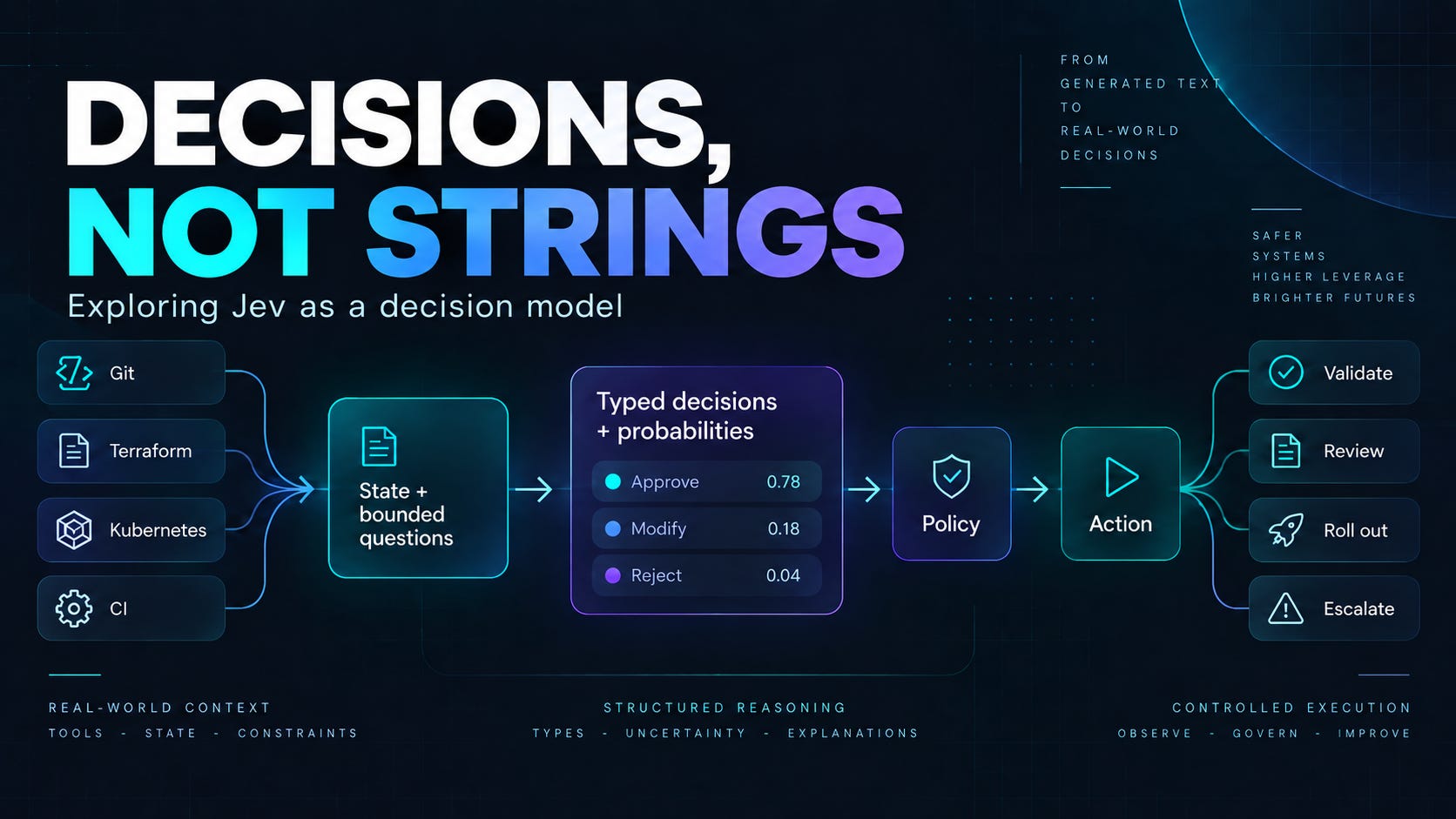
Most AI models give software the same thing they give humans:
More language.
Jev does something different.
Give it some state and a bounded question, and instead of generating another paragraph for your application to interpret, it returns a typed decision with probabilities.
That sounds like a small interface change.
I think it may be a much bigger one.
Because once an AI model stops being primarily a text generator, you can start thinking about it less like a chatbot embedded inside your product—and more like a probabilistic function that ordinary software can compose.
TypeSafe calls Jev its first public System One Model. Their description is succinct: unstructured state in, typed probabilistic decisions out. Jev gives up string generation and is designed around structured decisions that software can consume directly.
The interesting question is not whether this is a nicer API.
It is whether it changes what we can safely ask AI to do inside real software.
Consider a production deployment.
Your CI system already knows that a database migration changed.
It knows integration tests passed.
It knows the target environment is production.
It knows nobody ran a migration rehearsal.
Those are facts. We do not need an AI model to rediscover them.
But the facts leave harder questions unanswered:
Does this migration need to be coordinated with the application rollout?
Do the passing tests actually cover the dominant failure mode?
Is the rollback plan credible enough for an unattended deployment?
Should this change go to the database team, SRE, or both?
These are not really generation problems.
They are judgment problems.
And that is where Jev gets interesting.
There is a semantic gap between rules and agents
A lot of software automation sits at two extremes.
At one end, we have deterministic rules:
if terraform_destroy_count > 0:
require_manual_approval()
These are excellent when the condition can be expressed precisely.
At the other end, we increasingly have agent-style workflows:
Here is the pull request, Terraform plan, test output,
service documentation and deployment history.

Review everything and decide what we should do.
That gives the model considerably more freedom.
Sometimes that freedom is exactly what we need. Coding agents are useful because writing code is an open-ended problem. Research is useful because we often do not know the answer space beforehand.
But many software decisions sit somewhere between those two extremes.
They are too contextual to encode cleanly as an if statement, yet bounded enough that we do not need a model to invent an arbitrary answer.
For example:
Which review path does this change require?

A. normal service-owner review
B. database review
C. security review
D. SRE review
E. multiple specialist reviews
F. insufficient information
The software already knows what actions exist.
What it lacks is semantic judgment about which one applies.
That is a very different AI problem from generation.
Jev’s programming model
Jev currently exposes three useful kinds of judgment through TypeSafe’s System One API: Noul, Choice, and Score.
You can think about them this way:
Noul   → Does this condition hold?

Choice → Which known alternative best applies?

Score  → Where does this fall on an ordered scale?
Noul: whether something holds
Suppose we ask:
Does this application and database change require
an explicitly coordinated rollout?
Instead of producing an essay explaining both sides, the useful output is essentially:
P(yes)If the probability is close to 1, the model strongly favours yes.
If it is close to 0, it strongly favours no.
And if it is around 0.5, the model does not strongly distinguish between the alternatives.
That last case is important.
Uncertainty becomes something software can react to.
Choice: selecting from an answer space
We might instead ask:
Which review route best matches the dominant concern?and define:
service_owner
database_reviewer
security_reviewer
sre_reviewer
multiple_reviewers
insufficient_information
Jev selects from those alternatives and returns probabilities over the choices.
It cannot decide that the correct answer is "principalcloudwizard" unless we put that option in the schema.
Score: evaluating degree
We can also describe an ordered rubric:
How strong is the rollback evidence?

0 — No viable rollback is described

1 — Rollback is incomplete or entirely untested

2 — A plausible rollback exists with meaningful uncertainty

3 — Rollback is complete and supported by relevant tests

4 — Rollback is rehearsed and covers application
and persistent state
Now the result can become an input into an application policy.
The interesting idea is not the names of these primitives.
It is the constraint they impose:
the application defines the decision surface before inference happens.
Typed does not mean correct
This is where I think engineers need to be particularly careful.
A constrained answer space removes an important class of failure.
If software defines:
database_reviewer
security_reviewer
sre_reviewer
the model cannot respond with an unexpected fourth type.
It cannot suddenly emit prose where code expected a typed answer.
That is useful.
But a perfectly typed answer can still be wrong.
The model might select databasereviewer when securityreviewer was the better answer.
It may assign a high probability to a bad judgment.
It may misunderstand an ambiguous question.
Or the application may simply fail to provide a crucial piece of state.
So I would separate two properties:
Interface correctness ≠ semantic correctnessType-safe output solves the first problem.
Evaluation still has to establish the second.
That distinction will matter enormously if decision models are going to sit inside automated systems.
A DevOps workflow makes the boundary concrete
Imagine a change like this:
change:
title: Add order-region migration
environment: production

service:
name: orders-api
criticality: tier-1

facts:
application_code_changed: true
database_migration_changed: true
deployment_manifest_changed: true

ci:
unit_tests: passed
integration_tests: passed
migration_rehearsal: missing

rollback:
documented: true
rehearsed: false
Most of this should never go through AI reasoning.
Ordinary software can determine:
database migration changed       → true
target environment               → production
integration tests                → passed
migration rehearsal              → absent
rollback rehearsal               → absent
Those are facts.
The interesting questions start after fact extraction:
Does the application change depend on the migration
being deployed in a particular order?

Do the existing tests omit a material failure mode?

Could an application rollback leave the persistent
state incompatible with the previous version?

Which specialist review is needed?

How credible is the rollback strategy?
That is the semantic middle.
What a Jev request could look like
Here is the shape of the architecture we are testing.
This is a proposed request design, not a recorded result from Jev.
{
"model": "jev-latest",

"state": {
"environment": "production",
"service_criticality": "tier-1",

"facts": {
"application_code_changed": true,
"database_migration_changed": true,
"integration_tests_passed": true,
"migration_rehearsal_present": false,
"rollback_documented": true,
"rollback_rehearsed": false
}
},

"questions": {
"coordinated_rollout_required": {
"type": "noul",
"instructions":
"Does this application and database change require an explicitly coordinated rollout?"
},

"review_route": {
"type": "choice",
"instructions":
"Which review route best matches the dominant operational concern?",

"criteria": {
"service_owner":
"Normal service-owner review is sufficient.",

"database_reviewer":
"Specialist database review is materially required.",

"sre_reviewer":
"Operational reliability review is materially required.",

"multiple_reviewers":
"Multiple specialist reviews are materially required.",

"insufficient_information":
"The supplied state is insufficient to select a route."
}
},

"rollback_confidence": {
"type": "score",
"instructions":
"Assess the operational confidence of the rollback strategy.",

"criteria": [
"No viable rollback is described.",
"Rollback is incomplete or entirely untested.",
"A plausible rollback exists with meaningful uncertainty.",
"Rollback is complete and supported by relevant tests.",
"Rollback is rehearsed and covers application and persistent state."
]
}
}
}
There are several things I like about this pattern.
The questions are narrow.
The possible actions already exist.
insufficient_information is a legitimate outcome.
And the application can see uncertainty instead of receiving a polished paragraph that sounds equally confident in every situation.
The model should not own the workflow
Now comes the part I think matters more than the model call.
Suppose we receive the judgments.
The model should not get to decide what happens next.
Code should.
Conceptually:
def decide_workflow(facts, judgments):
actions = []

# Hard policy
if facts["environment"] == "production":
actions.append("require-service-owner-approval")

if facts["database_migration_changed"]:
actions.append("run-schema-compatibility-check")

# Probabilistic semantic judgment
if judgments["coordinated_rollout_required"] >= 0.80:
actions.append("require-coordinated-rollout-plan")

if judgments["review_route"] == "database_reviewer":
actions.append("request-database-review")

if judgments["rollback_confidence"] < 2.5:
actions.append("run-migration-rehearsal")
actions.append("hold-unattended-production-rollout")

return actions
The numbers here are deliberately illustrative.
I would not ship a 0.80 threshold because it feels reassuring.
Thresholds have to come from evaluation.
A low-risk workflow might tolerate more uncertainty.
A production IAM change should tolerate far less.
And some actions should never be authorized by model confidence alone.
This gives us a useful separation:
Facts are not judgments.

Judgments are not policy.

Policy is not execution.
I suspect that separation will become increasingly important as AI moves from helping humans produce things to participating directly inside software workflows.
Why not just use an LLM with structured output?
This is the obvious question.
Modern language-model APIs can already return schema-constrained JSON.
That means Jev’s value cannot simply be:
It produces valid JSON.
The more interesting proposition is that the model itself is designed around bounded decisions and probabilities rather than token generation.
TypeSafe says Jev uses a different architecture, a parallel sampler, and a training method they call Reinforcement Learning for Calibrated Decisions. The company also reports substantial latency and cost advantages on its System One workflow evaluations.
Those are TypeSafe’s own results.
We have not yet established whether those advantages hold for the DevOps workload described here.
That is exactly what we are testing.
And the comparison I care about is not simply:
Jev vs LLMIt is:
rules only

vs

one large LLM prompt

vs

decomposed typed judgments using an LLM

vs

decomposed typed judgments using Jev
That distinction matters.
If decomposition itself produces most of the improvement, that is a useful finding.
If Jev adds better calibration, latency, consistency, or economics on top of it, that is another useful finding.
Either way, we learn something about how AI should fit into software.
What we are building
We are building the first version of this idea as a small open-source Platform Change Reviewer.
The goal is not to create another agent that reads a repository and claims that a deployment is “safe.”
The goal is to separate the workflow into things software can know exactly, things that require semantic judgment, and things that must remain explicit policy.
The reviewer will consume evidence from:
Git
Terraform
Kubernetes
CI
service metadata
rollback information
and turn it into a flow like this:
Change evidence
↓
deterministic extraction
↓
bounded AI judgments
↓
deterministic policy
↓
validation / review / rollout / escalation
The first version is intended to work locally as a CLI and as a skill that coding agents can invoke during a real development workflow.
A developer should be able to ask something like:
Review my branch against main.

Use the Terraform plan at artifacts/tfplan.json.

This is a tier-1 production service.

Do not deploy anything.

Tell me which validations are missing,
who should review the change,
and what rollout path it should follow.
The important part is that the coding agent would not need to make every judgment itself.
It could delegate the bounded semantic decisions to Jev, while deterministic software owns fact extraction, policy and allowed actions.
The first autonomous actions should also be deliberately boring and reversible:
run another validation

request specialist review

recommend a migration rehearsal

select a preview-environment workflow

hold because evidence is missing
No automatic production deployment.
That is deliberate.
Autonomy should be earned by evidence, not granted because a model happens to expose an API.
We plan to publish the project on GitHub as the implementation becomes useful.
If this is a workflow you would actually use, I would also be interested to know. I’m happy to share the repository with readers who want to try the first public version and contribute real platform-change cases to test against.
The failures may be more interesting than the successes
Before using this architecture seriously, we want to test cases such as:
-
A three-line diff that changes a shared ingress rule.
-
A large refactor with almost no operational impact.
-
A database migration where application versions temporarily overlap.
-
A Terraform plan that replaces persistent infrastructure.
-
An IAM expansion that is syntactically valid but semantically broader than the feature requires.
-
A Kubernetes change with missing capacity evidence.
-
A good deployment description with an inadequate rollback strategy.
-
A change where the correct answer really is insufficient information.
And we want to measure more than average accuracy.
The important questions are:
When Jev says 90%, how often is it actually right?

What kinds of changes produce confident mistakes?

How often can the system safely act without human review?

What happens to accuracy as we increase automation coverage?

Does the same input produce materially different decisions across runs?

How well does it recognize missing information?
That is the evaluation required before probabilities can become policy inputs.
A model being confident is not the same thing as a system being safe.
The bigger idea
Jev is what prompted this exploration, but I think the question is broader than any particular model.
For the last few years, the dominant model of AI software has been built around generation.
Models generate:
answers
code
plans
SQL
Terraform
tool calls
analysis
That flexibility is enormously useful.
I do not expect it to disappear.
But there may be another important class of AI applications where generation is the wrong abstraction.
The application already knows the permitted actions.
It already knows the policy.
It already knows which side effects exist.
What it cannot express neatly in deterministic code is the semantic judgment connecting state to those actions.
In that world, perhaps the useful AI primitive is not:
generate(prompt) → stringbut something closer to:
judge(state, question, answer_space)
→ probabilities
Then ordinary software does what ordinary software is good at:
validation
composition
policy
permissions
state machines
side effects
auditability
And the model does something narrower:
semantic judgmentThat division of responsibility is what we want to test.
Not whether Jev can replace deterministic software.
Not whether an AI agent can be given enough permissions to run an entire production environment.
But whether probabilistic semantic decisions can become reliable enough to sit alongside normal programming primitives.
What comes next
The first question is straightforward:
Can a model like Jev make bounded platform-engineering judgments accurately enough that software can safely act on some of them—and reliably know when not to?
We are building the Platform Change Reviewer to find out.
The plan is to publish the implementation, the evaluation methodology, and the cases where the approach fails—not only the impressive examples.
No autonomous production deployment.
No benchmark claims before the data exists.
And no assumption that a typed answer must be a correct answer.
If you want to follow the implementation or try the first GitHub release when it is ready, reply to this post or newsletter. I’m happy to share the repository as soon as there is something genuinely useful to run.
Because if probabilistic decisions are going to become software primitives, knowing when not to trust them may matter just as much as knowing when to use them.