The future of agentic systems is not infinite reasoning. It is turning successful traces into skills, meta-tools, and deterministic workflows.
By Sumant Thakur
Published: 2026-05-26
URL: https://sumantthakur.substack.com/p/the-agent-compiler-is-coming
Most agentic systems today are still built around a simple assumption:
Give the model tools, let it reason, and let it figure out the workflow.
That works surprisingly well for demos.
It also becomes expensive, slow, and fragile very quickly.
Every agent run becomes a fresh act of rediscovery. The model has to decide which tools to call, in what order, what intermediate result matters, what failure means, and when the task is actually complete. Even when the agent has solved the same type of problem before, many systems force it to reason from scratch again.
That is the part I think will change.
The future of agentic systems is not that agents will reason more and more forever.
The future is that successful reasoning traces will be captured, compressed, reused, and eventually compiled into more deterministic workflows.
In other words:
The first wave of agents was about giving models tools.
The second wave is about giving them execution environments.
The next wave will be about compiling what they learn.
This is where agentic systems start to look less like chatbots with tools and more like adaptive platforms.
P.S. This is also one of the directions shaping how we are thinking about Flurit AI: not just agents that generate infrastructure, but governed execution paths for planning, reviewing, and applying infrastructure changes.
If that sounds relevant to your team, you can join the early-access waitlist here: [Join the Flurit waitlist]
Agents are still rediscovering too much work
A lot of current agent architectures are wasteful by design.
The agent receives a task. It plans. It calls a tool. It observes the result. It adjusts the plan. It calls another tool. It validates. It retries. It summarizes. Then the next time a similar task arrives, the same pattern starts again.
Sometimes that is necessary. Many problems are ambiguous, contextual, and require reasoning.
But many sub-flows are not truly novel.
For example, in a DevOps or infrastructure agent, these workflows repeat often:
- Detecting the application framework from a repository
- Identifying infrastructure drivers from code
- Mapping app requirements to cloud services
- Checking whether required environment variables exist
- Generating a Terraform skeleton
- Running static validation
- Producing a cost estimate
- Creating a pull request
- Reviewing infrastructure diffs
- Checking policy constraints before apply
The first few times, it makes sense for an agent to reason through these flows. But after enough successful runs, forcing the model to rediscover the same sequence again is not intelligence. It is waste.
This is why I think the next serious agentic platforms will not only execute workflows.
They will learn which parts of those workflows should stop being agentic.
The trace is the most underused artifact in agentic systems
Every agent run leaves behind a trace, Not just logs.
A trace contains the actual path the system took:
- The user request
- The plan
- The tools selected
- The order of tool calls
- The intermediate outputs
- The failed attempts
- The corrections
- The final artifact
- The approval points
- The policy decisions
- The stop condition
Today, most teams treat this trace as an observability artifact. Useful for debugging, maybe useful for audit, but not central to the intelligence of the system.
I think that is too limited.
The trace is not just a record of what happened.
It is training material for the workflow layer.
Recent research is already moving in this direction. One paper on Agent Workflow Optimization proposes analyzing workflow traces to find recurring tool-call sequences and converting them into deterministic “meta-tools.” The reported result is fewer LLM calls, shorter execution paths, reduced failure points, and improved task success.
That is the important shift.
The trace is no longer just something we inspect after failure.
The trace becomes raw material for optimization.
From tools to meta-tools
Most agent systems start with atomic tools.
A tool might be:
read\_file
search\_docs
run\terraform\validate
fetch\cloud\pricing
create\pull\request
query\repository\structure
The agent decides how to combine them.
That flexibility is useful, but it also creates cost and risk. Every intermediate decision requires model reasoning. Every reasoning step can drift. Every tool choice can be wrong. Every extra loop increases latency.
A meta-tool is different.
A meta-tool packages a recurring sequence of steps into a single deterministic capability.
Instead of asking the model to repeatedly decide:
- Scan repository
- Detect framework
- Identify exposed ports
- Detect database usage
- Infer background workers
- Summarize infra drivers
The platform can expose a higher-level tool:
analyze_application_infra_drivers(repo)
The agent still decides when to use it.
But it no longer has to reason through every low-level step.
This matters because the future of agents is not simply “more tools.” In fact, too many tools can make agents worse. The model has more choices, more possible paths, and more opportunities to pick the wrong abstraction.
The more mature direction is:
Fewer raw tools.
Better composed tools.
More deterministic execution behind them.
That is why meta-tools are interesting. They reduce unnecessary reasoning without removing agency where agency is actually needed.
Skills are the next layer of procedural memory
Meta-tools are one path.
Skills are another.
A skill is not just a prompt. It is procedural knowledge packaged for reuse.
The emerging pattern is that a skill contains instructions, examples, scripts, templates, references, and verification logic that help an agent perform a class of tasks more reliably. SkillsBench, a 2026 benchmark for agent skills, evaluates this idea across thousands of trajectories and describes skills as structured procedural packages used by agents at inference time. Curated skills improved average pass rate significantly in the benchmark, though results varied by domain and self-generated skills did not reliably help on average.
That last point matters.
It suggests a useful distinction:
Agents can consume skills better than they can reliably create them.
At least for now.
This has a very practical implication for product builders.
If every customer, team, or organization has its own way of working, then the future agent platform may need a skill layer that captures those local conventions.
For infrastructure and DevOps, that could mean skills like:
ecs_fargate_service_skill terraform_module_selection_skill cost_review_skill security_group_review_skill rds_production_readiness_skill github_pr_infra_review_skill incident_triage_skill
Each skill becomes a reusable operating procedure.
Not a vague memory.
Not a vector search result.
Not a long prompt pasted into context.
A real procedural artifact.
This is why I think skills will become a major part of internal developer platforms. Organizations already have golden paths. They already have platform standards. They already have preferred modules, deployment rules, naming conventions, approval requirements, and security constraints.
Agent skills are a natural way to make those standards executable.
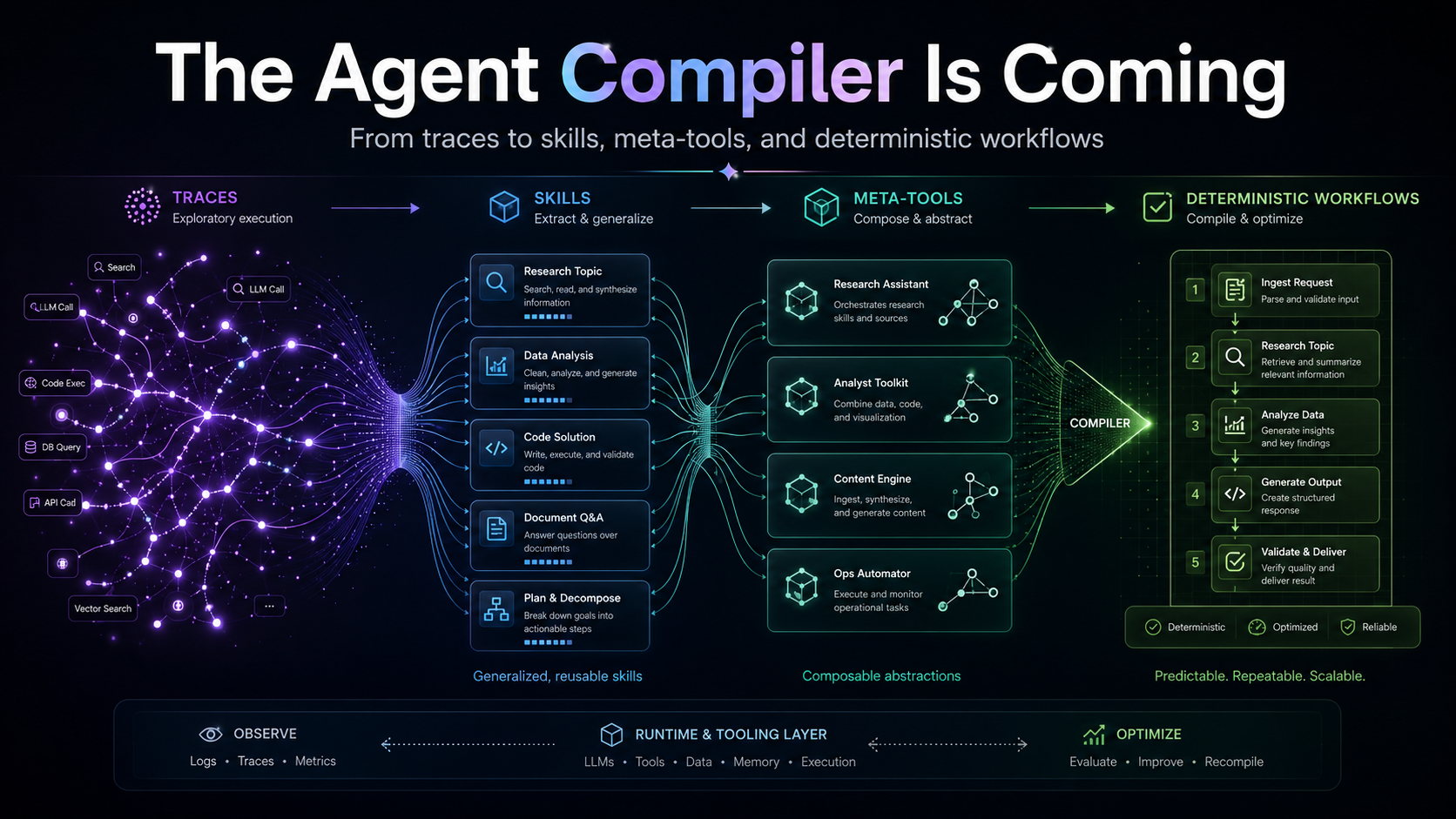
The agent compiler: traces → skills → meta-tools → workflows
Here is the bigger pattern I think will emerge.
Agentic systems will start exploratory.
They will reason, try tools, fail, recover, and find working paths.
But mature systems will not leave that behavior as a one-time execution.
They will compile it.
A possible maturity curve looks like this:
Raw agent execution ↓ Execution traces ↓ Reusable skills ↓ Meta-tools ↓ Deterministic workflows ↓ Platform primitives
At the beginning, the agent has to reason through the task.
After repeated success, the system identifies a recurring pattern.
That pattern becomes a skill.
If the skill is used frequently and its steps are stable, it becomes a meta-tool.
If the meta-tool becomes business-critical, it becomes a deterministic platform workflow.
This is what I mean by the agent compiler.
Not a compiler in the traditional programming-language sense.
A compiler in the system-design sense:
It takes repeated successful behavior and turns it into a more reliable execution artifact.
This changes how we think about agent platforms.
The goal is not to keep everything fluid and agentic forever.
The goal is to preserve flexibility at the edges while making the core workflow more predictable over time.
Why DevOps is the perfect domain for this
DevOps is a very strong testbed for this idea because it has both ambiguity and repetition.
There is ambiguity in understanding a new application:
- What does this repo do?
- What runtime does it need?
- Does it need a database?
- Does it expose HTTP traffic?
- Does it have workers?
- Does it need object storage?
- What environment variables matter?
- What should be provisioned first?
But there is also repetition:
- Framework detection
- Dependency scanning
- Dockerfile analysis
- Terraform validation
- Cost estimation
- Security checks
- PR creation
- Drift detection
- Policy review
- Deployment status checks
A good infrastructure agent should reason where the problem is ambiguous.
It should not reason through the same stable checklist forever.
This is one reason I think “AI-generated Terraform” is still a shallow framing. The more interesting problem is not whether an LLM can generate Terraform.
The deeper problem is:
Can the system learn the organization’s infrastructure workflow and make it more deterministic over time?
That is where the real value is.
Terraform generation is only one output.
The more important artifact is the evolving workflow behind it.
The orchestration graph becomes the optimization surface
As agents become multi-agent systems, the problem gets even more interesting.
It is not enough to optimize individual tool calls.
The system also needs to optimize orchestration:
- When should a sub-agent be spawned?
- Which specialist should receive the task?
- What context should be passed?
- When should agents communicate?
- When should the supervisor stop the loop?
- How should partial results be aggregated?
- Which agent was responsible for the final failure?
A 2026 paper on reinforcement learning for LLM-based multi-agent systems frames this through “orchestration traces”: temporal interaction graphs that include spawning, delegation, communication, tool use, aggregation, and stopping decisions. The important idea is that the orchestration itself becomes something to inspect, learn from, and optimize.
That is a big shift.
In simple systems, we trace requests.
In agentic systems, we trace decisions.
In multi-agent systems, we trace orchestration.
The workflow graph becomes the thing to improve.
This also means observability has to evolve. Logs and spans are not enough. We need to know why an agent delegated, why it selected a tool, why it retried, why it stopped, and which intermediate decision caused the final output.
There is already research in this direction too. AgentTrace, for example, proposes causal graph tracing for diagnosing failures in deployed multi-agent workflows, including settings like DevOps remediation where cascading failures and hidden dependencies make debugging harder.
This is why I believe future agent platforms will need three layers of tracing:
Execution trace: what tools ran? Decision trace: why were they selected? Orchestration trace: how did agents coordinate?
Without these, optimization is mostly guesswork.
This also changes how we think about memory
A lot of agent memory discussion is still too close to retrieval.
Store documents. Retrieve relevant chunks. Add them to context.
That is useful, but it is not enough.
A production agent does not only need to remember facts.
It needs to remember procedures.
It needs to remember:
- Which plan worked
- Which tool sequence failed
- Which policy blocked the action
- Which cloud configuration was accepted
- Which Terraform module caused issues
- Which approval path was required
- Which rollback strategy was used
- Which customer-specific convention mattered
This is procedural memory.
And procedural memory should not always stay as memory.
Some of it should become skills.
Some of it should become meta-tools.
Some of it should become deterministic workflow code.
That is the key distinction.
Memory is not the final form.
Memory is the staging area before compilation.
The model is not the whole system anymore
This is also why I think the model-centric view of agents is becoming weaker.
The model matters. Of course it does.
But the durable advantage in agentic systems may increasingly come from the layers around the model:
- Runtime
- Tooling
- Skills
- Workflow traces
- Evaluation
- Policy
- Sandboxing
- Orchestration
- Verification
- Customer-specific procedural knowledge
OpenAI’s recent work around the Responses API computer environment is a useful signal here. Their agent runtime work includes hosted containers, shell execution, filesystems, and secure execution environments for agents that need to do real work rather than only produce text.
This points to a broader architecture shift.
Agents need a place to work.
They need tools.
They need memory.
They need skills.
They need a way to recover.
They need a way to learn from traces.
And eventually, they need a way to compile what has become stable.
That is why I think the most important agent platforms will not look like thin wrappers over model APIs.
They will look like runtime systems.
What this means for builders
If you are building an agentic product today, the practical question is not only:
Which model should I use?
That matters, but it is not enough.
The better questions are:
- What traces does the system produce?
If every run disappears into logs, you are throwing away the raw material for optimization.
- Which parts of the workflow are repeatedly successful?
These are candidates for skills or meta-tools.
- Which parts still require reasoning?
Keep those agentic. Do not prematurely hard-code the ambiguous parts.
- Which parts should become deterministic?
If the same tool sequence runs successfully hundreds of times, it probably should not require full model reasoning every time.
- How do you verify compiled behavior?
A skill or meta-tool without verification can become a faster way to fail.
- How do you keep humans in the loop at the right points?
Compilation should not remove judgment from high-risk decisions. It should remove waste from stable sub-flows.
This is especially important in infrastructure, security, finance, healthcare, and enterprise operations.
The more consequential the action, the more the system needs a clear boundary between reasoning and execution.
The wrong lesson would be to remove agents
There is a possible misunderstanding here.
If repeated workflows become deterministic, does that mean agents become less important?
I do not think so.
It means agents move up the stack.
Agents should not spend their best reasoning capacity on repetitive glue work.
They should reason about:
- Ambiguous intent
- Trade-offs
- Exceptions
- Novel environments
- Missing information
- Policy conflicts
- Recovery paths
- Human-facing explanations
- Choosing between compiled capabilities
That is a better use of intelligence.
The agent becomes less like a script generator and more like an adaptive controller over an evolving set of capabilities.
The platform underneath becomes more reliable because it has learned from past executions.
This is the balance I think many systems are missing.
Too much determinism too early makes the system rigid.
Too much agentic freedom forever makes the system unreliable.
The future is probably a hybrid:
Agentic at the edges.
Deterministic in the core.
Compiled over time.
The future agent platform is part runtime, part compiler
My current mental model is this:
A production agent platform needs four things.
First, it needs a runtime where agents can execute work safely.
Second, it needs a trace layer that records what happened with enough structure to learn from it.
Third, it needs a skill layer where procedural knowledge can be reused.
Fourth, it needs a compiler layer that identifies stable patterns and turns them into more deterministic capabilities.
Without the runtime, the agent cannot do real work.
Without traces, the system cannot improve.
Without skills, the system cannot reuse procedural knowledge.
Without compilation, the system keeps paying the reasoning tax forever.
That reasoning tax is manageable in prototypes.
It becomes expensive in production.
It becomes dangerous in high-stakes systems.
And it becomes strategically wasteful when the same successful workflow keeps happening again and again.
Closing thought
The first generation of agentic products will be judged by what agents can do.
The next generation will be judged by what the system learns from what agents have already done.
That is the important difference.
A good agent can solve a task once.
A good agent platform can turn that solved task into a reusable capability.
The most advanced systems will not be the ones where agents think the most.
They will be the ones where agents know what no longer needs thinking.
P.S. This is also the direction we are exploring with Flurit AI: moving DevOps agents from one-off generation toward reusable, governed infrastructure workflows. If that sounds relevant to your team, you can join the early-access waitlist here: [Join the Flurit waitlist]