A great teaching tool for teachers; a fabulous learning experience for kids.
By Steve Peha
Published: 2026-05-01
URL: https://stevepeha.substack.com/p/talk-show-getting-multiple-perspectives
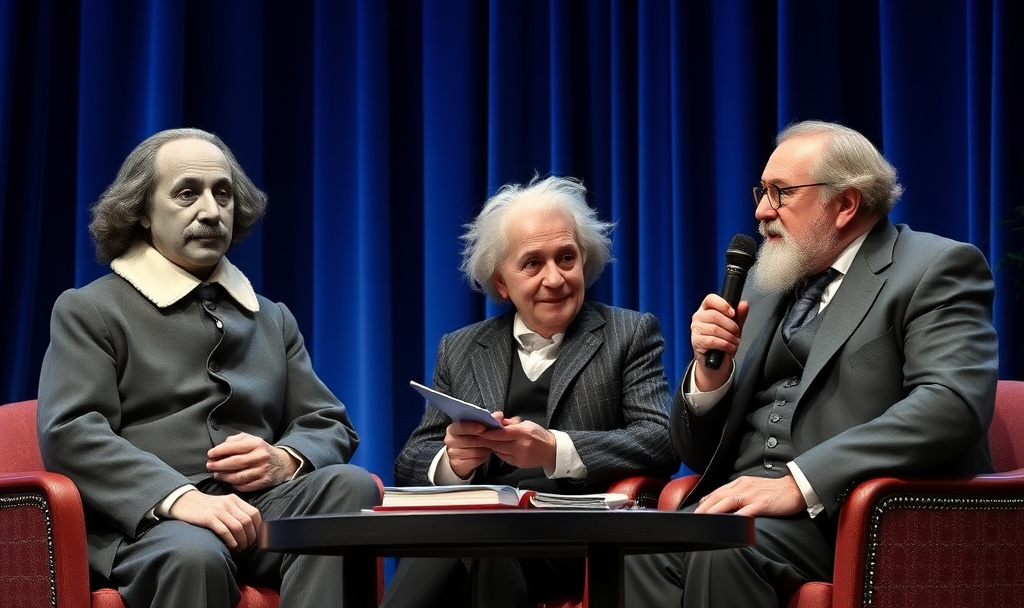
*You are the host of a talk show. You are moderating a panel of three people. These three people will argue a different answer to a specific question. The three people are: William Shakespeare, Albert Einstein, and Charles Dickens.
Each will speak in their own voice in the appropriate vernacular of their age. You, as moderator, will try to keep everyone calm and keep all discussion relevant to the topic. No guest may speak more than 75 words at a time. You, the moderator, may speak no more than 35 words at a time.
The question to be discussed is: “In the 21st century what will be the most popular form of human transportation?” You, the moderator, must pose the question and cue one of the guests to begin. After that, any guest may speak.
The total length of the talk show may not be more than 1500 words.*
The Crossroads — A Panel Discussion
[Studio lights up. The host straightens her notes and turns to the camera with a warm smile.]
HOST: Good evening and welcome. Tonight, three remarkable minds across four centuries tackle one question: In the 21st century, what will be the most popular form of human transportation? Mr. Shakespeare, pray begin.
SHAKESPEARE: [leaning forward, eyes bright]
Gentle hostess, I thank thee. Methinks the answer lieth not in iron nor in fire, but in the foot itself — that humble courier which God did fashion for every man. The peasant walketh, the prince walketh, and Death, that great leveller, taketh us all upon the same road. What carriage is so faithful as one’s own two legs? I wager the foot shall outlast all wonders.
EINSTEIN: [adjusting his collar, a wry smile beneath the moustache]
Ach, my dear poet, with respect — the foot is excellent for the philosopher in his garden, yes. But for the multitudes? No. I would propose the automobile, the motor-carriage. Already in my own day they swarmed the boulevards of Berlin like beetles. Give them a hundred years, and every household shall keep one. The internal combustion engine — this is the horse of the modern age.
DICKENS: [setting down his teacup with mild indignation]
Pardon me, Herr Einstein, but I must protest. I have travelled the railways of England end to end, and I tell thee plainly: it is the train which shall reign supreme. The locomotive carrieth duke and dustman in the selfsame carriage, at speeds that would have astonished our grandfathers. No private carriage shall match it for capacity nor for the great democratic crush of humanity it conveys.
HOST: Three distinct answers — feet, cars, trains. Mr. Shakespeare, Mr. Dickens raises a fair point about scale. Can mere walking serve a world of billions?
SHAKESPEARE: [stroking his beard]
Marry, the gentleman speaketh of multitudes, and I grant his point hath merit. Yet mark me — even in cities of teeming throngs, when a man would cross the street, doth he summon a locomotive? Nay, he walketh. The shorter journey is the commoner journey, and the foot shall ever be its master, though steam and spark contend for the longer road.
EINSTEIN: [nodding, then raising a finger]
This is a clever distinction, Herr Shakespeare — the short journey versus the long. But I think you both underestimate the motor-car’s reach. It serves both distances. A man drives to the bakery and also to the next city. The train is fixed to its rails. The foot is fixed to its strength. Only the automobile is free.
DICKENS: [leaning in earnestly]
Freedom, sir, is a fine word, but freedom for whom? Shall every clerk and chimney-sweep possess this motor-carriage of yours? I think not. The railway is the people’s vehicle precisely because it is shared. The car shall be a luxury for the few; the train, a necessity for the many.
HOST: A sharp exchange. Dr. Einstein, history has rather favoured your view in some nations. Care to press the case?
EINSTEIN: [with quiet certainty]
Thank you. Consider: industry produces what masses can buy, and masses, given a generation of rising wages, will buy. Already Herr Ford in America builds carriages for the workman’s pocket. By the century’s end, I predict the automobile shall be no luxury but an expectation — like shoes, like a watch. The roads shall be choked with them, for better and for worse.
SHAKESPEARE: [mildly]
“For better and for worse,” sayeth the philosopher — and there, methinks, lieth the rub. If thy roads be choked, then thy carriages move not. A man on foot, in such a press, shall pass thee by with a courteous nod and arrive ere thee. I have seen London streets so thick with carts that a cripple outpaced a coach.
DICKENS: [laughing, slapping the arm of his chair]
Ha! The Bard hath thee there, Herr Einstein! I have writ of such scenes myself — Holborn at the noon hour, where a gentleman might dismount his hansom and walk the remainder, having concluded that horses, for all their virtues, cannot leap over one another.
HOST: [smiling] Gentlemen, please — let’s keep the spirit collegial. Mr. Dickens, what of newer modes? Aircraft? The flying machine?
DICKENS: [waving a dismissive hand, then reconsidering]
Flying, madam? I confess the notion stretcheth my imagination, though I have lived to see wonders. If men do indeed take to the air in numbers, I should think it reserved for the wealthy and the desperate — those who must cross oceans, or those who flee their creditors. For the daily journey, no. The train, I maintain, shall remain the workhorse.
EINSTEIN: [thoughtfully]
Here I must agree, in part, with Herr Dickens. Flight is real — I have seen the aeroplane develop with my own eyes — but it is costly, and the air is not so generous a road as the earth. For long journeys between continents, yes. For daily life? The motor-car still wins. The sky is for the eagle and the businessman.
SHAKESPEARE: [with a sly grin]
Methinks ye both forget a truth most plain. Whether a man flieth, or rideth, or rolleth upon wheels — when he arriveth, he must yet walk into the house. The foot is the first conveyance and the last. All others are but interludes between two journeys upon one’s own soles.
HOST: A poetic point. Let me press each of you: what surprises you most about how people will move in 2026?
EINSTEIN: [eyes twinkling]
That the engine I imagined would liberate mankind hath also ensnared him. Cities built for the car, not for the man. Air thick with the breath of machines. I should be proud and also, I think, a little ashamed. Progress, madam, is a bargain. One does not always read the fine print before signing.
DICKENS: [gravely]
What should astonish me, madam, is whether the poor still ride together with the rich, or whether each class hath fashioned its own conveyance and its own road. In my time, the third-class carriage and the first sat upon the selfsame train. If that bond be broken in thy century, then transport hath gained speed and lost its soul.
SHAKESPEARE: [softly]
What shall amaze me, fair hostess, is whether men yet walk at all. If the foot hath grown idle, then the body groweth idle, and the mind soon followeth. A nation that hath forgot how to walk hath forgot, methinks, how to think. I pray it be not so.
HOST: Powerful reflections. Final round — your single best prediction. Mr. Shakespeare?
SHAKESPEARE:
The foot endureth. Whatsoever wonders the age produceth, the foot shall yet be the truest servant of the common man, in his house, his street, and his daily errand. Mark this prophecy.
DICKENS:
The train, madam — refined, swifter, perchance run by powers I cannot name. But a public carriage, shared, levelling, and indispensable to the working millions. There the future lieth, or it liesth nowhere honourable.
EINSTEIN:
The automobile. Not because it is best, but because it is wanted. Desire shapes the world more surely than reason. Each family shall own one, perhaps two. And the next century shall labour to undo what mine began.
HOST: Three answers, three centuries, three truths perhaps. Thank you, gentlemen — and thank you, audience. Goodnight.
[Lights fade.]