AI and the Hostile Takeover of US Balance Sheet: From “Break Things” to Too-Big-To-Fail
By Sovereign Insight Strategies
Published: 2025-12-12
URL: https://sovereigninsightstrategies.substack.com/p/the-great-externalization-of-cost
I. The Hostile Takeover: From “Break Things” to Too-Big-To-Fail
The operational creed that defined the last decade of Big Tech’s “move fast, break things” playbook has metastasized into the core AI tech stack1. We are not witnessing a benign technological scaling event. We are witnessing a calculated, rational effort by the major AI model makers to engineer a Too-Big-To-Fail (TBTF) scenario. This is a hostile takeover of the public U.S. balance sheet.
Let us be clear: this strategy is not innovation; it is financial engineering designed for asset stripping the public domain.
To understand the magnitude of this impending transfer of liability, I approach this crisis from seven distinct angles, each revealing a critical systemic flaw:
- As an economist and financial analyst, I analyze cashflows, valuation multiples, and credit risk—metrics that justify sound strategy. Yet, I see the inverse of value creation being built: the introduction of destruction multiples.
- As a supply chain expert, I see the inherent risks of a fragile logistics network where the most critical input, human data, is being contaminated by the very factories processing it.
- As a geopolitical expert, I observe how power flows and recognize the inherent fragility of governing a population that is not getting its needs met.
- As a former ESG strategist in the oil & gas sector, I understand the reality of thermal efficiency limits. I see this sector attempting to “greenwash” thermodynamic insolvency while asking the grid to write checks physics cannot cash. We simply do not have enough power for AI fever dreams.
- As someone who grew up in an authoritarian system (Saudi Arabia), I recognize the mechanics of state control and digital surveillance not as abstract concepts, but as a lived reality. This experience provides an invaluable lens for observing the digital infrastructure of control being built under the guise of “convenience” globally.
- As an American female user from underrepresented demographic groups, I see and feel the active digitization of discrimination. Systems trained on historical prejudice are flawing the operating system of the future, turning bias into code (This is why I deprioritized my time on LinkedIn—I don’t trust it. Many more are doing the same.)
When you converge these diverse perspectives, the financial and operational reality of the “great AI boom” becomes undeniable. What many in Silicon Valley label as “Force Multipliers” (creating exponential output from linear input) are actually creating a “mass liability accelerator” that we all will bear.
For every dollar of “efficiency” an OpenAI or Google books today, how much are they generating in downstream cleanup costs—in legal defense, environmental remediation, and disinformation mitigation? This is what negative compounding looks like in practice.
For every major corporation, contingent liability is a managed risk; for the AI sector, this is the unmanaged contingent doom. Given the scale of data IP infringement and the infinite scope of digital contamination, the true downstream cost is not merely expensive—it is currently uninsurable, creating an infinite and unquantifiable systemic risk. Why do you think major insurers are already publicly stating they will not insure D&O liability2?
This is not just a financial bubble; it is also a solvency and democracy crisis. In reality, its mechanisms are that of a ‘techno-fascist’ revolution. Here is the forensic audit of the liabilities they are transferring to the public.
II. The Mechanism: The Logic of “AI Slop” (Digital Asset Contamination)
The sudden degradation of online search results and general content is not a product failure but a “strategic” necessity. This move is the inevitable result of the Prisoner’s Dilemma locking the industry into a self-destructive race. The AI industry has hit the Data Wall—the exhaustion of high-quality and low-cost human knowledge. This scarcity has locked the major AI model makers into a deadly payoff matrix:
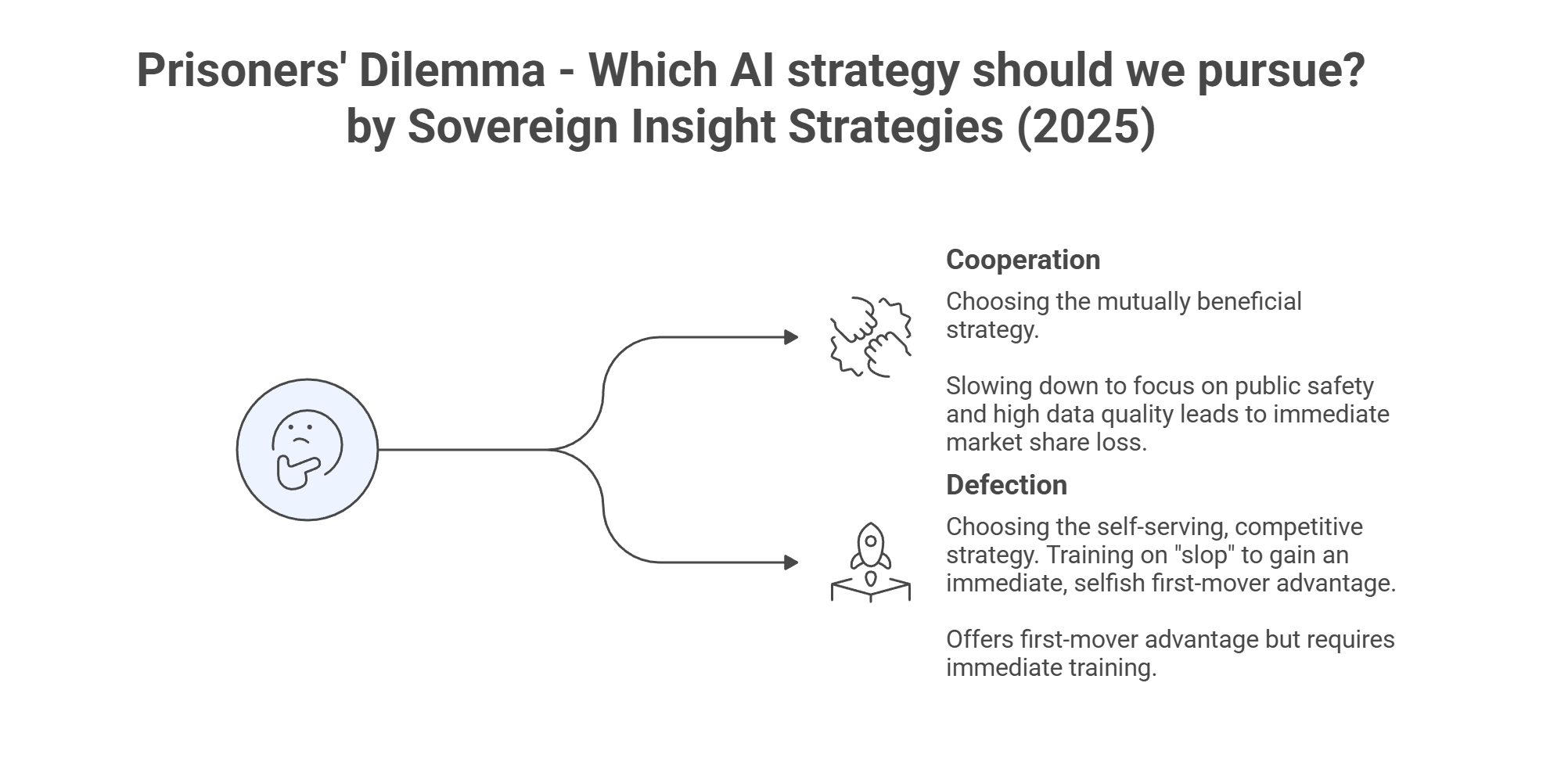 \AI Strategy: The Defection Choice in the Prisoner’s Dilemma\
Every CEO has chosen to defect, prioritizing speed over sanity and public benefits.
This creates a Tragedy of the Commons. By flooding the digital ecosystem with synthetic noise, they are actively polluting the information supply chain. This is the digital equivalent of the subprime mortgages from 2008. They are bundling low-quality data (subprime loans) into high-tech packages and rating them AAA.
The “slop” isn’t just annoying; it is a toxic asset sitting on the balance sheet of the internet.
The entire AI value proposition is predicated on a single, dangerous legal assumption: that they will not lose a major, precedent-setting IP lawsuit. A single adverse ruling on copyright or fair use will instantly turn their multi-billion-dollar models—the core of their balance sheet—into toxic, legally-impaired assets that must be written down to zero.
III. The ESG Inversion: A Polymath’s Audit of Systemic Risk
Investors often look at ESG (Environmental, Social, and Governance) considerations as “soft” metrics. That is a fundamental flaw that will cost them financial, legal, and reputational capital. Sustainability risks are, in this context, the hardest constraint on their balance sheet. The major AI model makers have inverted the concept of ESG, turning it into an economic model that externalizes corporate costs as systemic grief to the public.
Here is the cross-domain audit:
1. Environmental (The Thermodynamics of Insolvency)
Underneath the hype lies a physical reality: The Unit Economics do not work. The business model relies on a precarious equation where:
Input Costs (Energy + Compute) > Output Value (Slop).
We are seeing a real-time validation of the Jevons Paradox: As technology increases the efficiency of a resource, total consumption increases rather than decreases. Making chips 50% more efficient won’t necessarily lower energy bills; it will just encourage companies to run models that are 200% larger.
- The water crisis: To cool data centers, firms are evaporating millions of gallons of potable water. They are trading the public’s water security for chatbot latency.
- The energy & resource parasite: The grid demand is so high it threatens to stall electrification in other sectors. This is thermodynamically insolvent. Furthermore, this unprecedented energy and compute demand is now directly competing for resources, and rare earth materials, required for critical national security and scientific infrastructure, forcing a zero-sum trade-off between existential human needs and commercialized hallucination + bias in decision-making.
Electricity is considered a public utility but appears to be transitioning to commodity status.
2. Social (The Sociology of the “Prosumer Serf”)
To keep a broken business model afloat, they must steal the labor and automate the bias.
- Shadow Work: The zero-cost labor transfer. The models are corrected via Reinforcement Learning from Human Feedback (RLHF). Every time a user corrects a chatbot or flags an error, they are performing essential quality assurance labor—a high-cost business expense that model makers have successfully externalized to the public for zero wages (while their net worth values skyrocket).
- The digitization of discrimination: When systems rely on historical data, you are not creating neutrality; you are hard-coding structural bias. The “Black Box” doesn’t just hallucinate; it discriminates and scales sub-optimal outcomes, creating a massive, latent civil rights liability and economic issues.
Crucial reminder: Stable social and environmental systems are necessary for economic growth. If public infrastructure and trust are crumbling, how can any long-term asset or strategy hold its value?
3. Governance (The Epistemological Collapse)
The most insidious risk is the erosion of Shared Reality. Democracy relies on a baseline agreement of facts, a foundation the “Slop Economy,” driven by hallucinating models trained on biased data/context, is actively destroying.
- Regulatory capture: We are witnessing the rise of a class of operators best described by F. Scott Fitzgerald as “Careless People.” This carelessness has allowed the architects of the surveillance state to capture the regulatory apparatus. The image of Tech CEOs sitting in the front row of the inauguration is the public signal of this success3.
- The trust deficit: When citizens can no longer distinguish between a leaked document and a sophisticated AI generation, the legal, financial, and political systems seize up. This is a Governance Crisis of the highest order. Recent political topples in nations like Nepal and Bulgaria show precisely where this road leads.
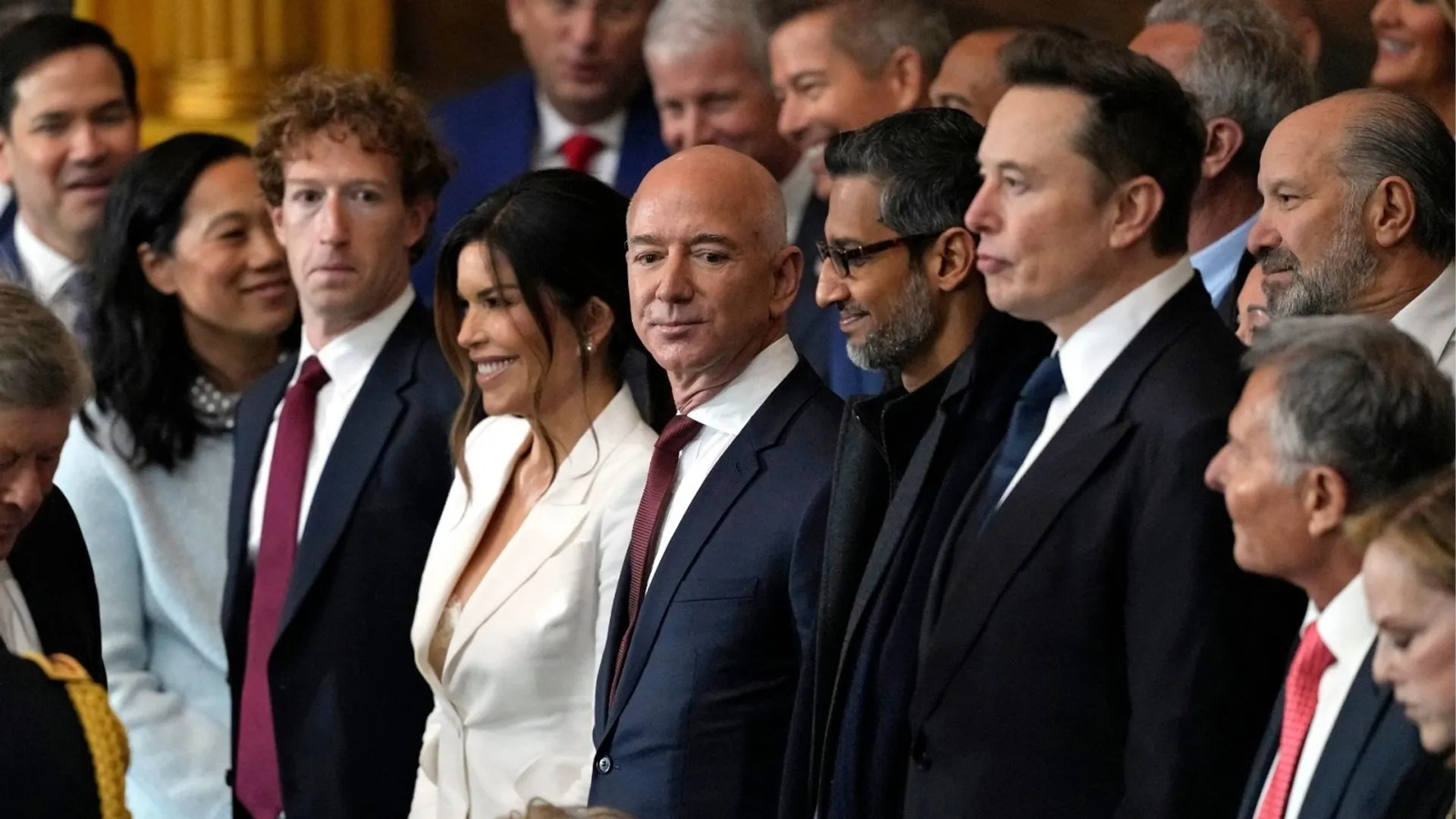 \Big Tech Front and Center at Trump 2025 Inauguration\
IV. The Bunker Signal: The Macro-Economic Forecast
If you doubt the crash is coming, look at where the capital is actually flowing. Why do you think the architects of this chaos are pouring millions into doomsday compounds from Hawaii to New Zealand?
This isn’t mere gossip; it is Insider Trading on a societal scale.
When a CEO sells stock, it’s a signal. When the wealthiest men in the world, tech CEOs, build self-sustaining compounds in New Zealand, this needs to be viewed as a macro-economic forecast. They are effectively shorting the very society they claim to be saving and empowering.
They know the unit economics are insolvent. They know the social contract is being shredded. They are hedging against the very societal collapse their insolvent business models are engineering.
V. The Minsky Moment: The “Revenue” Confession
The industry is currently operating in a state of Ponzi Finance: borrowing against the distant promise of “AGI” to perpetually cover today’s massive operational losses.
The playbook is clear:
- Establish Insolvency: Maintain massive burn rates based on phantom AGI revenue.
- Engineer Dependency: Integrate the product into the core of the U.S. financial, legal, and economic systems.
- Demand Sovereign Subsidy (government-forced bailout): When the Minsky Moment arrives, the engineered dependency forces the government to execute the bailout.
The Minsky Moment is an economic theory named after economist Hyman Minsky. It describes the precise moment when a financial bubble—fueled by speculative debt—suddenly collapses because investors realize the underlying assets can no longer generate enough cash flow to cover the debt taken on to finance them.
It is the transition from stable growth to catastrophic crisis4. Applying this theory to forecast a financial crisis in the AI sector is my original analysis and strategic position.
The industry is currently operating in a state of ponzi finance: borrowing against the distant promise of “AGI” to perpetually cover today’s massive operational losses.
This isn’t accidental oversight; it is an active strategy of operational negligence. Integrate your product into the core of the US economy system so the government must bail out the business.
Sam Altman, years before the ChatGPT boom, explicitly stating that he does not know how to generate revenue and plans to ask the AI to figure it out5.
This clip is a confession. It proves the strategy was always reliant on sovereign subsidy. The recent requests for federal loan guarantees are simply the predictable execution of that roadmap.
VI. The Way Out: The Sovereign Stance
The “Destruction Multiples” can be stopped, but only if we cease accepting the AI hype as fact and fully grasp how systemic sustainability risk is being engineered into the operating system.
For the Risk Officers, Legal Counsel, and Investors reading this: You have a fiduciary duty to immediately audit this liability.
- Stop the Valuation Hallucination: Do not value these companies on speculative “potential.” Value them solely on their burn rate and their quantified legal and financial exposure.
- Reject the Bailout: When the Minsky Moment arrives, recognize it for what it is: A calculated transfer of wealth from the taxpayer to the architects of the crisis. We are not here to subsidize the losses of billionaires like Zuckerberg or Musk.
- Stand Your Ground: Refuse to integrate LLM “wrappers” that expose your proprietary data to their training corpus. Refuse to work for free as an RLHF laborer.
The future is not written by the people building bunkers. It is written by the people who refuse to be driven into them.
The technology itself is not the enemy. Properly governed, these tools hold the exponential power to solve many of the world’s most pressing problems—to create abundance, not destruction. But that future is a choice, not a promise.
The bill is coming. Do not let them sign your name on the check.
If you need to move from analysis to action, reach out to me. I can help translate this systemic liability into a strategy you can control.
Wynn‑Williams, S. (2025). Careless People: A Cautionary Tale of Power, Greed, and Lost Idealism. Flatiron Books.
Riedenstein, C. (2025, December 10). Why insurers may unwittingly become AI safety champions. Tech Policy Press. <https://www.techpolicy.press/why-insurers-may-unwittingly-become-ai-safety-champions/>
Photo: Prestige Online. (2025, January 21). Tech billionaires take centre stage at Trump inauguration. Retrieved from https://www.prestigeonline.com/sg/lifestyle/culture-plus-entertainment/tech-billionaires-trump-inauguration/
Minsky Moment. Minsky, H. P. (1986). Stabilizing an unstable economy. Hyman P. Minsky Archive. Retrieved fromhttps://digitalcommons.bard.edu/hm\_archive/144/
[Scopeo]. (2025, December 10). Sam Altman (CEO @ Openai) talks about his business model in 2019. 3 years before chatGPT