See how a Yishun hawker uses AI to process WhatsApp orders during TikTok livestreams, and learn how to test a simple order-sorting workflow yourself.
By Anfernee
Published: 2026-11-25
URL: https://solopreneurcode.substack.com/p/ai-chatbot-hawker-whatsapp-orders
You’re in the middle of selling on a livestream. Someone asks about a bundle. Another person wants to know what’s available.
At the same time, your phone keeps lighting up with WhatsApp messages from people who want to order.
You can answer the messages, or you can keep talking to the people watching. Doing both at once gets difficult fast.
That was the problem Adam Danish faced at his family’s food stall in Yishun, Singapore. He and his sister were selling on TikTok Live, and customers were placing orders through WhatsApp for pickup or delivery. The livestreams gave the stall another way to reach customers. They also created a pile of orders to sort.
Adam started using an AI chatbot to process kitchen orders. CNA reported that it costs S$50 a month, compared with his estimate of S$900 to hire someone specifically for that role. He said he used to spend an hour and a half sorting orders before packing. With the chatbot, the orders could be handled at the same time, leaving him free to keep upselling to livestream viewers.
There’s a useful lesson here for anyone running a small business. Start with the task that gets in the way of serving customers, then find a way to make that task easier.
Understand the business behind the chatbot
Adam is the second-generation owner of Indonesian Selera Corner, a family-run stall known for its S$2 nasi lemak. His parents have kept that price for more than a decade.
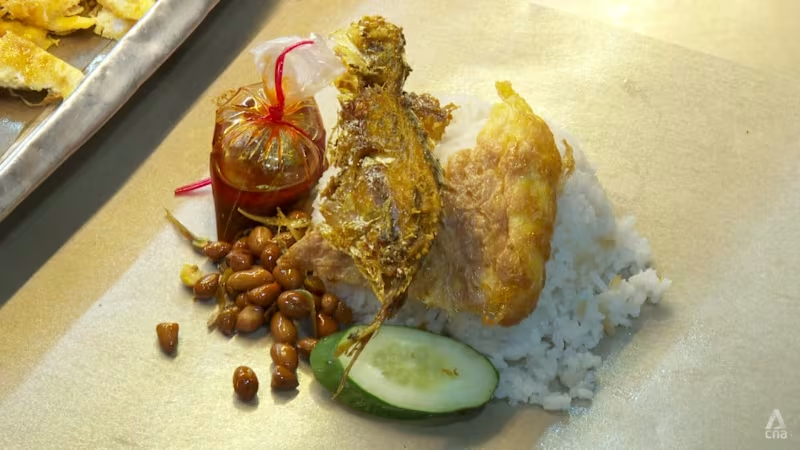
\A packet of the stall’s S$2 nasi lemak.\
They started selling the smaller portion after an elderly customer asked for something smaller than the stall’s standard S$5.50 serving. Other customers liked it too, including people looking for a quick breakfast. For Adam’s parents, the dish is a way to give back to customers, including elderly people and lower-income households. CNA reported that the stall sells about 200 packets a day.
Keeping that price takes work. The family pays nearly S$10,000 a month in rent. With utilities included, CNA reported the bill at S$13,000 a month, before ingredients and manpower. The stall operates in a privately owned coffee shop, so that rent isn’t a comparison with a government-run hawker centre.
Adam also started getting clearer on the numbers. He worked out that the ingredients in a S$2 packet cost S$1.30, before other operating costs. He calculated a break-even point for the stall as a whole of 159 plates a day at S$7.40 each, before the family draws salaries.
The chatbot is one part of a bigger effort. The family has been examining costs, working out its finances and looking for new revenue. There’s no evidence that the chatbot alone makes the S$2 price possible.
Find the task that stops you from selling
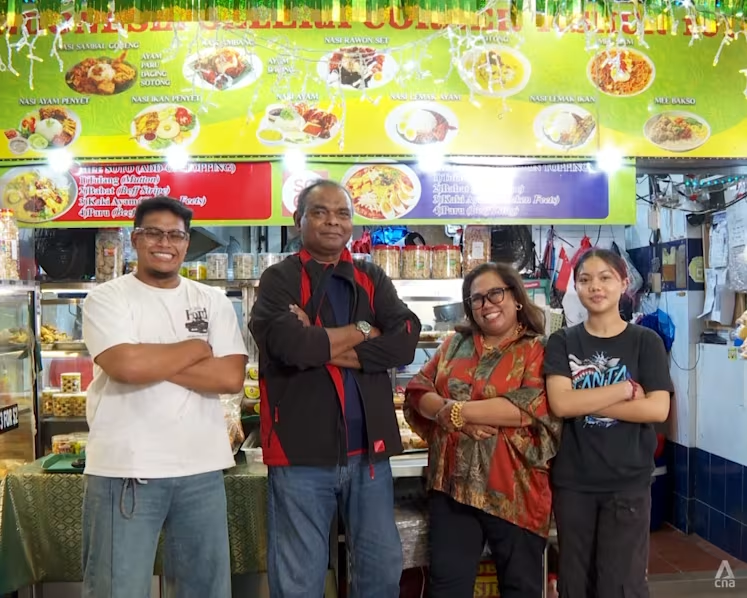
\(From left): Adam Danish, Reban Kasran, Sakdiah Abdul Latiff and Nurangellina Hassan run Indonesian Selera Corner in Block 101, Yishun Avenue 5.\
Adam and his sister, Nurangellina Hassan, known as Angel, started using TikTok Live to offer bundle deals and promotions. She handles the morning livestreams, and he takes over in the afternoon. Customers can order through WhatsApp and choose pickup or delivery.
That created a practical problem. If Adam was hosting a livestream, he couldn’t easily give his full attention to WhatsApp enquiries at the same time. Once orders came in, someone also had to get them ready for the kitchen.
His answer was to use a chatbot for the order-processing work. The reporting doesn’t name the chatbot or explain its exact setup, so we can’t say which product he chose or how it connects to WhatsApp.
What we do know is the job it was brought in to do: process kitchen orders while Adam continued selling.
Think about where that happens in your own business. You might be trying to answer enquiries while running a workshop, or pulling order details together while customers are still messaging you. If a task keeps pulling you away from the work you need to do live, write it down. That may be a good place to test a simple AI workflow.
Read the numbers carefully
The comparison in Adam’s story is striking. CNA reported a chatbot cost of S$50 per month against Adam’s estimated S$900 for hiring someone specifically for the role. That’s a difference of S$850 a month between the two figures.
But that difference is a comparison with an estimated hiring cost. The report doesn’t say he had an employee in that role and cut an existing S$900 payroll expense. It also doesn’t give a full cost comparison after setup, oversight or other possible expenses.
The time figure needs the same care. Adam said he previously spent an hour and a half sorting orders before packing. He told CNA the chatbot allowed the orders to be handled at the same time as the livestream. The report doesn’t establish that he saves 90 minutes every day, or that he never checks the orders himself.
CNA also reported that the livestreams had brought in as much as S$12,000 in gross revenue after about two months. Some livestreams received no orders. That figure is gross revenue from the livestreams, not profit, and it isn’t a measure of sales caused by the chatbot.
These are results reported in one business. They haven’t been independently checked, and they don’t tell you what your own results will be.
Try a simpler version before you automate
You don’t need to recreate Adam’s unnamed setup to learn from it. The Agent Stories page suggests starting with a manual process: give an AI assistant your menu and a batch of order messages, then ask it to prepare a list for the kitchen.
This is a starter workflow inspired by the story. It’s not a description of Adam’s exact chatbot, and it won’t automatically read your WhatsApp messages.
First, write your current menu in one place. Include prices and any bundle deals you want the assistant to recognise. Then collect a small batch of messages from a busy period. Remove customer names, phone numbers, addresses and other unnecessary personal details before using an AI tool, and check your tool’s data-handling settings and applicable privacy requirements.
Here’s the starter prompt from Agent Stories, adapted to use customer references instead of names:
You take orders for [stall or shop name].
Here is my menu with prices and bundle deals:
[paste menu]
Here are the order messages from today's livestream. Customer references are anonymised:
[paste messages]
For each message, list the customer reference, items, quantities, pickup or delivery, and requested time.
Mark anything unclear or not on the menu as CHECK. Don't guess missing details.
Then give me one kitchen list with the total of each dish, and a short confirmation reply for each customer that I can review and send.
Before you use the result, compare every order with the original messages. Check quantities, special requests, pickup or delivery, and timing. Ask the customer about anything marked CHECK. Confirm payment yourself before treating an order as paid.
A clean-looking list can still contain a mistake. A missed item matters to the customer, and a wrong quantity matters to the kitchen. Keep the human check in the process.
Measure the work you actually want to reduce
After you’ve tried a few batches, look at what happened. Did the list make the next step easier? Did you still need to spend time fixing quantities or asking customers for missing details?
For a useful comparison, record the same things before and during your test:
- How long you spend turning messages into a usable list.
- How many orders or messages are in the batch.
- How many corrections you have to make.
- What you pay for the tool and any extra setup.
Don’t count the time spent checking orders as zero. That check is part of the workflow. If you save ten minutes sorting but spend twenty minutes fixing mistakes, the process needs work.
You can also note what you did with the time you got back. In Adam’s case, CNA reported that he could keep upselling to viewers. For you, the useful work might be answering a customer, delivering a service or preparing the next order.
If the manual version works reliably over a few weeks, the Agent Stories guide suggests looking at chatbots that can read WhatsApp orders on their own. Before choosing one, check what it costs, what data it handles, how it deals with uncertain orders and where a person needs to step in.
Your order-sorting checklist
Before you set up anything more complicated, make sure you can answer these:
- What’s the repetitive task, and when does it interrupt you?
- What information does a usable order list need?
- What can you remove before sharing messages with an AI tool?
- Who checks unclear items, payment and the final list?
- How will you compare the time and mistakes before and after?
Start with one batch. Check the result against the original messages, then decide whether it deserves another test.
You can read my write-up of the story on Agent Stories. For the original reporting, see the CNA Insider piece.
Agent Stories collects real, sourced examples of people using AI agents to get work done. Each one comes with the tools used and a skill you can copy.
Read more at agentstories.org.
Built something similar? Send us your story.
You’re doing everything. But nothing is moving?
You are doing everything. But nothing is moving.
That is not a motivation problem.
Most solopreneurs are learning from everywhere and getting nowhere. Too much information. No clear system connecting effort to results.
You have everything it takes. You just do not have a clear system yet.
That is what paid subscribers get. Every system, playbook, prompt, and template. All inside the Premium Vault.
You’ll also gain access to this amazing tool I’ve built: Solopreneur OS for Claude: The complete operating system that is built to run your one-person business.
All for $79/year. That’s $6.58/month.
Upgrade now and unlock the Premium Vault worth thousands of dollars.
The Premium Vault holds the secret behind posts like this one, including the tools and resources I use to build the one-person business I love.
Thanks for reading! Ready for the next step?
Let’s crack the growth equation and build a thriving one-person business on your terms!
Anfernee