A practical exercise to decide what your one-person business should make possible, what it must avoid, and which choice to make this week.
By Anfernee
Published: 2026-10-26
URL: https://solopreneurcode.substack.com/p/write-your-vision-and-anti-vision
You open a fresh page and type the name of your next offer.
Maybe it’s a course. A template bundle. A service you could launch before the end of the month.
You start thinking about the price, the landing page, and what to post about it.
You still haven’t worked out what running this offer will require from your week.
If it sells, will your days fill with work you enjoy? Will customers expect you to reply every evening? Will delivery leave enough time to find the next customer?
An offer can look good on a sales page and still commit you to a schedule you don’t want.
I’d write two short descriptions before deciding what to build:
The working life you want, and the pattern you want to leave behind.
Your vision and anti-vision.
Unstuck your one-person business with the FREE Solopreneur Success Hub. You get this comprehensive command center for building and scaling a successful one-person business even as a Free Subscriber.
I created this all-in-one toolkit to build and grow my one-person business and it saves me 20+ hours a week.
This is definitely something I wish existed when I first started.
Now, it’s yours… FREE!
More information about the Hub here.
Access My Solopreneur Success Hub
Together, they give you something concrete to check an idea against.
You can still change your mind.
You just have a clearer reason for saying yes or no.
Set aside 20 minutes for a rough version.
A few honest sentences will do.
Trust me, you will love it. :)

Describe a working week you’d want to repeat
Picture an ordinary Tuesday a year from now.
There are still customers to help and bills to pay. Some work is routine. You won’t enjoy every task.
What would make that Tuesday a good day anyway?
Start with the details you’d experience, rather than a phrase like “a successful business.” Write about:
-
when you begin and finish work,
-
where you work and how often you need to be somewhere,
-
the work that fills most of your day,
-
the people you serve and how you communicate with them, and
-
the time your business leaves for life outside it.
“More freedom” leaves a lot undecided.
Finishing work at a particular time, keeping mornings free for writing, or delivering without daily calls gives you something you can plan around.
Try this sentence:
In a normal week, I work [hours] from [place], spend most of my time on [work], and serve [people] through [delivery model]. I protect [time or commitment].
Here’s a hypothetical example from a solopreneur consultant:
I work 25 hours a week from home. Most of my work is research, writing recommendations, and helping clients make decisions. Calls happen on two afternoons. I finish by 4 p.m. so evenings stay free.
A service that requires calls throughout every day would be difficult to fit. Work that can be reviewed and delivered in writing might be worth exploring.
Also write down what the business needs to earn to support that week.
Keep the amount separate from the lifestyle description so you can check both.
The business still needs to earn enough to support that schedule though.
Write the week you want to avoid
Now look at the habits and commitments that could keep you from that vision.
If nothing changes, what will your working week continue to look like?
Keep the answer specific and believable. You don’t need to imagine a disaster or criticise yourself.
-
If client messages regularly spill into your evenings, write that down.
-
If every project requires a new proposal and a new process, describe what that takes from your week.
-
If you keep building products before speaking to buyers, name the work that piles up.
If I keep [current pattern], my week will continue to include [unwanted consequence]. I want to stop building a business that requires [specific condition].
For the same hypothetical consultant, it might read:
Calls spread across five days. Every proposal promises a different custom solution. Evenings become the only time left to prepare, and clients expect answers whenever they send a message.
Use each part to decide how the business will run.
-
Calls could move to fixed days.
-
A service could have a standard scope.
-
Support could have a stated response window.
Those changes still need to work for your customers. But now you know which conditions to test and discuss, instead of carrying a general feeling that something needs to change.
I’d keep the anti-vision short. Use it to identify a pattern, then spend your attention on what you’ll do about it.
Check your vision against P.E.A.C.E.
*I coined P.E.A.C.E. when I first started my solopreneur journey back in 2023 as a way to constantly remind myself what is important and why am I doing what I did.
This is one of the first few times I share this here in Solopreneur Code. Hope you like it.*
Check whether the vision gives you the freedoms you care about.
P.E.A.C.E. gives you five areas to examine: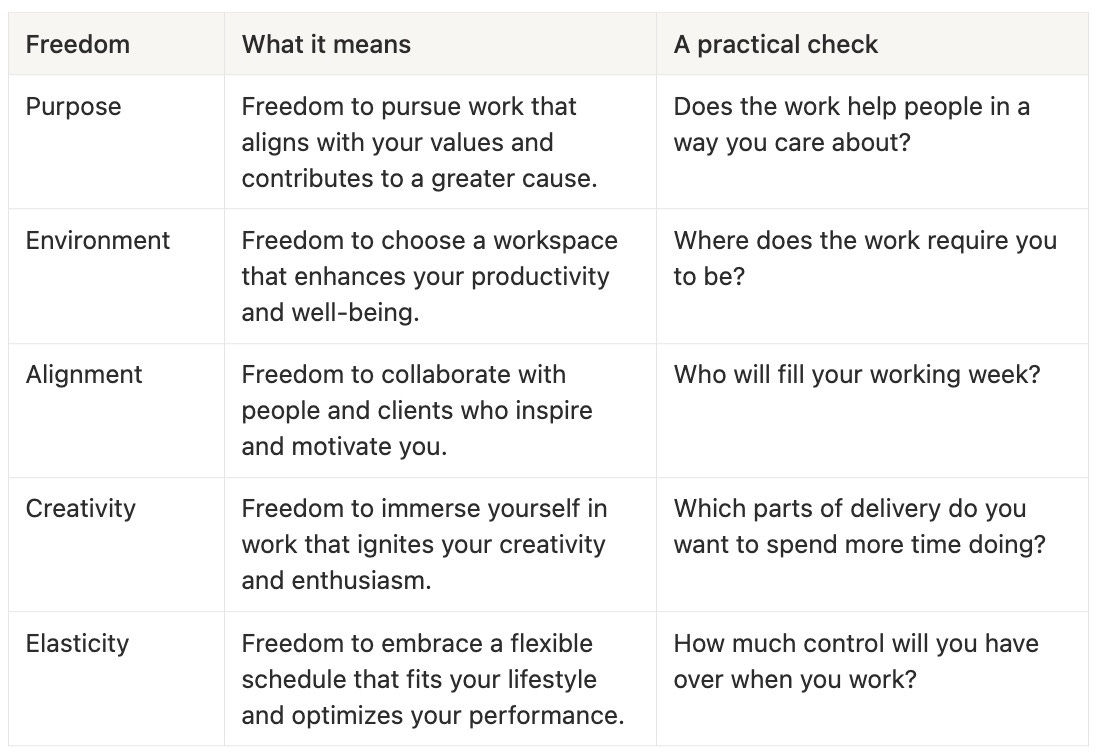
Give each area a score from 1 to 5.
-
Use 1 when the week you’ve described barely supports that freedom, and
-
5 when it supports it well.
Beside each score, write one reason. Point to a detail in your plan, such as the delivery format, the people you’ll work with, or the hours you’ve protected.
You may find a trade-off you’re happy to make. You might choose in-person work because you enjoy teaching in a room, even though it gives you less choice over location.
You may also spot a conflict. A business built around immediate replies makes a flexible schedule harder to protect.
Choose the freedom that matters most for your next decision. Trying to improve every score at once can leave you with another long project and no change to next week.
Give your reader a direction too
Write what your business should help a customer do.
Your reader has a current situation and a result they want. Your brand vision connects those two through work you can actually deliver.
I help [specific person] move from [current situation] to [useful result] through [approach I can actually deliver].
Keep the result close enough to your offer that you can support it honestly.
For example, a hypothetical proposal template could help freelancers prepare a clear proposal without starting from a blank page every time. Claiming that the same template will give them financial freedom would go far beyond what the product does.
Then write your brand anti-vision:
My reader wants to stop [recurring problem] so they can [specific improvement].
Name a frustrating process or an unwanted situation. Avoid blaming the reader or turning another group of people into an enemy.
The hypothetical proposal-template business might focus on the repeated work of rebuilding proposals from scratch. That gives it useful topics to teach:
-
what belongs in a proposal,
-
how to explain scope, and
-
which sections can be reused.
Your own experience can help you understand a problem. Check that other people recognise it too. Ask how they deal with it today, what they’ve already tried, and what still takes too much time or effort.
Use the exercise to make one business decision
Return to the offer idea on your fresh page.
Look at what delivery would require. Include the less visible work, such as answering questions, preparing sessions, updating materials, and finding customers.
Does that work fit the week you’ve described?
Return to our hypothetical consultant.
A new service with unlimited messaging and calls on demand would make the anti-vision more likely. Even if the offer attracted buyers, the delivery terms would conflict with the schedule they want.
An alternative worth testing could be a fixed-scope review, a written recommendation, and one scheduled follow-up. That format may fit their preferred work and protected evenings better.
Buyer demand still needs checking through conversations or a small paid test. An offer can fit your week and fail to solve a problem people will pay to fix.
Choose one visible action for this week. You could revise a delivery promise, move calls into a fixed window, or speak to a potential buyer before adding more features.
Then choose an activity to stop so the action has room in your schedule.
This week, I will [observable action] by [day]. I will stop [one activity] to make room for it.
You may need to make the change gradually while keeping existing commitments. Put the next decision in writing, even if the full transition will take longer.
Key takeaways
Keep a one-page direction check beside your next offer outline. It should contain:
-
a specific working week, including hours, place, delivery, and protected time,
-
an anti-vision tied to habits and commitments you can change,
-
a P.E.A.C.E. score with a reason for each freedom,
-
a useful result your brand helps a reader reach,
-
a recurring problem your reader wants to leave behind, and
-
one action this week, plus one activity you’ll stop.
Your answers will change as you learn more about your customers and the work. Revise the page when that happens.
For now, write the working week you want before you commit to the next offer.
One-page worksheet
A printable A4 worksheet with fillable fields for your vision, anti-vision, P.E.A.C.E. scores, brand direction and this week’s decision.Vision And Anti Vision Worksheet76.4KB ∙ PDF fileDownloadDownload
You’re doing everything. But nothing is moving?
You are doing everything. But nothing is moving.
That is not a motivation problem.
Most solopreneurs are learning from everywhere and getting nowhere. Too much information. No clear system connecting effort to results.
You have everything it takes. You just do not have a clear system yet.
That is what paid subscribers get. Every system, playbook, prompt, and template. All inside the Premium Vault.
You’ll also gain access to this amazing tool I’ve built: Solopreneur OS for Claude: The complete operating system that is built to run your one-person business.
All for $79/year. That’s $6.58/month.
Upgrade now and unlock the Premium Vault worth thousands of dollars.
The Premium Vault holds the secret behind posts like this one, including the tools and resources I use to build the one-person business I love.
Thanks for reading! Ready for the next step?
Let’s crack the growth equation and build a thriving one-person business on your terms!
Anfernee