Amazing principles for growing your revenue without growing your workload.
By Anfernee
Published: 2026-09-13
URL: https://solopreneurcode.substack.com/p/how-to-build-a-one-person-business-simpler
A one-person business can look deceptively simple from the outside.
No team meetings.
No layers of approval.
No office politics.
You make the decisions, set the direction, and move quickly.
But there is a trap.
Unstuck your one-person business with the FREE Solopreneur Success Hub. You get this comprehensive command center for building and scaling a successful one-person business even as a Free Subscriber.
I created this all-in-one toolkit to build and grow my one-person business and it saves me 20+ hours a week.
This is definitely something I wish existed when I first started.
Now, it’s yours… FREE!
More information about the Hub here.
Access My Solopreneur Success Hub
Many solopreneurs try to do too much, for too many people, through too many offers.
They create a service, a course, a newsletter, a community, a consulting package, a low-priced product, and a dozen content ideas.
Every opportunity feels worth pursuing because saying no feels risky.
Before long, the business is technically growing, but it is harder to run.
There are more customers to serve, more tools to manage, more promises to keep, and more decisions to make.
The business depends on one person holding every moving part together.
This is no longer freedom to me.
A sustainable one-person business needs focus before scale.
It needs a clear problem, a clear customer, a clear offer, and a way to turn repeated effort into assets and systems.
The goal is not to stay busy alone.
The goal is to build a business that becomes more useful and easier to run over time.
Here are seven (out of 37) principles that I picked out to help you do that.
More on how you can download the full PDF field guide later.
1. Start with one painful problem
Most business ideas start too broadly.
-
“I help people grow their business.”
-
“I help creators make more money.”
-
“I help small businesses use AI.”
These statements may be true, but they are not yet useful.
A person cannot easily tell whether you are for them.
They cannot tell what you solve.
They cannot tell what they should do next.
A stronger business starts with one painful problem experienced by a specific group of people.
Pain matters because it creates movement.
People can live without another interesting idea.
They find it harder to live with an expensive, frustrating, or time-consuming problem that keeps appearing in their work.
Ask yourself:
-
What is this person trying to do?
-
What gets in their way?
-
What does the problem cost them in time, money, confidence, or missed opportunities?
-
Why have their previous attempts not worked?
The more clearly you understand the problem, the easier every other part of your business becomes.
Your content becomes more relevant because you know what questions to answer.
Your offer becomes easier to explain because you know what outcome matters.
Your sales conversations become simpler because you can describe the problem in language people already use.
You do not need to solve every problem your customer has. In fact, trying to do so makes you less useful.
Start with one problem you can understand deeply. Solve it well.
Then earn the right to expand.
2. Choose ONE reader/customer
A common fear among solopreneurs is that choosing a niche will make the market too small.
The opposite is often true.
When your message is vague, people do not see themselves in it. They scroll past because it sounds like it could be for anyone.
When your message is specific, the right person feels recognised.
Choosing a reader does not mean you need a detailed imaginary persona with a job title, favourite coffee, and a made-up annual income. It means you know who you are speaking to well enough to understand their context.
For example, there is a difference between writing for “business owners” and writing for a solo consultant who is good at their work but has no repeatable way to turn their expertise into an offer.
The first is a category.
The second is a real situation.
A clear reader helps you make better decisions about:
-
The examples you use
-
The language you choose
-
The products you create
-
The channels you show up on
-
The problems you choose not to solve
Your business does not have to be relevant to everyone. It has to be useful to the people you want to help.
That is a much more manageable job.
If you are unsure who your reader is, look at the people you already understand. Former colleagues, clients, peers, or people you have helped informally are often a better starting point than a broad market research exercise.
Start where you have context.
You can refine the audience later. But do not wait for perfect certainty before you begin speaking clearly.
3. Sell an outcome, not your time
When you work alone, time is your most limited resource.
That is why many solopreneurs feel trapped by services.
Every new customer can feel like another claim on the calendar.
The more work you sell, the less capacity you have to think, create, or improve the business.
The answer is not to stop offering services.
Services are often the fastest way to learn what people need and generate revenue.
The answer is to stop framing your value around the hours you spend.
People do not really want your time. They want progress.
They want a clearer offer, a better decision, a faster workflow, more confidence, a working system, or a problem removed from their plate.
Your offer should make that outcome visible.
Instead of describing what you do as a list of tasks, describe the change a customer can expect.
-
Instead of: “I provide four strategy calls and document review.”
-
Try: “I help you turn your expertise into a clear, sellable offer in four weeks.”
The work behind the scenes may still involve calls, reviews, research, and documents. But the customer can now see why those activities matter.
This also helps you make better choices about delivery.
If you sell time, you will naturally add more time when a customer feels uncertain.
If you sell a defined outcome, you can create a clearer process. You can decide what is included, what is not included, what success looks like, and how you will get there.
That makes the offer easier to buy and easier to run.
4. One good offer beats five vague ones
Many solopreneurs create new offers because the current offer does not feel exciting anymore.
A new workshop sounds interesting. A new digital product feels scalable. A new service seems like it could attract a different kind of buyer.
But every new offer creates more work.
It needs a message, a price, a sales process, delivery steps, customer support, and content to explain it.
If you have five offers, you do not have five simple paths to revenue. You may have five small businesses competing for your attention.
A focused business needs one offer that is easy to understand.
A good offer should answer four questions quickly:
-
Who is it for?
-
What problem does it solve?
-
What result does it help create?
-
What happens after someone says yes?
If people struggle to explain your offer back to you, it is probably too complicated.
If you need a long list of exceptions to explain who it is for, it may be too broad.
If every customer gets a completely different experience, it may be difficult to deliver consistently.
That does not mean your offer needs to be rigid. You can still personalise your work. But the core promise and process should be stable enough that people can recognise it.
A simple offer is easier to market because you can repeat the same useful message.
It is easier to improve because you can see where customers get stuck.
It is easier to refer because past customers know who else might benefit.
And it is easier to deliver because you are not reinventing the work each time.
Do not ask, “What else can I sell?”
Ask, “How can I make my best offer clearer, more valuable, and easier to deliver?”
5. Validate before you build
Solopreneurs often overbuild because building feels productive.
You can spend weeks designing a course, recording lessons, writing a sales page, setting up payment tools, and creating a launch plan. At the end, you may have a polished product and no proof that people want it.
Validation is not glamorous. It usually involves conversations, simple offers, and small tests.
But it protects you from investing heavily in an assumption.
Before building the complete version, find a smaller way to test the idea.
You might:
-
Offer a paid workshop before creating a full course
-
Run a live cohort before recording self-paced lessons
-
Sell a lightweight audit before building a larger consulting package
-
Create a simple template before designing a full membership resource library
-
Ask people to join a waitlist, then speak to those who sign up
The goal is not to trick people into buying something unfinished. The goal is to be honest about what you are testing and involve early customers in the process.
When someone gives you time, attention, money, or a detailed reply, they are giving you more useful information than a casual “That sounds interesting.”
Validation also helps you hear the language people use when describing the problem. That language can improve your content, offer, and sales page.
A small paid test may feel less impressive than a big launch. But it gives you a stronger foundation.
Build after you have evidence.
6. Turn repeat work into a process
A one-person business becomes easier when you stop relying on memory.
If you have completed a task more than once, there is probably something worth documenting.
This does not need to be complicated. A process can begin as a simple checklist.
-
What happens when a new client says yes?
-
What information do you need before a project starts?
-
What steps do you follow to prepare a workshop?
-
How do you turn one piece of content into an email, a post, and a useful resource?
-
What do you do every time you send an invoice, respond to a common question, or finish a project?
The point of a process is not to make your work robotic. It is to protect your attention for the parts that need your judgement.
Without a process, you keep making the same low-value decisions.
-
You wonder what to send a client.
-
You search for a document you made before.
-
You rewrite the same instructions.
-
You forget a step because the work lives only in your head.
With a process, you create a reliable default. You can improve it over time, but you do not need to start from zero.
This is also the right time to use tools and automation.
Do not automate confusion.
First, do the work manually. Notice the steps. Simplify them. Document them. Then use a tool to remove the repeat effort.
The best system is usually not the most advanced one. It is the one you will actually use everyday.
7. Build assets, not just activity
A busy business is not always a better business.
You can spend every day replying to messages, attending calls, making custom work, and posting content. The calendar looks full, but the business may not be getting stronger.
The question is not only, “What did I get done today?”
It is also, “What did I create that will keep helping people after today?”
Assets create leverage.
-
A useful article can bring the right reader to your work months after you publish it.
-
A template can save a customer time without needing another hour from you.
-
A documented process can make delivery more consistent.
-
An email sequence can build trust while you are focused on client work.
-
A workshop can become a framework, a guide, a resource, or the starting point for a product.
This does not mean every task needs to become a product. Some work should remain personal and high-touch.
But you should notice where your effort repeats.
-
When you answer the same question several times, turn it into a resource.
-
When you use the same framework with multiple clients, name it and document it.
-
When a piece of content resonates, expand it into a deeper guide.
-
When you develop a useful process, make it easier for the next person to use.
Over time, these assets reduce the amount of value that depends on your calendar.
That is how a one-person business grows without requiring you to work every hour of the day.
Build a business that gets easier to run
There is no prize for being the busiest person in your business.
A one-person business should not be an endless test of how much you can carry alone. It should give you a way to create useful work, serve people well, and build a livelihood that has room to breathe.
-
Start with one painful problem.
-
Choose a clear reader.
-
Sell an outcome.
-
Make one good offer.
-
Validate before you build.
-
Turn repeat work into a process.
-
Build assets that keep working after you have finished.
None of these steps is complicated on its own. The power comes from putting them together.
-
A clearer problem leads to a clearer offer.
-
A clearer offer makes validation easier.
-
Validated work is easier to deliver repeatedly.
-
Repeated work can become a process.
-
Processes and useful content become assets.
-
And assets give you more space to focus on the work that matters.
The goal is not to stay busy alone.
It is to build a business that becomes more useful and easier to run over time.
This week, choose one thing to simplify:
-
a problem you solve,
-
an offer you sell, or
-
a process you repeat.
Then reply and tell me what you are simplifying.
Get the full guide: 37 One-Person Business Secrets
You do not have to subscribe to Solopreneur Code to get this guide.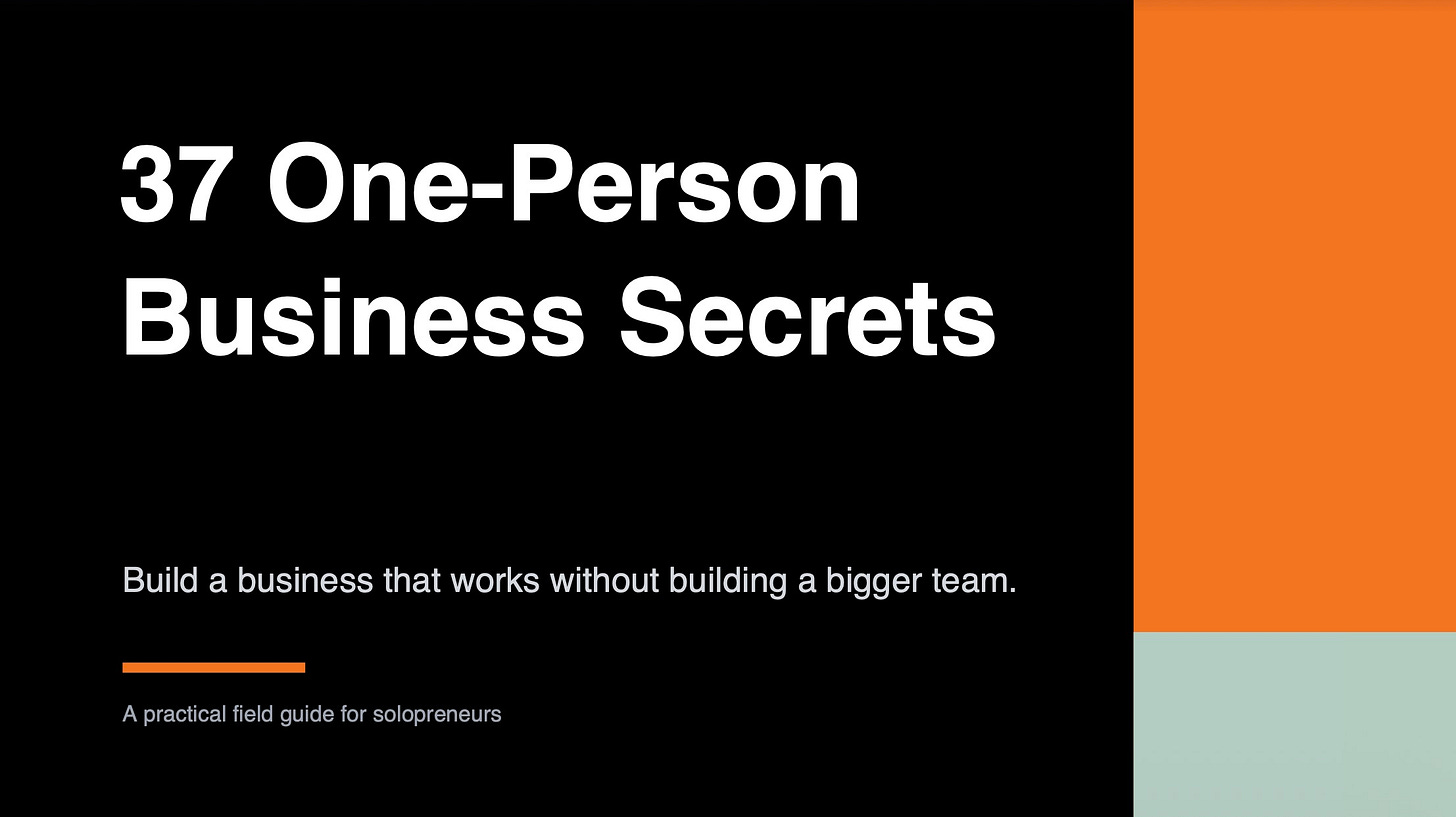
These seven principles give you the foundation.
The full guide gives you 37 practical ideas to help you build a business with clearer offers, simpler systems, stronger assets, and more room to think.
You do not have to subscribe to Solopreneur Code to get this guide.
So get it now > Download 37 One-Person Business Secrets
REMEMBER! The goal is not to stay busy alone. It is to build a business that becomes more useful and easier to run over time.
You’re doing everything. But nothing is moving?
You are doing everything. But nothing is moving.
That is not a motivation problem.
Most solopreneurs are learning from everywhere and getting nowhere. Too much information. No clear system connecting effort to results.
You have everything it takes. You just do not have a clear system yet.
That is what paid subscribers get. Every system, playbook, prompt, and template. All inside the Premium Vault.
You’ll also gain access to this amazing tool I’ve built: Solopreneur OS for Claude: The complete operating system that is built to run your one-person business.
All for $79/year. That’s $6.58/month.
Upgrade now and unlock the Premium Vault worth thousands of dollars.
The Premium Vault holds the secret behind posts like this one, including the tools and resources I use to build the one-person business I love.
Thanks for reading! Ready for the next step?
Let’s crack the growth equation and build a thriving one-person business on your terms!
Anfernee