Ideas don't come from staring at a blank page. They come from getting specific about who you're helping and what keeps them stuck.
By Anfernee
Published: 2026-07-12
URL: https://solopreneurcode.substack.com/p/how-to-generate-digital-product-ideas-that-sell
Most solopreneurs make the same mistake when brainstorming digital products.
They stay too broad.
They pick a giant category like “productivity” or “health” and try to find a problem inside it.
That’s like trying to find a specific person in a city of 10 million.
The fix is simple…
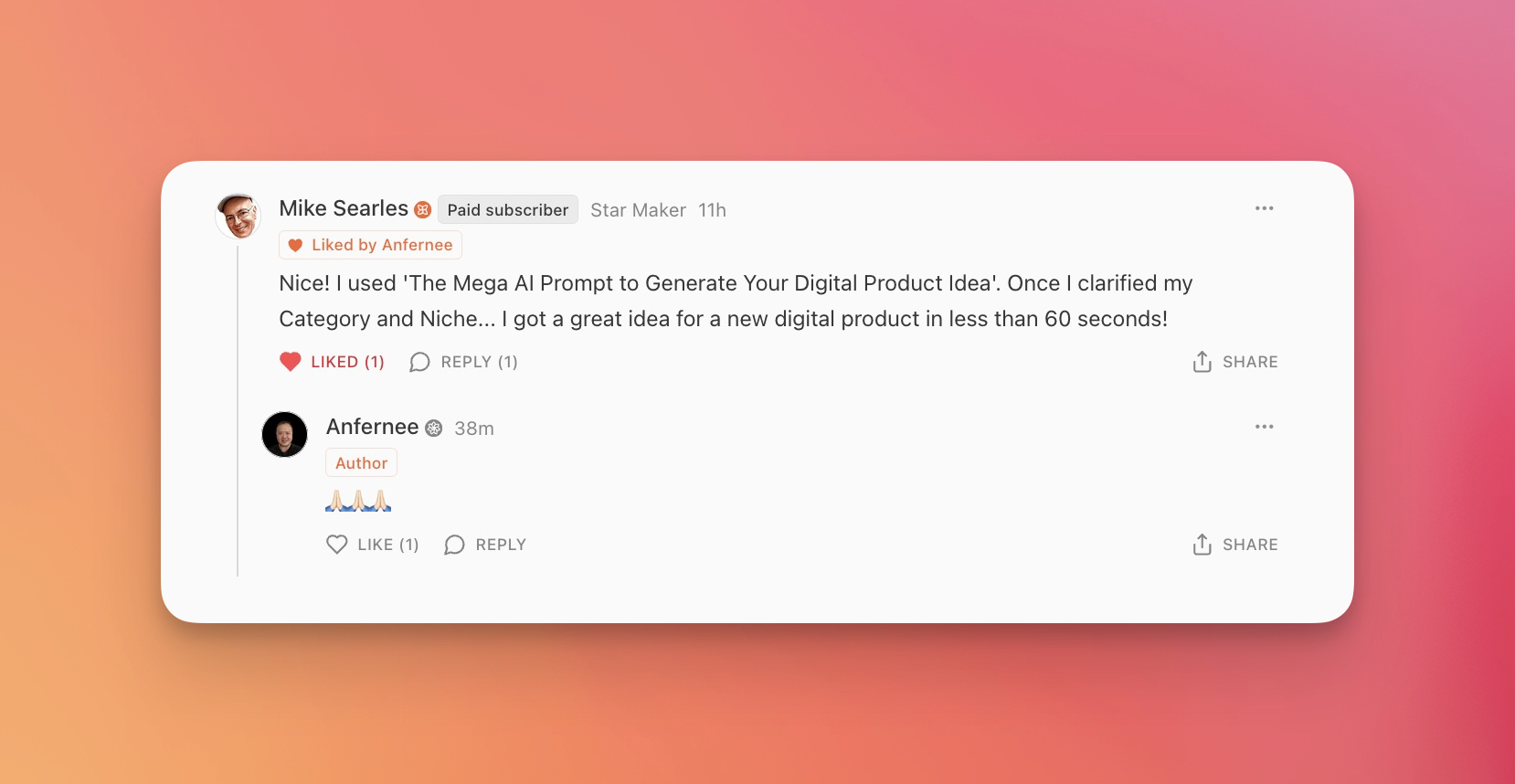
Here’s what Mike Searles think of the AI Prompt.
Access your FREE Solopreneur Success Hub - your subscribers-only comprehensive command center for building and scaling a successful one-person business.
I created this all-in-one toolkit for building a profitable one-person business, something I wish existed when I first started, and it saves me 20+ hours a week.
Now, it’s yours… FREE!
More information about the Hub here.
The fix is simple: get specific before you generate ideas.
Can this work?
This same exact system + my personal Solopreneur OS for Claude has enabled me to hit my highest ever sales in a SINGLE DAY: $3,020.70 on 14 April 2026.
Here’s the framework I use.

Step 1: Pick a Category, Then Pick a Niche
Everything starts broad and gets more specific. Your job is to move from a mega-category down to a niche you can actually serve.
The move looks like this:
Category → Niche
Here’s why this matters. Inside any mega-category, you’ll find completely different types of people with completely different problems. “Productivity” could mean a burned-out executive, a freelance designer, or a stay-at-home parent trying to manage their schedule. They don’t have the same problems. So a product built for all of them serves none of them.
Getting specific forces clarity. And clarity sells.
How to niche down
You can narrow by any of these:
- Industry: Productivity → Productivity for Freelance Writers
- Demographic: Productivity → Productivity for New Moms
- Platform: Productivity → Productivity for Notion Users
- Price or socioeconomic context: Productivity → Budget-Friendly Systems for Solo Creators
- Delivery format: Productivity → Async Workflows for Remote Teams
Pick one. The more specific, the better your ideas will be.
Step 2: List the 10 Biggest Problems in That Niche
Once you’ve landed on a niche, write down the 10 biggest problems that person faces.
Don’t skip Step 1 and jump here. It won’t work. Broad niches produce vague problems, and vague problems produce weak products.
Your niche should be somewhere you have personal experience. You’ve lived these problems. You’ve found ways through them. That’s your unfair advantage.
Here’s an example. Say your niche is Notion templates for freelancers.
Your list of 10 problems might look like:
- No system for tracking clients and projects
- Inconsistent invoicing and cash flow visibility
- Wasted time rebuilding the same documents from scratch
- No way to track leads or follow-ups
- Chaotic onboarding process for new clients
- No clear weekly planning routine
- Scattered notes with no system to act on them
- No content or deliverables calendar
- Difficulty separating personal tasks from client work
- No single place to manage everything
That list is your product roadmap. Each item is a potential product.
Step 3: List the 10 Most Desirable Outcomes
Now flip each problem into an outcome. What does this person actually want?
Write each outcome as an “I” statement. Put yourself in their position.
Here are a few examples from that list:
- Problem: No system for tracking clients
- → “If I had a clear client tracker, I’d stop missing follow-ups and feel in control of my business.”
- Problem: Wasted time rebuilding documents
- → “If I had templates ready to go, I’d save hours every week and look more professional to clients.”
- Problem: Chaotic onboarding
- → “If my onboarding was systemized, I’d impress clients from day one and spend less time on admin.”
This exercise tells you two things: what to build, and exactly how to talk about it in your marketing.
Those “I” statements? They’re your sales copy, almost word for word.
Step 4: Pick the Most Painful Problem and Build Around It
Here’s where most people get stuck again.
They want to solve all 10 problems at once.
Don’t.
When you position a product, lead with one problem.
That’s it.
Your product might solve three, five, or all ten of those problems in practice.
But if you lead with ten, the customer can’t prioritize.
If everything is the priority, nothing is.
Pick the problem that is:
- Most painful (they feel it every week)
- Most expensive (it costs them time, money, or clients)
- Most urgent (they’re actively looking for a solution)
Then build a product that solves that one problem better than anything else available.
You can mention the other problems you solve on your landing page, in your emails, and in your content. But your headline, your pitch, your hook? One problem.
A Complete Example: Notion Client Tracker Template
- Category: Productivity
- Niche: Notion Templates for Freelancers
- Lead problem: No system for tracking clients and projects
- Product: A Notion client management template with built-in project tracking, invoicing log, and weekly review
- Positioning: “Stop losing clients to disorganization. One Notion template to run your entire freelance business.”
Clean. Specific. Sellable.
Recap
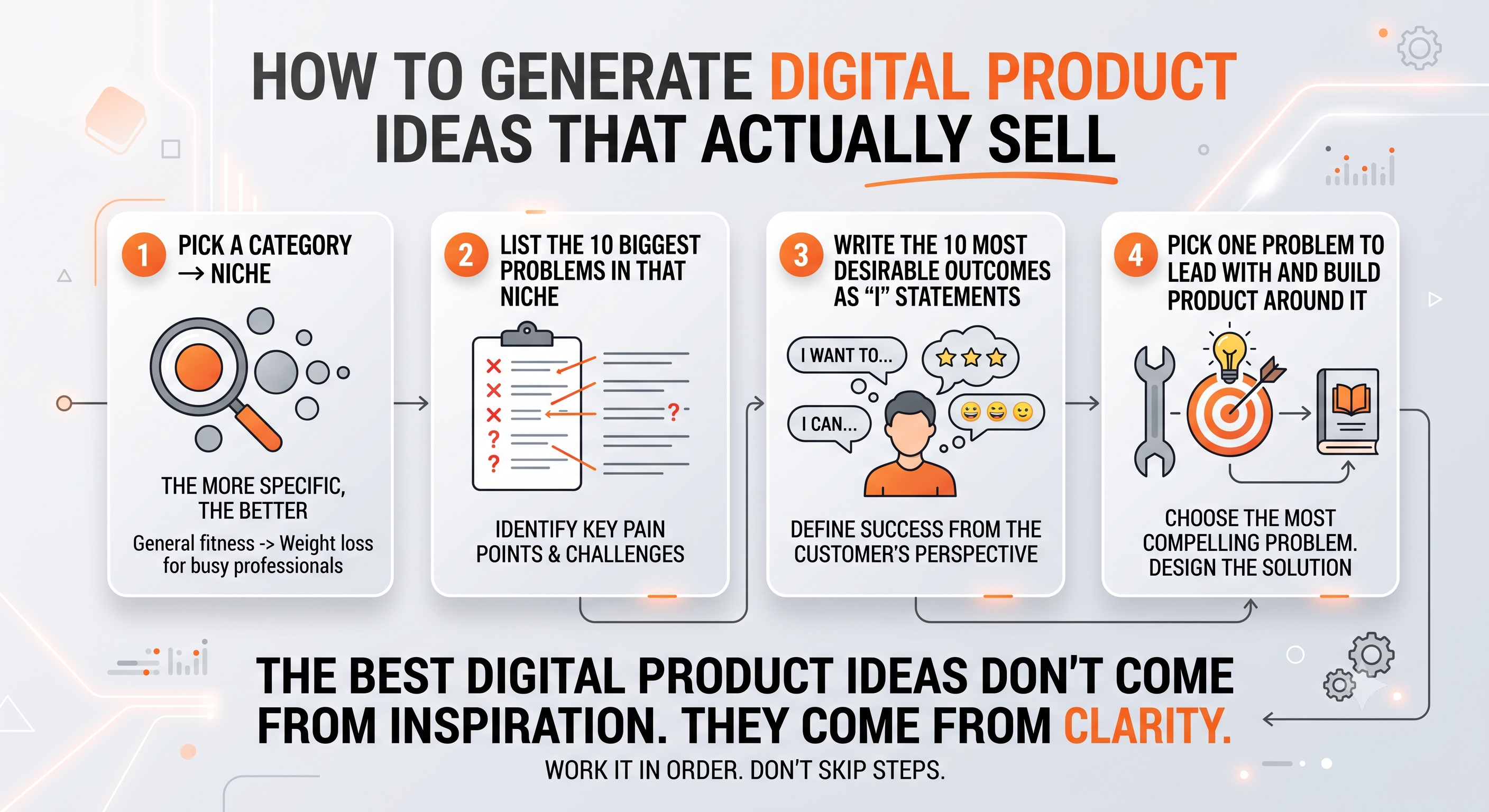
- Pick a Category → Niche (the more specific, the better)
- List the 10 biggest problems in that niche
- Write the 10 most desirable outcomes as “I” statements
- Pick one problem to lead with and build your product around it
This is the framework. Work it in order. Don’t skip steps.
The best digital product ideas don’t come from inspiration. They come from clarity.
Bonus: The Mega AI Prompt to Generate Your Digital Product Idea
This prompt is for paid subscribers only.
Paid members get tools like this every week, plus full access to the Premium Vault, a growing library of prompts, templates, and systems built for solopreneurs who are serious about building. See everything that’s included →
If you have already made the investment, head on to the bottom of this post for your mega AI prompt.
Here’s what think of the AI Prompt:
You’re doing everything. But nothing is moving?
You are doing everything. But nothing is moving.
That is not a motivation problem.
Most solopreneurs are learning from everywhere and getting nowhere. Too much information. No clear system connecting effort to results.
You have everything it takes. You just do not have a clear system yet.
That is what paid subscribers get. Every system, playbook, prompt, and template. All inside the Premium Vault.
All for $79/year. That’s $6.58/month.
Upgrade now and unlock the Premium Vault.
Thanks for reading! Ready for the next step?
Let’s crack the growth equation and build a thriving one-person business on your terms!
Anfernee
The prompt below is visible to paid subscribers only.
Copy it into any LLM (ChatGPT, Claude, Gemini). Fill in your Category and Niche. You’ll have a validated product idea in under two minutes.