Raise your existing digital product value in two hours. A step-by-step guide to sharpen your offer, speed up the first win, and make buyers say yes.
By Anfernee
Published: 2026-06-28
URL: https://solopreneurcode.substack.com/p/10x-digital-product-value-2-hours
Most digital products because they look like a pile of files instead of a result someone can feel.
Imagine you poured weeks into the content, then wrapped it in a vague title, a crowded layout, and zero guidance on where to start. The buyer opens it, feels a little lost, and quietly files it away.
Sound familiar?
Access your FREE Solopreneur Success Hub - your subscribers-only comprehensive command center for building and scaling a successful one-person business.
I created this all-in-one toolkit for building a profitable one-person business, something I wish existed when I first started, and it saves me 20+ hours a week.
Now, it’s yours… FREE!
More information about the Hub here.
Access My Solopreneur Success Hub
Here’s the good news. You can fix most of this in a single afternoon. You don’t have to add more modules, record more videos, or design more pages. You raise the perceived and real value by improving the offer, the outcome, and the experience of using the thing.
Two focused hours is enough to take a product from “fine” to “take my money.”
This guide walks you through that exact two-hour upgrade.
-
One hour to sharpen the core offer.
-
One hour to lift the perceived value.
By the end you’ll have a clear checklist you can run on any product you’ve already made.
What “10x value” actually means
When people hear “10x the value,” they assume more content. More lessons, more bonuses, more pages.
That’s the trap. Value isn’t volume.
A buyer rarely thinks, “I wish this had 40 more pages.”
They think, “I wish this got me the result faster.”
Real value moves on five levers:
-
Better outcome. The end result is clearer and more desirable.
-
Faster result. The buyer wins sooner, ideally in the first sitting.
-
Easier implementation. Fewer steps, less guesswork, less friction.
-
Clearer promise. They know exactly what they’re getting before they buy.
-
Stronger perceived value. The product looks and feels complete.
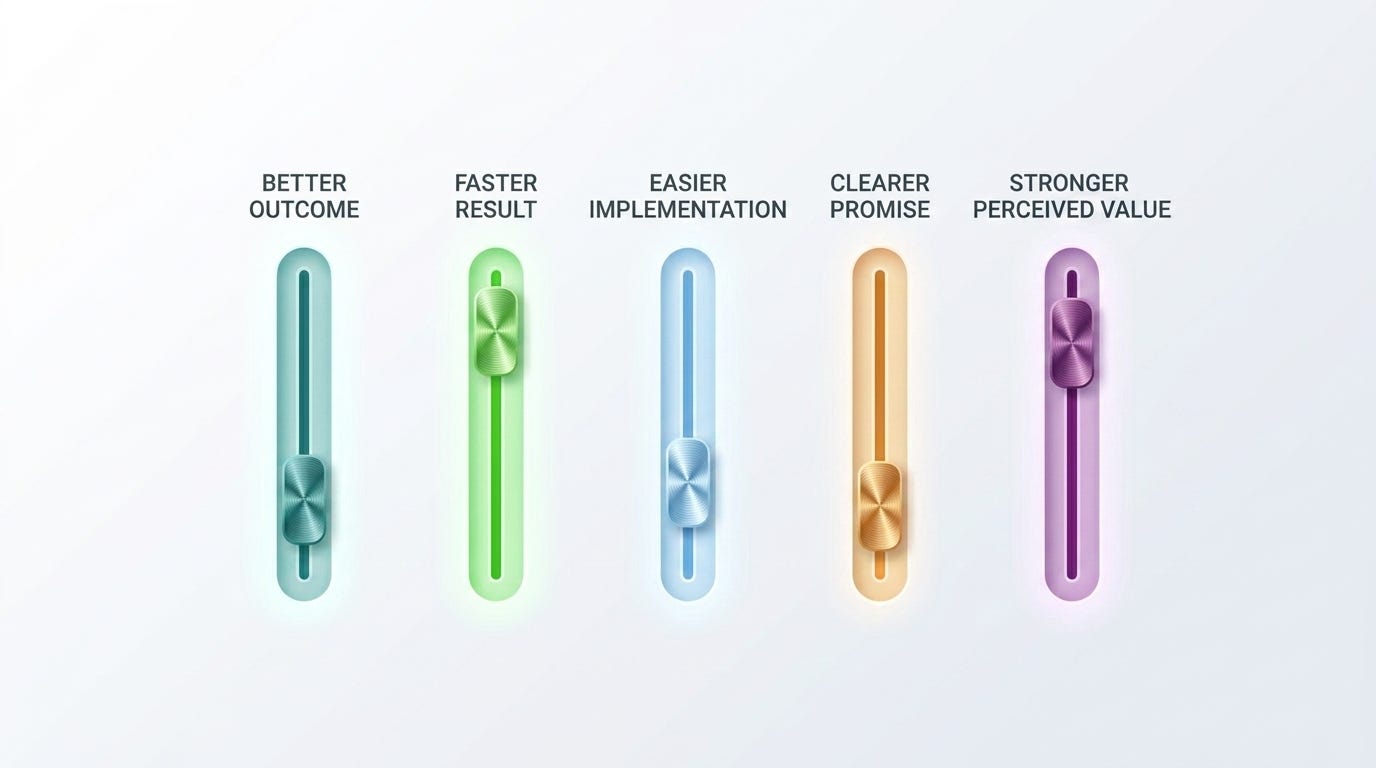
Notice that only one of those involves adding anything. The rest are about clarity and design, that’s why two hours can do so much.
Why most digital products underperform
Before the upgrade, it helps to see why products stall in the first place.
Almost every weak product shares a few of these symptoms:
-
The promise is too vague. “A productivity system” tells the buyer nothing. “Plan your whole week in 20 minutes every Sunday” tells them everything.
-
The product is too broad. It tries to serve five audiences and lands with none.
-
The result is invisible. The buyer can’t picture the win, so they can’t justify the price.
-
There’s no guidance. The product hands over raw material and expects the buyer to assemble it alone.
-
It feels like a folder, not a transformation. Files in, files out, no clear path through.
If you recognize two or three of these in your own product, that’s normal. It’s also exactly what the next two hours fix.
Hour 1: Sharpen the core offer
The first hour is about the offer itself, which is the core promise and the path to the result.
Clarify the transformation
Start by writing the before-and-after in plain language.
Where is the buyer now, and where will they be after using your product?
Be specific. Swap general claims for a concrete outcome.
-
Weak: “Learn to write better emails.”
-
Strong: “Write a five-email welcome sequence in one afternoon, even if you’ve never written a single copy before.”
The stronger version names the result, the timeframe, and who it’s for. That single rewrite often does more for sales than a week of new content.
Narrow the use case
Pick one audience, one problem, one promise.
Every feature that doesn’t serve the main result is a distraction.
Cutting scope feels scary, but a focused product is easier to understand, easier to use, and easier to sell.
Ask yourself: if this product could only do one job well, what would it be?
Build the offer around that answer and let the rest fall away.
Add a quick win
Find the fastest visible result your buyer can get, then design a path straight to it. Call it the “first 10 minutes.” When someone opens your product and gets a small win right away, they trust the rest of it. Momentum sells the deeper work for you.
This can be as simple as a single starter template, a one-page action plan, or a “do this first” instruction that produces something tangible before lunch.
Hour 2: Raise perceived value
The second hour is about how the product looks, feels, and reads.
Same content, much stronger packaging.
Improve the packaging
Rename the product around the outcome, not the format.
-
“Notion Template Bundle” describes the file type.
-
“The Sunday Reset: plan your week in 20 minutes” describes the result.
Add a subtitle that spells out the promise so a stranger gets it in three seconds.
Bundle supporting assets
In order for this to work, you need a few small assets that make the main thing easier to use:
-
A checklist that turns the lessons into actions.
-
A template the buyer can copy and fill in.
-
A swipe file or worked example they can model.
-
A short setup guide that removes the “where do I start” stall.
Each of these takes minutes to make and noticeably lifts how complete the product feels.
Reduce friction
Friction quietly kills value.
Add a “start here” page so nobody lands in your product confused.
Organize everything into a simple sequence, step one to step done.
Remove decisions the buyer shouldn’t have to make.
Every choice you make for them is a gift.
Add credibility markers
Show, don’t claim.
Include a sample, a screenshot of the structure, or a picture of the finished result.
When buyers can see what “done” looks like, the product feels real and trustworthy before they’ve even started.
A simple formula for digital product value
If you want one mental model to carry into every product, use this:
Value = outcome clarity + speed to first win + ease of use + perceived completeness
When one of those four is weak, the whole product feels thinner than it is.
The fix isn’t to max out one lever. It’s to lift all four a little.
A product that’s clear, fast, easy, and complete beats a bloated one every time, and it’s the heart of strong digital product value.
Run your product through the four parts and grade each one from one to five. Your lowest score is your next hour of work.
A real example: basic template to premium offer
Picture a Notion template that ships as a workspace with five databases and no instructions.
It’s powerful, but the buyer opens it, sees a wall of tables, and freezes. Powerful and useless at the same time.
Now run the two-hour upgrade.
-
Narrow it to one job, say weekly planning.
-
Add a “start here” page that explains the first move.
-
Include a quick-start guide,
-
a filled-in example workspace, and
-
a one-page checklist.
-
Rename it around the outcome.
The content barely changed. The experience changed completely. Same database, but now it feels like a system you can actually run. That’s the whole game. You made it more useful without making it more complicated.
Mistakes that quietly kill value
Watch for these as you upgrade, because they undo your work:
-
Adding more content instead of improving clarity.
-
Trying to serve every audience at once.
-
Hiding the transformation behind clever, vague wording.
-
Leaving the buyer to figure out the product alone.
-
Confusing “more stuff” with “more value.”
If you catch yourself reaching for “let me add one more thing,” pause. The better move is almost always to make what’s already there clearer and faster.
Your 2-hour upgrade checklist
Run this in order. Set a timer for each hour and resist the urge to over-build.
Hour 1, sharpen the offer
-
Rewrite the product promise as a specific before-and-after.
-
Narrow to one audience and one problem.
-
Design one quick win the buyer can reach in 10 minutes.
Hour 2, raise perceived value
-
Rename the product around the outcome and add a clear subtitle.
-
Bundle one support asset (checklist, template, or example).
-
Add a “start here” guide and tidy the structure.
-
Add one credibility marker (sample, screenshot, or finished result).
-
Read it back and make the outcome obvious at a glance.
That’s it. Eight moves, two hours, a product that feels worth more because it is worth more to use.
Value is designed, not dumped
A strong digital product doesn’t have to be huge. It has to be clear, fast, easy, and complete enough that the buyer feels the win and trusts the rest.
In two focused hours you can take something good and make it feel premium, simply by improving the outcome and the experience around it.
You now have the full method, and the checklist works. But here’s what usually happens. The doc gets saved, the week fills up, and your offer stays exactly where it is.
That’s the gap I wanted to close. The 10x My Offer prompt at the bottom of this page does the audit for you. Paste your product link and it scores your offer, finds the one weak spot quietly costing you sales, and hands back a ranked action plan: rewritten titles, a sharper promise, and the exact first move to make.
What takes most people a slow weekend takes about five minutes.
It’s available to paid subscribers of Solopreneur Code.
You’re doing everything. But nothing is moving?
You are doing everything. But nothing is moving.
That is not a motivation problem.
Most solopreneurs are learning from everywhere and getting nowhere. Too much information. No clear system connecting effort to results.
You have everything it takes. You just do not have a clear system yet.
That is what paid subscribers get. Every system, playbook, prompt, and template. All inside the Premium Vault.
All for $79/year. That’s $6.58/month.
Upgrade now and unlock the Premium Vault.
10x My Offer - AI Prompt (Audit an offer + value action plan)
A reusable prompt that studies one existing digital product offer (from a URL or a written description) and returns a prioritized action plan to 10x its value.
It runs on the same value formula as this post.
How to use it: Paste a URL to your offer (sales page, Gumroad, Substack, landing page) or a short description, run it through your most trusted LLM together with this prompt.
What you get
Paste your product link or a short description, and you get back a complete offer teardown:
-
An offer snapshot. Your product pulled apart into the parts that matter: promise, audience, price, what’s included, proof, and call to action. You see your offer the way a buyer sees it.
-
A value scorecard. Six levers scored out of 30: outcome clarity, speed to first win, ease of use, perceived completeness, promise specificity, and audience focus. You get a number and the one weak spot dragging the whole thing down.
-
A prioritized action plan. Specific moves built for your offer, sorted by effort. Quick wins under 30 minutes, a focused two-hour sprint, and bigger bets for later.
-
Rewritten, ready-to-use assets. Three new title options, a sharper subtitle, a stronger one-sentence promise, a “start here” path for buyers, three bundle ideas, two credibility markers, and a pricing read on whether you’re leaving money on the table.
-
A clear starting point. The top three moves ranked by impact versus effort, so you know exactly what to do first.
Hand it a link, get a diagnosis and a plan you can act on the same day.